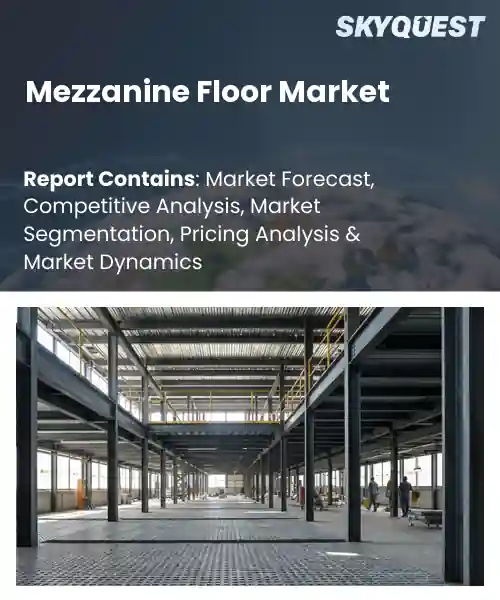
Mezzanine Floor Market
Report ID: SQMIG20B2169
Report ID: SQMIG20B2169
[email protected]
USA +1 351-333-4748
Report ID:
SQMIG20B2169 |
Region:
Global |
Published Date: June, 2026
Pages:
157
|Tables:
127
|Figures:
77


Global Mezzanine Floor Market size was valued at USD 8.4 Billion in 2024 and is poised to grow from USD 8.72 Billion in 2025 to USD 11.71 Billion by 2033, growing at a CAGR of 3.76% during the forecast period (2026-2033).
Mezzanine floors are intermediate platforms installed between main floors to increase usable space in warehouses, factories, retail outlets and offices; the market has expanded as businesses seek flexible, cost-efficient footprints without relocation. The primary driver is rising demand for space optimization fueled by e-commerce growth that pressures logistics providers to maximize storage capacity inside existing buildings. Over the last decade modular steel mezzanines and bolt-together systems evolved from bespoke builds into standardized, code-compliant products, enabling faster deployment and lower capital outlay. For example 3PL operators in North America retrofitted distribution centers to add mezzanine levels and reduce fulfillment cycle times.
Building on space optimization trends, a key trend driving the global mezzanine floor sector is modular design paired with automation compatibility, since prefabricated systems cut installation time, thereby minimizing downtime and delivering faster returns on investment that incentivize broader adoption. When companies add conveyors and robotics onto mezzanine levels throughput increases which justifies capital spending and boosts efficiency in e-commerce fulfillment and cold-chain operations. Regulatory focus on fire safety and load standards pushes suppliers to offer certified solutions, reducing buyer risk and shortening procurement cycles. As a result older industrial buildings, urban last-mile hubs and omnichannel retailers become targets for refurbishment projects.
How is AI Improving Design and Space Optimization in the Mezzanine Floor Market?
AI is improving mezzanine floor design and space optimization by linking generative design, BIM and data driven layout planning to real operational requirements. Key aspects include rapid scenario generation, structural simulation for load and safety and alignment with warehouse management and robotic workflows. Today designers use AI to test multiple layouts quickly, reduce rework and produce buildable modular plans that match changing inventory and picking patterns. Market pressure from growing e commerce and denser urban distribution makes vertical expansion attractive, so AI tools that create tailored mezzanine geometries and automated material lists are becoming practical aids for faster, more resilient installations.
In February 2025, Interlake Mecalux expanded its mezzanine capabilities through the acquisition of Mezzanine Systems which strengthens design to installation workflows. This helps the market by combining modular manufacturing with AI enabled planning so projects deploy faster and space is used more efficiently.
Market snapshot - (2026-2033)
Global Market Size
USD 8.4 Billion
Largest Segment
Freestanding Mezzanines
Fastest Growth
Rack-Supported Mezzanines
Growth Rate
3.76% CAGR
To get more insights on this market click here to Request a Free Sample Report
Global mezzanine floor market is segmented by type, material, application, end user and region. Based on type, the market is segmented into freestanding mezzanines, rack-supported mezzanines, shelving-supported mezzanines, custom bespoke mezzanines and others. Based on material, the market is segmented into steel mezzanines, concrete mezzanines, wood mezzanines, composite mezzanines and others. Based on application, the market is segmented into storage and warehousing, workshops and production areas, office spaces, retail display platforms, equipment platforms and others. Based on end user, the market is segmented into industrial and manufacturing, logistics and warehousing, retail and commercial, aviation and aerospace, food and beverage processing and others. Based on region, the market is segmented into North America, Europe, Asia Pacific, Latin America and Middle East & Africa.
Based on the global mezzanine floor market growth, freestanding mezzanines segment dominates because their independent, self supporting design allows rapid deployment without altering existing racking or building structures, enabling operators to add usable floor area with minimal disruption. Their modularity and adaptability suit diverse floor plans and load requirements, driving preference across warehousing and light industrial uses. This ease of installation and operational continuity reduces downtime and capital outlay, prompting widespread adoption as a primary space optimization solution.
However, rack-supported mezzanines are emerging as the most rapidly expanding area because their integration with pallet racking maximizes vertical density while supporting heavier loads and automated picking equipment. Growing demand for high throughput distribution and tighter footprint economics is accelerating investment in these systems, driving innovation in load sharing designs and compatibility with robotics and conveyor integrations.
Steel mezzanines segment dominates because steel offers unmatched structural strength, predictable long term performance, and broad design flexibility that addresses varied industrial load profiles. Fabrication efficiency and standardized components enable faster engineering to installation cycles while delivering durable, low maintenance platforms. These attributes reduce lifecycle costs and support tiered expansion, prompting facilities to favor steel when planning scalable mezzanine systems that must accommodate changing operational intensity and equipment upgrades.
Meanwhile, composite mezzanines are witnessing the strongest growth because advanced composite panels offer lighter weight, corrosion resistance, and design flexibility suited to moisture prone and corrosive environments. Improved manufacturing methods and sustainability appeal are boosting adoption in specialized retail and food processing uses, accelerating demand for modular, low maintenance platforms that simplify installation and lower environmental footprint.
To get detailed segments analysis, Request a Free Sample Report
As per the global mezzanine floor market share, Asia Pacific dominance stems from a convergence of dense urbanization, advanced manufacturing clusters, and rapid modernization of logistics infrastructure. Market strength is underpinned by strong adoption of space optimization solutions across industrial, retail and warehousing sectors, supported by local suppliers offering modular and customizable mezzanine systems. High demand from electronics and automotive supply chains encourages integration of mezzanine structures with automation and material handling systems. Regulatory frameworks and redevelopment initiatives in major metropolitan areas favor vertical expansion within existing facilities, reducing the need for new land. A competitive ecosystem of engineering services, fabrication capabilities, and distribution networks allows faster deployment and tailored solutions, reinforcing regional leadership and shaping global standards in mezzanine design and application. Close collaboration between developers, logistics operators, and technology providers further accelerates adoption across market segments.
Mezzanine floor market in Japan has a strong focus on precision engineering and integration of mezzanine systems with automated handling and robotic solutions. Demand is concentrated in compact urban industrial zones and value manufacturing facilities that require efficient vertical use of space. Local manufacturers and system integrators emphasize modular design, seismic resilience, and quality finishes. Collaboration between fabricators and logistics operators promotes bespoke installations which address complex infrastructure and regulatory requirements.
Mezzanine floor market in South Korea is characterized by rapid adoption of compact, high-strength mezzanine systems tailored for electronics and advanced manufacturing clusters. Industry focus combines lightweight materials, seismic considerations, and integration with automated storage solutions. Urban redevelopment and industrial upgrade initiatives drive retrofit projects and demand for mezzanine versatility. Local fabricators and engineering firms emphasize customization, installation, and coordination with logistics service providers to optimize floor utilization and warehouse efficiency.
Based on global mezzanine floor regional forecast, the rapid expansion in North America is driven by the convergence of evolving supply chain strategies, widespread adoption of e-commerce fulfillment models, and a need to modernize aging industrial estates. Market momentum reflects strong demand for flexible, retrofit-friendly mezzanine solutions that support inventory growth without requiring major construction. Integration with automation, safety compliance, and material handling equipment makes mezzanine systems central to distribution and manufacturing operations. A mature base of engineering consultancies, third party logistics providers, and specialty fabricators enables tailored offerings and faster implementation. Cross sector interest from retail, healthcare, and light manufacturing, together with emphasis on operational efficiency and workforce safety, further reinforces the regional position, encouraging broader uptake and innovation in mezzanine design and installation practices. Collaboration enhances outcomes.
Mezzanine floor market in United States exhibits demand from distribution centers, manufacturing operations and retail fulfillment networks seeking to maximize capacity within existing footprints. Market participants prioritize integration with automation, safety features, and compliance with building codes. Engineering firms and specialty fabricators collaborate with logistics providers to deliver bespoke mezzanine systems that accommodate heavy loads, handling equipment and workflows. Retrofit projects and designs increasingly incorporate mezzanine solutions for adaptable space planning.
Mezzanine floor market in Canada reflects demand driven by logistics modernization and light industrial renovation. Market emphasis centers on adaptable mezzanine designs that balance strength with ease of installation and compliance with regional building standards. Local integrators work closely with operators to tailor solutions for constrained sites and complex floor load requirements. The market favors modular systems that minimize operational disruption and support combined storage and production functions. It supports operational flexibility.
As per global mezzanine floor regional outlook, Europe is strengthening its position through a combination of regulatory alignment, emphasis on sustainable construction practices, and broad adoption of retrofit strategies that preserve built heritage while improving utility. Market advancement is supported by a mature engineering base and specialist fabricators who deliver high quality, certified mezzanine solutions tailored to stringent safety and environmental standards. Urban regeneration projects and the rise of last mile logistics hubs encourage adaptive reuse of space, while manufacturers seek flexible floor options to optimize production flows. Cross border trade and collaboration among designers, installers and supply chain operators foster standardized components and best practices, reinforcing the region's role as a center for innovation in mezzanine design and application. Investment in workforce training and advanced fabrication techniques supports scalable, high quality deployments across diverse sectors.
Mezzanine floor market in Germany benefits from a strong engineering tradition and close ties with heavy industry and automotive supply chains seeking robust mezzanine solutions. Emphasis on material quality, capacity and integration with production line equipment drives demand for engineered, certified installations. Local fabricators and engineering firms deliver bespoke systems that meet rigorous safety standards and facilitate modular expansion. Collaboration with automation integrators and planners supports efficient workflow and durable installations.
Mezzanine floor market in United Kingdom reflects focus on urban regeneration, mixed use developments and logistics hubs that require adaptable mezzanine solutions. Demand stems from retailers, manufacturers and service industries seeking efficient space utilization within constrained sites. Suppliers emphasize compliance with building regulations, acoustic and fire safety considerations, and aesthetic integration where mezzanines support office or showroom functions. Engineering consultancies and fabricators collaborate to deliver modular installation approaches that minimize disruption.
Mezzanine floor market in France emphasizes versatile solutions that complement urban industrial parks and retail environments where space efficiency is essential. Market drivers include renovation projects, manufacturing and distribution activities that favor modular engineered mezzanine installations. Suppliers prioritize compliance with seismic and fire safety norms as well as architectural integration in mixed use buildings. Collaboration among architects, structural engineers and fabricators yields solutions balancing operational needs with aesthetic and environmental considerations.
To know more about the market opportunities by region and country, click here to
Buy The Complete Report
Increasing Demand For Flexible Spaces
Rising Ecommerce And Distribution Needs
Complex Building Code Requirements
High Initial Capital Investment
Request Free Customization of this report to help us to meet your business objectives.
Competition in the global mezzanine floor market outlook is intensifying as e commerce and third party logistics operators demand faster, modular installations and tighter integration with intralogistics. Vendors pursue product innovation and strategic alliances to win large contracts: Doity’s Revlok modular system reduces install time, while Mecalux partners with Siemens and MIT to embed AI, cobots and WMS into multi level solutions.
Top Player’s Company Profile
Recent Developments
SkyQuest’s ABIRAW (Advanced Business Intelligence, Research & Analysis Wing) is our Business Information Services team that Collects, Collates, Correlates, and Analyses the Data collected by means of Primary Exploratory Research backed by robust Secondary Desk research.
As per SkyQuest analysis, a key driver behind the global mezzanine floor industry is rising e-commerce and distribution needs that push operators to optimize vertical space within existing facilities, while a second driver is the growing adoption of modular, automation compatible mezzanine designs that reduce installation time and enable robotics integration. One restraint is complex building code and permitting requirements that can extend timelines and increase project costs. Asia Pacific is the dominating region due to dense urbanization, manufacturing clusters and rapid logistics modernization. Freestanding mezzanines are the dominating segment because their self-supporting, modular nature allows rapid deployment with minimal disruption, making them the preferred choice for warehousing and light industrial users.
| Report Metric | Details |
|---|---|
| Market size value in 2024 | USD 8.4 Billion |
| Market size value in 2033 | USD 11.71 Billion |
| Growth Rate | 3.76% |
| Base year | 2024 |
| Forecast period | (2026-2033) |
| Forecast Unit (Value) | USD Billion |
| Segments covered |
|
| Regions covered | North America (US, Canada), Europe (Germany, France, United Kingdom, Italy, Spain, Rest of Europe), Asia Pacific (China, India, Japan, Rest of Asia-Pacific), Latin America (Brazil, Rest of Latin America), Middle East & Africa (South Africa, GCC Countries, Rest of MEA) |
| Companies covered |
|
| Customization scope | Free report customization with purchase. Customization includes:-
|
To get a free trial access to our platform which is a one stop solution for all your data requirements for quicker decision making. This platform allows you to compare markets, competitors who are prominent in the market, and mega trends that are influencing the dynamics in the market. Also, get access to detailed SkyQuest exclusive matrix.
Table Of Content
Executive Summary
Market overview
Parent Market Analysis
Market overview
Market size
KEY MARKET INSIGHTS
COVID IMPACT
MARKET DYNAMICS & OUTLOOK
Market Size by Region
KEY COMPANY PROFILES
Methodology
For the Mezzanine Floor Market, our research methodology involved a mixture of primary and secondary data sources. Key steps involved in the research process are listed below:
1. Information Procurement: This stage involved the procurement of Market data or related information via primary and secondary sources. The various secondary sources used included various company websites, annual reports, trade databases, and paid databases such as Hoover's, Bloomberg Business, Factiva, and Avention. Our team did 45 primary interactions Globally which included several stakeholders such as manufacturers, customers, key opinion leaders, etc. Overall, information procurement was one of the most extensive stages in our research process.
2. Information Analysis: This step involved triangulation of data through bottom-up and top-down approaches to estimate and validate the total size and future estimate of the Mezzanine Floor Market.
3. Report Formulation: The final step entailed the placement of data points in appropriate Market spaces in an attempt to deduce viable conclusions.
4. Validation & Publishing: Validation is the most important step in the process. Validation & re-validation via an intricately designed process helped us finalize data points to be used for final calculations. The final Market estimates and forecasts were then aligned and sent to our panel of industry experts for validation of data. Once the validation was done the report was sent to our Quality Assurance team to ensure adherence to style guides, consistency & design.
Analyst Support
Customization Options
With the given market data, our dedicated team of analysts can offer you the following customization options are available for the Mezzanine Floor Market:
Product Analysis: Product matrix, which offers a detailed comparison of the product portfolio of companies.
Regional Analysis: Further analysis of the Mezzanine Floor Market for additional countries.
Competitive Analysis: Detailed analysis and profiling of additional Market players & comparative analysis of competitive products.
Go to Market Strategy: Find the high-growth channels to invest your marketing efforts and increase your customer base.
Innovation Mapping: Identify racial solutions and innovation, connected to deep ecosystems of innovators, start-ups, academics, and strategic partners.
Category Intelligence: Customized intelligence that is relevant to their supply Markets will enable them to make smarter sourcing decisions and improve their category management.
Public Company Transcript Analysis: To improve the investment performance by generating new alpha and making better-informed decisions.
Social Media Listening: To analyze the conversations and trends happening not just around your brand, but around your industry as a whole, and use those insights to make better Marketing decisions.
REQUEST FOR SAMPLE
 REQUEST FREE CUSTOMIZATION
Global Mezzanine Floor Market size was valued at USD 8.4 Billion in 2024 and is poised to grow from USD 8.72 Billion in 2025 to USD 11.71 Billion by 2033, growing at a CAGR of 3.76% during the forecast period (2026-2033).
Competition in the global mezzanine floor market is intensifying as e commerce and third party logistics operators demand faster, modular installations and tighter integration with intralogistics. Vendors pursue product innovation and strategic alliances to win large contracts: Doity’s Revlok modular system reduces install time, while Mecalux partners with Siemens and MIT to embed AI, cobots and WMS into multi level solutions. 'MiTek', 'Jungheinrich', 'Konstant Group', 'SSI Schaefer', 'Mecalux', 'Stow Group', 'Interlake Mecalux', 'Cornix', 'Dexion', 'Cubic Designs', 'Cornerstone Specialty Wood Products', 'Penco Products', 'Lyon', 'Western Idaho', 'Steele Solutions', 'Mezzanine International', 'Krost Shelving and Racking', 'Sperrin Metal', 'Spanset', 'Panel Built'
Mezzanine floors enable businesses to maximize existing vertical space without costly structural expansion, which supports market growth by offering a flexible and adaptable solution for evolving operational needs. Their ability to create additional usable area for storage, offices, or light production allows companies to reconfigure layouts rapidly and respond to changing demands, reducing downtime and avoiding relocation. This adaptability appeals to varied sectors seeking scalable capacity improvements and efficient space utilization, thereby driving continued adoption as a practical, lower impact alternative to full building extensions.
Adaptive Space Optimization: Market demand is shifting toward mezzanine solutions that prioritize flexibility and modularity, enabling owners to reconfigure intermediate floors for changing tenant needs and varied operational uses. Design emphasis is on demountable systems, rapid installation, and compatibility with existing structures to maximize usable area without major structural interventions. Stakeholders value adaptable layouts that support mixed uses, temporary retail, light industrial tasks, and evolving logistics, enhancing asset utilization and tenant retention while reducing downtime during repurposing and lease transitions.
Why does Asia Pacific Dominate the Global Mezzanine Floor Market? |@12


Want to customize this report? This report can be personalized according to your needs. Our analysts and industry experts will work directly with you to understand your requirements and provide you with customized data in a short amount of time. We offer $1000 worth of FREE customization at the time of purchase.
Feedback From Our Clients


 USA (+1) 351-333-4748

