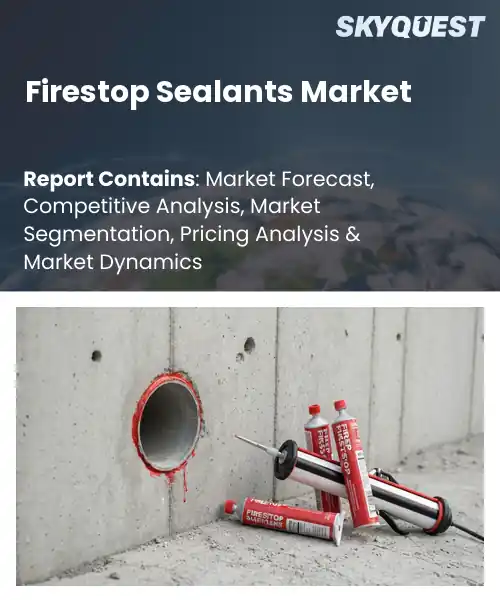
Firestop Sealants Market
Report ID: SQMIG15F2396
Report ID: SQMIG15F2396
[email protected]
USA +1 351-333-4748
Report ID:
SQMIG15F2396 |
Region:
Global |
Published Date: July, 2026
Pages:
157
|Tables:
188
|Figures:
79


Global Firestop Sealants Market size was valued at USD 520.00 Million in 2024 and is poised to grow from USD 553.80 Million in 2025 to USD 916.54 Million by 2033, growing at a CAGR of 6.5% during the forecast period (2026-2033).
The global firestop sealants market trends features compounds that prevent the passage of fire and smoke through openings in building assemblies, which is critical to protect life safety and property. Its importance was increased by the growth of high-rise construction, which demands reliable barrier solutions, and more rigorous fire-code enforcement. The sector was traditionally dominated by cementitious sealants but, after 2010, polymer-based formulations providing better elasticity and faster curing have gained ground. The 2017 revision of the International Building Code requiring fire-resistant sealing of penetrations in ventilated façades has led to a distinct increase in demand for advanced sealants in North America and Europe.
Growing demand for building designs is also driving the firestop sealants market growth, as tighter envelopes lead to an increased number of mechanical and electrical penetrations, which increases the risk of fire spread. Green certifications like LEED and BREEAM require façades and developers must select sealants that are fire resistant without sacrificing performance. Such a requirement is present in projects such as Singapore’s Net‑Zero office tower, where the sealant of choice was silicone-based, chosen for its ability to withstand temperatures above 1200 °C and to maintain heat-loss specifications. This is driving manufacturers to create hybrid products and invest in R&D efforts to combine insulating fillers with intumescent agents, and distributors to expand their service offerings in regions that are tightening sustainability codes.
How are AI-driven Analytics Influencing the Firestop Sealants Market?
AI-based analytics are shaping the firestop sealants market share by converting large volumes of data regarding product performance into valuable insights. Now manufacturers use machine‑learning models to predict how sealants perform in different fire‑rating scenarios, shortening formulation cycles and improving the reliability of compliance testing. Algorithms fed by real‑time monitoring of installation conditions recommend optimal application techniques, reducing rework and improving safety outcomes. These tools also allow distributors to match the right sealant to specific building codes, helping to simplify the procurement process and reduce inventory costs. This results in shorter product development timelines and increased customer confidence in the durability of fire-resistant constructions.
In April 2024, Hilti announced an AI-enhanced firestop sealant platform that incorporates predictive analytics into its product selection software, speeding up the specification process and improving its accuracy, and supporting market growth through improved efficiency.
Market snapshot - (2026-2033)
Global Market Size
USD 520.0 Million
Largest Segment
Intumescent Sealants
Fastest Growth
Hybrid Sealants
Growth Rate
6.5% CAGR
To get more insights on this market click here to Request a Free Sample Report
Global firestop sealants market is segmented by sealant type, installation method, fire resistance rating, application, substrate, end use industry and region. Based on sealant type, the market is segmented into intumescent sealants, elastomeric sealants, silicone sealants, acrylic sealants, polyurethane sealants, hybrid sealants and others. Based on installation method, the market is segmented into gun-applied, spray-applied and manual/putty-based. Based on fire resistance rating, the market is segmented into up to 2 hours, 2–4 hours and above 4 hours. Based on application, the market is segmented into penetration seals, construction joints, curtain wall perimeters, cable & pipe openings, duct & HVAC openings, electrical openings and others. Based on substrate, the market is segmented into concrete, metal, gypsum/drywall, masonry, wood and others. Based on end use industry, the market is segmented into commercial construction, residential construction, industrial facilities, healthcare facilities, data centers, transportation infrastructure, oil & gas & energy, government & defense and others. Based on region, the market is segmented into North America, Europe, Asia Pacific, Latin America and Middle East & Africa.
Intumescent sealants are the major segment as they naturally expand on exposure to heat to create a secured barrier that holds the structural integrity during a fire incident. They are the best choice for critical safety applications . They can fill in gaps and restore continuity in fire rated assemblies . This reliability of performance combined with a history of compliance with fire codes has resulted in wide specification by architects and contractors, solidifying their leadership position in the firestop sealants market.
The hybrid sealants segment is exhibiting the most robust growth momentum, as manufacturers are merging the flexibility of elastomers with the durability of silicone to create products that satisfy both movement and fire protection requirements. Green building standards and the demand for multifunctional solutions are driving adoption. The future of the market is being catalyzed by hybrid formulations.
The gun-applied installation method is leading the way as it allows for precise control, consistent bead placement and fast curing, which are critical to meeting stringent firestop performance criteria. Contractors like the repeatability and less laboriousness, and the method provides for less material waste and a uniform fire barrier formation. The ease of training applicators, combined with this operational efficiency, helps guarantee adherence to fire safety specifications on large projects, confirming its leadership in the firestop sealants market.
However, the spray-applied installation segment is emerging as the key high growth area as manufacturers are developing low viscosity formulas that can be atomized for quick coverage of complex shapes. The method decreases worker fatigue and accelerates sealing of large conduit networks, in line with trends towards automation and pressures from labor shortages, propelling the market growth.
To get detailed segments analysis, Request a Free Sample Report
North America’s dominance is due to a combination of stringent fire safety regulations, a mature construction ecosystem and wide-ranging technological expertise. The United States and Canada have strict building codes that demand sophisticated fire-stop solutions, driving manufacturers to innovate constantly. The close collaboration between industry, standards bodies and research institutions accelerates product development and certification. Major chemical producers and extensive distribution networks guarantee broad market coverage and quick adoption of new sealant chemistries. There’s a good base of talented engineers in the region too, and a progressive attitude to incorporating sustainability into fire‑stop formulations that aligns with the broader environmental objectives of building owners. The collaborative supply-chain models allow quick scaling of innovative products, and the ongoing training programs ensure that installation practices remain current and help cement market leadership.
Firestop sealants market outlook in United States benefits from extensive regulatory frameworks that mandate rigorous fire barrier testing, a large volume of commercial and industrial construction projects, and a culture of innovation that drives continuous product improvement. Leading manufacturers leverage sophisticated research labs and close collaboration with building code authorities to deliver high‑performance solutions that meet evolving performance expectations across diverse project types. The market also emphasizes strong after‑sales support and training programs to ensure correct installation and long‑term reliability.
Firestop sealants market forecast in Canada is shaped by stringent provincial building codes, a focus on energy‑efficient construction, and a growing demand in residential and institutional sectors. The market benefits from close proximity to US supply chains, fostering cross‑border collaboration that accelerates technology transfer and product availability. Industry participants emphasize sustainability and low‑VOC formulations to align with environmental priorities. Stakeholder initiatives also promote certification programs that reinforce installation quality and boost confidence among building owners.
Europe is growing fast because fire safety rules have been harmonised, so there is a common need for high quality fire stopping solutions across the member states. The market is supported by major investment in the renovation of aging infrastructure and a strong emphasis on sustainable construction practices. The German engineering excellence, the UK’s agile regulatory updates and the French emphasis on innovative material research creates a fertile ground for product development. The close collaboration between academic institutions, industry associations and manufacturers is speeding up the introduction of advanced sealant technologies. The regulatory structure also fosters ongoing development of fire‑stop performance, motivating manufacturers to develop state-of-the-art polymer chemistries that meet demanding smoke and toxicity requirements. Additionally, digital building information modelling enhances the accuracy of specification and installation, thus raising market uptake for commercial, residential and heritage projects.
Firestop sealants market regional outlook in Germany is anchored by rigorous national fire safety standards, a mature engineering sector, and strong emphasis on high‑quality manufacturing. The market sees active collaboration between research institutes and industrial players, fostering development of advanced sealant chemistries that address complex building designs. Demand is reinforced by ongoing infrastructure renewal and a commitment to sustainable construction practices. The sector also benefits from government incentives that support climate‑friendly product development, further strengthening its global competitiveness.
Firestop sealants market regional forecast in United Kingdom is driven by an aggressive push to modernize building stock and comply with evolving fire safety legislation. The market is energized by extensive renovation activity, especially in historic structures where fire‑stop solutions are critical. Companies focus on rapid product innovation and certification to meet the fast‑changing regulatory environment, supporting a dynamic market that adapts quickly to new safety requirements. Collaboration between architects and sealant suppliers ensures that specifications align with heritage preservation goals while maintaining fire protection standards.
Firestop sealants market analysis in France is emerging as a focal point for fire safety innovation, supported by EU directives and a growing appetite for high‑performance building solutions. The market benefits from strong ties between academic research and industry, encouraging the development of eco‑friendly sealant formulations. Expansion is further propelled by increasing investment in public infrastructure and a heightened awareness of fire protection in residential projects. Regulatory bodies also encourage the integration of fire‑stop systems early in design phases, improving overall building resilience.
The Asia Pacific region is making its presence felt, with a strong focus on urban development and the uptake of the latest fire protection technologies. Japan and South Korea are densely populated, and their populations have high safety expectations, so these countries emphasize the construction of resilient structures. The region’s advanced material research capabilities enable the development of sealants with high heat resistance and low emissions. Government programs that promote higher fire safety standards and incentives for innovative product development also stimulate activity in the market. Partnership ecosystems linking manufacturers, construction companies and research institutions foster knowledge exchange, leading to fast implementation of improved fire-stop solutions in new high-rise developments and large-scale retrofit programs. There is also a wider acceptance as property owners become more aware of the long-term cost benefits of effective fire containment. In addition, the increasing focus on green building certifications is propelling the adoption of low-VOC sealants, blending fire safety with environmental responsibility.
Firestop sealants market penetration in Japan is strengthened by the nation’s emphasis on resilient construction practices and rigorous fire protection codes. The market is characterized by advanced material science capabilities, enabling the creation of sealants that perform under stringent seismic and fire conditions. Collaboration between construction firms and technology providers drives continuous improvement and supports the integration of fire‑stop solutions in both new high‑rise developments and retrofit projects. Industry initiatives also focus on reducing emissions and improving durability, aligning fire safety with broader environmental objectives.
Firestop sealants industry in South Korea is propelled by rapid urban growth and a strategic focus on safety in high‑density environments. The market leverages a technologically sophisticated manufacturing base that produces high‑performance sealants tailored to modern architectural demands. Government initiatives encouraging stronger fire safety standards and support for research and development foster a dynamic ecosystem that accelerates market adoption across commercial and residential sectors. Partnerships with international research institutes also bring advanced fire‑stop technologies to the local market, enhancing overall product performance.
To know more about the market opportunities by region and country, click here to
Buy The Complete Report
Regulatory Compliance Demands
Sustainable Building Practices
High Material Cost Pressures
Complex Installation Requirements
Request Free Customization of this report to help us to meet your business objectives.
The global firestop sealants market is characterized by strong competition among established manufacturers that compete through product innovation, strategic acquisitions, manufacturing expansion, and the development of advanced passive fire protection technologies. Leading companies including Hilti, 3M, Sika, Saint-Gobain, H.B. Fuller, Fosroc, Specified Technologies Inc. (STI), RPM International, Dow, MAPEI, and CSW Industrials continue to strengthen their market positions by expanding intumescent sealant portfolios, improving compliance with international fire safety standards, and developing solutions for commercial buildings, industrial facilities, healthcare infrastructure, and data centers. Growing investments in sustainable construction, increasingly stringent building regulations, and rising demand for certified passive fire protection systems continue to drive innovation and intensify competition across global markets.
Top Player’s Company Profile
SkyQuest’s ABIRAW (Advanced Business Intelligence, Research & Analysis Wing) is our Business Information Services team that Collects, Collates, Correlates, and Analyses the Data collected by means of Primary Exploratory Research backed by robust Secondary Desk research. As per SkyQuest analysis the global firestop sealants market is propelled primarily by stringent fire‑safety regulations that compel architects and contractors to specify certified products, while a growing emphasis on sustainable building practices provides a second boost as low‑VOC, environmentally friendly sealants become a requirement for green certifications. The market is tempered by high material‑cost pressures that can deter cost‑sensitive projects, limiting broader adoption. North America remains the dominant region thanks to rigorous codes, mature construction activity and strong supplier networks. Intumescent sealants continue to lead the segment landscape because their reliable expansion under heat offers the most trusted fire barrier, reinforcing their market leadership.
| Report Metric | Details |
|---|---|
| Market size value in 2024 | USD 520.0 Million |
| Market size value in 2033 | USD 916.54 Million |
| Growth Rate | 6.5% |
| Base year | 2024 |
| Forecast period | (2026-2033) |
| Forecast Unit (Value) | USD Million |
| Segments covered |
|
| Regions covered | North America (US, Canada), Europe (Germany, France, United Kingdom, Italy, Spain, Rest of Europe), Asia Pacific (China, India, Japan, Rest of Asia-Pacific), Latin America (Brazil, Rest of Latin America), Middle East & Africa (South Africa, GCC Countries, Rest of MEA) |
| Companies covered |
|
| Customization scope | Free report customization with purchase. Customization includes:-
|
To get a free trial access to our platform which is a one stop solution for all your data requirements for quicker decision making. This platform allows you to compare markets, competitors who are prominent in the market, and mega trends that are influencing the dynamics in the market. Also, get access to detailed SkyQuest exclusive matrix.
Table Of Content
Executive Summary
Market overview
Parent Market Analysis
Market overview
Market size
KEY MARKET INSIGHTS
COVID IMPACT
MARKET DYNAMICS & OUTLOOK
Market Size by Region
KEY COMPANY PROFILES
Methodology
For the Firestop Sealants Market, our research methodology involved a mixture of primary and secondary data sources. Key steps involved in the research process are listed below:
1. Information Procurement: This stage involved the procurement of Market data or related information via primary and secondary sources. The various secondary sources used included various company websites, annual reports, trade databases, and paid databases such as Hoover's, Bloomberg Business, Factiva, and Avention. Our team did 45 primary interactions Globally which included several stakeholders such as manufacturers, customers, key opinion leaders, etc. Overall, information procurement was one of the most extensive stages in our research process.
2. Information Analysis: This step involved triangulation of data through bottom-up and top-down approaches to estimate and validate the total size and future estimate of the Firestop Sealants Market.
3. Report Formulation: The final step entailed the placement of data points in appropriate Market spaces in an attempt to deduce viable conclusions.
4. Validation & Publishing: Validation is the most important step in the process. Validation & re-validation via an intricately designed process helped us finalize data points to be used for final calculations. The final Market estimates and forecasts were then aligned and sent to our panel of industry experts for validation of data. Once the validation was done the report was sent to our Quality Assurance team to ensure adherence to style guides, consistency & design.
Analyst Support
Customization Options
With the given market data, our dedicated team of analysts can offer you the following customization options are available for the Firestop Sealants Market:
Product Analysis: Product matrix, which offers a detailed comparison of the product portfolio of companies.
Regional Analysis: Further analysis of the Firestop Sealants Market for additional countries.
Competitive Analysis: Detailed analysis and profiling of additional Market players & comparative analysis of competitive products.
Go to Market Strategy: Find the high-growth channels to invest your marketing efforts and increase your customer base.
Innovation Mapping: Identify racial solutions and innovation, connected to deep ecosystems of innovators, start-ups, academics, and strategic partners.
Category Intelligence: Customized intelligence that is relevant to their supply Markets will enable them to make smarter sourcing decisions and improve their category management.
Public Company Transcript Analysis: To improve the investment performance by generating new alpha and making better-informed decisions.
Social Media Listening: To analyze the conversations and trends happening not just around your brand, but around your industry as a whole, and use those insights to make better Marketing decisions.
REQUEST FOR SAMPLE
 REQUEST FREE CUSTOMIZATION
Global Firestop Sealants Market size was valued at USD 520.0 Million in 2024 and is poised to grow from USD 553.8 Million in 2025 to USD 916.54 Million by 2033, growing at a CAGR of 6.5% during the forecast period (2026-2033).
The competitive landscape of the global firestop sealants market is shaped by intense rivalry among established manufacturers, who are accelerating growth through strategic acquisitions, joint ventures, and the introduction of advanced intumescent technologies. Recent moves include a major merger between two leading sealant producers to broaden product portfolios, and a partnership between a leading chemical company and a construction firm to develop next‑generation fire‑resistant sealants, underscoring the sector’s focus on innovation and market consolidation. 'Hilti Corporation', '3M Company', 'Sika AG', 'Compagnie de Saint-Gobain S.A.', 'Morgan Advanced Materials plc', 'BASF SE', 'H.B. Fuller Company', 'Arkema S.A.', 'Fosroc International Ltd.', 'Rockwool International A/S', 'Specified Technologies Inc.', 'RPM International Inc.', 'Dow Inc.', 'Henkel AG & Co. KGaA', 'CSW Industrials, Inc.', 'Pecora Corporation', 'Etex Group', 'Akzo Nobel N.V.', 'Fischer Group SE & Co. KG', 'MAPEI S.p.A.'
Increased emphasis on fire safety standards across commercial and residential construction drives adoption of certified firestop sealants, prompting manufacturers to develop products that meet stringent test methods and certification processes, thereby expanding market reach and encouraging specifier preference for compliant solutions.
Integrated Green Building Guidelines: As sustainable construction standards become central to project approvals, architects and developers are embedding firestop sealants that meet both fire safety and environmental criteria. Regulatory bodies are tightening requirements for low‑VOC, recyclable, and energy‑efficient materials, prompting manufacturers to reformulate products with bio‑based polymers and greener curing agents. This shift is accelerating adoption of sealants that deliver comparable performance while supporting green building certifications, creating new demand channels through commercial and institutional construction sectors worldwide in emerging markets and beyond globally.
Why does North America Dominate the Global Firestop Sealants Market? |@12


Want to customize this report? This report can be personalized according to your needs. Our analysts and industry experts will work directly with you to understand your requirements and provide you with customized data in a short amount of time. We offer $1000 worth of FREE customization at the time of purchase.
Feedback From Our Clients


 USA (+1) 351-333-4748

