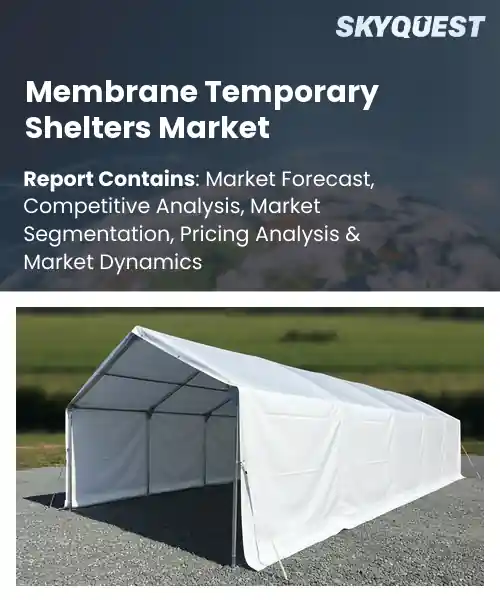
Membrane Temporary Shelters Market
Report ID: SQMIG20B2314
Report ID: SQMIG20B2314
[email protected]
USA +1 351-333-4748
Report ID:
SQMIG20B2314 |
Region:
Global |
Published Date: August, 2026
Pages:
157
|Tables:
150
|Figures:
78


Global Membrane Temporary Shelters Market size was valued at USD 3.42 Billion in 2024 and is poised to grow from USD 3.67 Billion in 2025 to USD 6.51 Billion by 2033, growing at a CAGR of 7.4% during the forecast period (2026-2033).
The membrane temporary shelters market revolves around light weight, tension‑fabric structures that can be put up fast for disaster relief, military deployments , or even big events. The main push behind it is the growing rate of natural catastrophes, so governments and NGOs feel more pressure to find affordable housing solutions that don’t drag on too long.
Moreover, the membrane temporary shelters market growth is driven due to the expansion part, where advanced coatings plus IoT sensors are quietly changing how the whole market moves, mostly by boosting durability and also making performance easier to track. When manufacturers blend in UV resistant additives, these shelters can handle longer sun exposure without falling apart, which means less upkeep and fewer surprises for relief agencies working in dry areas like the Sahel. At the same time, built-in temperature and stress sensors send data up to cloud platforms, letting teams reinforce structures ahead of time, before something bad happens, like what was shown in the 2024 Puerto Rico hurricane drills. This mix of technologies opens up chances for contracts, upgrades and even partnerships, so the market can dig in deeper across defense use cases and commercial event setups.
AI is reshaping safety and efficiency by making real time monitoring possible, supporting predictive maintenance, and helping with better resource allocation. With sensors tucked into fabric panels, data goes into machine learning models that can flag stress, tiny punctures, or thermal changes before they turn into actual hazards. That means operators can check shelter condition remotely, so there’s less dependence on manual inspections, and response time during disaster relief gets faster. AI guided design tools also help streamline the choice of membrane materials, plus the tensioning layout, which can cut setup time and reduce waste. Altogether, these things are encouraging wider adoption of modular shelters across humanitarian efforts and commercial applications.
Market snapshot - (2026-2033)
Global Market Size
USD 3.42 Billion
Largest Segment
Frame-Supported Membrane Shelters
Fastest Growth
Air-Supported Membrane Shelters
Growth Rate
7.4% CAGR
To get more insights on this market click here to Request a Free Sample Report
The global membrane temporary shelters market is segmented by product type, material, installation type, application, end user and region. Based on product type, the market is segmented into Frame-Supported Membrane Shelters, Air-Supported Membrane Shelters and Tensile Membrane Shelters. Based on material, the market is segmented into PVC Membrane, PTFE Membrane, ETFE Membrane, HDPE & Polyethylene Membrane and Other Membrane Materials. Based on installation type, the market is segmented into Portable and Semi-Permanent. Based on application, the market is segmented into Military, Disaster Relief, Industrial & Warehousing, Construction, Events & Exhibitions, Agriculture and Other Applications. Based on end user, the market is segmented into Government & Defense, Commercial, Humanitarian Organizations and Industrial Users. Based on region, the market is segmented into North America, Europe, Asia Pacific, Latin America and Middle East & Africa.
Frame supported membrane shelters run the show as they mix structural rigidity with modularity, so setup feels quicker, and the load bearing capability stays dependable. With steel or aluminum frames acting like a firm skeleton they can hold large spans without interior columns, which is a big deal for emergency housing and field operations. People who design these things like how performance is more predictable across varied climates. At the same time manufacturers get to use standardized components, which cuts down fabrication fuss and keeps supply chain logistics smoother during the whole project schedule
Then again, air supported membrane shelters seem to grow faster because their inflation based concept removes much of the heavy framing. So transport gets lighter, and the initial setup time drops a lot. Improvements in airtight membrane technology, plus better pressure management, make them more reliable too, which is why humanitarian agencies look at them when they want ultra lightweight solutions for remote or hard to reach areas during disaster response
PVC membrane segment leads, mainly because it delivers a cost effective middle ground between durability, weather resistance, and straightforward fabrication. That matters for a wide mix of users, not just a narrow niche. Its chemistry is proven enough to support seamless welding and quick patch work, helping maintain integrity even when conditions get rough. Suppliers also like it because production lines are already mature, while end users value how it adapts to different enclosure shapes. In practice it becomes the go to option for large scale temporary deployments across multiple sectors worldwide
On the other hand, ETFE membrane looks like the fastest grower, driven by very strong light transmission and high temperature tolerance. That makes room for creative designs where solar harvesting and daylighting can work together. Plus the surface tends to be self cleaning and the material is recyclable, which pulls in sustainability centered projects. Architects and developers then specify it for next generation temporary structures that need both strong performance and environmental responsibility
To get detailed segments analysis, Request a Free Sample Report
The region ties together a messy mix of fast urban growth, more awareness about disaster resilience, and advanced manufacturing muscle, and somehow that ends up reinforcing market leadership. Mature infrastructure ecosystems let people adopt high‑performance membrane solutions quickly, while government frameworks basically push for fast‑response housing, for natural events and humanitarian events, like at the same time. Innovation hubs keep nudging material improvements forward, so suppliers from the area stay ahead on design efficiency, durability and, the whole package. Then there are integrated logistics networks that make sure delivery happens on time across different geographies, which strengthens the region’s reputation as the go‑to source for dependable temporary shelter technologies.
Japan Membrane Temporary Shelters Market
Membrane Temporary Shelters Market in Japan is supported by a construction sector that leans hard on precision engineering and strict quality standards. There’s strong coordination between public agencies and private innovators, and that tends to speed up deployments in disaster‑prone zones. A cultural emphasis on preparedness keeps encouraging investments into versatile membrane systems that are reusable and can be erected and taken down rapidly. Collaborative research institutions keep contributing to material advancements, which improves weather resistance and thermal performance, and that gives the market its sturdiness.
South Korea Membrane Temporary Shelters Market
Membrane Temporary Shelters Market in South Korea rides on a blend of high‑tech manufacturing and proactive governmental policies for emergency response. The country’s strengths in lightweight composites and modular design turn into shelters that are resilient but also easy to transport. Strategic public‑private initiatives help with rapid prototyping and testing, so solutions tend to meet strict safety requirements. Continued focus on innovation drives progress in durability, hygiene, and rapid assembly, so the market stays competitive and solid.
What is Driving the Rapid Expansion of Membrane Temporary Shelters Market in Europe?
Europe’s momentum comes from a combined focus on sustainability, regulatory strictness, and cross‑border collaboration that basically boosts demand for adaptable shelter options. Strong environmental directives encourage recyclable and energy‑efficient membranes, while rigorous building codes set higher safety thresholds. Funding mechanisms back research into advanced materials and they promote harmonized standards across member states, which makes market movement feel smoother. Also, increased humanitarian awareness plus coordinated disaster‑response frameworks keep demand steady for modular, quickly deployable shelters across the continent.
Germany Membrane Temporary Shelters Market
Membrane Temporary Shelters Market in Germany rests on engineering credibility, and on a supply chain that delivers precision‑crafted solutions. Policy incentives stress resilient infrastructure, so high‑performance membrane shelters get integrated widely in public and private projects. Collaborative networks linking research institutes, manufacturers, and emergency services help the development of next‑generation materials, balancing strength with environmental stewardship. This whole ecosystem helps Germany maintain a dominant position across the European landscape.
United Kingdom Membrane Temporary Shelters Market
Membrane Temporary Shelters Market in United Kingdom sees rapid growth because of a concerted push toward quick deployment capabilities and regulatory compliance. Governmental emergency frameworks prioritize scalable shelter choices, which basically encourages private investment in lightweight, modular membrane designs. Academic partnerships and innovation hubs produce fresh research focused on durability and ease of assembly. That mix of policy direction and technological progress fuels the fastest expansion rate across the region, and it keeps going.
France Membrane Temporary Shelters Market
Membrane Temporary Shelters Market in France is becoming more visible as a segment driven by strong humanitarian support and climate adaptation. National strategies push recyclable membrane technologies, aligned with wider sustainability goals. Collaborative projects between municipal authorities and specialist manufacturers create tailored solutions for different geographic conditions. Continuous attention to research and community resilience positions France as an emerging contributor to the continental market dynamic, even if it’s still catching up in certain areas.
How is North America Strengthening its Position in Membrane Temporary Shelters Market?
North America keeps its market position strong by mixing a bunch of things, like more sophisticated emergency management systems, lots of manufacturing capacity, and a culture that pushes rapid innovation. The integrated public private partnerships help clean up the pathway for developing and distributing high quality membrane shelters, so readiness stays solid for natural disasters , and also for temporary event requirements. There’s a real focus on modular design, plus logistics that feel easier, which means quicker placement across different terrains. And because they keep investing in research and material science, they improve durability , better insulation, and overall environmental performance, which locks in a strategic advantage for the region
United States Membrane Temporary Shelters Market
Membrane Temporary Shelters Market in United States also relies on a wide network of manufacturers, able to scale output fast enough to match different emergency scenarios. Federal and state agencies team up with industry leaders to set standards that emphasize rapid response, safety, and re usability
To know more about the market opportunities by region and country, click here to
Buy The Complete Report
Growing Need for Emergency Housing
Adoption of Lightweight Materials
High Initial Capital Investment
Regulatory Compliance Challenges
Request Free Customization of this report to help us to meet your business objectives.
The competitive landscape of the global membrane temporary shelters market is shaped by intense rivalry among established manufacturers and emerging innovators, driving rapid product differentiation and cost‑efficiency improvements; a key market driver is the escalating demand for swift, scalable shelter solutions in disaster‑relief and humanitarian contexts, prompting firms to pursue concrete actions such as AirTent’s 2023 partnership with the Red Cross to supply inflatable shelters for emergency response and Shelter Systems’ 2022 acquisition of a specialized membrane‑coating technology company to enhance durability and reduce deployment time.
Top Player’s Company Profile
Recent Developments in the Membrane Temporary Shelters Market
SkyQuest’s ABIRAW (Advanced Business Intelligence, Research & Analysis Wing) is our Business Information Services team that Collects, Collates, Correlates, and Analyses the Data collected by means of Primary Exploratory Research backed by robust Secondary Desk research.
As per SkyQuest analysis, the global membrane temporary shelters market is being pushed mostly by the growing requirement for emergency housing. frequent natural disasters keep pushing governments and NGOs toward solutions that are fast, and weather‑resistant. Another factor, comes from improvements in lightweight polymer fabrics. these reduce transport weight and make on‑site assembly simpler, which then widens adoption further. Still, there’s a restraint that keeps showing up, high initial capital investment. that can limit uptake among budget‑constrained relief agencies. Asia Pacific leads the market, largely because it has strong manufacturing bases, disaster‑resilience policies, and logistics networks that work. Within the product landscape, frame‑supported membrane shelters take the lead segment. they give robust rigidity and modularity, which helps speed deployment during crisis situations.
| Report Metric | Details |
|---|---|
| Market size value in 2024 | USD 3.42 Billion |
| Market size value in 2033 | USD 6.51 Billion |
| Growth Rate | 7.4% |
| Base year | 2024 |
| Forecast period | (2026-2033) |
| Forecast Unit (Value) | USD Billion |
| Segments covered |
|
| Regions covered | North America (US, Canada), Europe (Germany, France, United Kingdom, Italy, Spain, Rest of Europe), Asia Pacific (China, India, Japan, Rest of Asia-Pacific), Latin America (Brazil, Rest of Latin America), Middle East & Africa (South Africa, GCC Countries, Rest of MEA) |
| Companies covered |
|
| Customization scope | Free report customization with purchase. Customization includes:-
|
To get a free trial access to our platform which is a one stop solution for all your data requirements for quicker decision making. This platform allows you to compare markets, competitors who are prominent in the market, and mega trends that are influencing the dynamics in the market. Also, get access to detailed SkyQuest exclusive matrix.
Table Of Content
Executive Summary
Market overview
Parent Market Analysis
Market overview
Market size
KEY MARKET INSIGHTS
COVID IMPACT
MARKET DYNAMICS & OUTLOOK
Market Size by Region
KEY COMPANY PROFILES
Methodology
For the Membrane Temporary Shelters Market, our research methodology involved a mixture of primary and secondary data sources. Key steps involved in the research process are listed below:
1. Information Procurement: This stage involved the procurement of Market data or related information via primary and secondary sources. The various secondary sources used included various company websites, annual reports, trade databases, and paid databases such as Hoover's, Bloomberg Business, Factiva, and Avention. Our team did 45 primary interactions Globally which included several stakeholders such as manufacturers, customers, key opinion leaders, etc. Overall, information procurement was one of the most extensive stages in our research process.
2. Information Analysis: This step involved triangulation of data through bottom-up and top-down approaches to estimate and validate the total size and future estimate of the Membrane Temporary Shelters Market.
3. Report Formulation: The final step entailed the placement of data points in appropriate Market spaces in an attempt to deduce viable conclusions.
4. Validation & Publishing: Validation is the most important step in the process. Validation & re-validation via an intricately designed process helped us finalize data points to be used for final calculations. The final Market estimates and forecasts were then aligned and sent to our panel of industry experts for validation of data. Once the validation was done the report was sent to our Quality Assurance team to ensure adherence to style guides, consistency & design.
Analyst Support
Customization Options
With the given market data, our dedicated team of analysts can offer you the following customization options are available for the Membrane Temporary Shelters Market:
Product Analysis: Product matrix, which offers a detailed comparison of the product portfolio of companies.
Regional Analysis: Further analysis of the Membrane Temporary Shelters Market for additional countries.
Competitive Analysis: Detailed analysis and profiling of additional Market players & comparative analysis of competitive products.
Go to Market Strategy: Find the high-growth channels to invest your marketing efforts and increase your customer base.
Innovation Mapping: Identify racial solutions and innovation, connected to deep ecosystems of innovators, start-ups, academics, and strategic partners.
Category Intelligence: Customized intelligence that is relevant to their supply Markets will enable them to make smarter sourcing decisions and improve their category management.
Public Company Transcript Analysis: To improve the investment performance by generating new alpha and making better-informed decisions.
Social Media Listening: To analyze the conversations and trends happening not just around your brand, but around your industry as a whole, and use those insights to make better Marketing decisions.
REQUEST FOR SAMPLE
 REQUEST FREE CUSTOMIZATION
Global Membrane Temporary Shelters Market size was valued at USD 3.42 Billion in 2024 and is poised to grow from USD 3.67 Billion in 2025 to USD 6.51 Billion by 2033, growing at a CAGR of 7.4% during the forecast period (2026-2033).
The competitive landscape of the global membrane temporary shelters market is shaped by intense rivalry among established manufacturers and emerging innovators, driving rapid product differentiation and cost‑efficiency improvements; a key market driver is the escalating demand for swift, scalable shelter solutions in disaster‑relief and humanitarian contexts, prompting firms to pursue concrete actions such as AirTent’s 2023 partnership with the Red Cross to supply inflatable shelters for emergency response and Shelter Systems’ 2022 acquisition of a specialized membrane‑coating technology company to enhance durability and reduce deployment time. 'Röder Group GmbH', 'Losberger De Boer Group', 'HTS TENTIQ GmbH', 'Weatherhaven Global Resources Ltd.', 'Alaska Structures, Inc.', 'Sprung Instant Structures Ltd.', 'Big Top Manufacturing, Inc.', 'Mahaffey Fabric Structures', 'Legacy Building Solutions, Inc.', 'Britespan Building Systems Inc.', 'Liri Tent Technology Co., Ltd.', 'Jiangsu Jinpeng High Polymer Materials Co., Ltd.', 'Yashada Green Ventures Pvt. Ltd.', 'FAMSUN Temporary Structures', 'De Boer Structures Holding B.V.', 'Utilis S.A.S.', 'Marshall Specialty Structures', 'GSM Outdoors', 'Taiyo Kogyo Corporation', 'MakMax Group'
Frequent natural disasters and humanitarian crises are prompting governments and relief agencies to prioritize rapid shelter solutions, and membrane temporary shelters meet this need through quick assembly and minimal site preparation. Their flexible design allows deployment in diverse terrains, reducing logistical complexities and enabling swift protection for displaced populations. This capability to provide immediate, weather‑resistant accommodation drives demand across emergency response sectors, reinforcing market expansion as stakeholders seek reliable, scalable options for temporary housing and fostering long‑term partnerships with NGOs and local authorities.
Rapid Deployment Innovations: Manufacturers are integrating modular frame systems and clip‑on anchoring mechanisms that dramatically reduce set‑up time, allowing shelters to be erected within hours rather than days. This agility meets the escalating demand from disaster‑relief agencies and temporary event organizers who require swift, reliable infrastructure. The shift also encourages the use of pre‑fabricated membrane panels with built‑in weather‑resistance, minimizing on‑site adjustments and labor. Consequently, suppliers are positioning rapid‑assembly capability as a core value proposition, driving broader adoption across humanitarian and commercial sectors.
Why does Asia Pacific Dominate the Global Membrane Temporary Shelters Market? |@12


Want to customize this report? This report can be personalized according to your needs. Our analysts and industry experts will work directly with you to understand your requirements and provide you with customized data in a short amount of time. We offer $1000 worth of FREE customization at the time of purchase.
Feedback From Our Clients


 USA (+1) 351-333-4748

