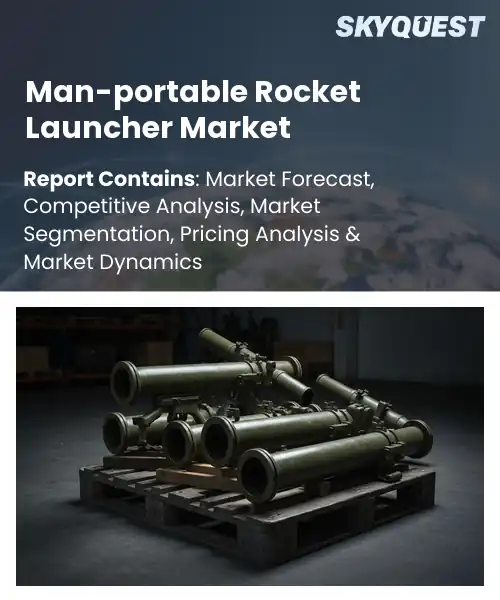
Man-portable Rocket Launcher Market
Report ID: SQMIG20A2835
Report ID: SQMIG20A2835
[email protected]
USA +1 351-333-4748
Report ID:
SQMIG20A2835 |
Region:
Global |
Published Date: August, 2026
Pages:
157
|Tables:
142
|Figures:
78


Global Man-Portable Rocket Launcher Market size was valued at USD 7.62 Billion in 2024 and is poised to grow from USD 8.07 Billion in 2025 to USD 12.77 Billion by 2033, growing at a CAGR of 5.9% during the forecast period (2026-2033).
The global man‑portable rocket launcher market is defined by lightweight, shoulder‑fired systems that deliver high‑explosive or anti‑armor warheads within a few hundred meters. Its significance lies in providing infantry units with rapid, precise firepower that can neutralize armored threats without requiring dedicated artillery. The primary driver stems from the rising prevalence of asymmetric warfare, where combatants rely on agile, low‑cost solutions to counter technologically superior adversaries. Since the 1970s, platforms such as the Soviet RPG‑7 and the U.S. M72 LAW have evolved into modern variants like the AT4 and NLAW, reflecting continuous improvements in range, accuracy, and safety protocols today. A second pivotal factor reshaping the market is the accelerated adoption of advanced fire‑control and networking technologies, which transform simple launchers into integral components of digitized battlefield ecosystems. Enhanced targeting sensors and Bluetooth‑enabled data links let operators acquire and engage targets faster, thereby increasing mission success rates and reducing collateral damage. Consequently, defense ministries allocate larger budgets toward next‑generation systems such as the Swedish NLAW‑2 and the Russian RShG‑2, creating opportunities for manufacturers to supply modular upgrades and training services. Deployments in Ukraine and the Sahel illustrate how interoperable launchers boost infantry effectiveness while prompting investment in research and exports.
How is AI enhancing targeting accuracy in the man‑portable rocket launcher market?
AI is reshaping the man‑portable rocket launcher market by turning traditional point‑and‑shoot weapons into precision tools. Modern systems embed sensor‑fusion algorithms that combine infrared, laser range‑finding and inertial data to generate a fire‑control solution. Machine‑learning models analyze terrain and target movement, allowing the launcher to predict the optimal lead angle before the operator pulls the trigger. This reduces the cognitive load on soldiers and raises first‑shot hit probability, especially in cluttered urban environments where decisions matter. As armed forces prioritize reduced collateral damage and higher lethality, manufacturers race to integrate AI‑driven guidance into new and upgraded launchers, making the market more competitive.Raytheon announced in June 2023 an AI‑enhanced targeting module for its Javelin missile, enabling automatic target discrimination and adaptive trajectory correction. The upgrade shortens engagement cycles and improves hit confidence, driving demand for smarter man‑portable launchers across modern armed forces.
Market snapshot - (2026-2033)
Global Market Size
USD 7.62 Billion
Largest Segment
Disposable Rocket Launchers
Fastest Growth
Reloadable Rocket Launchers
Growth Rate
5.9% CAGR
To get more insights on this market click here to Request a Free Sample Report
Global man-portable rocket launcher market is segmented by product type, launch mode, range, application, end user and region. Based on product type, the market is segmented into Disposable Rocket Launchers and Reloadable Rocket Launchers. Based on launch mode, the market is segmented into Unguided Rocket Launchers and Guided Rocket Launchers. Based on range, the market is segmented into Short Range, Medium Range and Long Range. Based on application, the market is segmented into Anti-Armor, Anti-Structure and Multi-Purpose. Based on end user, the market is segmented into Military, Special Forces and Law Enforcement. Based on region, the market is segmented into North America, Europe, Asia Pacific, Latin America and Middle East & Africa.
Disposable Rocket Launchers segment dominates because operators prioritize simplicity and immediate readiness, eliminating logistical burdens associated with reloading. The single use design aligns with fast paced combat scenarios where rapid deployment and minimal training are paramount. Convenience, lower life cycle maintenance, and the ability to stockpile large quantities drive its preeminence, making it the cornerstone of current procurement strategies for modern forces seeking versatility and reliability.
However, Reloadable Rocket Launchers segment is witnessing the strongest growth momentum as militaries invest in modular systems that can be rearmed for multiple engagements. Technological advances in fire control and reusable warhead designs lower long term costs, encouraging adoption in expeditionary units and expanding the market’s future potential.
Anti Structure segment dominates because urban combat demands precise destructive power against fortified positions and built up environments. Operators value rockets capable of penetrating concrete and masonry, reducing collateral damage while neutralizing enemy strongholds. This capability aligns with contemporary doctrines emphasizing rapid room clearance and infrastructure denial, prompting defense planners to prioritize such systems in acquisition programs and shaping procurement criteria across armed forces for modern militaries.
On the other hand, Multi Purpose segment is emerging as the key high growth area as users seek versatile platforms capable of engaging armor, structures and soft targets. Advances in warhead technology and interchangeable sight modules expand operational flexibility, attracting operations units and law enforcement agencies. This broadened applicability fuels procurement and opens revenue streams for manufacturers.
To get detailed segments analysis, Request a Free Sample Report
North America maintains dominance through a combination of deep defense industrial expertise, sustained investment in research and development, and a robust supply chain that supports rapid fielding of advanced systems. The region benefits from close integration between government procurement agencies and leading manufacturers, fostering continuous innovation and high‑quality production. Strategic alliances and joint training exercises reinforce interoperability and operational readiness, while extensive logistics networks ensure efficient distribution and maintenance. Additionally, a strong emphasis on modernization programs and a culture of technological excellence keep North American offerings at the forefront of performance and reliability, reinforcing its leadership position in the global arena.
United States Man-portable Rocket Launcher Market
Man-portable Rocket Launcher Market in the United States is driven by a mature defense ecosystem that blends cutting‑edge research institutions with seasoned manufacturers. The emphasis on rapid prototyping and field testing accelerates the transition of new concepts into operational capability. Close collaboration between the armed forces and industry partners ensures that system designs align with evolving tactical requirements, while extensive training infrastructure supports proficient operator skill development. A comprehensive logistics framework further enhances sustainment, enabling consistent availability across diverse operational theaters.
Canada Man-portable Rocket Launcher Market
Man-portable Rocket Launcher Market in Canada reflects a strategic focus on interoperability with allied forces and a commitment to domestic production capabilities. Collaborative defense initiatives encourage technology transfer and joint development, strengthening the national industrial base. Emphasis on rigorous testing and certification processes ensures that equipment meets stringent safety and performance standards. Integrated training programs and a well‑structured maintenance network contribute to high operational readiness, positioning Canada as a reliable contributor to collective security efforts.
Europe’s rapid expansion is propelled by heightened security concerns, deepening defense cooperation, and a resurgence of indigenous manufacturing capabilities. Nations are prioritizing modernization of infantry firepower, leading to increased demand for versatile, lightweight launchers that can be integrated across multiple platforms. Collaborative research programs and cross‑border industrial partnerships accelerate innovation while reducing development cycles. Strong regulatory frameworks and standardization efforts facilitate seamless integration among NATO members, enhancing collective deterrence. Moreover, a focus on sustainable production and lifecycle management aligns with broader European policy objectives, reinforcing the region’s competitive edge in the market.
Germany Man-portable Rocket Launcher Market
Man-portable Rocket Launcher Market in Germany benefits from a robust engineering tradition and a well‑established defense industrial sector. Emphasis on precision manufacturing and rigorous quality control ensures high reliability and performance. Close coordination between the armed forces and leading firms drives continuous refinement of system capabilities, while extensive training curricula maintain operator proficiency. Integrated logistics and support structures further guarantee sustained operational availability across varied mission profiles.
United Kingdom Man-portable Rocket Launcher Market
Man-portable Rocket Launcher Market in the United Kingdom is characterized by a dynamic approach to capability development and rapid fielding. Strong ties between defense ministries and innovative enterprises foster agile design cycles and swift adoption of emerging technologies. Emphasis on joint exercises with allied forces enhances interoperability and informs requirement shaping. Comprehensive training regimes and a resilient supply chain underpin high readiness levels, positioning the United Kingdom as a fast‑moving contributor to the European market landscape.
France Man-portable Rocket Launcher Market
Man-portable Rocket Launcher Market in France reflects an emerging focus on expanding domestic production and diversifying export opportunities. Collaborative initiatives with research institutions stimulate novel design concepts, while a commitment to modularity supports adaptability across mission sets. Training programs emphasize tactical versatility, and a streamlined logistics framework ensures efficient sustainment. These elements collectively nurture an emerging market presence that complements broader European growth dynamics.
Asia Pacific is strengthening its position through strategic investments in indigenous development, heightened regional security collaborations, and an expanding industrial base that emphasizes cost‑effective yet capable solutions. Nations are prioritizing self‑reliance, leading to accelerated research initiatives and the establishment of specialized production facilities. Joint exercises and defense dialogues promote standardization and knowledge exchange, enhancing operational compatibility across the region. A focus on modular design and rapid deployment capabilities aligns with the diverse terrain and threat environments prevalent in Asia Pacific, while robust supply chain networks ensure timely delivery and maintenance support, collectively elevating the region’s market stature.
Japan Man-portable Rocket Launcher Market
Man-portable Rocket Launcher Market in Japan is shaped by a disciplined approach to technology integration and a strong emphasis on precision engineering. Collaborative efforts between the Self‑Defense Forces and domestic manufacturers drive continuous improvement of system reliability and safety. Comprehensive training programs ensure high proficiency among operators, while a well‑coordinated logistics system guarantees sustained readiness. These factors collectively reinforce Japan’s commitment to maintaining a capable and responsive infantry firepower capability.
South Korea Man-portable Rocket Launcher Market
Man-portable Rocket Launcher Market in South Korea reflects a proactive stance on defense modernization and rapid technology adoption. Close cooperation between the armed forces and leading industrial partners accelerates the development of lightweight, high‑performance launchers tailored to varied operational scenarios. Intensive training initiatives and a resilient maintenance infrastructure support high operational availability. Emphasis on export potential and regional partnership programs further amplifies South Korea’s influence within the broader Asia Pacific market.
To know more about the market opportunities by region and country, click here to
Buy The Complete Report
Increasing Demand For Light Infantry
Advancements In Precision Technology
Stringent Export Control Regulations
High Operational Safety Concerns
Request Free Customization of this report to help us to meet your business objectives.
Top Player’s Company Profile
Recent Developments
SkyQuest’s ABIRAW (Advanced Business Intelligence, Research & Analysis Wing) is our Business Information Services team that Collects, Collates, Correlates, and Analyses the Data collected by means of Primary Exploratory Research backed by robust Secondary Desk research. As per SkyQuest analysis the global man‑portable rocket launcher market is expanding at a 5.9% CAGR driven primarily by the rising demand for lighter infantry firepower that can be carried and deployed rapidly, while advancements in precision technology provide a second boost by improving hit accuracy and reducing collateral damage. Stringent export‑control regulations act as a restraint, slowing cross‑border sales and adding compliance costs. North America remains the dominating region thanks to its deep defence industrial base and continual R&D investment. Within the market the disposable rocket launchers segment leads in volume because of its simplicity, immediate readiness and lower logistical burden for operators.
| Report Metric | Details |
|---|---|
| Market size value in 2024 | USD 7.62 Billion |
| Market size value in 2033 | USD 12.77 Billion |
| Growth Rate | 5.9% |
| Base year | 2024 |
| Forecast period | (2026-2033) |
| Forecast Unit (Value) | USD Billion |
| Segments covered |
|
| Regions covered | North America (US, Canada), Europe (Germany, France, United Kingdom, Italy, Spain, Rest of Europe), Asia Pacific (China, India, Japan, Rest of Asia-Pacific), Latin America (Brazil, Rest of Latin America), Middle East & Africa (South Africa, GCC Countries, Rest of MEA) |
| Companies covered |
|
| Customization scope | Free report customization with purchase. Customization includes:-
|
To get a free trial access to our platform which is a one stop solution for all your data requirements for quicker decision making. This platform allows you to compare markets, competitors who are prominent in the market, and mega trends that are influencing the dynamics in the market. Also, get access to detailed SkyQuest exclusive matrix.
Table Of Content
Executive Summary
Market overview
Parent Market Analysis
Market overview
Market size
KEY MARKET INSIGHTS
COVID IMPACT
MARKET DYNAMICS & OUTLOOK
Market Size by Region
KEY COMPANY PROFILES
Methodology
For the Man-portable Rocket Launcher Market, our research methodology involved a mixture of primary and secondary data sources. Key steps involved in the research process are listed below:
1. Information Procurement: This stage involved the procurement of Market data or related information via primary and secondary sources. The various secondary sources used included various company websites, annual reports, trade databases, and paid databases such as Hoover's, Bloomberg Business, Factiva, and Avention. Our team did 45 primary interactions Globally which included several stakeholders such as manufacturers, customers, key opinion leaders, etc. Overall, information procurement was one of the most extensive stages in our research process.
2. Information Analysis: This step involved triangulation of data through bottom-up and top-down approaches to estimate and validate the total size and future estimate of the Man-portable Rocket Launcher Market.
3. Report Formulation: The final step entailed the placement of data points in appropriate Market spaces in an attempt to deduce viable conclusions.
4. Validation & Publishing: Validation is the most important step in the process. Validation & re-validation via an intricately designed process helped us finalize data points to be used for final calculations. The final Market estimates and forecasts were then aligned and sent to our panel of industry experts for validation of data. Once the validation was done the report was sent to our Quality Assurance team to ensure adherence to style guides, consistency & design.
Analyst Support
Customization Options
With the given market data, our dedicated team of analysts can offer you the following customization options are available for the Man-portable Rocket Launcher Market:
Product Analysis: Product matrix, which offers a detailed comparison of the product portfolio of companies.
Regional Analysis: Further analysis of the Man-portable Rocket Launcher Market for additional countries.
Competitive Analysis: Detailed analysis and profiling of additional Market players & comparative analysis of competitive products.
Go to Market Strategy: Find the high-growth channels to invest your marketing efforts and increase your customer base.
Innovation Mapping: Identify racial solutions and innovation, connected to deep ecosystems of innovators, start-ups, academics, and strategic partners.
Category Intelligence: Customized intelligence that is relevant to their supply Markets will enable them to make smarter sourcing decisions and improve their category management.
Public Company Transcript Analysis: To improve the investment performance by generating new alpha and making better-informed decisions.
Social Media Listening: To analyze the conversations and trends happening not just around your brand, but around your industry as a whole, and use those insights to make better Marketing decisions.
REQUEST FOR SAMPLE
 REQUEST FREE CUSTOMIZATION


Want to customize this report? This report can be personalized according to your needs. Our analysts and industry experts will work directly with you to understand your requirements and provide you with customized data in a short amount of time. We offer $1000 worth of FREE customization at the time of purchase.
Feedback From Our Clients


 USA (+1) 351-333-4748

