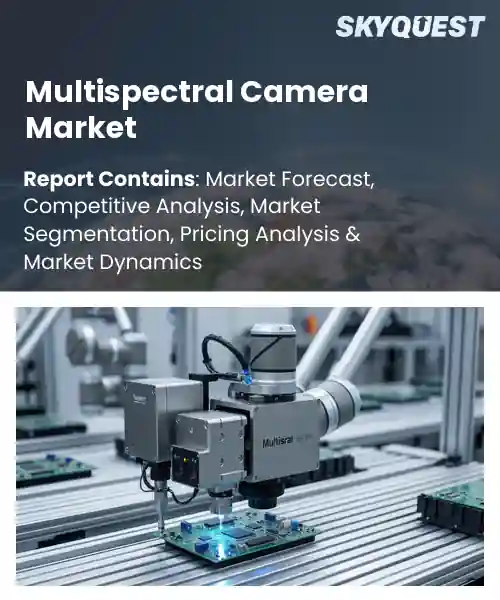
Multispectral Camera Market
Report ID: SQMIG45J2558
Report ID: SQMIG45J2558
[email protected]
USA +1 351-333-4748
Report ID:
SQMIG45J2558 |
Region:
Global |
Published Date: June, 2026
Pages:
157
|Tables:
121
|Figures:
77


Global Multispectral Camera Market size was valued at USD 1.8 Billion in 2024 and is poised to grow from USD 1.96 Billion in 2025 to USD 3.94 Billion by 2033, growing at a CAGR of 9.1% during the forecast period (2026-2033).
The multispectral camera market is fueled by the growing demand for actionable spectral data, especially in agriculture and forestry, driving adoption and innovation. Multispectral cameras capture several discrete wavelength bands and enable vegetation indices, material identification, and water quality assessment. This changes situational awareness across sectors and shifts the market from specialized satellite sensors to airborne and drone-mounted systems. Better sensor miniaturization, lower cost CMOS detectors and analytics have lowered barriers to entry and enterprises are deploying systems for NDVI mapping, precision spraying and habitat monitoring. Today’s market dynamics are defined by the shift from large platforms towards compact, integrated solutions.
Building on that shift, a key market driver is the falling cost and accessibility of multi-spectral sensors which expands markets and spurs ecosystem development. As unit prices drop, agricultural service providers and survey companies deploy fleets of drones with subscription analytics creating recurring revenue and funding advances in machine learning to extract actionable insights like nutrient deficits or pest outbreaks. Lower weight and power also permit integration into satellites and industrial inspection rigs to enable crop insurance assessments, solar farm defect detection and mining grade mapping. Those use cases attract investment and partnerships, creating virtuous cycles of innovation and market expansion.
How is AI enhancing data analytics in the multispectral camera market?
AI is transforming data analytics in the multispectral camera market, automating spectral feature extraction and enhancing signal calibration so customers get actionable data versus raw bands. Key aspects include spectral unmixing, anomaly detection and fusion with RGB and geospatial data which in combination speed interpretation and reduce manual analysis. Today the market is seeing increased adoption in agriculture, environmental monitoring, manufacturing and inspection where models can identify plant stress, disease, and material composition from multi-spectral captures. Vendors are embedding machine learning pipelines and providing turnkey analytics platforms to reduce barriers for end users and speed up deployment.
Spectral AI said in June 2026 that it had developed a DeepView system that uses a proprietary AI algorithm and multispectral imaging to assess wounds. This real world example shows how AI driven analytics turn multispectral data into predictive and easy to interpret outputs that improve decision making and operational efficiency.
Market snapshot - (2026-2033)
Global Market Size
USD 1.8 Billion
Largest Segment
Multispectral Cameras
Fastest Growth
Multispectral Sensors
Growth Rate
9.1% CAGR
To get more insights on this market click here to Request a Free Sample Report
Global multispectral camera market is segmented by product type, technology, application, end-user industry and region. Based on product type, the market is segmented into Multispectral Cameras, Multispectral Sensors and Others. Based on technology, the market is segmented into Snapshot, Pushbroom, Tunable Filters and Others. Based on application, the market is segmented into Precision Agriculture, Medical Diagnostics, Military and Defense, Remote Sensing and Others. Based on end-user industry, the market is segmented into Healthcare, Aerospace and Defense, Food and Agriculture and Others. Based on region, the market is segmented into North America, Europe, Asia Pacific, Latin America and Middle East & Africa.
Snapshot segment is the dominant one as its ability to capture full frame multispectral images in a single exposure caters to the need for real time, mobile data collection across drones and portable platforms . This capability simplifies workflow, reduces motion artifacts and reduces system complexity, driving adoption among integrators and end users. Improved sensor arrays and software integration increase utility and have resulted in broad adoption in areas where rapid spectral insight is needed for decision making.
Pushbroom, however, is rapidly gaining momentum as its continuous line scanning provides high spectral fidelity for both airborne and satellite mapping, enabling accurate terrain and vegetation analysis. There are improvements in stabilization, spectral calibration and the increasing demand for complete geospatial datasets that are driving adoption and enabling new products in the areas of environmental monitoring and resource mapping.
Precision The agriculture segment is dominant as it requires timely spectral insights which are directly aligned with the multispectral camera capabilities used on drones and ground vehicles to monitor crop health. That alignment fuels procurement by agribusinesses and service providers seeking yield optimization and input efficiency. When integrated with analytics platforms and agronomic decision systems, more value is added, fueling wide adoption and continued investment in higher performance imaging solutions throughout farming operations.
Meanwhile, the fastest-growing field of Medical Diagnostics is the rapidly emerging area of multispectral imaging for non invasive tissue assessment and surgical guidance. Portable clinical grade devices and growing research in spectral biomarkers are expanding clinical applications and attracting regulatory interest, paving the way for new commercial opportunities between imaging vendors and healthcare providers.
To get detailed segments analysis, Request a Free Sample Report
North America is the leading region in the global multispectral camera market because of its technological leadership, strong commercial and institutional demand, and mature service ecosystems. Strong R&D capabilities at universities and corporate labs speed sensor innovation and integration. Applications range from precision agriculture, defense and aerospace, environmental monitoring, and industrial inspection drives for diverse scales and specialization. A dense cluster of leading manufacturers, system integrators and software vendors is supporting rapid commercialization and aftermarket services. Favorable procurement practices of large customers, developed distribution and testing infrastructure and abundance of skilled workforce is keeping the innovation cycles alive. The growing use of unmanned platforms and data analytics is driving more use cases and more valuable systems, while partnerships between industry and research institutions are shortening product development timelines.
The United States multispectral camera market is driven by concentrated research, major system integrators and a plethora of end users seeking advanced imaging solutions. Corporate labs in collaboration with academic centers accelerate product development and validation. High specification requirements are being driven by the strong adoption in defense, agriculture and industrial inspection, and are pushing sensor performance. Deployment is backed by wide service networks and established supply chains. Start-up activity complements established vendors to broaden application ecosystems.
The Canadian multispectral camera market is driven by remote sensing applications in forestry, environmental monitoring, and resource exploration. Field validation and deployments are supported by government research initiatives and specialized service providers. Integration with unmanned platforms to access difficult terrain, and a demand for rugged, reliable sensors is stimulated. Research centres work with small manufacturers to develop solutions for northern climates, and export firms draw on that expertise to serve customers worldwide.
The multispectral camera market in Europe is experiencing rapid growth due to a combination of targeted policy initiatives for sustainability, strong industrial demand, and a thriving research and manufacturing environment. Cross-country collaboration among technology vendors, agricultural cooperatives and environmental agencies encourages practical implementation in precision farming, land management and infrastructure inspection. Robust manufacturing clusters facilitate integration with established machine vision and automation systems. A growing startup ecosystem accelerates product innovation and commercialization. Public and private investment in testing facilities and pilot programs, together with a skilled engineering workforce, creates fertile ground for the development of a wide range of applications and regional specialization, improving market dynamics across the continent. Harmonised standards make cross border deployment easier and linkages between instrument makers and analytics firms boost turnkey offerings for operators.
Germany Multispectral Camera Market is driven by strong industrial demand and an established manufacturing industry that facilitates the manufacturing of high-quality sensors and system integration. Need for precision imaging driven by automotive inspection, factory automation and infrastructure monitoring. Applied innovation is stimulated through close cooperation with technical universities and industrial research centers. Scale is made possible by established export channels and supplier networks and Germany is positioned as a source of industrial grade multispectral solutions through integration expertise.
The United Kingdom Multispectral Camera Market is characterized by continuous innovation, driven by research universities, startups, and strong expertise in robotics. Adoption of new sensors in agricultural technology and environmental monitoring creates testbeds for novel sensors. The collaboration between defense research organizations and commercial developers also speeds the ruggedization process. Deployments are supported by investment networks and demonstration programs. Imaging solutions along with connectivity and data analytics make products more attractive to international customers and after sales support networks.
The synergies of agritech innovators, aerospace engineering and environmental monitoring programs are taking shape in the France Multispectral Camera Market. Precision farming and satellite initiatives are driving demand for development of flexible sensor modules. Collaborative public research platforms, along with manufacturers, are working on the validation of solutions for different terrains and climatic conditions. The development of a growing ecosystem of system integrators and service providers supports customization and deployment in the field, increasing competitiveness and opening pathways to greater international engagement.
In Asia Pacific, the multispectral camera market is developing its capabilities in electronics manufacturing, sensor engineering and system integration. Regional clusters bring together suppliers of optical components, semiconductors and assembly expertise to cut time to market and allow competitive product pricing. Adoption is encouraged by governments and commercial players through demonstration programs in precision agriculture, coastal and urban monitoring, and industrial inspection that create practical use cases and generate demand locally. Close partnerships between original equipment manufacturers, imaging start-ups and analytics firms enable turnkey solutions. Investment in robotics and unmanned platforms further opens distribution channels, and a skilled engineering workforce and export-oriented manufacturers allow regional innovations to access global customers. Localization of component supply chains and joint research centers enhance resilience. Targeted commercialization programs accelerate uptake across different market segments.
Precision manufacturing capabilities, established imaging companies and advanced optics expertise that enable the development of high-quality sensors are some of the factors that drive the multispectral camera market in Japan. To meet the demands of industrial automation, quality inspection and robotics applications, complex systems are incorporating multispectral modules. Technical universities and corporate R and D centers partner up to accelerate applied research and pilot deployments. Manufacturers have a strong export orientation and an international reputation for reliability, which creates partnerships around the world.
The Multispectral Camera Market in South Korea is driven by the strong electronics manufacturing, semiconductor knowhow and relationship between component suppliers and system integrators. There are several major technology clusters that support prototyping and production of imaging modules. Adoption is driven by demand for integrated sensor and analytics packages in urban monitoring, industrial inspection and smart farming. “Conglomerates and start-ups work together on commercialization.” Export channels and competitive manufacturing capabilities enable firms to go after international projects and partnerships.
To know more about the market opportunities by region and country, click here to
Buy The Complete Report
Advancements In Sensor Technology
Expansion In Defense Applications
High System Integration Complexity
Limited Standardization Across Industries
Request Free Customization of this report to help us to meet your business objectives.
The competition for constellation operators, specialist sensor vendors and compact spectral startups has been fuelled by higher spectral fidelity and faster tasking. Companies are pursuing concrete strategies like acquisitions to add analytics, government and commercial partnerships to secure contracts and product innovation to differentiate. Examples include Maxar’s acquisition of Vricon, Satellogic’s expanded government awards and Pixxel’s demonstration satellite deployments following a Google led funding round.
SkyQuest’s ABIRAW (Advanced Business Intelligence, Research & Analysis Wing) is our Business Information Services team that Collects, Collates, Correlates, and Analyses the Data collected by means of Primary Exploratory Research backed by robust Secondary Desk research. As per SkyQuest analysis, the global multispectral camera market is being propelled by falling sensor costs and miniaturization as a key driver while adoption is further accelerated by AI-enabled analytics that convert spectral data into actionable insights. However, a major restraint remains the high system integration complexity required to embed multispectral systems into platforms and workflows. North America remains the dominating region due to technology leadership, strong R&D and diverse end users. The snapshot segment is the dominating segment as its single-exposure full-frame capture simplifies mobile and drone deployments, reduces motion artifacts and lowers system complexity, making it the preferred choice for rapid field operations.
| Report Metric | Details |
|---|---|
| Market size value in 2024 | USD 1.8 Billion |
| Market size value in 2033 | USD 3.94 Billion |
| Growth Rate | 9.1% |
| Base year | 2024 |
| Forecast period | (2026-2033) |
| Forecast Unit (Value) | USD Billion |
| Segments covered |
|
| Regions covered | North America (US, Canada), Europe (Germany, France, United Kingdom, Italy, Spain, Rest of Europe), Asia Pacific (China, India, Japan, Rest of Asia-Pacific), Latin America (Brazil, Rest of Latin America), Middle East & Africa (South Africa, GCC Countries, Rest of MEA) |
| Companies covered |
|
| Customization scope | Free report customization with purchase. Customization includes:-
|
To get a free trial access to our platform which is a one stop solution for all your data requirements for quicker decision making. This platform allows you to compare markets, competitors who are prominent in the market, and mega trends that are influencing the dynamics in the market. Also, get access to detailed SkyQuest exclusive matrix.
Table Of Content
Executive Summary
Market overview
Parent Market Analysis
Market overview
Market size
KEY MARKET INSIGHTS
COVID IMPACT
MARKET DYNAMICS & OUTLOOK
Market Size by Region
KEY COMPANY PROFILES
Methodology
For the Multispectral Camera Market, our research methodology involved a mixture of primary and secondary data sources. Key steps involved in the research process are listed below:
1. Information Procurement: This stage involved the procurement of Market data or related information via primary and secondary sources. The various secondary sources used included various company websites, annual reports, trade databases, and paid databases such as Hoover's, Bloomberg Business, Factiva, and Avention. Our team did 45 primary interactions Globally which included several stakeholders such as manufacturers, customers, key opinion leaders, etc. Overall, information procurement was one of the most extensive stages in our research process.
2. Information Analysis: This step involved triangulation of data through bottom-up and top-down approaches to estimate and validate the total size and future estimate of the Multispectral Camera Market.
3. Report Formulation: The final step entailed the placement of data points in appropriate Market spaces in an attempt to deduce viable conclusions.
4. Validation & Publishing: Validation is the most important step in the process. Validation & re-validation via an intricately designed process helped us finalize data points to be used for final calculations. The final Market estimates and forecasts were then aligned and sent to our panel of industry experts for validation of data. Once the validation was done the report was sent to our Quality Assurance team to ensure adherence to style guides, consistency & design.
Analyst Support
Customization Options
With the given market data, our dedicated team of analysts can offer you the following customization options are available for the Multispectral Camera Market:
Product Analysis: Product matrix, which offers a detailed comparison of the product portfolio of companies.
Regional Analysis: Further analysis of the Multispectral Camera Market for additional countries.
Competitive Analysis: Detailed analysis and profiling of additional Market players & comparative analysis of competitive products.
Go to Market Strategy: Find the high-growth channels to invest your marketing efforts and increase your customer base.
Innovation Mapping: Identify racial solutions and innovation, connected to deep ecosystems of innovators, start-ups, academics, and strategic partners.
Category Intelligence: Customized intelligence that is relevant to their supply Markets will enable them to make smarter sourcing decisions and improve their category management.
Public Company Transcript Analysis: To improve the investment performance by generating new alpha and making better-informed decisions.
Social Media Listening: To analyze the conversations and trends happening not just around your brand, but around your industry as a whole, and use those insights to make better Marketing decisions.
REQUEST FOR SAMPLE
 REQUEST FREE CUSTOMIZATION
Global Multispectral Camera Market size was valued at USD 1.8 Billion in 2024 and is poised to grow from USD 1.96 Billion in 2025 to USD 3.94 Billion by 2033, growing at a CAGR of 9.1% during the forecast period (2026-2033).
Competition centers on constellation operators, specialist sensor vendors, and compact spectral startups, driven by demand for higher spectral fidelity and faster tasking. Companies pursue concrete strategies such as acquisitions to add analytics, government and commercial partnerships to secure contracts, and product innovation to differentiate; for example Maxar’s acquisition of Vricon, Satellogic’s expanded government awards, and Pixxel’s demonstration satellite deployments following a Google led funding round. 'Teledyne FLIR', 'Tetracam', 'MicaSense', 'Parrot', 'Specim', 'Surface Optics', 'Pixelteq', 'Ricoh', 'Cubert', 'Ocean Insight', 'Telops', 'Ximea', 'Airborne Hydrography', 'Bayspec', 'FluxData', 'Quest Innovations', 'JAI', 'Hansen Photonics', 'Spectra Vista', 'Tetrasens'
Advancements in multispectral sensor design and fabrication have improved sensitivity, reduced size, and extended spectral coverage, enabling more versatile imaging platforms that meet diverse application needs. These technical improvements allow camera manufacturers to offer lighter, lower-power systems with enhanced image quality and operational reliability, encouraging integration into existing workflows and new use cases. As a result, procurement decisions favor multispectral solutions for tasks requiring precise spectral discrimination, which supports broader adoption across industries that value compactness, performance, and reduced operational constraints.
Ai Enabled Spectral Insights: Multispectral camera adoption is driven by the fusion of machine learning and contextual analytics that convert spectral data into operational insights. Edge processing and cloud workflows support automated feature classification, anomaly identification, and condition assessment tailored to enterprise needs. Intuitive software reduces dependence on specialist interpretation and shortens time to actionable outcomes, enabling broader adoption across agriculture, environmental monitoring, and industrial inspection. Providers that emphasize model scalability, continuous learning, and user friendly interfaces secure stronger engagement from solution oriented customers across markets.
Why does North America Dominate the Global Multispectral Camera Market? |@12


Want to customize this report? This report can be personalized according to your needs. Our analysts and industry experts will work directly with you to understand your requirements and provide you with customized data in a short amount of time. We offer $1000 worth of FREE customization at the time of purchase.
Feedback From Our Clients


 USA (+1) 351-333-4748

