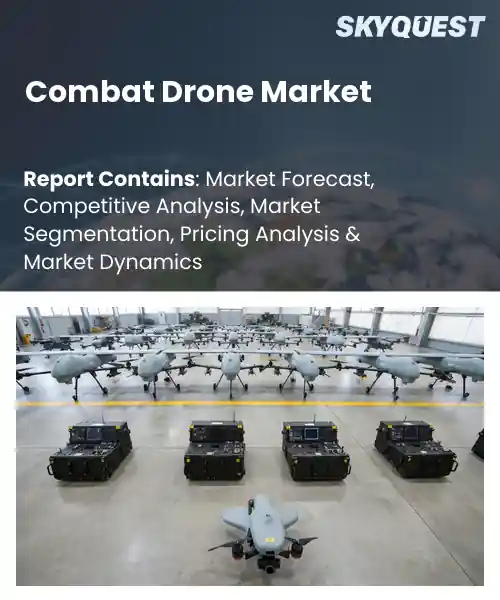
Combat Drone Market
Report ID: SQMIG20A2588
Report ID: SQMIG20A2588
[email protected]
USA +1 351-333-4748
Report ID:
SQMIG20A2588 |
Region:
Global |
Published Date: May, 2026
Pages:
157
|Tables:
184
|Figures:
79


Global Combat Drone Market size was valued at USD 13.79 Billion in 2024 and is poised to grow from USD 14.76 Billion in 2025 to USD 25.35 Billion by 2033, growing at a CAGR of 7.0% during the forecast period (2026-2033).
The primary driver of the combat drone market is the convergence of rapid technological innovation and changing military doctrine that emphasizes lower-risk, precision-enabled operations. The marketplace of unmanned aerial vehicles focuses on surveillance, target acquisition for armed engagement, reducing risk to human soldiers and increasing operational tempo and persistence. During the last 20 years these capabilities have evolved into armed combat systems capable of executing loitering munitions, as demonstrated by UAVs such as the MQ-9 Reaper and the Turkish Bayraktar TB2, which are both gaining prominence in major conflicts like those in Afghanistan and Nagorno-Karabakh. These two examples are also examples of how these new capabilities have altered procurement strategies and global trends in investment in the industrial base.
A key trend driving the global combat drone sector expansion is rapid progress in autonomy and artificial intelligence, producing tangible operational effects. As sensors, onboard processing and machine learning improve, systems can perform prolonged surveillance, autonomous navigation and assisted target recognition with fewer human operators, which lowers lifecycle costs and shortens training cycles. Consequently defense planners prioritize procurement of modular platforms and software ecosystems, creating demand for secure datalinks, mission payloads and analytics services. Real-world cases such as increased use of loitering munitions and coordinated small-drone attacks demonstrate how these capabilities open markets for suppliers, integration firms and counter-drone solutions globally too.
How is AI-enabled Autonomy Enhancing Combat Drone Mission Effectiveness?
AI enabled autonomy strengthens combat drone mission effectiveness by integrating onboard sensing, adaptive decision making, and mission level coordination. Key aspects include autonomous perception that filters sensor data, onboard route planning that shortens decision loops, and cooperative behaviors that permit resilient task sharing under contested communications. The current state mixes prototype demonstrations and operational experiments as defense programs and industry partners push for trusted autonomy within command and control architectures. Market interest is strong as primes and startups race to provide software centric solutions, and recent vendor and service tests show the technology moving from lab trials to field relevant demonstrations.
In February 2026, Shield AI demonstrated its Hivemind autonomy in flight tests, proving scalable mission autonomy integration. That advancement eases integration risk, reduces operator workload, and helps buyers adopt autonomous capabilities faster, supporting market growth and operational efficiency.
Market snapshot - (2026-2033)
Global Market Size
USD 13.79 Billion
Largest Segment
Fixed-wing Combat Drones
Fastest Growth
Loitering Munitions
Growth Rate
7.0% CAGR
To get more insights on this market click here to Request a Free Sample Report
Global combat drone market is segmented by drone type, range, payload type, application, end user, propulsion type and region. Based on drone type, the market is segmented into Fixed-wing Combat Drones, Rotary-wing Combat Drones, Hybrid Combat Drones, Loitering Munitions, Swarm Drones, Stealth Combat Drones and Others. Based on range, the market is segmented into Short-range Combat Drones, Medium-range Combat Drones and Long-range Combat Drones. Based on payload type, the market is segmented into Missile Payloads, Bomb Payloads, Electronic Warfare Payloads, ISR Payloads and Others. Based on application, the market is segmented into Intelligence, Surveillance & Reconnaissance, Target Acquisition, Combat Operations, Border Security, Electronic Warfare, Naval Operations and Others. Based on end user, the market is segmented into Defense Forces, Homeland Security Agencies, Special Operations Units, Border Patrol Agencies and Others. Based on propulsion type, the market is segmented into Electric-powered Combat Drones, Hybrid-powered Combat Drones and Fuel-powered Combat Drones. Based on region, the market is segmented into North America, Europe, Asia Pacific, Latin America and Middle East & Africa.
As per the global combat drone market growth, fixed-wing combat drones segment dominates because their efficient aerodynamics and high endurance enable sustained patrol and long range mission profiles that are central to contemporary combat drone doctrine. These platforms carry larger sensor and weapon loads and support resilient communication links, which drives their selection for persistent ISR and strike tasks and reinforces investment in integrated systems and operational concepts.
However, loitering munitions segment is emerging as the most rapidly expanding area in the combat drone market because lower system complexity and cost broaden adoption by tactical units. Their compact, expendable design enables rapid innovation and fielding, stimulating new procurement models and supplier investment that create fresh operational use cases and growth opportunities.
ISR payloads segment leads because advances in sensor miniaturization, multispectral imaging, and secure data links have made persistent situational awareness the foundation of modern combat drone employment. The timely delivery of actionable intelligence is responsible for transforming how we make targeting and maneuver decisions, giving rise to the procurement of modular sensor suites and integration of command networks, thereby broadening the scope of missions and relying on ISR capabilities.
Meanwhile, electronic warfare payloads segment is witnessing the strongest growth momentum as spectrum dominance becomes a core battlefield requirement, driving integration of compact jammers and cyber capable suites on drone platforms. Advances in software defined radios and modular EW kits enable quick capability upgrades, broaden mission sets, and attract focused investment and procurement activity.
To get detailed segments analysis, Request a Free Sample Report
Based on the global combat drone market share, North America dominates due to a deep, mature defense innovation ecosystem that blends advanced research institutions, large prime contractors, and an expansive supplier base. Combining the concepts, will lead to fast moving from design to operational deployment. The large number of testing facilities and training facilities available along with the ongoing industry government cooperation make this possible. The culture of systems integration and modularity provides a means to develop interoperability across multiple mission suites and also reduce dependency upon foreign material through strong domestic manufacturing and supply capabilities provide end to end sustainment. In addition, partnerships with allied countries further extend the reach of the markets and promote standardization of unmanned systems making North America a leader in these areas through their technology innovation.
Combat drone market in the United States is driven by deep integration between defense research institutions, major aerospace companies, and operational forces. Emphasis on advanced autonomy, sensor fusion, networked operations, and logistics support shapes procurement and development. Close collaboration across industry and government accelerates technology maturation, while a broad ecosystem of suppliers and testing infrastructure supports system deployment and sustainment across varied mission profiles and training hubs across domestic ranges.
Combat drone market in Canada reflects a focus on interoperable systems suited to maritime, arctic, and expeditionary missions. Adaptability and sustainability are crucial considerations in determining which platforms will be used. Industry and government partnerships are key to developing specialized vendors of components and experience in integration, as well as providing access to military installations for training, conducting cooperative testing, and coordinating with regulatory authorities to align with changing operating capabilities.
Based on global combat drone regional forecast, rapid expansion in Asia Pacific is propelled by intersecting strategic imperatives, industrial policy, and a dynamic technology ecosystem that together prioritize unmanned capability modernization. This has led to countries encouraging local manufacturing by funding research cooperatives with the potential of including joint venture arrangements, creating solutions in a particular area. The advances in sensors and autonomy are assisted by a robust electronics and semiconductor industry that supports the accelerated development of sensor technology and autonomous systems. The increasing capability maturity through interoperability with foreign partners, regulatory changes concerning testing and employment and training programs, will create an additional source of diversified suppliers that can respond to unique operational requirements in different regions of the world.
Combat drone market in Japan is shaped by an emphasis on precision, reliability, and systems integration for maritime and island defense roles. In order to adjust platforms to conform with local operational doctrine, domestic aerospace and electronics companies are developing technologies to promote autonomous navigation, secure communication, and miniaturized sensors in cooperation with defense agencies. To facilitate the development of supply chains and native production capabilities, supportive policy incentives and government/industry strategic partnerships exist to strengthen international interoperability with friends and allies.
Combat drone market in South Korea is propelled by vigorous indigenous development and close coordination between industrial conglomerates and specialized startups. Emphasis will be placed on advanced sensors, autonomous flight controls and missions with modular design for supporting peninsula defense and naval missions. Assistance from government to help with transferring technology and promoting exports will allow further development and collaboration worldwide. Education and training programs as well as dedicated test sites will aid in refining operational concepts and speeding up service readiness across the branches.
As per global combat drone regional outlook, Europe is strengthening its position through coordinated industrial strategies, collaborative research initiatives, and harmonized regulatory approaches that emphasize interoperability, certification, and responsible autonomy. Collaborative relationships between established aerospace manufacturers and new, more agile entrants into the marketplace are providing adaptable systems for the customers of these organizations. Pooled procurement and cross-border development may spread technical expertise and risk. While dual-use technology, supply chain resilience, and public-private partnerships play an increasing role in supporting competitive industrial capacity, a shared commitment to alliance standards, investment in testing infrastructure, and a pan-regional ethical framework will further strengthen both cooperative capability building and exportability throughout the continent.
Combat drone market in Germany benefits from a robust engineering base and established aerospace firms that drive platform-level innovation and systems integration. Reliable industrial supply chains and strict certifications create a basis for quality products and export readiness. Partnerships with Europe through collaboration and autonomy-focused secure communications and modular payloads provides adaptable mission capability solution options for land and maritime operations. Public procurement support will also help in developing overall capabilities.
Combat drone market in the United Kingdom is characterized by advanced research institutions collaborating with major defense primes to produce operationally mature unmanned systems. Emphasis on expeditionary capability, secure communications, and survivability informs design choices and procurement. Having good relationships with other alliance partners aids in working together on developing new products together and the setting of standards for interoperability. A large number of suppliers and test facilities that work together to provide a large supply chain and rapid iterations.
Combat drone market in France is driven by established aerospace capabilities and a concentration of specialized suppliers focused on sensors, avionics, and mission systems. Procurement and export public programs foster the industrial-scale growth of companies involved with land- and sea-based equipment manufacture and international collaboration in this area. Working with our European partners toward investment in research to develop autonomous systems is the basis for our ability to continue to improve our capabilities and to apply those capabilities across many operational environments.
To know more about the market opportunities by region and country, click here to
Buy The Complete Report
Advancements In Autonomy
Rising Defense Modernization Efforts
Regulatory and Legal Uncertainty
Technical Integration and Interoperability
Request Free Customization of this report to help us to meet your business objectives.
The competitive landscape is shaped by rapid field-proven innovation and urgent procurement needs, driving consolidation and strategic tie-ups among primes and startups. Companies pursue targeted M&A to secure manufacturing and composites capabilities, form cross-border partnerships to co-develop attack and counter-drone systems, and accelerate swarm and autonomy technologies to win fixed contracts; recent examples include Anduril’s tactical acquisition activity, Rheinmetall’s collaboration with U.S. innovators, and fast-scaling swarm entrants.
Top Player’s Company Profile
Recent Developments
SkyQuest’s ABIRAW (Advanced Business Intelligence, Research & Analysis Wing) is our Business Information Services team that Collects, Collates, Correlates, and Analyses the Data collected by means of Primary Exploratory Research backed by robust Secondary Desk research.
As per SkyQuest analysis, rapid advancements in autonomy and AI are a primary driver fueling the global combat drone industry by improving mission effectiveness, reducing operator workload and enabling longer, more capable missions, while rising defense modernization efforts act as a second driver by prioritizing networked, upgradeable platforms. However, regulatory and legal uncertainty remains a key restraint, complicating procurement, airspace integration and exportability. North America continues to dominate the global market thanks to its mature innovation ecosystem and integrated supply chains, and fixed-wing combat drones lead the market given their endurance, payload capacity and suitability for persistent ISR and strike roles.
| Report Metric | Details |
|---|---|
| Market size value in 2024 | USD 13.79 Billion |
| Market size value in 2033 | USD 25.35 Billion |
| Growth Rate | 7.0% |
| Base year | 2024 |
| Forecast period | (2026-2033) |
| Forecast Unit (Value) | USD Billion |
| Segments covered |
|
| Regions covered | North America (US, Canada), Europe (Germany, France, United Kingdom, Italy, Spain, Rest of Europe), Asia Pacific (China, India, Japan, Rest of Asia-Pacific), Latin America (Brazil, Rest of Latin America), Middle East & Africa (South Africa, GCC Countries, Rest of MEA) |
| Companies covered |
|
| Customization scope | Free report customization with purchase. Customization includes:-
|
To get a free trial access to our platform which is a one stop solution for all your data requirements for quicker decision making. This platform allows you to compare markets, competitors who are prominent in the market, and mega trends that are influencing the dynamics in the market. Also, get access to detailed SkyQuest exclusive matrix.
Table Of Content
Executive Summary
Market overview
Parent Market Analysis
Market overview
Market size
KEY MARKET INSIGHTS
COVID IMPACT
MARKET DYNAMICS & OUTLOOK
Market Size by Region
KEY COMPANY PROFILES
Methodology
For the Combat Drone Market, our research methodology involved a mixture of primary and secondary data sources. Key steps involved in the research process are listed below:
1. Information Procurement: This stage involved the procurement of Market data or related information via primary and secondary sources. The various secondary sources used included various company websites, annual reports, trade databases, and paid databases such as Hoover's, Bloomberg Business, Factiva, and Avention. Our team did 45 primary interactions Globally which included several stakeholders such as manufacturers, customers, key opinion leaders, etc. Overall, information procurement was one of the most extensive stages in our research process.
2. Information Analysis: This step involved triangulation of data through bottom-up and top-down approaches to estimate and validate the total size and future estimate of the Combat Drone Market.
3. Report Formulation: The final step entailed the placement of data points in appropriate Market spaces in an attempt to deduce viable conclusions.
4. Validation & Publishing: Validation is the most important step in the process. Validation & re-validation via an intricately designed process helped us finalize data points to be used for final calculations. The final Market estimates and forecasts were then aligned and sent to our panel of industry experts for validation of data. Once the validation was done the report was sent to our Quality Assurance team to ensure adherence to style guides, consistency & design.
Analyst Support
Customization Options
With the given market data, our dedicated team of analysts can offer you the following customization options are available for the Combat Drone Market:
Product Analysis: Product matrix, which offers a detailed comparison of the product portfolio of companies.
Regional Analysis: Further analysis of the Combat Drone Market for additional countries.
Competitive Analysis: Detailed analysis and profiling of additional Market players & comparative analysis of competitive products.
Go to Market Strategy: Find the high-growth channels to invest your marketing efforts and increase your customer base.
Innovation Mapping: Identify racial solutions and innovation, connected to deep ecosystems of innovators, start-ups, academics, and strategic partners.
Category Intelligence: Customized intelligence that is relevant to their supply Markets will enable them to make smarter sourcing decisions and improve their category management.
Public Company Transcript Analysis: To improve the investment performance by generating new alpha and making better-informed decisions.
Social Media Listening: To analyze the conversations and trends happening not just around your brand, but around your industry as a whole, and use those insights to make better Marketing decisions.
REQUEST FOR SAMPLE
 REQUEST FREE CUSTOMIZATION
Global Combat Drone Market size was valued at USD 13.79 Billion in 2024 and is poised to grow from USD 14.76 Billion in 2025 to USD 25.35 Billion by 2033, growing at a CAGR of 7.0% during the forecast period (2026-2033).
The competitive landscape is shaped by rapid field-proven innovation and urgent procurement needs, driving consolidation and strategic tie-ups among primes and startups. Companies pursue targeted M&A to secure manufacturing and composites capabilities, form cross-border partnerships to co-develop attack and counter-drone systems, and accelerate swarm and autonomy technologies to win fixed contracts; recent examples include Anduril’s tactical acquisition activity, Rheinmetall’s collaboration with U.S. innovators, and fast-scaling swarm entrants. 'General Atomics', 'Northrop Grumman', 'Lockheed Martin', 'Boeing', 'RTX Corporation', 'BAE Systems', 'Elbit Systems', 'Israel Aerospace Industries', 'Turkish Aerospace Industries', 'AeroVironment', 'Anduril Industries', 'Leonardo', 'Saab', 'Thales Group', 'Kratos Defense & Security Solutions', 'STM', 'China Aerospace Science and Technology Corporation', 'AVIC', 'Rostec', 'EDGE Group'
Advancements in autonomy have improved mission efficiency, enabling combat drones to undertake complex tasks with reduced operator workload. Improved onboard decision-making, sensor fusion, and path-planning allow sustained operations in contested environments while reducing human error and response latency. This capability expands potential use cases across reconnaissance, target acquisition, and precision engagement, increasing operational value to defense organizations. As autonomy frees personnel for higher-level tasks and lowers long-term manpower demands, procurement preference shifts toward platforms offering reliable automated functions, thus stimulating market demand.
Autonomous Systems Adoption: Defense organizations are accelerating deployment of increasingly capable autonomous combat drones that reduce manpower risk, enable persistent surveillance and allow forces to operate with greater agility. Emphasis on mission-level autonomy shifts platform design toward modular sensors and adaptable payloads, fostering iterative upgrades and rapid fielding. This trend encourages defense suppliers to prioritize software-defined architectures and mission orchestration tools, and drives partnerships between legacy manufacturers and technology firms focused on autonomy, creating new competitive dynamics and capability-based procurement priorities and opportunities.
Why does North America Dominate the Global Combat Drone Market? |@12


Want to customize this report? This report can be personalized according to your needs. Our analysts and industry experts will work directly with you to understand your requirements and provide you with customized data in a short amount of time. We offer $1000 worth of FREE customization at the time of purchase.
Feedback From Our Clients


 USA (+1) 351-333-4748

