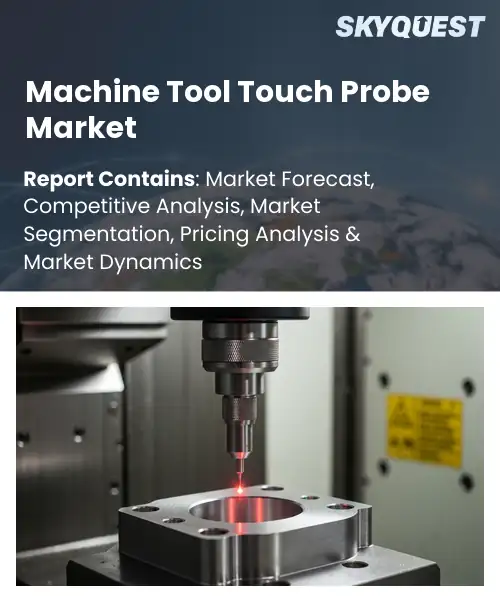
Machine Tool Touch Probe Market
Report ID: SQMIG45J2496
Report ID: SQMIG45J2496
[email protected]
USA +1 351-333-4748
Report ID:
SQMIG45J2496 |
Region:
Global |
Published Date: June, 2026
Pages:
157
|Tables:
179
|Figures:
79


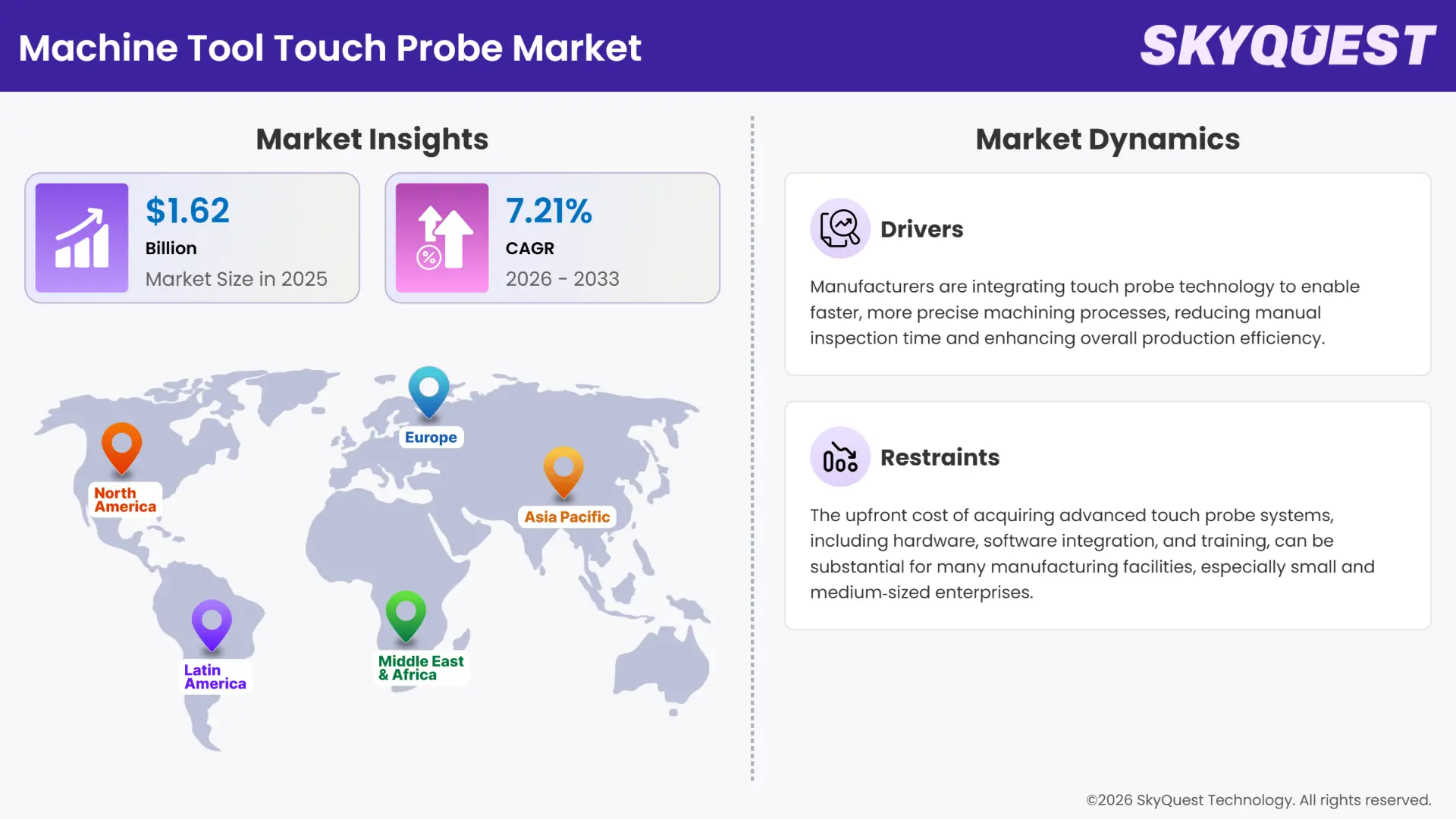
Global Machine Tool Touch Probe Market size was valued at USD 1.51 Billion in 2024 and is poised to grow from USD 1.62 Billion in 2025 to USD 2.83 Billion by 2033, growing at a CAGR of 7.21% during the forecast period (2026-2033).
Machine‑tool touch probes are precision sensors mounted on CNC lathes, mills or grinding centers that capture position data during machining, allowing real‑time dimensional verification without stopping production. Their relevance has grown with tighter tolerances demanded by aerospace, automotive and medical device parts, where a single deviation can trigger costly rework. The market originated in the 1990s as manufacturers shifted from manual coordinate‑measuring machines to integrated probing systems, with early adopters such as Siemens and Renishaw. In the last decade, the spread of Industry 4.0 platforms and the drive for automated quality control have turned probes from niche accessories into process components. The dominant growth factor is the surge in factory initiatives, which compel manufacturers to embed sensors that feed feedback to CNC controllers. As factories adopt maintenance and twins, touch probes become data nodes that convert physical geometry into actionable metrics, enabling path adjustments and reducing scrap rates. For instance, a German automotive supplier integrated probing cycles into its milling line, cutting inspection time by 60 % and freeing capacity for orders. This efficiency gain spurs demand for wireless probes, prompting vendors to invest in AI‑driven error‑correction algorithms and expand service networks, thereby creating a cycle of technology uptake and market expansion.
How is AI improving measurement accuracy in the machine tool touch probe market?
AI is reshaping how touch probes capture dimensional data by applying real time signal processing and predictive modeling that corrects for thermal drift and tool wear. Machine learning models learn the characteristic response of each probe and automatically adjust calibration settings, delivering tighter tolerances without manual intervention. This capability aligns with the broader shift toward smart manufacturing where precision and speed are critical. As manufacturers adopt more automated cells, the demand for probes that can maintain accuracy across varied operating conditions rises. The market therefore sees a surge in solutions that embed AI directly into the probe electronics and the surrounding CNC software, creating a feedback loop that continuously refines measurement quality.Persistence Market Research, August 2018, highlighted the rollout of AI enhanced probe units that self adjust during machining, a step that reduces setup time and improves repeatability. This innovation reinforces market growth by delivering faster, more reliable measurements for advanced manufacturing.
To get more insights on this market click here to Request a Free Sample Report
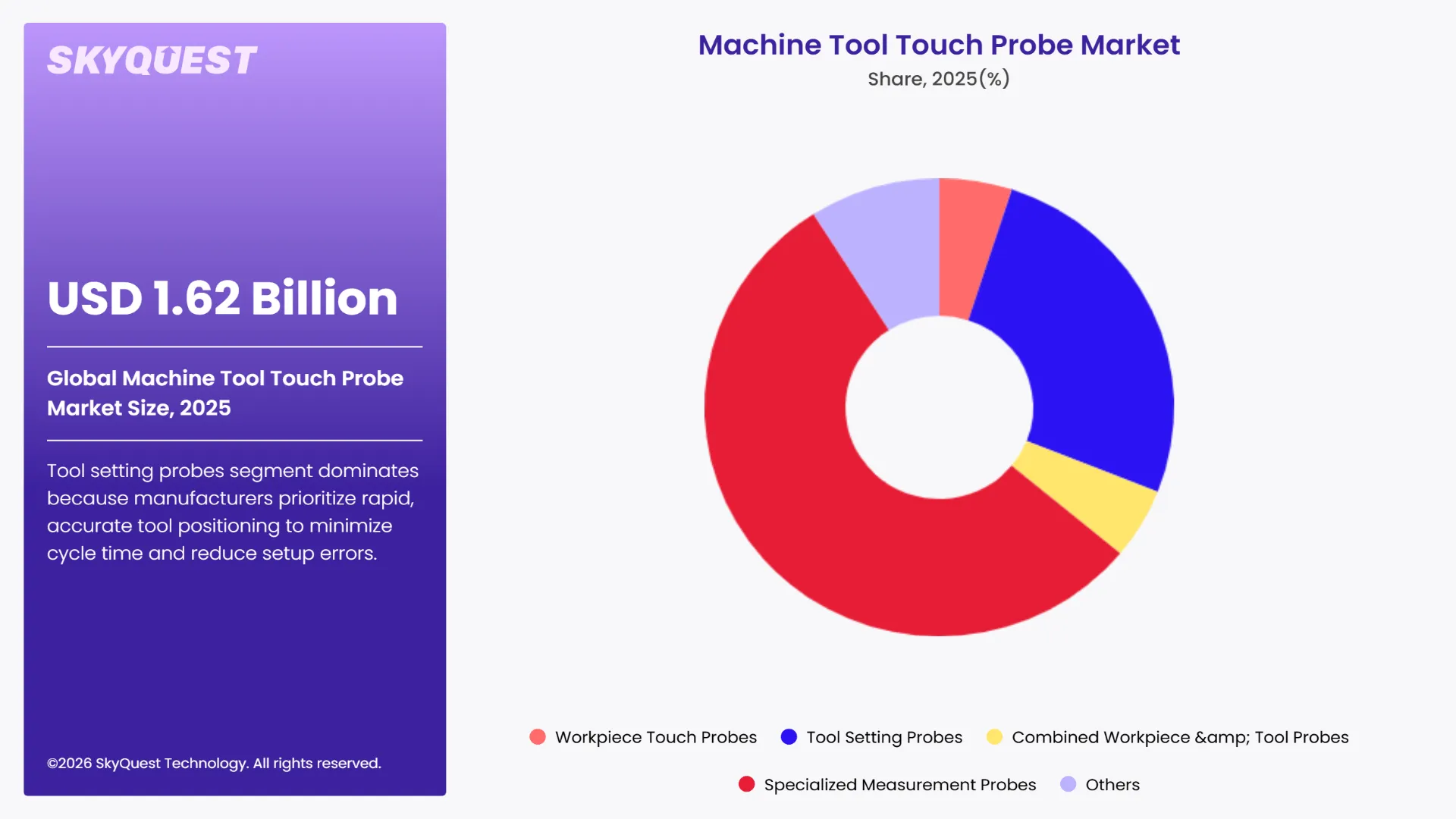
Global machine tool touch probe market is segmented by product type, transmission technology, machine type, application, end user, distribution channel and region. Based on product type, the market is segmented into Workpiece Touch Probes, Tool Setting Probes, Combined Workpiece & Tool Probes, Specialized Measurement Probes and Others. Based on transmission technology, the market is segmented into Optical Transmission, Radio Transmission and Wired Transmission. Based on machine type, the market is segmented into Machining Centers, CNC Milling Machines, CNC Turning Centers, Grinding Machines and Others. Based on application, the market is segmented into Workpiece Inspection & Measurement, Tool Setting & Calibration, Process Control & Automation, Quality Assurance and Others. Based on end user, the market is segmented into Automotive Manufacturing, Aerospace & Defense, General Machinery Manufacturing, Medical Device Manufacturing and Others. Based on distribution channel, the market is segmented into Direct Sales, Industrial Automation Distributors and Machine Tool OEMs. Based on region, the market is segmented into North America, Europe, Asia Pacific, Latin America and Middle East & Africa.
Tool setting probes segment dominates because manufacturers prioritize rapid, accurate tool positioning to minimize cycle time and reduce setup errors. Their ability to integrate directly with CNC controllers simplifies programming and enhances repeatability, meeting the high speed production demands of modern machining environments. This functional advantage aligns with industry focus on productivity and cost reduction, making tool setting probes the preferred choice for a broad range of machine tool operations.
However, specialized measurement probes are witnessing the strongest growth momentum as complex part geometries demand higher precision and multi axis capability. Advances in sensor miniaturization and AI driven data analytics enable these probes to capture detailed surface contours, expanding their use in aerospace, medical and high tech sectors and fueling new market opportunities.
Workpiece inspection & measurement application segment dominates because it directly addresses the core need for part conformity, ensuring that produced components meet strict dimensional tolerances. The increasing reliance on in process verification and real time feedback loops strengthens its relevance, while integration with quality management systems streamlines compliance and reduces scrap, positioning it as essential across diverse manufacturing settings. Moreover, the capability to quickly detect deviations supports lean initiatives and minimizes downtime, reinforcing its strategic importance for manufacturers seeking competitive advantage.
Meanwhile, process control & automation application emerges as the key high growth area as factories adopt Industry 4.0 architectures. Seamless integration of touch probes with IoT platforms enables continuous monitoring, predictive maintenance and closed loop adjustments, driving efficiency gains and reducing human intervention. This digital convergence accelerates adoption across high mix, low volume production lines, creating fresh revenue streams and expanding market breadth.
To get detailed segments analysis, Request a Free Sample Report
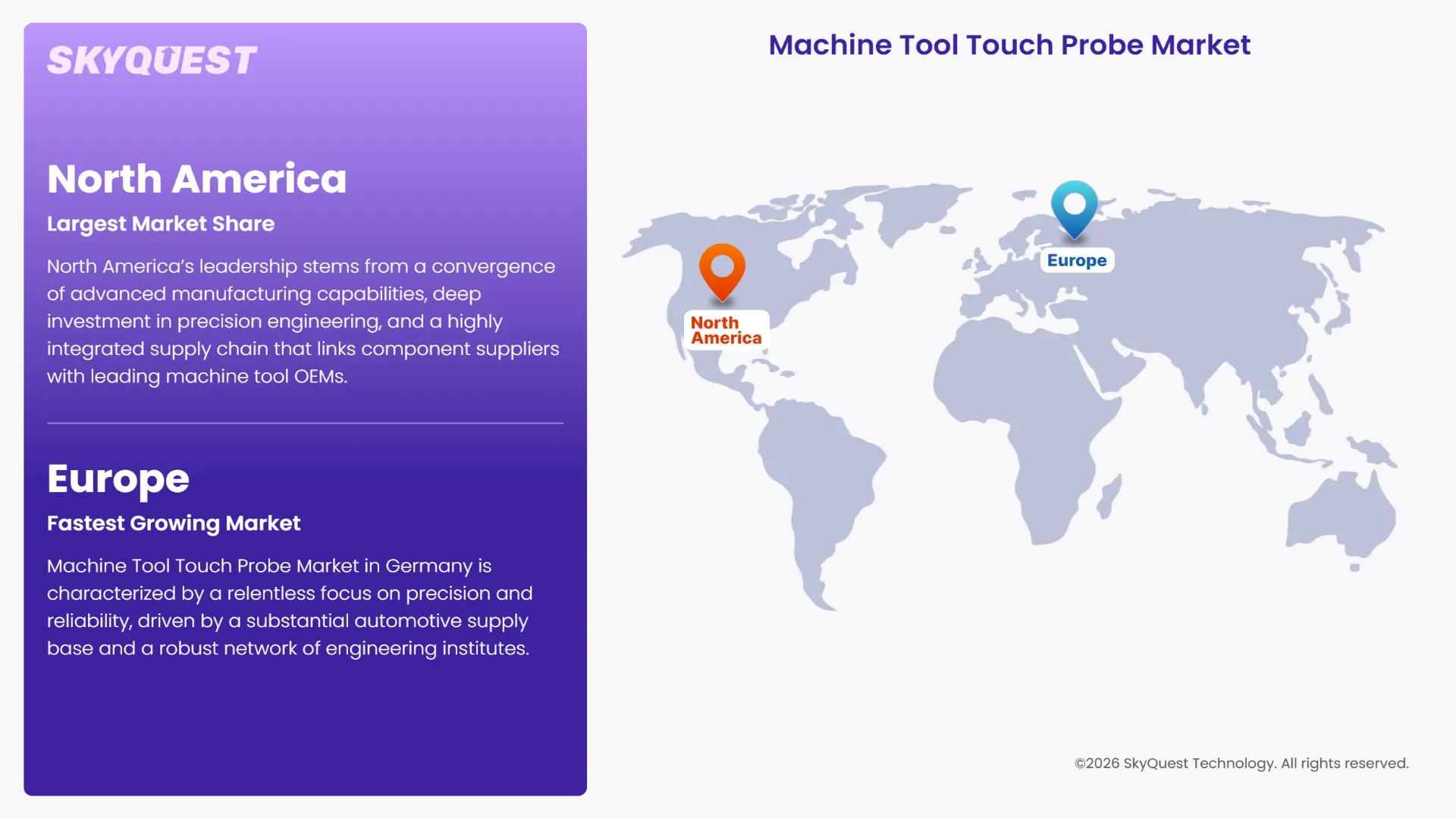
North America’s leadership stems from a convergence of advanced manufacturing capabilities, deep investment in precision engineering, and a highly integrated supply chain that links component suppliers with leading machine tool OEMs. The region benefits from a mature aerospace and defence sector that demands stringent measurement accuracy, while automotive and industrial equipment manufacturers pursue high‑speed automation. A skilled workforce combined with strong research collaborations accelerates adoption of next‑generation probe technologies. Supportive regulatory frameworks encourage innovation and facilitate rapid product qualification. Together these elements create an ecosystem where high‑performance touch probes become standard tools for improving productivity, quality control and digital connectivity across the manufacturing value chain.
Machine Tool Touch Probe Market in the United States thrives on extensive automation initiatives and a concentration of world‑class OEMs that integrate probes as core components of smart machining solutions. Close collaboration between research laboratories, technology providers and end users accelerates the rollout of high‑precision sensing capabilities. Emphasis on cybersecurity‑ready devices and open data architectures further strengthens adoption across aerospace, automotive and heavy equipment sectors.
Machine Tool Touch Probe Market in Canada is propelled by a strong precision engineering niche that serves aerospace, medical device and renewable energy manufacturers. Emphasis on reliability and compliance with rigorous environmental standards drives preference for robust probe technologies. Collaborative programs linking Canadian suppliers with North American OEMs enhance technology transfer and foster a resilient supply chain that supports steady growth in advanced machining applications.
Europe’s rapid expansion is underpinned by a tradition of engineering excellence, harmonized standards and a collaborative ecosystem that encourages cross‑border innovation. Heavy investment in digital manufacturing initiatives enables seamless integration of touch probes with adaptive control systems, boosting productivity in automotive, aerospace and renewable energy sectors. A dense network of mid‑size manufacturers leverages shared research facilities to accelerate development of high‑accuracy sensing solutions. Policy frameworks that promote sustainability and circular economy principles further stimulate demand for precise measurement tools that reduce waste and improve product quality. Together these factors position Europe as a vibrant hub where advanced probe technology fuels competitive advantage across diverse industrial segments.
Machine Tool Touch Probe Market in Germany is characterized by a relentless focus on precision and reliability, driven by a substantial automotive supply base and a robust network of engineering institutes. German manufacturers prioritize integration of probes with smart factory platforms, enabling real‑time monitoring and adaptive machining. Strong collaboration between machine tool builders and component specialists fosters continuous refinement of probe performance, reinforcing the country’s reputation for high‑quality manufacturing solutions.
Machine Tool Touch Probe Market in the United Kingdom is experiencing accelerated growth as national initiatives champion advanced manufacturing hubs and digital transformation. The sector benefits from a thriving aerospace and defence community that demands sophisticated measurement capabilities. Growing investment in data‑driven production systems encourages adoption of probes that deliver high resolution and rapid feedback. Collaborative research projects between universities and industry accelerate innovation, positioning the United Kingdom as a fast‑moving market for next‑generation probing solutions.
Machine Tool Touch Probe Market in France is emerging as a dynamic arena supported by expanding aerospace programs and a rising focus on cost‑effective precision tooling. French manufacturers emphasize modular probe designs that align with flexible production lines and sustainability objectives. Government incentives for high‑tech industrial development stimulate partnerships between technology providers and regional clusters. This environment nurtures the adoption of advanced touch probes that enhance quality assurance while supporting the country’s broader ambition to strengthen its manufacturing competitiveness.
Asia Pacific is strengthening its position through a blend of rapid industrialization, strategic governmental support and a pronounced emphasis on cost‑efficient high‑precision manufacturing. Nations across the region are investing heavily in smart factory initiatives that embed touch probes within automated CNC environments, elevating both speed and accuracy. The surge in demand from electronics, automotive and semiconductor sectors fuels the need for compact, high‑resolution sensing devices. Local manufacturers are scaling capabilities to deliver indigenous probe solutions, reducing reliance on imports and fostering supply chain resilience. Coupled with a growing talent pool focused on digital engineering, these dynamics amplify the region’s role as a pivotal contributor to the evolution of touch probe technology.
Machine Tool Touch Probe Market in Japan is driven by an unwavering commitment to ultra‑high precision and seamless integration with sophisticated robotics and CNC platforms. Japanese manufacturers value probes that deliver exceptional repeatability and can be incorporated into tightly controlled production cells. Strong ties between industrial firms and research institutions accelerate the development of sensor technologies that support real‑time adaptive machining. The focus on quality assurance and lean production reinforces demand for highly reliable probing solutions that sustain the nation’s reputation for meticulous engineering.
Machine Tool Touch Probe Market in South Korea is propelled by the country’s dominant semiconductor and display manufacturing sectors, which require minute measurement accuracy at high volumes. Emphasis on automation and smart factory adoption drives the integration of high‑speed probes that can keep pace with rapid production cycles. Collaborative innovation between large conglomerates and specialized sensor firms yields compact, high‑frequency probing devices tailored for dense circuit and panel fabrication. Government programs that champion Industry 4.0 further encourage investment in advanced probe technologies, solidifying South Korea’s role as a leading adopter in the region.
To know more about the market opportunities by region and country, click here to
Buy The Complete Report
Increasing Automation In Manufacturing
Advancements In Sensor Accuracy
High Initial Capital Investment
Complex Integration With Legacy Systems
Request Free Customization of this report to help us to meet your business objectives.
The Global Machine Tool Touch Probe market is shaped by intense rivalry among established sensor manufacturers and CNC system providers, each seeking to capture growth from the accelerating adoption of automated machining. Competitive pressure is driven by demand for higher precision and faster cycle times, prompting firms to pursue technology integration and portfolio expansion to differentiate their offerings.
Top Player’s Company Profile
Recent Developments
SkyQuest’s ABIRAW (Advanced Business Intelligence, Research & Analysis Wing) is our Business Information Services team that Collects, Collates, Correlates, and Analyses the Data collected by means of Primary Exploratory Research backed by robust Secondary Desk research. As per SkyQuest analysis the global machine‑tool touch probe market is set to expand at a 7.2 % CAGR through 2033, propelled primarily by increasing automation in manufacturing which embeds probes into CNC workflows to cut inspection time and improve yield. A second strong engine is the rapid advancement in sensor accuracy that delivers tighter tolerances and reduces rework. The market is still hampered by the high initial capital investment required for advanced probe systems, especially for smaller plants. North America remains the dominant region thanks to its mature aerospace, automotive and OEM ecosystem, while tool‑setting probes hold the largest share of product‑type sales owing to their essential role in rapid, accurate tool positioning.
| Report Metric | Details |
|---|---|
| Market size value in 2024 | USD 1.51 Billion |
| Market size value in 2033 | USD 2.83 Billion |
| Growth Rate | 7.21% |
| Base year | 2024 |
| Forecast period | (2026-2033) |
| Forecast Unit (Value) | USD Billion |
| Segments covered |
|
| Regions covered | North America (US, Canada), Europe (Germany, France, United Kingdom, Italy, Spain, Rest of Europe), Asia Pacific (China, India, Japan, Rest of Asia-Pacific), Latin America (Brazil, Rest of Latin America), Middle East & Africa (South Africa, GCC Countries, Rest of MEA) |
| Companies covered |
|
| Customization scope | Free report customization with purchase. Customization includes:-
|
To get a free trial access to our platform which is a one stop solution for all your data requirements for quicker decision making. This platform allows you to compare markets, competitors who are prominent in the market, and mega trends that are influencing the dynamics in the market. Also, get access to detailed SkyQuest exclusive matrix.
Table Of Content
Executive Summary
Market overview
Parent Market Analysis
Market overview
Market size
KEY MARKET INSIGHTS
COVID IMPACT
MARKET DYNAMICS & OUTLOOK
Market Size by Region
KEY COMPANY PROFILES
Methodology
For the Machine Tool Touch Probe Market, our research methodology involved a mixture of primary and secondary data sources. Key steps involved in the research process are listed below:
1. Information Procurement: This stage involved the procurement of Market data or related information via primary and secondary sources. The various secondary sources used included various company websites, annual reports, trade databases, and paid databases such as Hoover's, Bloomberg Business, Factiva, and Avention. Our team did 45 primary interactions Globally which included several stakeholders such as manufacturers, customers, key opinion leaders, etc. Overall, information procurement was one of the most extensive stages in our research process.
2. Information Analysis: This step involved triangulation of data through bottom-up and top-down approaches to estimate and validate the total size and future estimate of the Machine Tool Touch Probe Market.
3. Report Formulation: The final step entailed the placement of data points in appropriate Market spaces in an attempt to deduce viable conclusions.
4. Validation & Publishing: Validation is the most important step in the process. Validation & re-validation via an intricately designed process helped us finalize data points to be used for final calculations. The final Market estimates and forecasts were then aligned and sent to our panel of industry experts for validation of data. Once the validation was done the report was sent to our Quality Assurance team to ensure adherence to style guides, consistency & design.
Analyst Support
Customization Options
With the given market data, our dedicated team of analysts can offer you the following customization options are available for the Machine Tool Touch Probe Market:
Product Analysis: Product matrix, which offers a detailed comparison of the product portfolio of companies.
Regional Analysis: Further analysis of the Machine Tool Touch Probe Market for additional countries.
Competitive Analysis: Detailed analysis and profiling of additional Market players & comparative analysis of competitive products.
Go to Market Strategy: Find the high-growth channels to invest your marketing efforts and increase your customer base.
Innovation Mapping: Identify racial solutions and innovation, connected to deep ecosystems of innovators, start-ups, academics, and strategic partners.
Category Intelligence: Customized intelligence that is relevant to their supply Markets will enable them to make smarter sourcing decisions and improve their category management.
Public Company Transcript Analysis: To improve the investment performance by generating new alpha and making better-informed decisions.
Social Media Listening: To analyze the conversations and trends happening not just around your brand, but around your industry as a whole, and use those insights to make better Marketing decisions.
REQUEST FOR SAMPLE
 REQUEST FREE CUSTOMIZATION
Global Machine Tool Touch Probe Market size was valued at USD 1.51 Billion in 2024 and is poised to grow from USD 1.62 Billion in 2025 to USD 2.83 Billion by 2033, growing at a CAGR of 7.21% during the forecast period (2026-2033).
The Global Machine Tool Touch Probe market is shaped by intense rivalry among established sensor manufacturers and CNC system providers, each seeking to capture growth from the accelerating adoption of automated machining. Competitive pressure is driven by demand for higher precision and faster cycle times, prompting firms to pursue technology integration and portfolio expansion to differentiate their offerings. 'Renishaw plc', 'Blum-Novotest GmbH', 'Marposs S.p.A.', 'Hexagon AB', 'HEIDENHAIN Corporation', 'Mitutoyo Corporation', 'Mahr GmbH', 'Metrol Co., Ltd.', 'Mecatronica Micromec S.r.l.', 'Tschorn GmbH', 'KOMEG Industrietechnik GmbH', 'Pioneer CNC Technology', 'Centroid CNC', 'Quality Vision International Inc.', 'Tokyo Seimitsu Co., Ltd.', 'ZEISS Industrial Quality Solutions', 'OGP (Optical Gaging Products)', 'Haff & Schneider GmbH', 'In-Process Measurement, LLC', 'MPM Micro Präzision Marx GmbH'
Manufacturers are integrating touch probe technology to enable faster, more precise machining processes, reducing manual inspection time and enhancing overall production efficiency. This automation supports consistent product quality and allows for complex part geometries to be measured without extensive rework. As factories adopt smart manufacturing principles, the demand for reliable, real‑time measurement solutions grows, encouraging equipment suppliers to expand their touch probe offerings and drive market expansion through continuous innovation and improved workflow integration in increasingly competitive global supply chains.
Smart Integration Of Probing Systems: Manufacturers are embedding probe data directly into CAD‑CAM environments, enabling real‑time geometry validation and adaptive machining without manual transfer. This seamless flow reduces inspection cycles, enhances first‑pass yield, and supports collaborative design loops across distributed engineering teams. As software platforms standardize open APIs, operators can configure probing parameters on the shop floor with intuitive interfaces, fostering greater flexibility and rapid response to product‑mix changes while maintaining tight tolerance control throughout production and ensuring consistent quality standards across all units globally.
Why does North America Dominate the Global Machine Tool Touch Probe Market? |@12


Want to customize this report? This report can be personalized according to your needs. Our analysts and industry experts will work directly with you to understand your requirements and provide you with customized data in a short amount of time. We offer $1000 worth of FREE customization at the time of purchase.
Feedback From Our Clients


 USA (+1) 351-333-4748

