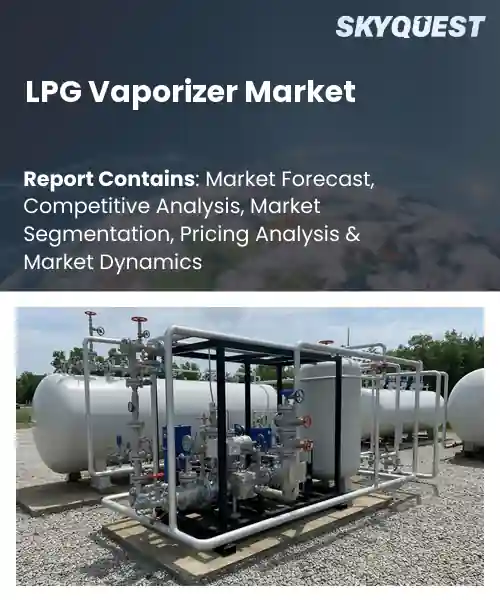
LPG Vaporizer Market
Report ID: SQMIG20B2170
Report ID: SQMIG20B2170
[email protected]
USA +1 351-333-4748
Report ID:
SQMIG20B2170 |
Region:
Global |
Published Date: June, 2026
Pages:
157
|Tables:
153
|Figures:
78


Global Lpg Vaporizer Market size was valued at USD 2.1 Billion in 2024 and is poised to grow from USD 2.15 Billion in 2025 to USD 2.65 Billion by 2033, growing at a CAGR of 2.6% during the forecast period (2026-2033).
The LPG vaporizer market is basically about equipment that turns liquefied petroleum gas into a gas form, for industrial, commercial, and residential use, and the main pull behind it is the growing need for sturdy energy infrastructure in places that are drifting away from centralized natural gas pipelines. People also care because vaporizers make fuel delivery safer and more efficient, whether that’s for power generation, chemical workflows and even winter heating. Over time, what used to be simple coil style units and ambient-air setups, has shifted toward electric and hybrid configurations, with digital controls baked in, so the whole thing runs smoother and more consistently. For instance, LNG import terminals, far-off mining camps, and food processing facilities now commonly deploy packaged vaporizer systems, to boost safety, uptime, and day to day operational reliability.
A major factor driving the global LPG vaporizer market growth is regulatory pressure on safety, and that pushes buyers toward certified electric or hybrid packaged units, especially those with monitoring features. Since tougher codes increase liability around gas handling, firms tend to swap out improvised, or older vaporizers, to cut down leak exposure and unexpected stoppages. That naturally drives retrofit work, for hospitals, data centers, and offshore installations. As a result, manufacturers are putting more effort into digital control schemes, skid-mounted modular platforms, and aftermarket services. This also creates openings for rental fleets, predictive maintenance agreements, and cross-overs with heat trace systems, which makes deployment easier and can reduce total cost of ownership, while still supporting broader decarbonization targets globally.
IoT is changing safety monitoring for LPG vaporizers by linking sensor clusters with constant connectivity, then layering cloud analytics on top. The key pieces are ongoing leak and pressure sensing, temperature tracking, plus real time alerting that routes alarms directly to operators. Instead of relying on periodic manual checks, the market is moving toward remote condition monitoring, so teams can initiate faster shutdowns and schedule preventive work in a predictive way that helps avoid incidents and cuts downtime. This matters even more for distributed sites and remote vaporizer locations, where intrinsic safety certified telemetry and networked gas detectors help meet compliance requirements, while giving better asset visibility and lowering operational risk.
Market snapshot - 2026-2033
Global Market Size
USD 2.1 Billion
Largest Segment
Water Bath Vaporizers
Fastest Growth
Electric Vaporizers
Growth Rate
2.6% CAGR
To get more insights on this market click here to Request a Free Sample Report
The global lpg vaporizer market is segmented by roduct type, capacity, application, end user, installation type and region. Based on roduct type, the market is segmented into Electric Vaporizers, Water Bath Vaporizers, Steam Vaporizers, Direct-Fired Vaporizers, Ambient Air Vaporizers and Others. Based on capacity, the market is segmented into Small Capacity Vaporizers, Medium Capacity Vaporizers and Large Capacity Vaporizers. Based on application, the market is segmented into Industrial Heating, Metal Processing, Food Processing, Chemical & Petrochemical Plants, Commercial Buildings, Power Generation, Agriculture and Others. Based on end user, the market is segmented into Industrial, Commercial, Utilities & Energy, Agriculture and Others. Based on installation type, the market is segmented into Fixed Installation and Portable Installation. Based on region, the market is segmented into North America, Europe, Asia Pacific, Latin America and Middle East & Africa.
As per the LPG vaporizer market analysis, the Electric Vaporizers segment dominates, because electric units are able to deliver very precise temperature regulation and that consistent vapor quality, which is needed across key LPG use cases. Their day to day operational predictability cuts down on safety risks and it also makes automation simpler, so industrial and commercial buyers get pulled in fast. This all matches with stricter expectations around emissions and safety, plus it is easier to plug into control systems, and lifecycle costs stay predictable, so adoption becomes more natural and procurement ends up steadier in the market.
But then, Direct Fired Vaporizers are the most rapidly expanding type, like operators really like their simplicity and high heat output, especially for larger scale sites and remote installations. There is less upfront complexity, compatibility with heavy duty operations feels smoother, and the robustness is already proven so deployments move quicker. Fuel versatility and rapid vaporization capacity, gives immediate operational value, and that tends to open up more retrofit prospects and new build efforts too.
According to the LPG vaporizer market forecast, the Chemical & Petrochemical Plants segment dominate, largely because these facilities need continuous and high reliability vaporization to keep sensitive downstream processes stable. They also need feedstock consistency, and that becomes the bigger priority. Since uninterrupted operations matter a lot, plus the safety rules are strict, and integration with process controls is non negotiable, buyers lean toward vaporizers with proven lifecycle performance. This concentrated purchasing for industrial continuity and regulatory compliance nudges vendors to invest in more rugged designs, stronger service networks, and more engineered customization, even when projects vary a bit.
Meanwhile, power generation is emerging as the fastest growing application area, because the whole grid balancing challenge is growing, and LPG adoption as a flexible backup fuel pushes demand for reliable vaporizers. Utility interest in modular solutions is a clear driver, and regulatory focus on fuel security adds momentum. There are also chances to pair vaporizers with distributed generation projects, and that expands both aftermarket activity and system integration opportunities, at a steady pace.
To get detailed segments analysis, Request a Free Sample Report
As per the LPG vaporizer market regional forecast, Asia Pacific dominance comes from this mix, of steady industrial activity, a few very focused demand hotspots, and sophisticated engineering ecosystems that push faster adoption of LPG vaporizer technologies. Strong commercial as well as residential consumption trends in select economies keep the pressure on for dependable vaporization solutions, and then the huge port and logistics setups help the supply chain move smoothly, plus they make equipment deployment easier. Local know-how in precise component production and systems integration also helps keep equipment pricing competitive, and it strengthens service coverage. On top of that, regulators are really leaning into energy security and reducing more polluting fuels, so the shift toward LPG uses keeps pulling demand. And have these working relationships between technology providers and big industrial buyers , they speed up customization for local conditions which cements leadership in innovation, maintenance, and longer lifecycle support for vaporizer installs. Finally, broad after sales networks and training support make the whole market feel more stable, and customer confidence goes up too.
Japan LPG Vaporizer Market
The LPG Vaporizer sector in Japan is defined by high engineering discipline, tough safety expectations, and demand for compact, high dependability solutions for both urban and industrial premises. There is a strong local OEM footprint, plus specialization in precision manufacturing, so vaporizer designs get tailored and service offerings stay more complete. The market really likes system integration, quality assurance, and long term upkeep partnerships, so it leans toward tried and tested technologies and teams that can respond quickly with after sales help across the country.
South Korea LPG Vaporizer Market
The LPG Vaporizer industry in South Korea is pushed by advanced industrial end users, a preference for compact modular setups, and strong demand from marine plus heavy industrial sectors. Local engineering companies tend to highlight customization, quick commissioning, and tight integration with automation controls. Suppliers compete heavily on technical backing, mechanical toughness, and how easy it is to maintain, while partnerships between manufacturers and end users keep feeding improvements. That cooperation also broadens after sales service coverage across different regional networks.
Rapid LPG vaporizer market penetration in North America seems driven by infrastructural renewal, varied end use requirements, and serious industry investment that favors reliable vaporization solutions. When older assets get replaced, and distribution networks expand, safety becomes a bigger priority, along with automation and remote monitoring features. Industrial and commercial customers also tend to value uninterrupted operations and flexible fuel supply options. The region has a mature supplier base, plus maintenance and aftermarket capabilities, and overall standards are fairly structured , which helps adoption of more advanced vaporizers and integrated systems. When equipment manufacturers coordinate closely with utilities, they can tailor solutions for different climatic realities and operational needs, which strengthens market depth. It also supports service forward business models, and helps these offerings stay competitive. On top of that, more money goes into workforce training and rental style service programs so advanced units are easier to access. Supply chain partners and compliance support also help ensure rollouts happen reliably.
United States LPG Vaporizer Market
LPG Vaporizer Market in United States is influenced by diverse climatic bands, large industrial facilities, and strong regulatory focus on safety along with emissions management. Buyers usually lean toward scalable, high throughput solutions with advanced controls and remote monitoring. A developed aftermarket and rental ecosystem helps deploy quickly and keep things running, while close coordination between vendors and utility plus industrial clients supports specification led procurement. It also boosts innovation in system integration for different operating setups.
Canada LPG Vaporizer Market
LPG Vaporizer Market in Canada highlights resilience for cold conditions, reliability for remote operations, and steady demand from energy and industrial users. Suppliers concentrate on dependable thermal management, modular design approaches, and serviceability when sites are dispersed. Regulatory attention on safety and transport compatibility guides how equipment is selected, and local service networks together with engineering partners help shape customized approaches. The goal is to protect uptime, keep maintenance practical, and stay aligned with operational compliance requirements effectively across regional differences.
Europe is tightening up its position in the market by mixing regulatory harmonization, a clear push on safety and technical rules, and some focused industrial modernization that really lifts the need for efficient vaporization equipment. There’s also this ongoing investment into reworking older infrastructure and improving system controls, which nudges companies to choose advanced vaporizers that have better automation, plus more monitoring. On top of that, cooperation between manufacturers, certification organizations, and energy providers supports compatibility, and helps products get accepted faster… even across different regions. Regional engineering know how also helps with customization for industrial and maritime scenarios, while aftermarket and service frameworks make the lifecycle value feel stronger. Cross border supply chains and innovation that’s more targeted toward what already works, make scaling feel achievable, and enable quicker reaction to different application needs across multiple European markets. And local training programs plus certification routes improve installation quality and day to day operational safety. Finally, the growing attention to digitalization, and predictive maintenance, differentiates the offers even more and helps deployments expand across markets quicker.
Germany LPG Vaporizer Market
In Germany, the LPG Vaporizer Market is supported by solid engineering strengths, strict technical standards, and a close match with industrial manufacturing needs. Vendors tend to highlight precision work, durable material choices, and smooth system integration, especially for heavy industry and maritime use. Demand hubs are into certified setups, lots of testing steps, and long term service agreements that don’t fall apart later on. There’s also a ongoing relationship between manufacturers and research institutions, which helps with continued product upgrades and adaptation to those strict operational and safety expectations that are common in industrial environments.
United Kingdom LPG Vaporizer Market
The LPG Vaporizer Market in the United Kingdom mixes a longstanding maritime culture with a range of industrial demand, and an emphasis on meeting tough safety plus environmental requirements. Suppliers usually lean toward flexible designs that stay compact, so they fit sites with limited space, including port operations. They also bring advanced control capabilities, not just basic functionality. Aftermarket service networks, and integrated solutions for fuel handling and monitoring, become real differentiators, while partnerships with service providers help speed up customization and ensure compliance with technical requirements that are specific to each sector, effectively.
France LPG Vaporizer Market
For France, the LPG Vaporizer Market sits at the intersection of industrial modernization and maritime activity, with a noticeable focus on energy efficiency and safety standards. Suppliers concentrate on vaporizer units that can adapt, and that slot into wider fuel systems along with emissions controls. Strong engineering services and local certification paths build confidence in equipment decisions. Meanwhile, maintenance providers and regional distributors back tailored solutions that actually match the operational demands in urban areas, industrial zones, and also coastal use cases, with less friction and more continuity.
To know more about the market opportunities by region and country, click here to
Buy The Complete Report
Increasing Industrial Demand
Expansion Of Off Grid Applications
Stringent Safety Regulations
Variability In Feedstock Availability
Request Free Customization of this report to help us to meet your business objectives.
Competitive pressures in the global LPG vaporizer market keep circling around cost efficient modular systems and low carbon fuel readiness, so there’s this push toward M&A, odd partnerships, and nonstop product innovation. Like, Chart Industries did some big service acquisitions to widen their gas equipment services, SHV Energy teamed up with Futuria Fuels alongside Furukawa and Astomos for bioLPG, and Kagla rolled out an compact electric ADX vaporizer, as a technical breakthrough.
Top Player’s Company Profile
Recent Developments in the LPG Vaporizer Market
SkyQuest’s ABIRAW (Advanced Business Intelligence, Research & Analysis Wing) is our Business Information Services team that Collects, Collates, Correlates, and Analyses the Data collected by means of Primary Exploratory Research backed by robust Secondary Desk research.
As per SkyQuest analysis, overall, the global LPG vaporizer market is being pushed forward by rising industrial demand for dependable decentralized fuel delivery, while the expansion of off grid applications acts like a second major driver, since remote sites need robust vaporization. Electric vaporizers show up more often in the product lineup because they provide precise temperature control and can be paired with automation. Asia Pacific still leads the region because of strong industrial activity and local manufacturing strength. At the same time, market expansion is slowed by strict safety rules, which boost certification and installation expenses. That pressure makes vendors lean into modular, monitored systems ,and also invest in aftermarket services so they can stay compliant and meet operational reliability expectations
| Report Metric | Details |
|---|---|
| Market size value in 2024 | USD 2.1 Billion |
| Market size value in 2033 | USD 2.65 Billion |
| Growth Rate | 2.6% |
| Base year | 2024 |
| Forecast period | 2026-2033 |
| Forecast Unit (Value) | USD Billion |
| Segments covered |
|
| Regions covered | North America (US, Canada), Europe (Germany, France, United Kingdom, Italy, Spain, Rest of Europe), Asia Pacific (China, India, Japan, Rest of Asia-Pacific), Latin America (Brazil, Rest of Latin America), Middle East & Africa (South Africa, GCC Countries, Rest of MEA) |
| Companies covered |
|
| Customization scope | Free report customization with purchase. Customization includes:-
|
To get a free trial access to our platform which is a one stop solution for all your data requirements for quicker decision making. This platform allows you to compare markets, competitors who are prominent in the market, and mega trends that are influencing the dynamics in the market. Also, get access to detailed SkyQuest exclusive matrix.
Table Of Content
Executive Summary
Market overview
Parent Market Analysis
Market overview
Market size
KEY MARKET INSIGHTS
COVID IMPACT
MARKET DYNAMICS & OUTLOOK
Market Size by Region
KEY COMPANY PROFILES
Methodology
For the LPG Vaporizer Market, our research methodology involved a mixture of primary and secondary data sources. Key steps involved in the research process are listed below:
1. Information Procurement: This stage involved the procurement of Market data or related information via primary and secondary sources. The various secondary sources used included various company websites, annual reports, trade databases, and paid databases such as Hoover's, Bloomberg Business, Factiva, and Avention. Our team did 45 primary interactions Globally which included several stakeholders such as manufacturers, customers, key opinion leaders, etc. Overall, information procurement was one of the most extensive stages in our research process.
2. Information Analysis: This step involved triangulation of data through bottom-up and top-down approaches to estimate and validate the total size and future estimate of the LPG Vaporizer Market.
3. Report Formulation: The final step entailed the placement of data points in appropriate Market spaces in an attempt to deduce viable conclusions.
4. Validation & Publishing: Validation is the most important step in the process. Validation & re-validation via an intricately designed process helped us finalize data points to be used for final calculations. The final Market estimates and forecasts were then aligned and sent to our panel of industry experts for validation of data. Once the validation was done the report was sent to our Quality Assurance team to ensure adherence to style guides, consistency & design.
Analyst Support
Customization Options
With the given market data, our dedicated team of analysts can offer you the following customization options are available for the LPG Vaporizer Market:
Product Analysis: Product matrix, which offers a detailed comparison of the product portfolio of companies.
Regional Analysis: Further analysis of the LPG Vaporizer Market for additional countries.
Competitive Analysis: Detailed analysis and profiling of additional Market players & comparative analysis of competitive products.
Go to Market Strategy: Find the high-growth channels to invest your marketing efforts and increase your customer base.
Innovation Mapping: Identify racial solutions and innovation, connected to deep ecosystems of innovators, start-ups, academics, and strategic partners.
Category Intelligence: Customized intelligence that is relevant to their supply Markets will enable them to make smarter sourcing decisions and improve their category management.
Public Company Transcript Analysis: To improve the investment performance by generating new alpha and making better-informed decisions.
Social Media Listening: To analyze the conversations and trends happening not just around your brand, but around your industry as a whole, and use those insights to make better Marketing decisions.
REQUEST FOR SAMPLE
 REQUEST FREE CUSTOMIZATION
Global Lpg Vaporizer Market size was valued at USD 2.1 Billion in 2024 and is poised to grow from USD 2.15 Billion in 2025 to USD 2.65 Billion by 2033, growing at a CAGR of 2.6% during the forecast period (2026-2033).
Competitive pressures in the global LPG vaporizer market center on cost efficient modular systems and low carbon fuel readiness, driving M&A, partnerships, and product innovation. Recent examples include large service acquisitions by Chart Industries to broaden gas equipment services, SHV Energy’s Futuria Fuels partnership with Furukawa and Astomos on bioLPG, and Kagla’s compact electric ADX vaporizer launch as a technical innovation. 'Ransome Manufacturing', 'Algas-SDI International LLC', 'Pegoraro Gas Technologies S.r.l.', 'FAS Flüssiggas-Anlagen GmbH', 'ADCENG Gas Equipment Pty Ltd', 'Kosan Crisplant A/S', 'Meeder Equipment Company', 'Standby Systems, Inc.', 'Marshall Excelsior Company', 'Ebsray Pumps Pty Ltd', 'REGO Products', 'Cavagna Group S.p.A.', 'Siraga S.A.', 'Aether DBS', 'TransTech Energy LLC', 'SHV Energy N.V.', 'Infragas Equipment Ltd.', 'Pietro Fiorentini S.p.A.', 'Cryonorm Systems B.V.', 'Rochester Sensors LLC'
Industrial sectors increasingly rely on liquefied petroleum gas for heating, process heat, and backup energy in locations lacking pipeline infrastructure, which drives demand for reliable vaporization technology. Facility planners prioritize equipment that ensures steady gas supply, operational safety, and compatibility with varied pressure and flow requirements, prompting investment in vaporizers during plant expansions and upgrades. OEMs and service providers respond with improved designs and aftermarket support, reinforcing procurement cycles and long term replacement patterns that sustain market expansion through continual equipment turnover and specification upgrades.
Modular Skid Mounted Vaporizers: Manufacturers are shifting toward modular skid mounted vaporizers that enable rapid deployment, simplified onsite assembly, and standardized quality controls. Prefabricated units reduce installation complexity and allow easier relocation for transient projects, supporting growth in remote and distributed energy applications. The modular approach facilitates maintenance access and spare part commonality, shortens commissioning cycles through factory testing, and opens opportunities for rental and turn key delivery models. Buyers value predictable performance and lower integration risk when selecting modular vaporizer solutions across markets.
Why does Asia Pacific Dominate the Global LPG Vaporizer Market? |@12


Want to customize this report? This report can be personalized according to your needs. Our analysts and industry experts will work directly with you to understand your requirements and provide you with customized data in a short amount of time. We offer $1000 worth of FREE customization at the time of purchase.
Feedback From Our Clients


 USA (+1) 351-333-4748

