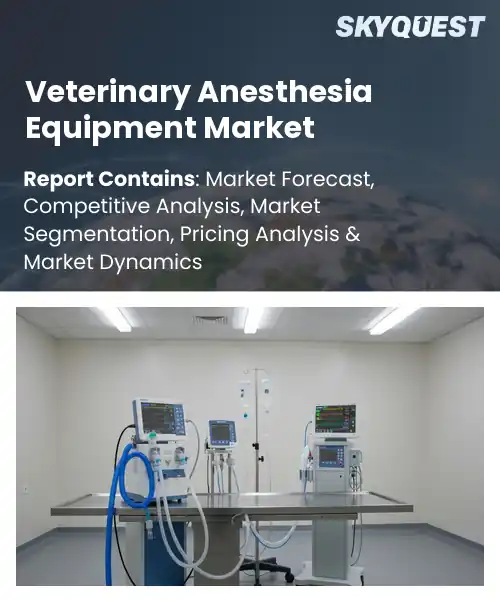
Veterinary Anesthesia Equipment Market
Report ID: SQMIG35A3996
Report ID: SQMIG35A3996
[email protected]
USA +1 351-333-4748
Report ID:
SQMIG35A3996 |
Region:
Global |
Published Date: June, 2026
Pages:
157
|Tables:
152
|Figures:
78


Global Veterinary Anesthesia Equipment Market size was valued at USD 850.0 Million in 2024 and is poised to grow from USD 914.6 Million in 2025 to USD 1643.35 Million by 2033, growing at a CAGR of 7.6% during the forecast period (2026-2033).
The primary impetus behind the veterinary anesthesia equipment market is the growing demand for comprehensive perioperative care, fueled by the increasing population of companion animals and rising client expectations for surgical outcomes. This market consists of anesthesia machines, vaporizers, and ventilators and monitoring systems that help maintain safety during procedures. It matters because anesthesia-related complications directly impact animal welfare and clinic liability. In the past 20 years, clinicians have shifted from simple sedation toward more complicated general anesthesia for orthopedic, oncologic and soft tissue procedures . This has prompted manufacturers to innovate by offering compact workstations and sophisticated capnography used in small animal specialty centers to minimize morbidity and mortality .
The largest factor driving the global market is the confluence of stricter clinical standards and the rapid pace of technological innovation. Clinics are compelled to upgrade old equipment to multifunctional monitors and safer anesthesia delivery systems due to the tighter guidelines. Capnography, pulse oximetry and closed-circuit ventilators are measurable reductions in perioperative complications. Veterinary hospitals respond to this by investing in integrated workstations that allow longer and more complex procedures and thus increase turnover of devices. In practice, ambulatory equine teams perform surgery in the field using portable anesthesia machines, and urban specialty centers use networked monitors to review cases, creating opportunities for modular product lines, training services, and subscription-based software.
How is AI improving monitoring accuracy in the veterinary anesthesia equipment market?
AI enhances the accuracy of monitoring in veterinary anaesthesia through better signal processing, pattern recognition and continuous trend analysis. Key features include reducing motion and electrical noise of sensors, fusing data from multiple parameters, and predictive alerts that detect subtle changes before they become critical. At this point, the manufacturers are putting these algorithmic tools and cloud analytics into monitors in the market to give clinicians clearer, more actionable vital signs. This is significant because clinics want anesthesia that is safer and less disruptive. Industry reviews and examples of cloud connected wireless monitoring demonstrate how gains in accuracy are already resulting in smoother workflows and better intraoperative awareness.
Midmark (February 2026) launched new multiparameter monitors for animal health, with emphasis on integrated signal processing and connectivity. This development supports wider adoption of AI enabled monitoring which increases efficiency and patient safety by helping clinicians respond sooner by reducing artifact driven alarms and improving trend detection.
Market snapshot - (2026-2033)
Global Market Size
USD 850.0 Million
Largest Segment
Anesthesia Monitors
Fastest Growth
Portable Anesthesia Devices
Growth Rate
7.6% CAGR
To get more insights on this market click here to Request a Free Sample Report
Global veterinary anesthesia equipment market is segmented by product type, animal category, component type, end-user, sales channel and region. Based on product type, the market is segmented into Portable Anesthesia Devices, Standalone Systems, Anesthesia Monitors, Vaporizers, Ventilators and Others. Based on animal category, the market is segmented into Small Animals, Large Animals, Exotic Animals, Laboratory Animals and Others. Based on component type, the market is segmented into Rebreathing Systems, Non-Rebreathing Systems, Waste Gas Scavenging Systems and Others. Based on end-user, the market is segmented into Veterinary Hospitals, Veterinary Clinics, Research Laboratories and Others. Based on sales channel, the market is segmented into Direct Institutional Sales, Veterinary Equipment Wholesalers, Online B2B Platforms and Others. Based on region, the market is segmented into North America, Europe, Asia Pacific, Latin America and Middle East & Africa.
The Portable Anesthesia Devices segment dominates due to their mobile nature and ease of operation which directly enables care delivery outside the traditional theater environments. Veterinarians performing procedures in ambulatory clinics, field settings and small practices lacking fixed infrastructure drive routine adoption. Lower upfront cost, easier maintenance and compatibility with both inhalant and injection workflows lower logistical barriers, while predictable performance in a variety of conditions gives buyers more confidence to purchase across a range of clinical use cases.
However, the clinics’ growing demand for continuous physiological tracking and data integration is providing the strongest growth momentum to Anesthesia Monitors. Innovations in compact design, connectivity and intuitive interfaces make it easier to use during procedures. Demand for sophisticated monitoring platforms and new purchases is driven by increased expectations on patient safety and electronic record linkage.
The Veterinary Hospitals segment dominates the market as these facilities function with high caseloads and complex surgical programs that require robust, integrated anesthesia solutions. Centralized procurement and clinical governance are encouraging durable systems with good monitoring and interoperability and suppliers are pushed to offer service contracts and training. Institutional purchasing criteria are based on uptime, standardization and adherence to clinical protocols, which encourages the adoption of advanced systems and consolidates vendor relationships based on long-term reliability and clinical support.
Research Laboratories are, on the other hand, emerging as the fastest growing end-user due to the critical need for accurate anesthesia control in preclinical studies and regulatory compliance. The demand for specialized small animal systems with reproducible dosing, data integration and predictable maintenance cycles drives procurement, stimulating targeted product innovation.
To get detailed segments analysis, Request a Free Sample Report
North America leads the way, boasting a sophisticated clinical infrastructure, a dense network of veterinary specialty centers, and a well-established vendor ecosystem that facilitates rapid technology adoption. Strong partnerships between veterinary schools, research institutions and manufacturers advance clinical validation and iterative product improvement. Distribution and service networks and professional training standards are well developed and ensure reliable aftermarket support and encourage clinician confidence in the use of complex monitoring and delivery systems. The active investment environment and competitive supplier environment drives innovation in device design, integration and user training. In addition, companion animal and equine practices in the region are highly clinically specialized and require a complete anesthesia platform that is compatible with different surgical workflows and safety protocols.
In United States, the Veterinary Anesthesia Equipment Market is characterized by a dense network of specialty hospitals and academic centers that facilitate the early adoption of advanced monitoring and anesthesia delivery systems. Clinician expertise, availability of technical service networks and proximity to the major device manufacturers support rapid uptake. Suppliers are witnessing a demand for integrated solutions and dedicated training programs, which is being driven by a mature companion animal care market and surgical caseload complexity.
The Veterinary Anesthesia Equipment Market in Canada is driven by a tight cluster of referral clinics and progressive general practice providers with an eye on perioperative safety and monitoring. Regional procurement networks and partnerships with international manufacturers allow access to mid and high tier anesthesia systems. Adoption is underpinned by emphasis on clinician training, veterinary continuing education and service reliability. Cross border collaboration with institutions and vendors accelerates technology transfer, knowledge transfer.
Europe has experienced rapid growth due to high clinical standards, a dense network of referral centres and a strong domestic production capacity to meet customized needs in anesthesia. Collaboration between veterinary colleges, industry and professional associations is fostering clinical validation and implementation of guidelines, driving acceptance of integrated monitoring and delivery platforms. Procurement strategies within hospital networks often favor integrated systems with aftermarket support. Clinical training programs improve perioperative practice. Product differentiation is driven by the different clinical needs in the companion animal, equine and laboratory segments. Regulatory alignment and existing distribution channels provide for effective market reach and vendors are able to scale operations and introduce innovations to meet regional clinical and service expectations.
The Veterinary Anesthesia Equipment Market in Germany is driven by advanced veterinary hospitals, a strong domestic presence of OEMs and close ties between research institutions and manufacturers that foster high specification anesthesia solutions. Clinical guidelines for patient monitoring and operator training are driving demand for integrated monitoring suites and specialized delivery systems. Strong service networks and a culture of clinical research back the piloting of innovations. Procurement practices favor service agreements and aftermarket support.
Strong adoption of veterinary anesthesia equipment in the United Kingdom is driven by focus on perioperative standards, growing referral network and increased access to pet insurance for advanced care. A dynamic private practice sector that is open to upgrades and clinician led demand for modern monitoring and safety enhancements is good for suppliers. Targeted training programs and regional centers of excellence speed up the dissemination of best practices and the integration of innovative equipment.
Veterinary Anesthesia Equipment The French market is evolving with more attention to perioperative care in university hospitals and more specialist practices employing advanced monitoring systems. Veterinary researchers and manufacturers can work together to customize equipment to the needs of local clinics. Procurement patterns are informed by reliability and service agreements and a steady uptake is supported through training programmes and regional trade partnerships. Vendors are being pushed to develop anesthesia solutions that are small and easy to use as the clinical focus increases on specialization.
The Asia Pacific is leveraging its position and helping to remove barriers to adoption through growing clinical ability, targeted investment in veterinary education and more local manufacturing. The demand for surgical care for companion animals is growing and the specialty practice base is coming of age, which presents opportunities for international and domestic suppliers to offer advanced anesthesia and monitoring products customized to regional workflows. Global vendors are partnering with regional distributors to expand service coverage and train clinicians. They test equipment performance locally through research collaborations and pilot programs. Suppliers are also creating compact, affordable platforms and localized interfaces to better match language and workflow preferences, and improve acceptance in diverse clinical settings.
Veterinary Anesthesia Equipment Japan’s market is supported by good veterinary education and a culture of embracing technology in specialty clinics and university hospitals. Domestic and international suppliers use local clinical protocols to align equipment. Service networks are established to keep systems functioning. Precision and patient monitoring create demand for sophisticated monitoring platforms. Vendors and research centers working together help to refine products and conduct clinical validation that fits national practice patterns.
South Korea Veterinary Anesthesia Equipment Market is growing owing to modernization of clinics, investment in veterinary training programs, and collaboration between manufacturers and clinicians to develop customized solutions. Suppliers are implementing effective distribution and responsive service models to deliver compact anesthesia machines and integrated monitors. Adoption is fueled by the focus on minimally invasive procedures and high quality perioperative care. Pilot programs with teaching hospitals aid in validation and broader clinical acceptance and ongoing innovation.
To know more about the market opportunities by region and country, click here to
Buy The Complete Report
Rising Demand For Minimally Invasive Procedures
Advances In Anesthesia Monitoring Technology
High Equipment Acquisition and Maintenance Costs
Regulatory Approval and Reimbursement Challenges
Request Free Customization of this report to help us to meet your business objectives.
The competitive landscape is characterized by consolidation, channel partnerships and device innovation. Covetrus going private, Heska’s acquisition of scil and other private equity and corporate deals have reshaped distribution and service reach. Incumbents are launching dedicated veterinary anesthesia workstations, while new entrants are driving competition in integrated monitoring, workflow integration and fast regulatory scaling through intraoperative monitoring and portability.
SkyQuest’s ABIRAW (Advanced Business Intelligence, Research & Analysis Wing) is our Business Information Services team that Collects, Collates, Correlates, and Analyses the Data collected by means of Primary Exploratory Research backed by robust Secondary Desk research.
As per SkyQuest analysis, one key driver is rising demand for minimally invasive procedures, while a second driver is rapid advances in anesthesia monitoring technology that improve perioperative safety and enable complex surgeries. A key restraint remains high equipment acquisition and maintenance costs which slow adoption among smaller clinics. North America is the dominating region owing to advanced clinical infrastructure and specialty centers, and Portable Anesthesia Devices represent the dominating segment because mobility and lower upfront cost expand field and ambulatory care. Overall, manufacturers should prioritize connected monitoring, training and cost-effective modular platforms while strengthening service support to capture diverse end-user needs.
| Report Metric | Details |
|---|---|
| Market size value in 2024 | USD 850.0 Million |
| Market size value in 2033 | USD 1643.35 Million |
| Growth Rate | 7.6% |
| Base year | 2024 |
| Forecast period | (2026-2033) |
| Forecast Unit (Value) | USD Million |
| Segments covered |
|
| Regions covered | North America (US, Canada), Europe (Germany, France, United Kingdom, Italy, Spain, Rest of Europe), Asia Pacific (China, India, Japan, Rest of Asia-Pacific), Latin America (Brazil, Rest of Latin America), Middle East & Africa (South Africa, GCC Countries, Rest of MEA) |
| Companies covered |
|
| Customization scope | Free report customization with purchase. Customization includes:-
|
To get a free trial access to our platform which is a one stop solution for all your data requirements for quicker decision making. This platform allows you to compare markets, competitors who are prominent in the market, and mega trends that are influencing the dynamics in the market. Also, get access to detailed SkyQuest exclusive matrix.
Table Of Content
Executive Summary
Market overview
Parent Market Analysis
Market overview
Market size
KEY MARKET INSIGHTS
COVID IMPACT
MARKET DYNAMICS & OUTLOOK
Market Size by Region
KEY COMPANY PROFILES
Methodology
For the Veterinary Anesthesia Equipment Market, our research methodology involved a mixture of primary and secondary data sources. Key steps involved in the research process are listed below:
1. Information Procurement: This stage involved the procurement of Market data or related information via primary and secondary sources. The various secondary sources used included various company websites, annual reports, trade databases, and paid databases such as Hoover's, Bloomberg Business, Factiva, and Avention. Our team did 45 primary interactions Globally which included several stakeholders such as manufacturers, customers, key opinion leaders, etc. Overall, information procurement was one of the most extensive stages in our research process.
2. Information Analysis: This step involved triangulation of data through bottom-up and top-down approaches to estimate and validate the total size and future estimate of the Veterinary Anesthesia Equipment Market.
3. Report Formulation: The final step entailed the placement of data points in appropriate Market spaces in an attempt to deduce viable conclusions.
4. Validation & Publishing: Validation is the most important step in the process. Validation & re-validation via an intricately designed process helped us finalize data points to be used for final calculations. The final Market estimates and forecasts were then aligned and sent to our panel of industry experts for validation of data. Once the validation was done the report was sent to our Quality Assurance team to ensure adherence to style guides, consistency & design.
Analyst Support
Customization Options
With the given market data, our dedicated team of analysts can offer you the following customization options are available for the Veterinary Anesthesia Equipment Market:
Product Analysis: Product matrix, which offers a detailed comparison of the product portfolio of companies.
Regional Analysis: Further analysis of the Veterinary Anesthesia Equipment Market for additional countries.
Competitive Analysis: Detailed analysis and profiling of additional Market players & comparative analysis of competitive products.
Go to Market Strategy: Find the high-growth channels to invest your marketing efforts and increase your customer base.
Innovation Mapping: Identify racial solutions and innovation, connected to deep ecosystems of innovators, start-ups, academics, and strategic partners.
Category Intelligence: Customized intelligence that is relevant to their supply Markets will enable them to make smarter sourcing decisions and improve their category management.
Public Company Transcript Analysis: To improve the investment performance by generating new alpha and making better-informed decisions.
Social Media Listening: To analyze the conversations and trends happening not just around your brand, but around your industry as a whole, and use those insights to make better Marketing decisions.
REQUEST FOR SAMPLE
 REQUEST FREE CUSTOMIZATION
Global Veterinary Anesthesia Equipment Market size was valued at USD 850.0 Million in 2024 and is poised to grow from USD 914.6 Million in 2025 to USD 1643.35 Million by 2033, growing at a CAGR of 7.6% during the forecast period (2026-2033).
Competitive landscape is defined by consolidation, channel partnerships and device innovation. Private equity and corporate deals such as Covetrus going private and Heska’s acquisition of scil have reshaped distribution and service reach. Incumbents are launching dedicated veterinary anesthesia workstations while new entrants push intraoperative monitoring and portability, intensifying competition around integrated monitoring, workflow integration and fast regulatory scaling. 'Midmark', 'Smiths Medical', 'Derial', 'Kent Scientific', 'Vetland Medical', 'DRE Veterinary', 'Supera Anesthesia Innovations', 'Mindray Animal Medical', 'Henry Schein', 'Jorgensen Laboratories', 'B. Braun', 'Dispomed', 'Dispomedica', 'Hallowell EMC', 'Highland Medical', 'Eickemeyer', 'Singular Medical', 'Kruuse', 'Advanced Anesthesia Specialists', 'Darvall'
Minimally invasive surgical techniques in veterinary practice reduce recovery times and improve patient outcomes, prompting clinicians to adopt advanced anesthesia equipment designed for precise dosing and monitoring. As veterinarians prioritize animal welfare and procedural efficiency, demand increases for equipment that supports shorter procedures, targeted anesthesia delivery, and rapid monitoring. This preference drives procurement decisions in clinics and hospitals, encourages manufacturers to innovate user-friendly devices, and expands adoption across practice sizes, thereby positively influencing overall market expansion through sustained replacement and upgrade cycles.
Smart Monitoring Integration: Veterinary facilities are adopting interoperable monitoring platforms that consolidate anesthesia delivery and physiological tracking into unified workflows. Clinicians increasingly value systems that enable continuous, real-time visualization of vital signs and automated alerts to support decision making during procedures. This convergence of hardware and software improves procedural consistency, facilitates remote consultation, and enhances postoperative monitoring. Vendors emphasize connectivity and intuitive interfaces to reduce cognitive load, streamline training, foster broader acceptance across practice settings, and improve patient safety through enhanced situational awareness.
Why does North America Dominate the Global Veterinary Anesthesia Equipment Market? |@12


Want to customize this report? This report can be personalized according to your needs. Our analysts and industry experts will work directly with you to understand your requirements and provide you with customized data in a short amount of time. We offer $1000 worth of FREE customization at the time of purchase.
Feedback From Our Clients


 USA (+1) 351-333-4748

