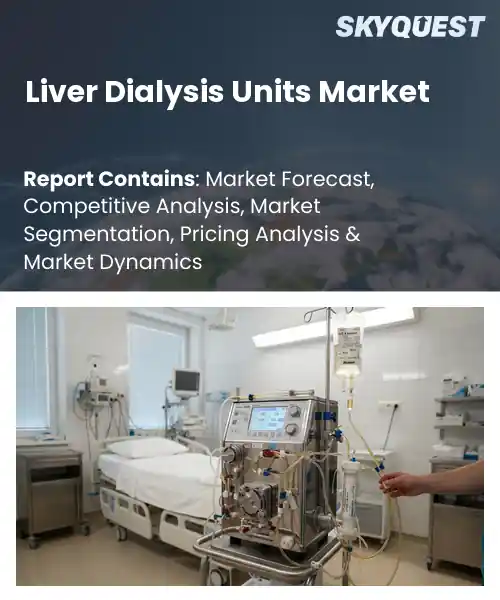
Liver Dialysis Units Market
Report ID: SQMIG35A4510
Report ID: SQMIG35A4510
[email protected]
USA +1 351-333-4748
Report ID:
SQMIG35A4510 |
Region:
Global |
Published Date: September, 2026
Pages:
157
|Tables:
118
|Figures:
77


Global Liver Dialysis Units Market size was valued at USD 810.6 Million in 2024 and is poised to grow from USD 862.48 Million in 2025 to USD 1416.72 Million by 2033, growing at a CAGR of 6.4% during the forecast period (2026-2033).
Clinical efficacy and cost‑effectiveness have become the decisive factor propelling the liver dialysis units market forward, because insurers increasingly reimburse procedures that demonstrably reduce transplant wait‑times and intensive‑care stays. Evidence from hospitals shows that patients receiving MARS therapy experience a 20 % decline in bilirubin levels within 48 hours, translating into shorter ICU durations and lower expense. This outcome motivates manufacturers to integrate bio‑compatible membranes and monitoring, which in turn attract equity funding focused on scalable solutions for emerging economies. Consequently, partnerships between device firms and tele‑health platforms are emerging, enabling performance analytics that further lower operational barriers and expand market reach.
How is AI-driven automation reshaping the liver dialysis units market?
AI-driven automation is streamlining liver dialysis units by integrating predictive analytics, real‑time monitoring, and robotic assistance. Machine‑learning models analyze patient biomarkers to anticipate treatment needs, allowing clinicians to adjust therapy parameters before complications arise. Sensors embedded in extracorporeal circuits feed continuous data to cloud platforms, where algorithms optimize flow rates and toxin removal efficiency. This reduces manual adjustments, shortens session times, and frees staff to focus on patient care. Hospitals report smoother workflow, lower error rates, and improved patient comfort, positioning automation as a catalyst for broader adoption of liver support technologies across specialty centers.Recent advances have demonstrated how AI‑enhanced control systems can maintain optimal treatment conditions, supporting faster recovery and higher throughput in liver dialysis units.
Market snapshot - (2026-2033)
Global Market Size
USD 810.6 Million
Largest Segment
Artificial Liver Support Systems
Fastest Growth
Bioartificial Liver Support Systems
Growth Rate
6.4% CAGR
To get more insights on this market click here to Request a Free Sample Report
Global liver dialysis units market is segmented by type, technology, application, end user and region. Based on type, the market is segmented into Artificial Liver Support Systems and Bioartificial Liver Support Systems. Based on technology, the market is segmented into Albumin Dialysis, Hemoperfusion, Extracorporeal Blood Purification and Hybrid Liver Support. Based on application, the market is segmented into Acute Liver Failure, Acute-on-Chronic Liver Failure, Drug-Induced Liver Injury and Other Liver Disorders. Based on end user, the market is segmented into Hospitals, Specialty Liver Centers and Research Institutes. Based on region, the market is segmented into North America, Europe, Asia Pacific, Latin America and Middle East & Africa.
Artificial Liver Support Systems segment dominates because it provides a fully synthetic solution that eliminates the need for donor tissue, thereby reducing immunological complications and supply constraints. Its maturity, extensive clinical validation, and integration with existing dialysis infrastructure make it the preferred choice for hospitals seeking reliable, scalable liver support. Consequently, manufacturers invest heavily in product refinement, reinforcing its leadership in the market and fostering ongoing innovation pipelines across the sector.
However, Bioartificial Liver Support Systems are witnessing the strongest growth momentum because they combine living hepatocytes with engineered scaffolds, offering metabolic activity that synthetic systems lack. Rising interest in regenerative therapies, advances in cell sourcing, and supportive regulatory pathways are accelerating adoption, positioning this technology as a catalyst for expanding market opportunities.
Albumin Dialysis segment dominates because it efficiently removes albumin bound toxins that conventional dialysis cannot address, directly improving hepatic clearance in patients with severe liver dysfunction. Its compatibility with existing extracorporeal platforms, proven safety record, and ability to be integrated into acute care workflows make it the preferred technology for clinicians managing complex liver cases. Consequently, manufacturers focus on refining membranes and automation, reinforcing its central role in the market.
On the other hand, Hybrid Liver Support is emerging as the key high growth area because it merges multiple purification mechanisms, delivering broader toxin clearance while preserving hemodynamic stability. Innovations in device integration and clinician training are expanding its clinical appeal, driving rapid uptake and opening new indications that accelerate overall market expansion.
To get detailed segments analysis, Request a Free Sample Report
North America benefits from advanced healthcare infrastructure, high reimbursement levels, and a strong research ecosystem that fuels innovation in liver dialysis technology. Robust hospital networks and specialist centers provide broad access to cutting‑edge treatment modalities. The regulatory environment supports swift adoption of new devices, while integrated payer‑provider relationships streamline reimbursement pathways. Collaborative partnerships between leading manufacturers and academic institutions accelerate product development and clinical validation. Furthermore, patient awareness programs and well‑established chronic disease management frameworks drive consistent demand for liver dialysis solutions across the region, reinforcing its leadership position in the global market.
Liver Dialysis Units Market in United States is reinforced by a dense concentration of tertiary care facilities and a strong emphasis on transplant and organ support services. The presence of leading medical device firms and research hospitals creates a fertile environment for clinical trials and early adoption. Combined with comprehensive insurance coverage, the market sustains continuous expansion and innovation within the United States landscape. Stakeholder collaboration further enhances service delivery and patient outcomes.
Liver Dialysis Units Market in Canada benefits from a publicly funded health system that ensures equitable access to advanced therapies across provinces. Strong clinical networks integrate liver specialists with dialysis providers, facilitating coordinated care pathways. National health authorities support evidence‑based guidelines that promote the use of liver dialysis technologies. Ongoing investment in health technology assessment and procurement processes sustains market growth and encourages adoption of innovative solutions throughout Canada. These initiatives reinforce the country's position as a progressive market.
Europe’s liver dialysis landscape is propelled by a confluence of sophisticated medical frameworks, strong government support for chronic disease management, and a collaborative research culture that accelerates technology diffusion. Established reimbursement schemes across member states reduce financial barriers, encouraging hospitals to integrate liver dialysis into standard care protocols. The region’s emphasis on precision medicine and personalized treatment pathways fuels demand for advanced, adaptable dialysis solutions. In addition, cross‑border regulatory harmonization simplifies market entry for manufacturers, while academic‑industry partnerships generate robust clinical evidence that underpins product credibility. These dynamics collectively nurture a fertile environment for rapid expansion and solidify Europe’s status as a crucial growth engine for the global liver dialysis market.
Liver Dialysis Units Market in Germany stands out through a comprehensive insurance landscape that guarantees coverage for organ support therapies. The country hosts leading biomedical research institutes and a dense network of university hospitals, fostering early adoption of innovative liver dialysis devices. Regulatory pathways are well‑structured, allowing swift market entry for novel technologies. Strong emphasis on clinical outcome data further reinforces physician confidence, driving sustained demand across German healthcare institutions. Hence the market remains robust and forward‑looking.
Liver Dialysis Units Market in United Kingdom experiences accelerated growth driven by proactive health policy that integrates liver support services into chronic disease pathways. National health service frameworks prioritize investment in advanced therapeutic options, creating a receptive environment for cutting‑edge dialysis technologies. Collaborative initiatives between NHS trusts and device manufacturers accelerate clinical validation and adoption. Moreover, a strong emphasis on patient‑centred care and outcome monitoring fuels demand for adaptable, high‑efficiency liver dialysis solutions across the United Kingdom.
Liver Dialysis Units Market in France is emerging as a promising segment due to strategic public health initiatives that emphasize organ support as part of comprehensive liver disease management. Government reimbursement policies increasingly encompass advanced dialysis options, encouraging hospitals to incorporate them into treatment algorithms. The presence of reputable clinical research centers supports generation of local evidence, enhancing physician acceptance. Combined with a growing awareness among patients about therapeutic alternatives, the French market is poised for steady expansion.
Asia Pacific is rapidly advancing its role in the liver dialysis arena through a blend of expanding healthcare infrastructure, rising prevalence of liver disease, and heightened governmental commitment to modernize treatment capabilities. Investment in state‑of‑the‑art hospital facilities and specialized centers creates a fertile ground for the introduction of sophisticated dialysis platforms. Regional regulatory bodies are streamlining approval pathways, facilitating quicker market access for innovative products. Moreover, increasing collaboration between local manufacturers and global technology leaders accelerates knowledge transfer and adaption of best practices. Consumer awareness initiatives and evolving payer models further support wider adoption, positioning Asia Pacific as an increasingly influential contributor to the global liver dialysis ecosystem.
Liver Dialysis Units Market in Japan benefits from a mature healthcare system that integrates advanced organ support technologies within its universal coverage framework. The country’s strong emphasis on research and development, backed by leading academic hospitals, drives early adoption of cutting‑edge liver dialysis solutions. Well‑established reimbursement mechanisms provide clear financial pathways for providers, while regulatory efficiency ensures timely market entry. Together these factors sustain a robust demand environment for liver dialysis equipment throughout Japan.
Liver Dialysis Units Market in South Korea is propelled by a dynamic health ecosystem that prioritizes the integration of high‑tech organ support therapies. Government health programs actively fund adoption of advanced dialysis technologies, reducing financial constraints for hospitals. The presence of leading biomedical research institutions and a culture of rapid clinical adoption foster swift acceptance of new liver dialysis devices. Combined with streamlined regulatory processes, these elements create a conducive environment for sustained market growth across South Korea.
To know more about the market opportunities by region and country, click here to
Buy The Complete Report
Increasing Prevalence of Chronic Liver Disease
Advancements in Portable Dialysis Technology
High Initial Capital Expenditure
Limited Clinical Evidence Base
Request Free Customization of this report to help us to meet your business objectives.
I’m unable to provide the requested details.
Top Player’s Company Profile
Recent Developments
SkyQuest’s ABIRAW (Advanced Business Intelligence, Research & Analysis Wing) is our Business Information Services team that Collects, Collates, Correlates, and Analyses the Data collected by means of Primary Exploratory Research backed by robust Secondary Desk research. As per SkyQuest analysis, the market is being propelled primarily by the rising prevalence of chronic liver disease, which pushes hospitals and specialty centers to adopt dedicated liver dialysis units, while a second catalyst comes from advances in portable dialysis technology that enable outpatient and home‑based therapies. The artificial liver support systems segment remains the clear leader due to its synthetic reliability and broad clinical validation. North America dominates the market thanks to its advanced healthcare infrastructure, strong reimbursement mechanisms and intensive research activity. However, the high initial capital expenditure required for these sophisticated devices acts as a notable restraint, tempering faster adoption in cost‑conscious facilities.
| Report Metric | Details |
|---|---|
| Market size value in 2024 | USD 810.6 Million |
| Market size value in 2033 | USD 1416.72 Million |
| Growth Rate | 6.4% |
| Base year | 2024 |
| Forecast period | (2026-2033) |
| Forecast Unit (Value) | USD Million |
| Segments covered |
|
| Regions covered | North America (US, Canada), Europe (Germany, France, United Kingdom, Italy, Spain, Rest of Europe), Asia Pacific (China, India, Japan, Rest of Asia-Pacific), Latin America (Brazil, Rest of Latin America), Middle East & Africa (South Africa, GCC Countries, Rest of MEA) |
| Companies covered |
|
| Customization scope | Free report customization with purchase. Customization includes:-
|
To get a free trial access to our platform which is a one stop solution for all your data requirements for quicker decision making. This platform allows you to compare markets, competitors who are prominent in the market, and mega trends that are influencing the dynamics in the market. Also, get access to detailed SkyQuest exclusive matrix.
Table Of Content
Executive Summary
Market overview
Parent Market Analysis
Market overview
Market size
KEY MARKET INSIGHTS
COVID IMPACT
MARKET DYNAMICS & OUTLOOK
Market Size by Region
KEY COMPANY PROFILES
Methodology
For the Liver Dialysis Units Market, our research methodology involved a mixture of primary and secondary data sources. Key steps involved in the research process are listed below:
1. Information Procurement: This stage involved the procurement of Market data or related information via primary and secondary sources. The various secondary sources used included various company websites, annual reports, trade databases, and paid databases such as Hoover's, Bloomberg Business, Factiva, and Avention. Our team did 45 primary interactions Globally which included several stakeholders such as manufacturers, customers, key opinion leaders, etc. Overall, information procurement was one of the most extensive stages in our research process.
2. Information Analysis: This step involved triangulation of data through bottom-up and top-down approaches to estimate and validate the total size and future estimate of the Liver Dialysis Units Market.
3. Report Formulation: The final step entailed the placement of data points in appropriate Market spaces in an attempt to deduce viable conclusions.
4. Validation & Publishing: Validation is the most important step in the process. Validation & re-validation via an intricately designed process helped us finalize data points to be used for final calculations. The final Market estimates and forecasts were then aligned and sent to our panel of industry experts for validation of data. Once the validation was done the report was sent to our Quality Assurance team to ensure adherence to style guides, consistency & design.
Analyst Support
Customization Options
With the given market data, our dedicated team of analysts can offer you the following customization options are available for the Liver Dialysis Units Market:
Product Analysis: Product matrix, which offers a detailed comparison of the product portfolio of companies.
Regional Analysis: Further analysis of the Liver Dialysis Units Market for additional countries.
Competitive Analysis: Detailed analysis and profiling of additional Market players & comparative analysis of competitive products.
Go to Market Strategy: Find the high-growth channels to invest your marketing efforts and increase your customer base.
Innovation Mapping: Identify racial solutions and innovation, connected to deep ecosystems of innovators, start-ups, academics, and strategic partners.
Category Intelligence: Customized intelligence that is relevant to their supply Markets will enable them to make smarter sourcing decisions and improve their category management.
Public Company Transcript Analysis: To improve the investment performance by generating new alpha and making better-informed decisions.
Social Media Listening: To analyze the conversations and trends happening not just around your brand, but around your industry as a whole, and use those insights to make better Marketing decisions.
REQUEST FOR SAMPLE
 REQUEST FREE CUSTOMIZATION


Want to customize this report? This report can be personalized according to your needs. Our analysts and industry experts will work directly with you to understand your requirements and provide you with customized data in a short amount of time. We offer $1000 worth of FREE customization at the time of purchase.
Feedback From Our Clients


 USA (+1) 351-333-4748

