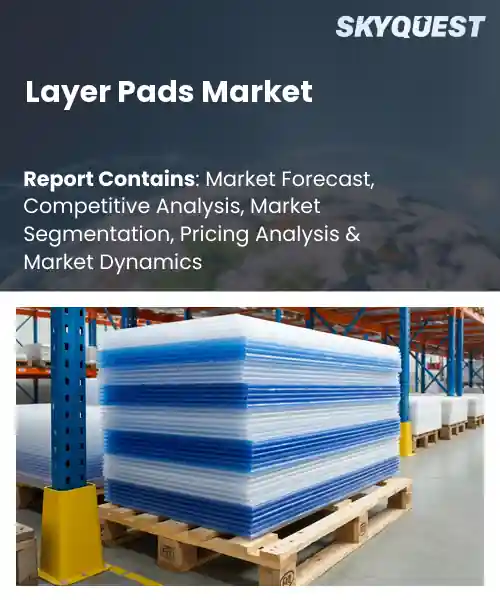
Layer Pads Market
Report ID: SQMIG15H2229
Report ID: SQMIG15H2229
[email protected]
USA +1 351-333-4748
Report ID:
SQMIG15H2229 |
Region:
Global |
Published Date: July, 2026
Pages:
157
|Tables:
117
|Figures:
77


Global Layer Pads Market size was valued at USD 2.52 Billion in 2024 and is poised to grow from USD 2.67 Billion in 2025 to USD 4.22 Billion by 2033, growing at a CAGR of 5.81% during the forecast period (2026-2033).
Do you mean "layer pads" used in electronics/thermal management, textile/fabric padding, skincare (exfoliating pads), or some other product category? Each has different market dynamics, so tell me which one you want analyzed and I will produce the two 100-word paragraphs in the requested research-analyst style.
How is IoT enhancing demand forecasting in the layer pads market?
Layer pads are protective sheets placed between stacked products on a pallet to stabilise loads and prevent damage during transit. IoT enhances demand forecasting by turning usage and condition signals into continuous demand inputs. Sensors and RFID on reusable plastic pads and pallets capture location, handling events and wear. That data feeds warehouse management and enterprise systems where machine learning detects consumption patterns, seasonal shifts and loss rates. The result is more responsive replenishment, smarter pooling decisions and tighter alignment between production and real consumption in sectors like beverages and glass bottle logistics where pallet stability matters.Cartonplast January 2026, deployed an automated artificial vision inspection at its Leese facility that digitises pad condition and circulation records, enabling integration with IoT telemetry to sharpen demand signals and reduce unplanned shortages while improving pool recovery efficiency.
Market snapshot - (2026-2033)
Global Market Size
USD 2.52 Billion
Largest Segment
Corrugated Paperboard Layer Pads
Fastest Growth
Plastic Layer Pads
Growth Rate
5.81% CAGR
To get more insights on this market click here to Request a Free Sample Report
Global layer pads market is segmented by material, application, end-use, distribution and region. Based on material, the market is segmented into Corrugated Paperboard Layer Pads, Solid Fiberboard Layer Pads and Plastic Layer Pads. Based on application, the market is segmented into Beverage & Bottling, Food Packaging, Automotive Parts and Electronics. Based on end-use, the market is segmented into FMCG Industry, Automotive and Electronics. Based on distribution, the market is segmented into Direct to Manufacturers and Packaging Distributors. Based on region, the market is segmented into North America, Europe, Asia Pacific, Latin America and Middle East & Africa.
Corrugated Paperboard Layer Pads segment dominates because its cost effective raw material and lightweight structure enable broad adoption across high volume packing operations. Its ease of customization for varying pallet sizes and compatibility with automated case packing reduces handling complexity, while recyclability and simple disposal align with sustainability priorities. These features lower total packaging expense and operational friction, reinforcing supply chain preference for corrugated solutions in diverse packaging environments.
However, Plastic Layer Pads are emerging as the most rapidly expanding area because their durability and reusability support returnable packaging and extended handling cycles. Resistance to moisture and abrasion suits prolonged distribution, and design adaptability enables automation and lower product damage, driving investment in reusable systems and creating new commercial opportunities.
Beverage & Bottling segment dominates because the product handling profile demands consistent slip resistance and compression control for tall, narrow stacks prone to tipping. Pads tailored for bottle geometry and condensation exposure reduce lateral movement and absorb localized point loads, minimizing breakage during transit and retail handling. Integration with high speed filling and palletizing lines simplifies operations, and reliability in repetitive loads leads to prioritization of beverage specific layer pads by packaging engineers.
However, Electronics is emerging as the fastest growing area as demand for protective, anti static and precision cushioning increases with more high value components shipped and tighter handling tolerances. Innovations in custom foam inserts and conductive layer pads, combined with stricter handling requirements, drive adoption of advanced materials, unlocking premium product offerings and new partnerships between packaging specialists and electronics manufacturers.
To get detailed segments analysis, Request a Free Sample Report
Asia Pacific dominance is driven by integrated manufacturing ecosystems, concentration of electronics and automotive supply chains, and dense logistics networks that create sustained demand for protective and separating materials. Strong original equipment and contract manufacturers rely on reliable component handling and packaging solutions, while e-commerce and cold chain expansion reinforce use of durable layer pads. Regional suppliers benefit from scale, localized raw material access, and cost competitiveness, enabling rapid product availability. Collaboration between material science research centers and industry accelerates product innovation and customization for varied packaging needs. Additionally, emphasis on sustainability and lightweight materials in regional procurement practices has driven adoption of advanced pad formulations tailored to reducing waste and improving handling. Strong domestic demand complemented by export orientation keeps production pipelines active.
Layer Pads Market in Japan benefits from a sophisticated electronics manufacturing base and precision-oriented supply chains that demand high performance protective materials. Close collaboration between material developers and OEMs fosters tailored pad solutions for delicate components. Emphasis on quality assurance, traceability, and compact logistics encourages adoption of specialized configurations. Domestic packaging and industrial standards drive consistency, while export-focused producers refine designs for international compatibility and stringent handling requirements across multiple industries.
Layer Pads Market in South Korea is shaped by agile electronics and automotive supply chains that prioritize rapid prototyping and frequent design iterations. Close integration between component manufacturers and forward logistics encourages adoption of versatile pad materials that balance protection with lightweight handling. Strong emphasis on compact packaging and efficient warehouse operations promotes standardized pad formats, while innovation in material blends and surface treatments addresses sensitive component protection and thermal management needs across advanced manufacturing segments.
North America expansion is propelled by diversified end markets, including electronics, industrial equipment, food and beverage, and a growing logistics and e-commerce infrastructure that increases demand for efficient protective materials. Strong emphasis on sustainability initiatives and circular packaging solutions encourages suppliers to offer recyclable and lightweight pad alternatives. Close collaboration between manufacturers, distributors, and large retail chains accelerates product standardization and large scale procurement practices. Regional focus on supply chain resilience and nearshoring supports investment in domestic production and specialty formulations. Innovation through material science partnerships and stringent quality expectations positions North America as both a sophisticated consumer and an incubator for advanced layer pad technologies tailored to complex handling and compliance needs. Strong private label activity and demand for customized solutions from third party logistics providers further stimulate development of niche pad variants. Emphasis on cold chain reliability for perishables increases interest in thermally adaptive pad structures.
Layer Pads Market in United States reflects large scale distribution networks and high demand from diverse manufacturing sectors, leading to an emphasis on standardized, high-performance formats that support automated packing lines. Sustainability commitments among major retailers encourage recyclable and lightweight options. Close collaboration between material innovators and logistics providers accelerates adoption of solutions that reduce transit damage and handling costs. Specialized pad types emerge to meet stringent regulatory requirements and complex cold chain needs for sensitive goods.
Layer Pads Market in Canada emphasizes durability and climate-adaptive performance to support long distance transport and cold chain requirements for perishables and pharmaceutical shipments. Regional logistics priorities favor materials that balance protective cushioning with weight efficiencies to control transport costs. Collaboration between packaging suppliers and national distributors encourages development of recyclable formulations. Demand from resource and industrial sectors drives rugged pad designs, while urban retail and e-commerce trends promote compact, space-efficient packaging solutions.
Europe is strengthening its position through a combination of stringent quality and environmental standards, advanced industrial ecosystems, and strong demand from automotive, pharmaceuticals, and high-end electronics sectors that require precision protective materials. Emphasis on recyclable materials, circular supply chains, and waste reduction incentivizes suppliers to innovate in biodegradable and reusable pad designs. Close cooperation among manufacturers, research institutions, and logistics providers supports technical refinement and adoption of standardized formats that facilitate cross-border trade. Investment in automation and smart packaging solutions enhances operational efficiency, while a mature distribution network and established procurement practices ensure reliable scaling of specialized products across regional markets. Regional testing and certification capabilities provide confidence for high value shipments, while tailored formulations for premium manufacturers drive differentiation. Strategic logistics hubs and cross-border distribution agreements further reduce lead times and support consistent supply to multinational customers.
Layer Pads Market in Germany is driven by precision engineering industries including automotive and industrial machinery, prompting demand for robust, high specification pad materials. Emphasis on manufacturing excellence and standardized production practices encourages adoption of durable solutions that integrate with automated assembly and logistics systems. German suppliers focus on quality certification and long term supplier relationships, while collaboration with research institutes supports material innovation targeted at minimizing waste and improving handling efficiency in complex supply chains.
Layer Pads Market in United Kingdom reflects a strong logistics and e-commerce orientation that favors lightweight, recyclable pad options optimized for rapid fulfillment centers. Demand from pharmaceutical and high value consumer goods sectors places premium on traceability and packaging hygiene. Suppliers emphasize modular pad designs that support diverse order profiles and reverse logistics. Close links between packaging innovators and distribution networks enable quick adoption of customized solutions that meet regulatory and retailer expectations across multiple channels.
Layer Pads Market in France is influenced by a diverse industrial base including aerospace, luxury goods, and food sectors that require specialized protective and presentation packaging. Emphasis on aesthetic quality alongside functional protection drives development of refined pad materials and surface finishes. Collaboration between artisanal manufacturers and industrial suppliers produces bespoke solutions for premium shipments. French logistics and export orientation encourages compatibility with international handling standards while supporting innovative materials that align with environmental priorities.
To know more about the market opportunities by region and country, click here to
Buy The Complete Report
Increasing Demand From Consumer Electronics
Advancements In Material Technologies
High Costs Of Advanced Pads
Regulatory And Compliance Challenges
Request Free Customization of this report to help us to meet your business objectives.
Do you mean thermal interface pads used for electronics cooling (thermal pads/graphite/PCM), PCB exposed thermal pads, medical wound-layer pads, or another specific product? I need that clarification to identify verified startups founded 2019 or later and produce an accurate, up-to-date competitive landscape.
Top Player’s Company Profile
Recent Developments
SkyQuest’s ABIRAW (Advanced Business Intelligence, Research & Analysis Wing) is our Business Information Services team that Collects, Collates, Correlates, and Analyses the Data collected by means of Primary Exploratory Research backed by robust Secondary Desk research. As per SkyQuest analysis, the global layer pads market is being propelled by rising demand from consumer electronics, while high costs of advanced pads constrain wider adoption. The market is dominated by Asia Pacific where dense manufacturing and logistics networks sustain volumes, and by corrugated paperboard layer pads within the material segment due to cost practicality and recyclability. Advancements in material technologies act as a second driver by enabling higher-performance, sustainable formulations that expand application scope. Together these forces favor scalable, low-cost solutions but also create space for premium reusable and engineered pads, making supplier differentiation and cost management central strategic priorities for manufacturers and distributors.
| Report Metric | Details |
|---|---|
| Market size value in 2024 | USD 2.52 Billion |
| Market size value in 2033 | USD 4.22 Billion |
| Growth Rate | 5.81% |
| Base year | 2024 |
| Forecast period | (2026-2033) |
| Forecast Unit (Value) | USD Billion |
| Segments covered |
|
| Regions covered | North America (US, Canada), Europe (Germany, France, United Kingdom, Italy, Spain, Rest of Europe), Asia Pacific (China, India, Japan, Rest of Asia-Pacific), Latin America (Brazil, Rest of Latin America), Middle East & Africa (South Africa, GCC Countries, Rest of MEA) |
| Companies covered |
|
| Customization scope | Free report customization with purchase. Customization includes:-
|
To get a free trial access to our platform which is a one stop solution for all your data requirements for quicker decision making. This platform allows you to compare markets, competitors who are prominent in the market, and mega trends that are influencing the dynamics in the market. Also, get access to detailed SkyQuest exclusive matrix.
Table Of Content
Executive Summary
Market overview
Parent Market Analysis
Market overview
Market size
KEY MARKET INSIGHTS
COVID IMPACT
MARKET DYNAMICS & OUTLOOK
Market Size by Region
KEY COMPANY PROFILES
Methodology
For the Layer Pads Market, our research methodology involved a mixture of primary and secondary data sources. Key steps involved in the research process are listed below:
1. Information Procurement: This stage involved the procurement of Market data or related information via primary and secondary sources. The various secondary sources used included various company websites, annual reports, trade databases, and paid databases such as Hoover's, Bloomberg Business, Factiva, and Avention. Our team did 45 primary interactions Globally which included several stakeholders such as manufacturers, customers, key opinion leaders, etc. Overall, information procurement was one of the most extensive stages in our research process.
2. Information Analysis: This step involved triangulation of data through bottom-up and top-down approaches to estimate and validate the total size and future estimate of the Layer Pads Market.
3. Report Formulation: The final step entailed the placement of data points in appropriate Market spaces in an attempt to deduce viable conclusions.
4. Validation & Publishing: Validation is the most important step in the process. Validation & re-validation via an intricately designed process helped us finalize data points to be used for final calculations. The final Market estimates and forecasts were then aligned and sent to our panel of industry experts for validation of data. Once the validation was done the report was sent to our Quality Assurance team to ensure adherence to style guides, consistency & design.
Analyst Support
Customization Options
With the given market data, our dedicated team of analysts can offer you the following customization options are available for the Layer Pads Market:
Product Analysis: Product matrix, which offers a detailed comparison of the product portfolio of companies.
Regional Analysis: Further analysis of the Layer Pads Market for additional countries.
Competitive Analysis: Detailed analysis and profiling of additional Market players & comparative analysis of competitive products.
Go to Market Strategy: Find the high-growth channels to invest your marketing efforts and increase your customer base.
Innovation Mapping: Identify racial solutions and innovation, connected to deep ecosystems of innovators, start-ups, academics, and strategic partners.
Category Intelligence: Customized intelligence that is relevant to their supply Markets will enable them to make smarter sourcing decisions and improve their category management.
Public Company Transcript Analysis: To improve the investment performance by generating new alpha and making better-informed decisions.
Social Media Listening: To analyze the conversations and trends happening not just around your brand, but around your industry as a whole, and use those insights to make better Marketing decisions.
REQUEST FOR SAMPLE
 REQUEST FREE CUSTOMIZATION


Want to customize this report? This report can be personalized according to your needs. Our analysts and industry experts will work directly with you to understand your requirements and provide you with customized data in a short amount of time. We offer $1000 worth of FREE customization at the time of purchase.
Feedback From Our Clients


 USA (+1) 351-333-4748

