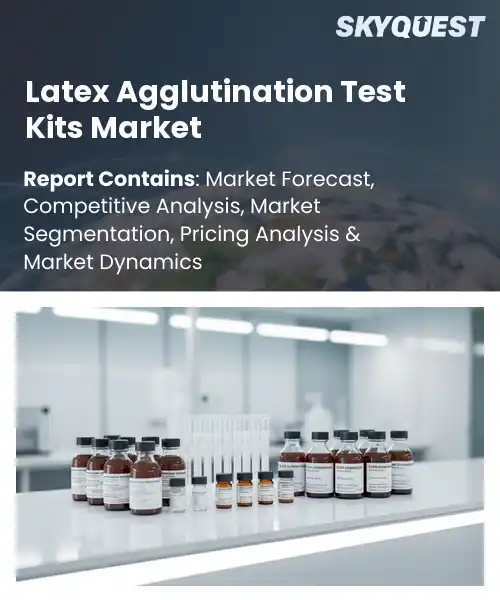
Latex Agglutination Test Kits Market
Report ID: SQMIG35J2469
Report ID: SQMIG35J2469
[email protected]
USA +1 351-333-4748
Report ID:
SQMIG35J2469 |
Region:
Global |
Published Date: June, 2026
Pages:
157
|Tables:
116
|Figures:
77


Global Latex Agglutination Test Kits Market size was valued at USD 382.5 Million in 2024 and is poised to grow from USD 405.91 Million in 2025 to USD 652.4 Million by 2033, growing at a CAGR of 6.12% during the forecast period (2026-2033).
Rising demand for decentralized diagnostics fuels the latex agglutination test kits market because health systems aim to detect diseases early, limit spread, and lower hospitalization costs. This need pushes manufacturers to expand assay portfolios with markers for pathogens such as Zika, dengue, and drug‑resistant bacteria, creating revenue opportunities. A Southeast Asian public‑health program adopted latex kits for on‑site dengue screening, cutting laboratory turnaround from days to hours and enabling timely vector‑control actions. The resulting cost savings and improved outcomes encourage further investment in assay development, distribution and regulatory pathways, which broadens market access to remote clinics and mobile testing units. The global latex agglutination test kits market encompasses diagnostic devices that detect antigens or antibodies through clumping of latex particles. Its significance stems from the need for testing that delivers results within minutes, a requirement amplified by growing infectious‑disease burdens and decentralized healthcare delivery. Historically, the market emerged in the 1980s when manufacturers introduced latex‑based assays for streptococcal infections, then expanded to malaria, HIV, and COVID‑19 panels as molecular techniques proved costly for low‑resource settings. This evolution illustrates how the combination of technological simplicity and cost efficiency has turned latex agglutination into a staple for clinical laboratories and field screenings.
How is AI-driven automation impacting the latex agglutination test kits market?
AI-driven automation is reshaping the latex agglutination test kits market by streamlining assay design, reducing hands‑on time, and improving reproducibility. Machine‑learning algorithms now analyze antigen‑antibody interactions to suggest optimal reagent concentrations, while robotic liquid‑handling platforms execute precise dispensing steps. These technologies enable faster turnaround for bacterial identification and support higher throughput in clinical laboratories. As a result, manufacturers can launch more versatile kits that cater to emerging pathogens, and end‑users benefit from consistent performance across batches. The overall landscape is shifting toward integrated solutions that combine diagnostic chemistry with intelligent workflow management, fostering greater efficiency and cost savings.In March 2026, a leading diagnostics firm announced an AI‑enhanced latex agglutination platform, accelerating result interpretation and boosting laboratory productivity, thereby reinforcing market growth.
Market snapshot - (2026-2033)
Global Market Size
USD 382.5 Million
Largest Segment
Direct Agglutination Kits
Fastest Growth
Passive/Indirect Agglutination Kits
Growth Rate
6.12% CAGR
To get more insights on this market click here to Request a Free Sample Report
Global latex agglutination test kits market is segmented by type, application, end-user, distribution and region. Based on type, the market is segmented into Direct Agglutination Kits and Passive/Indirect Agglutination Kits. Based on application, the market is segmented into Infectious Disease Testing (Meningitis), Pregnancy Testing (hCG) and Rheumatoid Arthritis (RF). Based on end-user, the market is segmented into Hospitals, Diagnostic Labs and POC Settings. Based on distribution, the market is segmented into Direct, Distributors and Online. Based on region, the market is segmented into North America, Europe, Asia Pacific, Latin America and Middle East & Africa.
Direct Agglutination Kits segment dominates because they provide immediate visual readouts without secondary antibodies, simplifying workflow for clinicians. Their ability to detect a broad range of antigens with high specificity reduces false results, fostering trust among users. The simplicity aligns with cost‑sensitive environments, encouraging adoption across facilities. Consequently, manufacturers prioritize production efficiencies and supply chain robustness, reinforcing the segment’s leadership in the Latex Agglutination Test Kits market globally today.
However, Passive/Indirect Agglutination Kits segment is witnessing the strongest growth momentum as advancements in labeling technologies enhance signal amplification, making low‑concentration analyte detection feasible. This innovation attracts research laboratories and specialized diagnostic centers, driving demand for more sensitive assays and opening new avenues for product differentiation within the market.
Pregnancy Testing (hCG) segment leads because rapid point‑of‑care kits deliver quantitative hormone levels, enabling early detection and timely clinical decisions. The high clinical relevance of early pregnancy monitoring drives hospitals and primary care providers to prioritize these kits. Manufacturers leverage established immunoassay platforms to ensure reliability, while integration with digital readers improves user confidence, cementing this segment’s pivotal role in the Latex Agglutination Test Kits market for global healthcare advancement.
Conversely, Rheumatoid Arthritis (RF) segment emerges as the key high‑growth area as clinicians seek more precise auto‑antibody detection to guide therapy choices. Integration of latex agglutination with multiplex platforms expands diagnostic panels, attracting rheumatology clinics and specialty labs. This surge fuels product innovation and broadens the market’s application scope, signaling robust future expansion.
To get detailed segments analysis, Request a Free Sample Report
North America leads the Latex Agglutination Test Kits market through a combination of deep clinical adoption, sophisticated laboratory networks, and a culture of rapid innovation. The United States and Canada host an extensive array of hospitals and reference laboratories that prioritize timely and reliable pathogen detection, creating a steady demand for high‑performance agglutination solutions. Strong investment in biomedical research fuels continuous product refinement, while clear regulatory pathways streamline market entry for new kits. Collaborative relationships between academic institutions, diagnostic manufacturers, and health‑care providers further accelerate technology transfer and implementation. The region also benefits from extensive reimbursement frameworks that encourage the adoption of advanced diagnostic platforms, and a well‑established supply chain that ensures rapid distribution to end‑users. Ongoing commitment to quality standards reinforces confidence among clinicians and contributes to high market penetration.
Latex Agglutination Test Kits Market in the United States is propelled by a dense network of research hospitals and a vibrant ecosystem of biotech firms that prioritize rapid diagnostic development. Robust reimbursement policies and a strong emphasis on point‑of‑care testing accelerate adoption across acute care settings. The presence of global manufacturers with extensive distribution capabilities further reinforces market depth, while continuous clinical validation reinforces confidence among health‑care practitioners globally today.
Latex Agglutination Test Kits Market in Canada benefits from a universal health‑care framework that emphasizes preventive screening and response to infectious threats. Provincial laboratory networks collaborate closely with diagnostic innovators, fostering tailored solutions for diverse clinical settings. A transparent regulatory pathway and proactive government initiatives encourage production and import efficiency. This supportive environment, combined with a skilled workforce, sustains demand and reinforces Canada’s role as a market for agglutination technologies.
Europe experiences rapid expansion of the Latex Agglutination Test Kits market driven by harmonized regulatory standards, well‑established public health networks, and a strong tradition of diagnostic innovation. Collaborative research programs across Germany, the United Kingdom and France accelerate product development while ensuring clinical relevance. Government health agencies prioritize rapid pathogen identification, creating a receptive environment for agglutination technologies. The region’s extensive hospital infrastructure supports widespread adoption, and demand for point‑of‑care solutions fuels diversification of product portfolios. Additionally, robust funding mechanisms for laboratory modernization encourage integration of advanced kits into routine workflows. The growing emphasis on antimicrobial stewardship further underscores the value of rapid, accurate testing, while cross‑border collaborations streamline knowledge exchange and market entry. Emerging digital integration within laboratories enhances data management, reinforcing the appeal of latex agglutination platforms.
Latex Agglutination Test Kits Market in Germany is underpinned by a robust manufacturing base and a dense network of university hospitals that drive clinical validation. Federal health programs emphasize rapid diagnostics, encouraging hospitals to incorporate agglutination kits into routine testing algorithms. Collaboration between biotech firms and academic research centers accelerates innovation, while supply chains ensure timely delivery. This comprehensive ecosystem sustains high adoption rates across public and private health sectors.
Latex Agglutination Test Kits Market in the United Kingdom is expanding due to focused detection within the National Health Service and growing use of point‑of‑care testing in clinics. Government initiatives promote streamlined regulatory approval, enabling quick market entry for kits. Collaboration between academic research hubs and emerging biotech firms fuels product enhancement. Rising demand for rapid, affordable diagnostics strengthens the United Kingdom’s position as a fast‑moving market for agglutination technologies.
Latex Agglutination Test Kits Market in France is emerging as health authorities prioritize microbiological testing to support public health objectives. Investment in laboratory modernization across hospital networks creates new opportunities for agglutination kits. Partnerships between French research institutes and niche diagnostic firms stimulate tailored product development for local clinical needs. Growing awareness of cost‑effective point‑of‑care solutions encourages adoption, positioning France as an important growth market within the broader European landscape.
Asia Pacific is strengthening its position in the Latex Agglutination Test Kits market through a blend of advanced manufacturing capacity, focused government support, and rising clinical demand across the region. Japan and South Korea lead with well‑established biotech sectors that prioritize rapid diagnostic solutions for both hospital and point‑of‑care environments. Investment in next‑generation laboratory automation enhances kit performance and throughput, while national health programs emphasize early detection of infectious diseases. The growing elderly population drives higher testing volumes, encouraging manufacturers to expand local production and distribution networks. Collaborative initiatives between academic researchers and commercial entities further accelerate innovation, positioning Asia Pacific as a dynamic hub for agglutination technology advancement. Regulatory harmonization within the region also facilitates cross‑border market entry, allowing firms to leverage shared standards and accelerate product roll‑out across multiple countries.
Latex Agglutination Test Kits Market in Japan benefits from a healthcare system that integrates diagnostics into routine patient management. Government health policies incentivize testing for infectious diseases, driving widespread adoption in both large hospitals and community clinics. Domestic manufacturers possess production capabilities, ensuring kits with turnaround times. Strong collaboration between research universities and industry accelerates technology transfer, while an emphasis on medicine reinforces the role of agglutination assays in decision‑making.
Latex Agglutination Test Kits Market in South Korea is buoyed by adoption of diagnostic technologies and governmental encouragement of innovation. Leading biotech firms leverage manufacturing facilities to produce kits that meet quality standards. Integration of agglutination assays into infectious disease surveillance programs expands clinical use, while export strategies open pathways to neighboring markets. Ties between academic research centers and industry foster improvement and customization of test kits for clinical applications.
To know more about the market opportunities by region and country, click here to
Buy The Complete Report
Rising Demand for Rapid Diagnostics
Advancements in Antibody Technology
High Production Cost Constraints
Regulatory Approval Delays
Request Free Customization of this report to help us to meet your business objectives.
The market is shaped by intense rivalry among established diagnostic manufacturers and emerging niche players, with competition driving rapid product differentiation, cost‑efficiency initiatives, and geographic expansion. Recent consolidation sees major firms acquiring specialized kit developers to broaden assay portfolios, while strategic alliances with AI‑focused biotech firms accelerate multiplex detection capabilities and shorten time‑to‑market for new test kits. Partnerships with hospital networks are also enhancing real‑world validation and adoption rates across regional markets.
Top Player’s Company Profile
Recent Developments
SkyQuest’s ABIRAW (Advanced Business Intelligence, Research & Analysis Wing) is our Business Information Services team that Collects, Collates, Correlates, and Analyses the Data collected by means of Primary Exploratory Research backed by robust Secondary Desk research. As per SkyQuest analysis, the global latex agglutination test kits market is being propelled primarily by the rising demand for rapid diagnostics that enable minute‑level results in hospitals, point‑of‑care and public‑health programs, while continuous advancements in antibody technology further boost specificity and broaden assay panels. Manufacturers are also leveraging AI‑driven automation to streamline assay design and improve reproducibility, further supporting growth. The Direct Agglutination Kits segment leads the market because of its simple visual readout and cost‑effectiveness, and North America remains the dominant region thanks to its extensive laboratory network, strong reimbursement frameworks and fast innovation cycles. However, high production‑cost constraints limit adoption in price‑sensitive settings, representing the main market restraint.
| Report Metric | Details |
|---|---|
| Market size value in 2024 | USD 382.5 Million |
| Market size value in 2033 | USD 652.4 Million |
| Growth Rate | 6.12% |
| Base year | 2024 |
| Forecast period | (2026-2033) |
| Forecast Unit (Value) | USD Million |
| Segments covered |
|
| Regions covered | North America (US, Canada), Europe (Germany, France, United Kingdom, Italy, Spain, Rest of Europe), Asia Pacific (China, India, Japan, Rest of Asia-Pacific), Latin America (Brazil, Rest of Latin America), Middle East & Africa (South Africa, GCC Countries, Rest of MEA) |
| Companies covered |
|
| Customization scope | Free report customization with purchase. Customization includes:-
|
To get a free trial access to our platform which is a one stop solution for all your data requirements for quicker decision making. This platform allows you to compare markets, competitors who are prominent in the market, and mega trends that are influencing the dynamics in the market. Also, get access to detailed SkyQuest exclusive matrix.
Table Of Content
Executive Summary
Market overview
Parent Market Analysis
Market overview
Market size
KEY MARKET INSIGHTS
COVID IMPACT
MARKET DYNAMICS & OUTLOOK
Market Size by Region
KEY COMPANY PROFILES
Methodology
For the Latex Agglutination Test Kits Market, our research methodology involved a mixture of primary and secondary data sources. Key steps involved in the research process are listed below:
1. Information Procurement: This stage involved the procurement of Market data or related information via primary and secondary sources. The various secondary sources used included various company websites, annual reports, trade databases, and paid databases such as Hoover's, Bloomberg Business, Factiva, and Avention. Our team did 45 primary interactions Globally which included several stakeholders such as manufacturers, customers, key opinion leaders, etc. Overall, information procurement was one of the most extensive stages in our research process.
2. Information Analysis: This step involved triangulation of data through bottom-up and top-down approaches to estimate and validate the total size and future estimate of the Latex Agglutination Test Kits Market.
3. Report Formulation: The final step entailed the placement of data points in appropriate Market spaces in an attempt to deduce viable conclusions.
4. Validation & Publishing: Validation is the most important step in the process. Validation & re-validation via an intricately designed process helped us finalize data points to be used for final calculations. The final Market estimates and forecasts were then aligned and sent to our panel of industry experts for validation of data. Once the validation was done the report was sent to our Quality Assurance team to ensure adherence to style guides, consistency & design.
Analyst Support
Customization Options
With the given market data, our dedicated team of analysts can offer you the following customization options are available for the Latex Agglutination Test Kits Market:
Product Analysis: Product matrix, which offers a detailed comparison of the product portfolio of companies.
Regional Analysis: Further analysis of the Latex Agglutination Test Kits Market for additional countries.
Competitive Analysis: Detailed analysis and profiling of additional Market players & comparative analysis of competitive products.
Go to Market Strategy: Find the high-growth channels to invest your marketing efforts and increase your customer base.
Innovation Mapping: Identify racial solutions and innovation, connected to deep ecosystems of innovators, start-ups, academics, and strategic partners.
Category Intelligence: Customized intelligence that is relevant to their supply Markets will enable them to make smarter sourcing decisions and improve their category management.
Public Company Transcript Analysis: To improve the investment performance by generating new alpha and making better-informed decisions.
Social Media Listening: To analyze the conversations and trends happening not just around your brand, but around your industry as a whole, and use those insights to make better Marketing decisions.
REQUEST FOR SAMPLE
 REQUEST FREE CUSTOMIZATION


Want to customize this report? This report can be personalized according to your needs. Our analysts and industry experts will work directly with you to understand your requirements and provide you with customized data in a short amount of time. We offer $1000 worth of FREE customization at the time of purchase.
Feedback From Our Clients


 USA (+1) 351-333-4748

