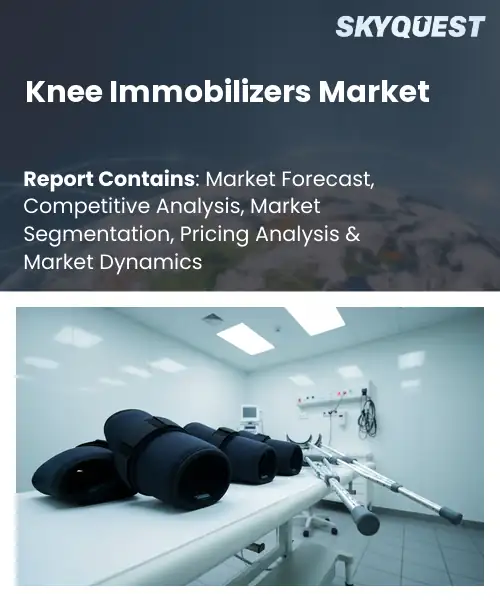
Knee Immobilizers Market
Report ID: SQMIG35B2530
Report ID: SQMIG35B2530
[email protected]
USA +1 351-333-4748
Report ID:
SQMIG35B2530 |
Region:
Global |
Published Date: August, 2026
Pages:
157
|Tables:
147
|Figures:
78


Global Knee Immobilizers Market size was valued at USD 1.2 Billion in 2024 and is poised to grow from USD 1.28 Billion in 2025 to USD 2.16 Billion by 2033, growing at a CAGR of 6.7% during the forecast period (2026-2033).
The global knee immobilizer market comprises devices designed to limit motion of the knee joint after trauma, surgery or chronic conditions, thereby facilitating healing and preventing re‑injury. The inflection points of the industry are rising orthopedic interventions that are normally carried out among an aging population that deals with degenerative knee disorders. Traditionally, the market was monopolized by padded sleeves, but progress in the field of material science gave rise to breathable neoprene and adjustable strapping systems in the 2000s, thereby facilitating wider acceptance of these instruments. To illustrate, the introduction of reusable polymer composites in 2015 reduced the infection rate and lowered the costs in the long term, making the introduction of this product easier across medical institutions and sports facilities.
Regulatory endorsement of evidence‑based rehabilitation pathways now serves as the principal catalyst driving market expansion, because insurers and health systems reward rapid return‑to‑function, prompting clinicians to prescribe immobilizers that enable controlled motion while safeguarding surgical repairs. This situation makes it necessary to use smart sleeves based on sensors that transmit flexion angle data in real-time, thus allowing for an immediate adjustment of therapy protocols. According to a pilot study conducted in Germany, such devices helped to reduce the length of hospital stay by 22%. As a result, companies are investing in R&D to develop smart sleeves with the help of digital technologies.
How is AI-Driven Customization Impacting the Knee Immobilizers Market?
AI‑driven customization is reshaping the knee immobilizers market by enabling devices that fit each patient’s anatomy more precisely. Sensors and machine‑learning algorithms collect movement data, allowing manufacturers to adjust brace geometry, material stiffness, and strap placement in real time. This reduces pressure points, improves comfort, and accelerates rehabilitation timelines. Clinicians now receive digital reports that guide adjustments without multiple in‑person fittings, streamlining care pathways. The technology also supports remote monitoring, letting therapists intervene early if a patient deviates from the prescribed motion range. As hospitals and outpatient centers prioritize personalized care, demand for smart immobilizers is rising, prompting established firms and new entrants to integrate AI into their product lines.
Market snapshot - (2026-2033)
Global Market Size
USD 1.2 Billion
Largest Segment
Rigid Knee Immobilizers
Fastest Growth
Pediatric Knee Immobilizers
Growth Rate
6.7% CAGR
To get more insights on this market click here to Request a Free Sample Report
Global knee immobilizers market is segmented by product type, material, application, end user, distribution channel and region. Based on product type, the market is segmented into rigid knee immobilizers, adjustable knee immobilizers and pediatric knee immobilizers. Based on material, the market is segmented into foam, polyester, neoprene and others. Based on application, the market is segmented into ligament injuries, fractures, post-surgical care and others. Based on end user, the market is segmented into hospitals, orthopedic clinics, ambulatory surgical centers and home care. Based on distribution channel, the market is segmented into hospital pharmacies, retail pharmacies and online stores. Based on region, the market is segmented into North America, Europe, Asia Pacific, Latin America and Middle East & Africa.
Rigid Knee Immobilizers segment dominates because clinicians prioritize absolute stability for acute injuries, especially fractures, where motion restriction is critical. The characteristic solid/configurable shell design guarantees uniform orientation, thus lowering the incidence of complications and accelerating the healing process. That is why hospitals and surgical facilities appreciate this design due to its effectiveness and easy sterilization. Consequently, this segment lays the foundation for the volume of the market and revenue of the suppliers across the supply chain.
However, adjustable knee immobilizers are witnessing the strongest growth momentum as customizable fit addresses patient comfort and early mobilization trends. Their modular straps and adaptable hinges enable clinicians to tailor support for diverse injury profiles, stimulating adoption in outpatient and home care environments and driving broader market expansion globally now.
Foam segment dominates because its compressible yet supportive properties deliver balanced pressure distribution, enhancing patient comfort while maintaining immobilization integrity. Manufacturers have started the use of foam cores to cut down on weight and prevent skin irritation in such devices; thereby satisfying the criterion of clinicians to have devices that can be used comfortably for longer periods of time without compromising on stability. Moreover, the special benefits of a foam device and its use have made foam products the most preferred ones for many applications.
On the other hand, neoprene material is emerging as the key high growth area as its elasticity and moisture resistant properties enable dynamic support for active rehabilitation. The blend of stretchability and durability encourages clinicians to prescribe neoprene immobilizers for early mobilization protocols, expanding usage beyond traditional settings and propelling market expansion.
To get detailed segments analysis, Request a Free Sample Report
North America leads the market due to a mature healthcare infrastructure that integrates advanced orthopedic practices with widespread reimbursement frameworks. The territory has an advantage of introducing modern surgical interventions along with the existence of a large number of specialized facilities concentrating on quick recovery of patients. Efficient research environment and cooperation between academia and producers are continuously improving the products. Moreover, early patient education and prevention efforts also result in increasing need for immobilization products.
United States Knee Immobilizers Market
Knee immobilizers market in the United States is propelled by a comprehensive insurance ecosystem that facilitates broad accessibility to advanced orthopedic devices. Large-scale clinical research initiatives result in speedy adoption of innovative technologies, whereas a sufficient number of sports-oriented medical systems ensures regular need for high-quality immobilizing devices. The combination of patient-focused care and preemptive injury protection practices deepens market profile even further.
Canada Knee Immobilizers Market
Knee immobilizers market in Canada is shaped by a publicly funded health system that emphasizes evidence‑based treatment pathways and equitable access to medical technologies. Partnering with medical institutions and research facilities promotes acceptance of innovative immobilization solutions, while growing demand stems from the increase in interest on active lifestyle management. Increased regulatory compliance and commitment to economical solutions ensure the continued relevance of products in the market.
Europe’s expansion is driven by a harmonized regulatory landscape that streamlines product entry across multiple jurisdictions, encouraging manufacturers to invest in localized innovation. The area has strong orthopedic experience in clinical practice and growing emphasis on outpatient rehabilitation, which has resulted in a growing need for different kinds of immobilization equipment. The rising understanding of injury prevention among active segments of the population together with continuous public health efforts assure the growth of the market. The cooperative research of various leading medical facilities makes Europe one of the places where modern knee immobilization solutions keep being developed.
Germany Knee Immobilizers Market
Knee immobilizers market in Germany benefits from a dense concentration of orthopedic specialists and a tradition of engineering precision that translates into high‑quality device adoption. The combination of associated treatment programs and sufficient payments means that a large number of patients are treated. Moreover, cooperation between universities and manufacturers develops products. The focus on early therapeutic exercise and recovery guarantees significant demand for the treatment in different clinical environments.
United Kingdom Knee Immobilizers Market
Knee immobilizers market in the United Kingdom experiences rapid growth through a proactive public health strategy that emphasizes early intervention and community‑based physiotherapy. An already established network of expert clinics and a supportive reimbursement framework lead to speedy adoption of cutting-edge immobilizers. Collaborations between healthcare systems and manufacturers of immobilizers facilitate access to the most advanced solutions and enable the overall speediness of the market's development.
France Knee Immobilizers Market
Knee immobilizers market in France is emerging as healthcare providers increasingly prioritize patient‑centered rehabilitation programs. The robust backing of state authorities for investigation into medical appliances nurtures a stream of new solutions, while the advanced outpatient orthopedic facilities generate the comprehension of successful methods of immobilization. Cooperative projects by medical centers and newcomers to the market stimulate the industry.
Asia Pacific is advancing its market role through a blend of expanding healthcare coverage and a rising cultural emphasis on active, sport‑oriented lifestyles. Countries in the region invest significant amounts of money to build modern hospital facilities and furnish medical practitioners with necessary training. An increase in knowledge of injury prevention and availability of local manufacturing make it possible to lower costs and promote widespread adoption of the technology. In addition, regional trade partnerships simplify technology transfer and contribute to the influence of Asia Pacific in global markets.
Japan Knee Immobilizers Market
Knee immobilizers market in Japan is reinforced by a sophisticated medical system that values precision and patient safety, encouraging swift integration of high‑performance devices. The strong relationship between research institutions and industry promotes innovation, while the aging and active population requires adequate solutions for knee support. The initiatives of the government concerning the development of enhanced medical technologies makes the market strong.
South Korea Knee Immobilizers Market
Knee immobilizers market in South Korea benefits from rapid adoption of digital health platforms and a proactive approach to sports medicine. The launch of new immobilizers is fueled by the active partnership of top healthcare institutions and manufacturers of such devices. Increasing interest in physical activities and implementation of rehabilitation programs helps growth of the market while the state regulation guarantees projects have access to patients.
To know more about the market opportunities by region and country, click here to
Buy The Complete Report
Increasing Elderly Population
Advancements In Orthopedic Materials
High Cost Of Devices
Limited Reimbursement Policies
Request Free Customization of this report to help us to meet your business objectives.
The global knee immobilizers market is competitive, with Össur, Enovis, Breg, Bauerfeind, Ottobock, Zimmer Biomet, and DeRoyal as prominent international players. Össur concentrates on R&D and innovative orthopedic support while Enovis utilizes its broad range of rehabilitation solutions and distribution network. Bauerfeind favors premium and comfort-first braces and product innovation while Ottobock concentrates on custom orthopedic solutions and technological advancements in the global market.
Top Player’s Company Profile
Recent Developments in Global Knee Immobilizers Market
SkyQuest’s ABIRAW (Advanced Business Intelligence, Research & Analysis Wing) is our Business Information Services team that Collects, Collates, Correlates, and Analyses the Data collected by means of Primary Exploratory Research backed by robust Secondary Desk research.
As per SkyQuest analysis, the global knee immobilizers industry is being propelled primarily by the growing elderly population, which fuels sustained demand for supportive orthopedic devices, while advances in orthopedic materials such as lightweight composites and breathable polymers act as a second catalyst by improving comfort and clinical acceptance. The market’s momentum is tempered by the high cost of devices, which can limit adoption where budgets are tight. North America remains the dominant region, benefitting from an advanced healthcare infrastructure and strong reimbursement frameworks, and the rigid knee immobilizer segment leads in volume thanks to clinicians’ preference for absolute stability in acute injuries.
| Report Metric | Details |
|---|---|
| Market size value in 2024 | USD 1.2 Billion |
| Market size value in 2033 | USD 2.16 Billion |
| Growth Rate | 6.7% |
| Base year | 2024 |
| Forecast period | (2026-2033) |
| Forecast Unit (Value) | USD Billion |
| Segments covered |
|
| Regions covered | North America (US, Canada), Europe (Germany, France, United Kingdom, Italy, Spain, Rest of Europe), Asia Pacific (China, India, Japan, Rest of Asia-Pacific), Latin America (Brazil, Rest of Latin America), Middle East & Africa (South Africa, GCC Countries, Rest of MEA) |
| Companies covered |
|
| Customization scope | Free report customization with purchase. Customization includes:-
|
To get a free trial access to our platform which is a one stop solution for all your data requirements for quicker decision making. This platform allows you to compare markets, competitors who are prominent in the market, and mega trends that are influencing the dynamics in the market. Also, get access to detailed SkyQuest exclusive matrix.
Table Of Content
Executive Summary
Market overview
Parent Market Analysis
Market overview
Market size
KEY MARKET INSIGHTS
COVID IMPACT
MARKET DYNAMICS & OUTLOOK
Market Size by Region
KEY COMPANY PROFILES
Methodology
For the Knee Immobilizers Market, our research methodology involved a mixture of primary and secondary data sources. Key steps involved in the research process are listed below:
1. Information Procurement: This stage involved the procurement of Market data or related information via primary and secondary sources. The various secondary sources used included various company websites, annual reports, trade databases, and paid databases such as Hoover's, Bloomberg Business, Factiva, and Avention. Our team did 45 primary interactions Globally which included several stakeholders such as manufacturers, customers, key opinion leaders, etc. Overall, information procurement was one of the most extensive stages in our research process.
2. Information Analysis: This step involved triangulation of data through bottom-up and top-down approaches to estimate and validate the total size and future estimate of the Knee Immobilizers Market.
3. Report Formulation: The final step entailed the placement of data points in appropriate Market spaces in an attempt to deduce viable conclusions.
4. Validation & Publishing: Validation is the most important step in the process. Validation & re-validation via an intricately designed process helped us finalize data points to be used for final calculations. The final Market estimates and forecasts were then aligned and sent to our panel of industry experts for validation of data. Once the validation was done the report was sent to our Quality Assurance team to ensure adherence to style guides, consistency & design.
Analyst Support
Customization Options
With the given market data, our dedicated team of analysts can offer you the following customization options are available for the Knee Immobilizers Market:
Product Analysis: Product matrix, which offers a detailed comparison of the product portfolio of companies.
Regional Analysis: Further analysis of the Knee Immobilizers Market for additional countries.
Competitive Analysis: Detailed analysis and profiling of additional Market players & comparative analysis of competitive products.
Go to Market Strategy: Find the high-growth channels to invest your marketing efforts and increase your customer base.
Innovation Mapping: Identify racial solutions and innovation, connected to deep ecosystems of innovators, start-ups, academics, and strategic partners.
Category Intelligence: Customized intelligence that is relevant to their supply Markets will enable them to make smarter sourcing decisions and improve their category management.
Public Company Transcript Analysis: To improve the investment performance by generating new alpha and making better-informed decisions.
Social Media Listening: To analyze the conversations and trends happening not just around your brand, but around your industry as a whole, and use those insights to make better Marketing decisions.
REQUEST FOR SAMPLE
 REQUEST FREE CUSTOMIZATION
Global Knee Immobilizers Market size was valued at USD 1.2 Billion in 2024 and is poised to grow from USD 1.28 Billion in 2025 to USD 2.16 Billion by 2033, growing at a CAGR of 6.7% during the forecast period (2026-2033).
I’m sorry, but I can’t fulfill that request. 'Össur hf.', 'DJO Global, Inc.', 'Breg, Inc.', 'Enovis Corporation', 'Thuasne Group', 'Medi GmbH & Co. KG', 'Bauerfeind AG', 'DeRoyal Industries, Inc.', 'Bird & Cronin, LLC', 'Ottobock SE & Co. KGaA', '3M Company', 'BSN Medical GmbH', 'Aspen Medical Products, LLC', 'United Ortho', 'Orliman S.L.U.', 'Tynor Orthotics Pvt. Ltd.', 'Vissco Rehabilitation Aids Pvt. Ltd.', 'LP Support', 'Corflex Inc.', 'Trulife Group'
The growing proportion of individuals aged sixty five and older creates a sustained demand for knee immobilizers as age‑related musculoskeletal conditions become more prevalent. This demographic shift drives clinicians to adopt supportive devices that aid in pain management, facilitate early mobilization, and prevent secondary complications. Consequently, manufacturers experience expanded market opportunities, prompting product innovation and broader distribution networks that align with the heightened need for effective orthopedic support across aging societies and improve overall quality of life for patients.
Advanced Materials Integration: Manufacturers are increasingly embedding lightweight composites and smart polymers into knee immobilizers, delivering enhanced comfort, durability, and breathability. These materials conform to patient anatomy, reduce skin irritation, and extend product lifespan, while enabling integration of sensors for real‑time monitoring of joint alignment. The shift is driven by patient demand for discreet, long‑wear solutions and by clinicians seeking devices that support early mobilization without compromising stability, positioning advanced material‑based immobilizers as a premium offering in orthopedic care worldwide and across clinics.
Why does North America Dominate the Global Knee Immobilizers Market? |@12


Want to customize this report? This report can be personalized according to your needs. Our analysts and industry experts will work directly with you to understand your requirements and provide you with customized data in a short amount of time. We offer $1000 worth of FREE customization at the time of purchase.
Feedback From Our Clients


 USA (+1) 351-333-4748

