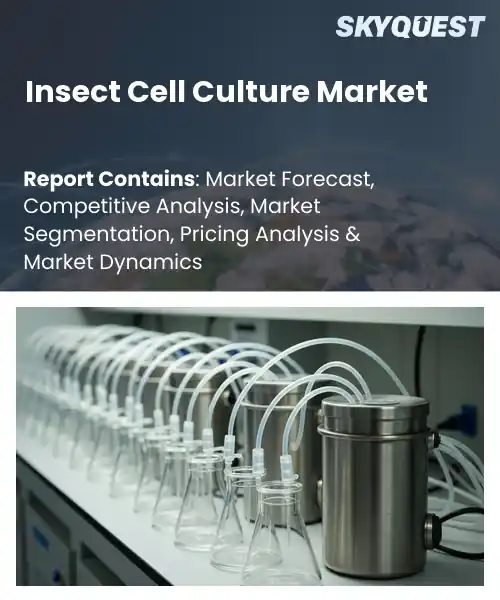
Insect Cell Culture Market
Report ID: SQMIG35J2518
Report ID: SQMIG35J2518
[email protected]
USA +1 351-333-4748
Report ID:
SQMIG35J2518 |
Region:
Global |
Published Date: July, 2026
Pages:
157
|Tables:
119
|Figures:
77


Global Insect Cell Culture Market size was valued at USD 0.85 Billion in 2024 and is poised to grow from USD 0.93 Billion in 2025 to USD 1.95 Billion by 2033, growing at a CAGR of 9.62% during the forecast period (2026-2033).
The global insect cell culture market supplies platforms for producing recombinant proteins, vaccines, and gene‑therapy vectors. Its importance stems from the ability of insect cells such as Sf9 and High‑Five to yield high‑density cultures with modifications that approximate mammalian systems while remaining cost‑effective. The primary driver behind market expansion is rising demand for scalable biomanufacturing prompted by pandemic‑era vaccine development. Early adoption by companies like Novartis for influenza antigens demonstrated feasibility, and collaborations with biotech start‑ups accelerated technology diffusion. Over the past decade, improvements in baculovirus expression vectors have cemented insect cell culture as a mainstream alternative to traditional cell lines. Additionally, regulatory incentives for green bioprocessing shape the second key factor, encouraging manufacturers to replace mammalian hosts with insect systems that generate lower waste and consume fewer resources. As carbon‑footprint targets tighten, companies such as Lonza have integrated insect‑based platforms into their service portfolios, offering clients reduced upstream expenses and faster time‑to‑market for biologics. This shift fuels investment in automation and high‑throughput screening, which in turn lowers entry barriers for smaller biotech firms seeking rapid vaccine prototypes. Consequently, the market experiences a virtuous cycle where cost efficiencies attract new adopters, expanding the addressable market across therapeutics, diagnostics, and agricultural biologics.
How is AI-driven automation reshaping the insect cell culture market?
AI-driven automation is redefining insect cell culture by embedding intelligent sensors, real‑time data analytics and predictive algorithms into bioreactors. These tools continuously monitor pH, temperature, cell density and metabolite levels, allowing instant adjustments that keep cultures in optimal conditions. Machine‑learning models forecast growth trends and flag deviations before they affect yield, reducing batch failures and shortening development cycles. The technology also streamlines scale‑up, as digital twins simulate large‑volume runs, giving manufacturers confidence to move from lab to production faster. Together, these advances lower costs, improve consistency and make insect‑based biologics more attractive to investors and partners.In April 2026, an AI‑controlled bioprocess platform accelerated insect‑cell vaccine production, showcasing efficiency gains that reinforce market momentum.
Market snapshot - (2026-2033)
Global Market Size
USD 0.85 Billion
Largest Segment
Cell Culture Media & Supplements
Fastest Growth
Baculovirus Expression Vectors
Growth Rate
9.62% CAGR
To get more insights on this market click here to Request a Free Sample Report
Global insect cell culture market is segmented by product, application, end-user, distribution and region. Based on product, the market is segmented into Insect Cell Lines (Sf9, Hi5, Sf21), Baculovirus Expression Vectors and Cell Culture Media & Supplements. Based on application, the market is segmented into Recombinant Protein Production, Baculovirus-Like Particle (VLP) Vaccines and Drug Discovery. Based on end-user, the market is segmented into Pharma & Biotech Companies, Research Institutes and CROs. Based on distribution, the market is segmented into Direct B2B, Distributors and Online. Based on region, the market is segmented into North America, Europe, Asia Pacific, Latin America and Middle East & Africa.
Sf9 insect cell line segment dominates because it provides a well characterized, high yield host that is compatible with widely used baculovirus vectors, enabling reliable protein expression across diverse projects. Its robustness simplifies scale up, reduces development risk, and attracts both established manufacturers and emerging biotechs, cementing its central position in the market. The line’s genetic stability and historical data make it a trusted choice for process validation, while its cost effective cultivation supports rapid prototyping and scale manufacturing.
However, cell culture media and supplements segment is witnessing the strongest growth momentum because novel formulations tailored to insect cell metabolism are unlocking higher protein yields and reducing batch to batch variability. This innovation attracts biotech firms seeking efficient production pipelines, driving broader adoption and expanding the market’s overall capacity.
Baculovirus like particle vaccine segment dominates because it leverages insect cells to produce structurally authentic viral mimics that elicit strong immune responses without requiring live pathogens. This approach streamlines regulatory pathways, shortens development timelines, and offers scalable manufacturing, making it attractive for vaccine innovators seeking rapid response to emerging infectious diseases. The technology’s flexibility across multiple antigen targets consolidates its leadership within the market.
Meanwhile, drug discovery segment emerges as the key high growth area because insect cell platforms enable expression of complex eukaryotic proteins that are difficult to produce in bacterial systems, facilitating target validation and lead optimization. Researchers increasingly adopt these cells for high throughput screening, expanding pipeline opportunities and fueling market expansion.
To get detailed segments analysis, Request a Free Sample Report
North America leads the global insect cell culture market because of its mature biotechnology ecosystem, strong academic‑industry collaborations, and substantial investment in advanced biomanufacturing infrastructure. The region benefits from a concentration of pioneering research institutions that generate innovative cell line technologies and from a network of contract manufacturers adept at scaling processes. Regulatory frameworks that encourage rapid product approval further accelerate adoption. In addition, a culture of venture capital support fuels start‑ups focused on novel applications such as biopharmaceuticals, vaccines, and sustainable protein production, reinforcing the region’s leadership. The talent pool includes highly skilled scientists and engineers who are attracted by leading research hospitals and a tradition of translational science. Access to a reliable supply chain for raw materials and specialized reagents reduces barriers to entry, allowing companies to move from proof‑of‑concept to commercial scale with confidence. Collectively these factors create a self‑reinforcing ecosystem that sustains North America’s dominant position.
Insect Cell Culture Market in the United States is propelled by a dense cluster of biotech hubs that translate academic breakthroughs into commercial platforms. Strong governmental funding programs encourage research on alternative protein sources and vaccine production, while established contract manufacturing organizations provide scale‑up expertise. Collaboration between leading pharmaceutical firms and specialist cell‑culture startups accelerates technology transfer, fostering an environment where innovative applications quickly reach market readiness and long‑term viability.
Insect Cell Culture Market in Canada benefits from a supportive research ecosystem anchored by leading universities and government‑backed innovation clusters. Emphasis on sustainable biomanufacturing aligns with national priorities on circular economy and food security, encouraging investment in insect‑derived proteins and biologics. Close collaboration between biotech incubators and established pharmaceutical players streamlines development pathways, while a skilled workforce familiar with advanced fermentation technologies underpins the country’s growing capabilities for future growth and international collaboration.
Europe’s rapid expansion in the insect cell culture market stems from a unified focus on sustainable bioproduction, robust public‑private partnerships, and progressive regulatory encouragement for novel biologics. A strong tradition of interdisciplinary research across universities and industry accelerates discovery of high‑yield cell lines and process optimizations. Policy frameworks that streamline approval for alternative protein and vaccine platforms lower entry barriers, while substantial funding mechanisms prioritize environmentally responsible manufacturing. The region’s mature supply chain for reagents and specialized equipment synergizes with a skilled talent pool, enabling quick translation from laboratory to pilot scale. Together these elements create a fertile environment where innovative applications proliferate, positioning Europe as a leading hub for next‑generation biomanufacturing.
Insect Cell Culture Market in Germany is anchored by world‑class research institutes that drive cell‑line engineering and scale‑up methodologies. Strong industrial clusters in biotechnology and pharmaceuticals provide a ready market for advanced protein expression platforms. Government incentives that reward low‑carbon manufacturing amplify interest in insect‑based production, aligning with national sustainability agendas. Collaborative networks linking academia, contract manufacturers, and large‑scale producers facilitate rapid technology transfer, reinforcing Germany’s dominant role in the European landscape.
Insect Cell Culture Market in the United Kingdom experiences rapid growth driven by a vibrant life‑science ecosystem and strong investment in biotech start‑ups. Leading universities foster cutting‑edge research in cell‑culture technology, while government grant programmes target alternative protein and vaccine development. Close links between academic spin‑outs and established pharmaceutical firms shorten commercialization timelines. A proactive regulatory environment that embraces novel biologics encourages scale‑up, cementing the United Kingdom’s role as a fast‑advancing market within Europe.
Insect Cell Culture Market in France is emerging as a niche yet promising segment, supported by a strong emphasis on sustainable food technologies and bio‑innovation. National research agencies fund collaborative projects that explore insect‑derived proteins for nutraceuticals and therapeutic proteins for biopharma. Proximity to leading aerospace and material science clusters encourages cross‑disciplinary approaches, enhancing process efficiency. While the market size remains modest, growing consumer acceptance of insect‑based ingredients and supportive policy incentives signal a trajectory toward broader adoption.
Asia Pacific strengthens its position in the insect cell culture market through a combination of government-backed research initiatives, expanding biomanufacturing capacity, and rising demand for sustainable protein solutions across food and health sectors. Regional players leverage advanced fermentation expertise to adapt insect cell platforms for high‑value biologics, while collaborative networks between universities, research institutes, and private firms accelerate technology transfer. Policy frameworks that encourage environmentally friendly production methods and provide funding for innovative bioprocesses stimulate market entry. Growing consumer awareness of alternative protein sources and increasing investment in vaccine development further drive the adoption of insect cell technologies, positioning the region as a dynamic hub for future growth.
Insect Cell Culture Market in Japan gains momentum from a mature pharmaceutical sector and a strategic focus on regenerative medicine and vaccine development. Government initiatives promote alternative protein platforms to address food security, while leading research universities excel in genetic engineering of insect cell lines. Integration with advanced bioprocessing facilities enables rapid scale‑up, and strong intellectual‑property frameworks attract multinational collaborations, positioning Japan as a key innovator in the regional ecosystem.
Insect Cell Culture Market in South Korea is strengthened by aggressive government funding for biotech innovation and a fast‑growing demand for high‑value biologics. The country’s expertise in fermentation technology translates seamlessly to insect cell platforms, facilitating efficient protein expression. Collaborations between leading universities and emerging biotech firms accelerate the development of vaccine and therapeutic candidates. An emerging ecosystem of contract manufacturing organizations provides the necessary scale‑up capacity, reinforcing South Korea’s rising influence in the Asia Pacific landscape.
To know more about the market opportunities by region and country, click here to
Buy The Complete Report
Rising Demand for Biopharmaceuticals
Advancements in Genetic Engineering
Regulatory Uncertainty Around Insect‑Derived Products
High Initial Investment for Infrastructure
Request Free Customization of this report to help us to meet your business objectives.
The competitive landscape is shaped by intense rivalry among firms leveraging proprietary baculovirus‑insect cell platforms, with recent M&A activity consolidating technology assets and strategic partnerships accelerating entry into vaccine and biologics pipelines; leading players are expanding through joint ventures with pharmaceutical giants and investing in high‑throughput bioreactor innovations to outpace rivals.
Top Player’s Company Profile
Recent Developments
SkyQuest’s ABIRAW (Advanced Business Intelligence, Research & Analysis Wing) is our Business Information Services team that Collects, Collates, Correlates, and Analyses the Data collected by means of Primary Exploratory Research backed by robust Secondary Desk research. As per SkyQuest analysis, the global insect cell culture market is being propelled primarily by rising demand for biopharmaceuticals which shortens development cycles and lowers manufacturing costs, while a second driver comes from rapid advances in genetic engineering that boost yields and enable complex protein production. The Sf9 insect cell line segment leads the market because of its reliability and high‑yield performance. North America dominates thanks to its mature biotech ecosystem, strong academic‑industry ties and abundant venture capital. A notable restraint is regulatory uncertainty surrounding insect‑derived biologics which can delay approvals and increase compliance costs, tempering growth globally and encouraging further investment.
| Report Metric | Details |
|---|---|
| Market size value in 2024 | USD 0.85 Billion |
| Market size value in 2033 | USD 1.95 Billion |
| Growth Rate | 9.62% |
| Base year | 2024 |
| Forecast period | (2026-2033) |
| Forecast Unit (Value) | USD Billion |
| Segments covered |
|
| Regions covered | North America (US, Canada), Europe (Germany, France, United Kingdom, Italy, Spain, Rest of Europe), Asia Pacific (China, India, Japan, Rest of Asia-Pacific), Latin America (Brazil, Rest of Latin America), Middle East & Africa (South Africa, GCC Countries, Rest of MEA) |
| Companies covered |
|
| Customization scope | Free report customization with purchase. Customization includes:-
|
To get a free trial access to our platform which is a one stop solution for all your data requirements for quicker decision making. This platform allows you to compare markets, competitors who are prominent in the market, and mega trends that are influencing the dynamics in the market. Also, get access to detailed SkyQuest exclusive matrix.
Table Of Content
Executive Summary
Market overview
Parent Market Analysis
Market overview
Market size
KEY MARKET INSIGHTS
COVID IMPACT
MARKET DYNAMICS & OUTLOOK
Market Size by Region
KEY COMPANY PROFILES
Methodology
For the Insect Cell Culture Market, our research methodology involved a mixture of primary and secondary data sources. Key steps involved in the research process are listed below:
1. Information Procurement: This stage involved the procurement of Market data or related information via primary and secondary sources. The various secondary sources used included various company websites, annual reports, trade databases, and paid databases such as Hoover's, Bloomberg Business, Factiva, and Avention. Our team did 45 primary interactions Globally which included several stakeholders such as manufacturers, customers, key opinion leaders, etc. Overall, information procurement was one of the most extensive stages in our research process.
2. Information Analysis: This step involved triangulation of data through bottom-up and top-down approaches to estimate and validate the total size and future estimate of the Insect Cell Culture Market.
3. Report Formulation: The final step entailed the placement of data points in appropriate Market spaces in an attempt to deduce viable conclusions.
4. Validation & Publishing: Validation is the most important step in the process. Validation & re-validation via an intricately designed process helped us finalize data points to be used for final calculations. The final Market estimates and forecasts were then aligned and sent to our panel of industry experts for validation of data. Once the validation was done the report was sent to our Quality Assurance team to ensure adherence to style guides, consistency & design.
Analyst Support
Customization Options
With the given market data, our dedicated team of analysts can offer you the following customization options are available for the Insect Cell Culture Market:
Product Analysis: Product matrix, which offers a detailed comparison of the product portfolio of companies.
Regional Analysis: Further analysis of the Insect Cell Culture Market for additional countries.
Competitive Analysis: Detailed analysis and profiling of additional Market players & comparative analysis of competitive products.
Go to Market Strategy: Find the high-growth channels to invest your marketing efforts and increase your customer base.
Innovation Mapping: Identify racial solutions and innovation, connected to deep ecosystems of innovators, start-ups, academics, and strategic partners.
Category Intelligence: Customized intelligence that is relevant to their supply Markets will enable them to make smarter sourcing decisions and improve their category management.
Public Company Transcript Analysis: To improve the investment performance by generating new alpha and making better-informed decisions.
Social Media Listening: To analyze the conversations and trends happening not just around your brand, but around your industry as a whole, and use those insights to make better Marketing decisions.
REQUEST FOR SAMPLE
 REQUEST FREE CUSTOMIZATION


Want to customize this report? This report can be personalized according to your needs. Our analysts and industry experts will work directly with you to understand your requirements and provide you with customized data in a short amount of time. We offer $1000 worth of FREE customization at the time of purchase.
Feedback From Our Clients


 USA (+1) 351-333-4748

