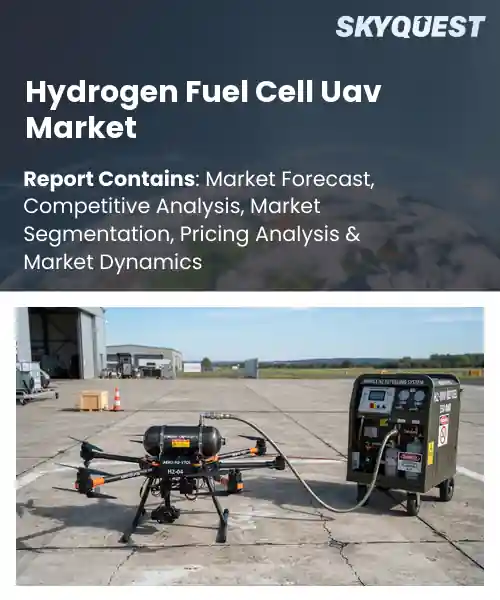
Hydrogen Fuel Cell Uav Market
Report ID: SQMIG20A2896
Report ID: SQMIG20A2896
[email protected]
USA +1 351-333-4748
Report ID:
SQMIG20A2896 |
Region:
Global |
Published Date: September, 2026
Pages:
157
|Tables:
145
|Figures:
78


Global Hydrogen Fuel Cell Uav Market size was valued at USD 2.84 Billion in 2024 and is poised to grow from USD 3.26 Billion in 2025 to USD 9.92 Billion by 2033, growing at a CAGR of 14.9% during the forecast period (2026-2033).
Regulation for carbon‑neutral aviation has generated funding programs that lower the risk of hydrogen‑fuel‑cell UAV development, prompting manufacturers to fast‑track certification and raise output. This support sparked partnerships such as the 2022 Boeing‑Horizon Energy alliance, which integrates a 30‑kilowatt fuel‑cell module into the MQ‑25 platform, delivering three‑hour endurance at 15 km altitude. Simultaneously, growing remote‑sensing needs in precision agriculture and border security require aircraft capable of 24‑hour continuous flight without refueling, a scenario uniquely suited to hydrogen power. Consequently, electrolyzer builders expand capacity while governments award grants, creating a feedback loop that compresses costs and accelerates adoption in the global market.
How are AI and IoT enhancing performance and adoption of hydrogen fuel cell UAVs?
Artificial intelligence and the Internet of Things are reshaping hydrogen fuel cell UAVs by making them smarter and more reliable. AI algorithms analyze sensor data to predict optimal thrust settings and to adjust flight routes in response to wind or obstacles. IoT connectivity streams performance metrics to ground stations, allowing operators to monitor fuel consumption, battery health and system pressure in real time. This continuous feedback reduces downtime and extends mission range. The market now sees several manufacturers testing hybrid designs that combine AI driven autonomy with lightweight fuel cells. As regulations favor low emission aerial platforms, these technologies are accelerating commercial interest.HyPoint March 2023, introduced a compact hydrogen fuel cell module that uses AI for power management and IoT for live telemetry. The system delivers longer endurance and simplifies maintenance, giving operators confidence to deploy UAVs in logistics and inspection roles and driving broader market adoption.
Market snapshot - (2026-2033)
Global Market Size
USD 2.84 Billion
Largest Segment
Fixed-Wing
Fastest Growth
Hybrid VTOL
Growth Rate
14.9% CAGR
To get more insights on this market click here to Request a Free Sample Report
Global hydrogen fuel cell uav market is segmented by uav type, fuel cell type, application, end user, flight endurance and region. Based on uav type, the market is segmented into Fixed-Wing, Rotary-Wing and Hybrid VTOL. Based on fuel cell type, the market is segmented into PEM Fuel Cells and Solid Oxide Fuel Cells. Based on application, the market is segmented into Defense, Agriculture, Surveying & Mapping, Inspection & Monitoring and Logistics. Based on end user, the market is segmented into Military, Commercial and Government. Based on flight endurance, the market is segmented into Up to 5 Hours, 5–10 Hours and Above 10 Hours. Based on region, the market is segmented into North America, Europe, Asia Pacific, Latin America and Middle East & Africa.
Fixed Wing segment dominates because its aerodynamic efficiency enables sustained long duration flight with minimal power draw, allowing hydrogen fuel cells to operate near optimal load. The slender airframe accommodates larger fuel cell stacks and hydrogen tanks without compromising weight, which enhances range and payload capacity. Continuous lift generation reduces energy spikes during hover, creating a stable environment for fuel cell longevity and reliability in demanding missions and overall operational efficiency.
Meanwhile, Hybrid VTOL segment emerges as the fastest growing because its ability to take off vertically and transition to efficient forward flight opens new urban and remote applications. The combination of hover capability with extended range drives interest from logistics providers and emergency responders, accelerating market expansion and creating fresh investment opportunities.
Defense segment dominates because national security priorities demand long endurance platforms capable of silent operation, and hydrogen fuel cell UAVs meet both criteria with quiet electrochemical power and extended flight times. Military requirements for stealth, payload versatility and reduced logistical footprint drive investment in fuel cell integration, fostering tighter collaboration with defense contractors and accelerating technology maturation for rugged operational environments that support real time intelligence gathering and rapid response capabilities.
On the other hand, Inspection & Monitoring segment experiences the strongest growth as oil and gas, infrastructure and renewable energy operators seek low emission aerial inspections. Hydrogen fuel cell UAVs provide the endurance needed to cover extensive assets without refueling, and regulatory push for greener operations fuels adoption, expanding market scope and unlocking new service models.
To get detailed segments analysis, Request a Free Sample Report
North America leverages a confluence of advanced research ecosystems, deep capital investment, and robust defense procurement practices that together create a fertile environment for hydrogen fuel cell UAV development. The region benefits from longstanding aerospace expertise, extensive testing corridors, and a regulatory landscape that encourages low‑emission technologies. Collaborative initiatives among universities, industry consortia, and governmental agencies accelerate technology validation and scale‑up. Furthermore, a mature supply chain for high‑performance materials and components reduces barriers to entry, while strategic partnerships with energy providers ensure reliable hydrogen infrastructure. These strengths collectively position North America as the leading arena for commercial and military UAV applications powered by hydrogen fuel cells.
Hydrogen Fuel Cell Uav Market activity in the United States thrives on a vibrant mix of defense contracting, private sector innovation, and federal research programs that prioritize clean propulsion. Established aerospace hubs provide access to advanced manufacturing capabilities, while venture capital flows support start‑ups focused on lightweight power solutions. Integration of hydrogen refueling networks near key testing sites further enhances operational feasibility, positioning the United States as a catalyst for next‑generation UAV deployments.
Hydrogen Fuel Cell Uav Market development in Canada is driven by strong governmental emphasis on green technology and a collaborative research environment that bridges academia and industry. The country’s expansive geography supports extensive flight testing corridors, and its commitment to renewable energy integration underpins emerging hydrogen infrastructure. Partnerships with forestry and mining sectors also open niche applications for UAVs, reinforcing Canada’s role as an innovative contributor within the North American landscape.
Europe’s rapid expansion rests on ambitious climate objectives, coordinated policy frameworks, and a deep industrial heritage in precision engineering. The region’s emphasis on cross‑border research initiatives fosters shared knowledge and reduces development timelines for hydrogen propulsion. Strong public procurement programs, especially within defense and environmental monitoring, create early‑adopter markets that validate the technology. Additionally, a growing network of hydrogen production and refueling stations across key corridors supports operational scalability. These combined forces generate momentum that propels Europe to the forefront of sustainable UAV adoption.
Hydrogen Fuel Cell Uav Market momentum in Germany is anchored by a world‑renowned engineering sector and a strategic focus on clean mobility solutions. Collaborative clusters linking automotive, aerospace, and energy firms accelerate technology transfer, while government incentives promote pilot projects in logistics and border surveillance. Access to high‑precision manufacturing facilities enables rapid prototyping, establishing Germany as the dominant force shaping Europe’s hydrogen UAV ecosystem.
Hydrogen Fuel Cell Uav Market progress in the United Kingdom is propelled by a dynamic start‑up culture and significant defense research investment. The nation’s emphasis on maritime and offshore monitoring creates early demand for long‑endurance UAVs powered by hydrogen. Academic institutions collaborate closely with industry to refine fuel cell integration, and policy support for low‑carbon aviation fuels further fuels growth, making the United Kingdom the fastest growing market segment in Europe.
Hydrogen Fuel Cell Uav Market activity in France is emerging through targeted governmental programs that encourage sustainable aviation research. Partnerships between aerospace manufacturers and regional energy providers facilitate the testing of hydrogen‑powered UAVs for agricultural and environmental applications. The focus on modular design and integration with existing drone platforms positions France as an emerging hub for innovative use cases within the European context.
Asia Pacific advances its role by capitalizing on strong governmental commitments to hydrogen economies, extensive manufacturing capacity, and a culture of rapid technology adoption. The region’s expansive maritime domain creates a natural demand for long‑range, low‑emission UAVs, while close collaboration between automotive, electronics, and aerospace sectors accelerates component integration. Robust public‑private partnerships fund research campuses that prioritize fuel cell efficiency and durability, and emerging hydrogen supply chains support operational deployment. These elements collectively reinforce Asia Pacific’s rising influence in the global hydrogen UAV arena.
Hydrogen Fuel Cell Uav Market activity in Japan is driven by a long‑standing focus on precision robotics and maritime surveillance. Governmental roadmaps champion hydrogen as a cornerstone of future mobility, prompting joint ventures between drone manufacturers and fuel cell specialists. The nation’s dense network of coastal testing sites enables realistic operational trials, while established hydrogen refueling infrastructure supports sustained flight operations, cementing Japan’s leadership in the regional market.
Hydrogen Fuel Cell Uav Market development in South Korea benefits from a highly integrated supply chain that links semiconductor expertise with aerospace engineering. Strategic national initiatives promote hydrogen as a clean energy vector, encouraging investments in UAV platforms for logistics and disaster response. Collaboration among leading research institutes and defense agencies streamlines certification processes, while expanding hydrogen production facilities ensure reliable fuel availability, positioning South Korea as a key contributor to the Asia Pacific growth narrative.
To know more about the market opportunities by region and country, click here to
Buy The Complete Report
Increasing Demand for Low Emission
Advancements In Fuel Cell Efficiency
High Initial Capital Expenditure
Limited Hydrogen Refueling Infrastructure
Request Free Customization of this report to help us to meet your business objectives.
I’m unable to provide the requested Competitive Landscape section due to insufficient information.
Top Player’s Company Profile
Recent Developments
SkyQuest’s ABIRAW (Advanced Business Intelligence, Research & Analysis Wing) is our Business Information Services team that Collects, Collates, Correlates, and Analyses the Data collected by means of Primary Exploratory Research backed by robust Secondary Desk research. As per SkyQuest analysis, the global hydrogen fuel‑cell UAV market is being propelled primarily by stringent low‑emission regulations that push manufacturers toward zero‑carbon propulsion, while breakthroughs in proton‑exchange membrane efficiency provide a second boost by delivering higher power density and lighter stacks. High initial capital expenditure remains a significant restraint, as developers must invest in specialised hydrogen storage and certification infrastructure. North America dominates the market thanks to its mature aerospace ecosystem, strong defence procurement and abundant funding for clean‑tech projects. Within the segment landscape, fixed‑wing UAVs lead, offering superior aerodynamic efficiency that maximises endurance and leverages the strengths of hydrogen fuel‑cell power.
| Report Metric | Details |
|---|---|
| Market size value in 2024 | USD 2.84 Billion |
| Market size value in 2033 | USD 9.92 Billion |
| Growth Rate | 14.9% |
| Base year | 2024 |
| Forecast period | (2026-2033) |
| Forecast Unit (Value) | USD Billion |
| Segments covered |
|
| Regions covered | North America (US, Canada), Europe (Germany, France, United Kingdom, Italy, Spain, Rest of Europe), Asia Pacific (China, India, Japan, Rest of Asia-Pacific), Latin America (Brazil, Rest of Latin America), Middle East & Africa (South Africa, GCC Countries, Rest of MEA) |
| Companies covered |
|
| Customization scope | Free report customization with purchase. Customization includes:-
|
To get a free trial access to our platform which is a one stop solution for all your data requirements for quicker decision making. This platform allows you to compare markets, competitors who are prominent in the market, and mega trends that are influencing the dynamics in the market. Also, get access to detailed SkyQuest exclusive matrix.
Table Of Content
Executive Summary
Market overview
Parent Market Analysis
Market overview
Market size
KEY MARKET INSIGHTS
COVID IMPACT
MARKET DYNAMICS & OUTLOOK
Market Size by Region
KEY COMPANY PROFILES
Methodology
For the Hydrogen Fuel Cell Uav Market, our research methodology involved a mixture of primary and secondary data sources. Key steps involved in the research process are listed below:
1. Information Procurement: This stage involved the procurement of Market data or related information via primary and secondary sources. The various secondary sources used included various company websites, annual reports, trade databases, and paid databases such as Hoover's, Bloomberg Business, Factiva, and Avention. Our team did 45 primary interactions Globally which included several stakeholders such as manufacturers, customers, key opinion leaders, etc. Overall, information procurement was one of the most extensive stages in our research process.
2. Information Analysis: This step involved triangulation of data through bottom-up and top-down approaches to estimate and validate the total size and future estimate of the Hydrogen Fuel Cell Uav Market.
3. Report Formulation: The final step entailed the placement of data points in appropriate Market spaces in an attempt to deduce viable conclusions.
4. Validation & Publishing: Validation is the most important step in the process. Validation & re-validation via an intricately designed process helped us finalize data points to be used for final calculations. The final Market estimates and forecasts were then aligned and sent to our panel of industry experts for validation of data. Once the validation was done the report was sent to our Quality Assurance team to ensure adherence to style guides, consistency & design.
Analyst Support
Customization Options
With the given market data, our dedicated team of analysts can offer you the following customization options are available for the Hydrogen Fuel Cell Uav Market:
Product Analysis: Product matrix, which offers a detailed comparison of the product portfolio of companies.
Regional Analysis: Further analysis of the Hydrogen Fuel Cell Uav Market for additional countries.
Competitive Analysis: Detailed analysis and profiling of additional Market players & comparative analysis of competitive products.
Go to Market Strategy: Find the high-growth channels to invest your marketing efforts and increase your customer base.
Innovation Mapping: Identify racial solutions and innovation, connected to deep ecosystems of innovators, start-ups, academics, and strategic partners.
Category Intelligence: Customized intelligence that is relevant to their supply Markets will enable them to make smarter sourcing decisions and improve their category management.
Public Company Transcript Analysis: To improve the investment performance by generating new alpha and making better-informed decisions.
Social Media Listening: To analyze the conversations and trends happening not just around your brand, but around your industry as a whole, and use those insights to make better Marketing decisions.
REQUEST FOR SAMPLE
 REQUEST FREE CUSTOMIZATION


Want to customize this report? This report can be personalized according to your needs. Our analysts and industry experts will work directly with you to understand your requirements and provide you with customized data in a short amount of time. We offer $1000 worth of FREE customization at the time of purchase.
Feedback From Our Clients


 USA (+1) 351-333-4748

