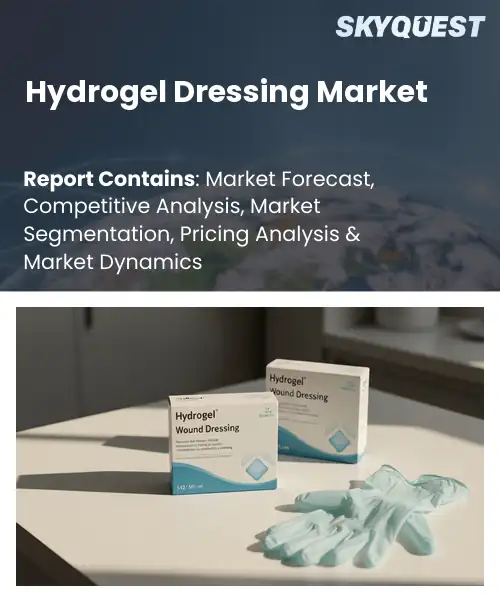
Hydrogel Dressing Market
Report ID: SQMIG35B2305
Report ID: SQMIG35B2305
[email protected]
USA +1 351-333-4748
Report ID:
SQMIG35B2305 |
Region:
Global |
Published Date: May, 2026
Pages:
157
|Tables:
118
|Figures:
72


Global Hydrogel Dressing Market size was valued at USD 1.22 Billion in 2024 and is poised to grow from USD 1.3 Billion in 2025 to USD 2.22 Billion by 2033, growing at a CAGR of 6.91% during the forecast period (2026-2033).
The hydrogel dressing market is driven by an aging global population and consequent rise in chronic wounds such as diabetic ulcers and pressure injuries, which create sustained demand for advanced moist-wound-care solutions. As a category, hydrogel dressings are polymer-based, water-rich wound covers that maintain hydration, support autolytic debridement, and reduce pain, making them valuable across hospitals, long-term care and home-health settings. Over the past two decades the market evolved from simple amorphous gels to cross-linked, antimicrobial and bioactive formulations, with major suppliers like Smith & Nephew and Convatec expanding portfolios while regulatory approvals and clinical evidence have progressively broadened adoption.
A key trend driving the global hydrogel dressing sector is technological innovation in polymer chemistry and formulation, because improved cross-linking and incorporation of antimicrobial agents directly enhance healing outcomes and patient comfort, prompting clinicians to prefer hydrogel options. As a result manufacturers invest in bioactive and sustained-release hydrogels that target diabetic foot ulcers, donor sites and partial-thickness burns, which increases clinical trial activity and payer consideration. Wider availability of easy-to-use dressings facilitates transition to outpatient and home-based care, thereby lowering treatment costs and expanding addressable markets in emerging economies. Consequently market revenues rise while ancillary opportunities emerge for digital wound monitoring and bundled care pathways.
How will Ai-driven Analytics Improve Commercialization Strategies in the Hydrogel Dressing Market?
AI driven analytics will sharpen commercialization strategies in the hydrogel dressing market by connecting clinical performance to commercial decisions. Key aspects include predictive wound assessment, demand forecasting, clinician and consumer segmentation, pricing intelligence, and real world outcome monitoring. The current market favors evidence led products sold in both hospital and retail channels so manufacturers must show clear usability and healing benefits to win adoption. Practical instances include AI wound imaging for objective assessment and market intelligence platforms that help tailor launch plans, prioritize channels, and improve clinician engagement through data driven insights.
In March 2026, Sonoma Pharmaceuticals recently launched an advanced burn relief hydrogel in major US retailers, and AI driven analytics can speed such roll outs by optimizing channel placement, personalizing consumer messaging, and linking sales to clinical outcomes for continuous improvement.
Market snapshot - (2026-2033)
Global Market Size
USD 1.22 Billion
Largest Segment
Amorphous Hydrogel Dressings
Fastest Growth
Sheet Hydrogel Dressings
Growth Rate
6.91% CAGR
To get more insights on this market click here to Request a Free Sample Report
Global hydrogel dressing market is segmented by product type, wound type, end-user, distribution and region. Based on product type, the market is segmented into Amorphous Hydrogel Dressings, Impregnated Hydrogel Dressings and Sheet Hydrogel Dressings. Based on wound type, the market is segmented into Burns, Pressure Ulcers, Diabetic Foot Ulcers and Surgical Wounds. Based on end-user, the market is segmented into Hospitals, Home Healthcare and Wound Care Clinics. Based on distribution, the market is segmented into Direct to Hospitals, Distributors and Online. Based on region, the market is segmented into North America, Europe, Asia Pacific, Latin America and Middle East & Africa.
Based on the global hydrogel dressing market growth, amorphous hydrogel dressings segment dominates because their highly conformable, gel based matrices promote intimate contact with irregular wound beds, enhancing moisture balance and facilitating autolytic debridement. This clinical suitability across burns, pressure ulcers and chronic wounds drives clinician preference and procurement. Additionally, manufacturing simplicity and formulation versatility enable varied therapeutic loadings, causing wide adoption in both acute care and home settings as a go to dressing choice.
However, sheet hydrogel dressings is emerging as the most rapidly expanding area because preformed shapes and adhesive backs simplify application for surgical and outpatient care, improving comfort and reducing change time. New antimicrobial coatings and laminated designs are driving approvals and adoption in ambulatory and home care, expanding product availability and clinical use.
Distributors segment dominates because established distribution networks aggregate a broad range of hydrogel dressing portfolios and provide critical logistics, inventory management and training services to clinical customers. By offering regulatory documentation and bundling product purchases together with consumables, hospitals and clinics are able to streamline their procurement processes and ensure that product is consistently flowing into both acute care and outpatient settings, as well as providing a means for manufacturers to expand the amount of market presence. This distribution is based on trust and allows clinicians to quickly access new formulas.
However, online is witnessing the strongest growth momentum as e commerce platforms and specialty portals expand direct access for patients and caregivers, supporting home healthcare and telemedicine models. Improved digital marketing, easier replenishment and targeted education for self care are increasing demand, enabling rapid market entry for niche hydrogel innovations and personalized product offerings.
To get detailed segments analysis, Request a Free Sample Report
Based on the global hydrogel dressing market share, North America dominates the industry due to an integrated combination of advanced clinical infrastructure, robust research and development capabilities, and strong commercial pathways that accelerate product adoption. Wound care innovation is supported by existing reimbursement systems, early clinical usage in both hospital and outpatient settings, as well as established wound management specialty centers and KOLs that allow for validation of new formulations. Also, the strength of the overall medtech investment and partner ecosystem allows for quick scale-up and distribution. Although there may be some limitations to regulatory systems, there is always clear direction provided by regulators which help manufacturers maximize performance and find appropriate routes for entry into the market. Collaboration between industry and academia also supports iterative development and generation of real-world evidence.
Hydrogel dressing market in the United States benefits from concentrated clinical expertise, established distribution channels, and high demand from hospital wound care services. There is a close working relationship between device developers and wound care experts in order to ensure that product features are developed and tested through clinical feedback. Both device manufacturers and clinicians are encouraged to collaborate on product development due to the reimbursement and procurement practices in place for comprehensive wound management. An interconnected network of specialized facilities and their business associates serve as conduits for promoting technology transfer throughout a variety of health service settings both acute and outpatient.
Hydrogel dressing market in Canada reflects a collaborative approach between provincial health systems and manufacturers, emphasizing evidence-based adoption and cost-effective wound care pathways. Clinical networks and specialized clinics provide programs and education for clinicians that help promote acceptance. The procurement framework will enable centralised purchasing of innovative dressings which allows for wider distribution throughout the health system. Research initiatives at the local level and partnerships with industry help provide real-world performance data to clinicians, building their confidence and creating more consistent implementation across the continuum of care.
Based on global hydrogel dressing regional forecast, rapid expansion of the industry in Europe is driven by a convergence of strong clinical demand for advanced wound care, progressive adoption across hospital and community care, and proactive engagement by healthcare authorities and professional societies. Germany has established strong manufacturing capabilities and clinical networks that validate the therapeutic benefits of product use. The United Kingdom (UK) has exhibited an agile adoption dynamic which has been fostered by utilizing procurement pilots and funding to innovate through streamlined channels. France is beginning to emerge through targeted research initiatives and a growing integration of the wound care pathway. The harmonization of regulatory standards as well as collaboration on a cross-border basis among clinicians, payers, and suppliers supports a faster diffusion of new formulation into their respective markets. Evidence generation, clinician education, value-based procurement, and continued regional momentum are supported by partnerships between industry and healthcare systems to create a market with diverse offerings and accessibility within them.
Hydrogel dressing market in Germany is characterized by strong domestic manufacturing expertise, well-established clinical research networks, and proactive hospital procurement practices that support adoption. Clinical validation, and working alongside specialized centres and academic institutions, supports improved product applications. Strong distribution channels combined with partnerships involving wound care specialists ensure wide-ranging access to products in acute and outpatient environments. The strong focus on quality products, regulatory compliance and clinician engagement position Germany as a leader in the industry.
Hydrogel dressing market in the United Kingdom is marked by rapid adoption driven by agile procurement pilots, strong clinical leadership in wound care, and active industry engagement with health services. Effective collaboration among stakeholders such as clinicians, healthcare administrators and suppliers helps test and develop incremental improvements. As funding sources and innovation networks facilitate the translation of initiatives from pilot projects to larger scale usage, increased focus on cost-effectiveness and clinician education will lead to faster acceptance of these efforts throughout hospitals and communities across the country.
Hydrogel dressing market in France is emerging through strengthened clinical research, growing clinician awareness, and targeted initiatives to integrate advanced wound care into standard pathways. Increased communication among manufacturers and health stakeholders enables projects that demonstrate the value of new products. By focusing on training of clinicians and demonstrating value through a results-driven process, healthcare providers will feel more confident in using new products consistently throughout both hospitals and community-based healthcare environments.
As per global hydrogel dressing regional outlook, Asia Pacific is strengthening its position in the industry through strategic investments in manufacturing scale-up, targeted clinical research, and growing integration of wound care services across both advanced and emerging healthcare systems. Japan and South Korea play leading roles in developing technologies and materials as well as facilitating collaboration between manufacturers and clinical services. Local suppliers are increasingly adapting their formulations based on local preferences for clinical use and care delivery; while cross-border collaboration increases product distribution and sharing of expertise. Increased clinician education, the establishment of specialty wound care fields, and partnerships between industry and academia support use. Gradually improving regulatory harmonization and clinician training also support greater use across markets. All stakeholders are benefiting from the increased competitiveness of the region and the commercialization of products/services geographically in all types of care facilities.
Hydrogel dressing market in Japan benefits from advanced material science research, close collaboration between manufacturers and clinical institutions, and a strong focus on product refinement for high-quality wound care outcomes. Clinical trial centers are assessing new products and technologies and providing ongoing assistance with their continued development. In contrast, manufacturers focus on manufacturing quality and regulatory compliance. Hospitals and outpatient clinics receive education about how to utilize new products within their respective protocols.
Hydrogel dressing market in South Korea is strengthened by strong ties between innovative manufacturers and specialized clinical research centers that prioritize product performance and usability. By focusing on material innovation and production efficiency, competitive solutions will meet the clinical needs of consumers. The use of cooperative pilot studies and active clinician interaction help define product position. They already developed distribution networks and educational programs help facilitate the adoption of products by providers in the hospital and community settings as well as generate evidence to support their use in the real world.
To know more about the market opportunities by region and country, click here to
Buy The Complete Report
Improved Clinical Outcomes With Hydrogel
Advancements In Hydrogel Formulations
High Costs Impact Adoption
Complex Regulatory Approval Processes
Request Free Customization of this report to help us to meet your business objectives.
Competitive intensity in the global hydrogel dressing market outlook has risen as incumbents pursue targeted acquisitions, regulatory clearances and distribution deals to add antimicrobial and biosynthetic cellulose technologies. Examples include Evonik’s acquisition of JeNaCell and Kane Biotech’s FDA clearance for an antimicrobial hydrogel, while European spinouts secure translational funding and distribution partnerships to accelerate product launches.
Top Player’s Company Profile
Recent Developments
SkyQuest’s ABIRAW (Advanced Business Intelligence, Research & Analysis Wing) is our Business Information Services team that Collects, Collates, Correlates, and Analyses the Data collected by means of Primary Exploratory Research backed by robust Secondary Desk research.
As per SkyQuest analysis, the global hydrogel dressing industry is propelled by an aging population and rising chronic wounds, supported by technological innovation in polymer chemistry that is enabling bioactive, antimicrobial and sustained-release formulations. Adoption is strongest in North America where advanced clinical infrastructure, reimbursement frameworks and active wound care networks drive uptake. Amorphous hydrogel dressings dominate the product mix due to their conformability and versatility across wound types. As a result of cost constraints applied to premium/advanced dressings, cost pressure continues to be a significant barrier to product adoption, especially in price-sensitive healthcare systems and emerging markets. Manufacturers who integrate evidence generation along with evidence of cost-effectiveness and digital commercialization will have an advantage in the market in terms of capturing potential growth opportunities.
| Report Metric | Details |
|---|---|
| Market size value in 2024 | USD 1.22 Billion |
| Market size value in 2033 | USD 2.22 Billion |
| Growth Rate | 6.91% |
| Base year | 2024 |
| Forecast period | (2026-2033) |
| Forecast Unit (Value) | USD Billion |
| Segments covered |
|
| Regions covered | North America (US, Canada), Europe (Germany, France, United Kingdom, Italy, Spain, Rest of Europe), Asia Pacific (China, India, Japan, Rest of Asia-Pacific), Latin America (Brazil, Rest of Latin America), Middle East & Africa (South Africa, GCC Countries, Rest of MEA) |
| Companies covered |
|
| Customization scope | Free report customization with purchase. Customization includes:-
|
To get a free trial access to our platform which is a one stop solution for all your data requirements for quicker decision making. This platform allows you to compare markets, competitors who are prominent in the market, and mega trends that are influencing the dynamics in the market. Also, get access to detailed SkyQuest exclusive matrix.
Table Of Content
Executive Summary
Market overview
Parent Market Analysis
Market overview
Market size
KEY MARKET INSIGHTS
COVID IMPACT
MARKET DYNAMICS & OUTLOOK
Market Size by Region
KEY COMPANY PROFILES
Methodology
For the Hydrogel Dressing Market, our research methodology involved a mixture of primary and secondary data sources. Key steps involved in the research process are listed below:
1. Information Procurement: This stage involved the procurement of Market data or related information via primary and secondary sources. The various secondary sources used included various company websites, annual reports, trade databases, and paid databases such as Hoover's, Bloomberg Business, Factiva, and Avention. Our team did 45 primary interactions Globally which included several stakeholders such as manufacturers, customers, key opinion leaders, etc. Overall, information procurement was one of the most extensive stages in our research process.
2. Information Analysis: This step involved triangulation of data through bottom-up and top-down approaches to estimate and validate the total size and future estimate of the Hydrogel Dressing Market.
3. Report Formulation: The final step entailed the placement of data points in appropriate Market spaces in an attempt to deduce viable conclusions.
4. Validation & Publishing: Validation is the most important step in the process. Validation & re-validation via an intricately designed process helped us finalize data points to be used for final calculations. The final Market estimates and forecasts were then aligned and sent to our panel of industry experts for validation of data. Once the validation was done the report was sent to our Quality Assurance team to ensure adherence to style guides, consistency & design.
Analyst Support
Customization Options
With the given market data, our dedicated team of analysts can offer you the following customization options are available for the Hydrogel Dressing Market:
Product Analysis: Product matrix, which offers a detailed comparison of the product portfolio of companies.
Regional Analysis: Further analysis of the Hydrogel Dressing Market for additional countries.
Competitive Analysis: Detailed analysis and profiling of additional Market players & comparative analysis of competitive products.
Go to Market Strategy: Find the high-growth channels to invest your marketing efforts and increase your customer base.
Innovation Mapping: Identify racial solutions and innovation, connected to deep ecosystems of innovators, start-ups, academics, and strategic partners.
Category Intelligence: Customized intelligence that is relevant to their supply Markets will enable them to make smarter sourcing decisions and improve their category management.
Public Company Transcript Analysis: To improve the investment performance by generating new alpha and making better-informed decisions.
Social Media Listening: To analyze the conversations and trends happening not just around your brand, but around your industry as a whole, and use those insights to make better Marketing decisions.
REQUEST FOR SAMPLE
 REQUEST FREE CUSTOMIZATION
Global Hydrogel Dressing Market size was valued at USD 1.22 Billion in 2024 and is poised to grow from USD 1.3 Billion in 2025 to USD 2.22 Billion by 2033, growing at a CAGR of 6.91% during the forecast period (2026-2033).
Competitive intensity in the global hydrogel dressing market has risen as incumbents pursue targeted acquisitions, regulatory clearances and distribution deals to add antimicrobial and biosynthetic cellulose technologies. Examples include Evonik’s acquisition of JeNaCell and Kane Biotech’s FDA clearance for an antimicrobial hydrogel, while European spinouts secure translational funding and distribution partnerships to accelerate product launches. 'Smith & Nephew', 'Mölnlycke Health Care', 'Coloplast A/S', 'Convatec Group', '3M Company', 'Hartmann Group', 'BSN Medical (Essity)', 'Paul Hartmann', 'Derma Sciences (Integra)', 'Medline Industries', 'Hollister Inc.', 'Cardinal Health', 'McKesson Corporation', 'Kruuse Group', 'Hydrofera LLC'
Improved moisture balance and atraumatic removal properties of hydrogel dressings promote a favorable wound environment that supports tissue repair and patient comfort. These clinical advantages reduce dressing change trauma and enhance adherence among clinicians and patients, which in turn increases clinician preference and institutional adoption. As wound healing becomes more predictable and care pathways prioritize patient-centered outcomes, hydrogel dressings are viewed as effective tools in standard protocols, driving procurement decisions and encouraging broader integration across outpatient, hospital, and home-care settings.
Personalized Wound Care Solutions: Demand is rising for hydrogel dressings tailored to individual patient needs and specific wound types, prompting suppliers to develop varied formulations and adaptable product lines. Clinicians and care facilities are seeking options that address patient comfort, moisture balance and comorbidity considerations, enabling more targeted healing pathways. This trend fosters closer collaboration between manufacturers and clinical teams to design dressing kits that can be customized by formulation and size, improving adherence, clinical experience and perceived value across care settings.
Why does North America Dominate the Global Hydrogel Dressing Market? |@12


Want to customize this report? This report can be personalized according to your needs. Our analysts and industry experts will work directly with you to understand your requirements and provide you with customized data in a short amount of time. We offer $1000 worth of FREE customization at the time of purchase.
Feedback From Our Clients


 USA (+1) 351-333-4748

