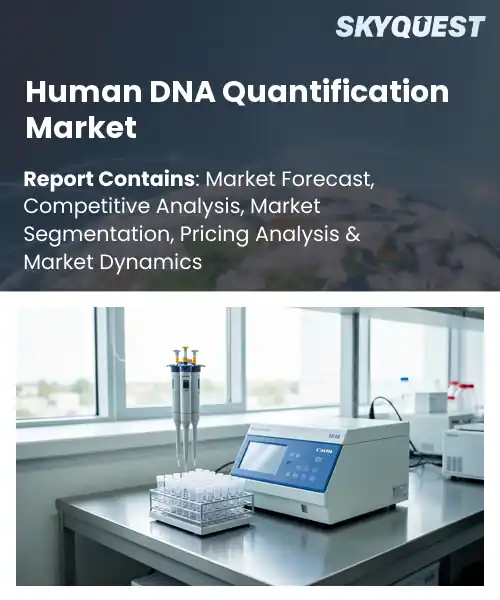
Human DNA Quantification Market
Report ID: SQMIG35J2678
Report ID: SQMIG35J2678
[email protected]
USA +1 351-333-4748
Report ID:
SQMIG35J2678 |
Region:
Global |
Published Date: August, 2026
Pages:
157
|Tables:
118
|Figures:
77


Global Human Dna Quantification Market size was valued at USD 2.18 Billion in 2024 and is poised to grow from USD 2.37 Billion in 2025 to USD 4.58 Billion by 2033, growing at a CAGR of 8.6% during the forecast period (2026-2033).
The need for accurate input of DNA in clinical diagnostic tests owing to regulatory requirements is the next big catalyst for the human DNA quantification market worldwide. Agencies ask for validation of the exact amount of DNA to be used in order to get reproducible results, which compels laboratories to use automated fluorescence-based systems with sample tracking and analysis on the cloud platform. In the field of oncology, the use of companion diagnostic panel in 2022 made hospitals procure highly precise quantifiers, and hence vendors increased their research and development activities to develop multiplexing kits.
How is AI-driven Automation Reshaping the Human DNA Quantification Market?
The application of artificial intelligence in automation is revolutionizing the Human DNA Quantification market through increasing the efficiency, consistency, and scalability of DNA quantification and quality analysis. Automated fluid-handling devices can handle tasks such as sample preparation, dispensing reagents, and transferring samples, thus minimizing manual error and inconsistencies. AI algorithms can also be used to analyze absorbance and fluorescence data, detect any anomalies, recognize contaminants, and enhance interpretation precision. The integration of NGS protocols and LIMS allows for automation in evaluating whether the DNA samples are appropriate for sequencing, thus eliminating failed sequencing runs, reagent wastage, and time consumption. These technologies will be extremely beneficial in forensic labs, clinical diagnosis, biotech companies, pharma research, and genomics, considering that these areas use a lot of samples which require standardization of workflows. Innovations from startup development will be quite helpful in this regard as startups focusing on AI-enabled lab automation and intelligent sample-analysis solutions are aiding laboratories to incorporate robotics and data analytics into their quality management process.
Market snapshot - (2026-2033)
Global Market Size
USD 2.18 Billion
Largest Segment
Kits & Reagents
Fastest Growth
Software
Growth Rate
8.6% CAGR
To get more insights on this market click here to Request a Free Sample Report
Global human dna quantification market is segmented by product type, technology, application, end user and region. Based on product type, the market is segmented into Kits & Reagents, Instruments and Software. Based on technology, the market is segmented into qPCR, Fluorometry and Spectrophotometry. Based on application, the market is segmented into Forensic Testing, Clinical Diagnostics, Research and NGS Sample Preparation. Based on end user, the market is segmented into Diagnostic Laboratories, Research Institutes and Forensic Laboratories. Based on region, the market is segmented into North America, Europe, Asia Pacific, Latin America and Middle East & Africa.
QPCR segment prevails since the method offers high-specificity amplification, which allows for accurate quantitation of low-copy human DNA. The well-proven methodology of the qPCR is well compatible with standard laboratory practices and offers reproducible results in compliance with forensic and clinical requirements. Data of validation and regulatory clearance provide additional guarantees to end-users, who stimulate investment in qPCR systems and consolidate the segment's leading position on the market. Compatibility of the qPCR with downstream applications including next-generation sequencing increases the attractiveness of the technology.
Nevertheless, the Fluorometry segment proves itself to be the fastest-growing segment of the Human DNA Quantification Market. Real-time analysis feature makes the method simple, appealing to laboratories interested in throughput and reduced costs of consumables.
Instruments Segment leads as the precision of hardware ensures signal detection is consistent enough for accurate human DNA quantification. Instruments have optical components and temperature control that make the devices produce consistently reliable results with different kinds of samples. Instruments can be easily integrated with laboratory information management systems to streamline work and raise efficiency. Robustness and scalability of these instruments inspire trust and confidence on the part of diagnostic labs and research facilities. Firmware update options and design of instruments allow users to adjust to specific needs of assays, which makes instrumentation relevant.
At the same time, Kits & Reagents Segment becomes more popular in the Human DNA Quantification Market. Easy-to-use kits decrease time spent on training personnel and reduce errors. Innovation in reagents chemistry increases sensitivity and compatibility with samples and helps to adopt kits for forensic, clinical, and research use.
To get detailed segments analysis, Request a Free Sample Report
North America dominates owing to the presence of an excellent research infrastructure, widespread use of sophisticated analytical tools, and a conducive funding environment that stimulates innovations in biomedicine. Universities and biotech companies foster a synergistic approach to developing and validating assays. The regulations promote clinical translation, whereas the broad availability of clinical laboratories facilitates fast deployment. Government agencies and industry consortia collaborate in a healthcare ecosystem to facilitate the exchange of knowledge and standardization. Participants in the market enjoy an experienced workforce as well as precision medicine culture, which stimulates demand for high-quality DNA quantification systems.
Human DNA Quantification Market in the United States is aided by the presence of many world-class universities along with an active biotechnology cluster which provides the necessary push to drive constant innovation. Abundant venture capital funding ensures fast commercialization of new quantification technologies. These technologies are used by integrated healthcare providers for personalized medicine, thus driving the demand. Public-private partnerships help in standardization, while regulatory clearances make sure of clinical acceptance of these technologies.
Canadian Human DNA Quantification Market sees benefits from research-driven activities funded by the government along with an ecosystem that connects universities, hospitals, and biotechnology startups. Focus on multi-disciplinary research fosters innovation in quantification tools and techniques used in clinical genomics and environmental monitoring applications. Availability of skilled manpower and favorable policy support provides impetus for investments, whereas public health campaigns incorporate DNA quantification within disease surveillance.
The growth of Europe is driven by its strong public health initiatives, wide-ranging research networks, and harmonized standards that encourage cross-border cooperation. The governments emphasize genomics and personalized medicines, offering a funding framework that encourages development and validation of assays. The availability of prestigious research institutions in Germany, the United Kingdom, and France ensures that there is a pipeline of both solutions and talented people. Consortia in the industry help to create common standards that make DNA quantification platforms more interoperable. Furthermore, the existing clinical laboratory capabilities across Europe contribute to rapid implementation of new DNA quantification technology in diagnostics, forensics, and agricultural biotechnology.
DNA Quantification Market of Human DNA in Germany
Germany’s Human DNA Quantification Market is bolstered by a large number of biotechnology companies and world-class research centers dedicated to developing assays. The federal government emphasizes genomics research, bringing academia and industry together. Clinical lab systems incorporate quantification techniques on a regular basis, and strict quality guidelines ensure reliability. These factors maintain Germany’s dominance in the European market context.
United Kingdom Human DNA Quantification Market
Human DNA Quantification Market in United Kingdom experiences accelerated growth through a dynamic mix of university research excellence and a thriving life‑science sector. Government incentives encourage translational projects, linking discovery with commercial deployment. Strong emphasis on personalized medicine within the NHS creates a ready market for precise DNA measurement tools. Collaborative hubs and biotech incubators further amplify innovation, positioning the United Kingdom as the fastest growing market in Europe.
France’s Human DNA Quantification Market represents a significant area of innovation for assays based on research being conducted in France by relevant research organizations and the thriving biotechnology industry there. The research into genomics as well as related public health measures helps promote the use of DNA quantification technology in both clinical and agricultural sectors. Collaboration between laboratory researchers and startups helps to transfer technologies, and regulatory compliance to European standards helps access the market.
Asia Pacific has been enhancing its presence through investments made in the genomic infrastructure, increasing demands for precision diagnostics, and improving biopharmaceuticals manufacturing facilities. Science and technology programs have become a priority for many governments in the area and involve funding research laboratories and transferring technologies. Modernization of the clinical laboratories and introduction of DNA quantification into regular tests make it easier to penetrate the market. The manufacturing base in Japan and South Korea allows producing quality reagents and equipment at reduced costs. Academic-industry collaboration helps to foster innovations. Increased awareness of the forensic and environmental applications makes demands even more diverse.
The Human DNA Quantification Market in Japan has a lot going for it because of the developed research environment and concentration on the provision of cutting-edge healthcare solutions. The government drives efforts towards incorporating DNA quantification into the clinical diagnostic process and individualized medicines programs. The cooperation between prominent manufacturers and research facilities helps develop highly accurate instruments. The developed QA system and a smooth regulation process speed up market penetration.
Market for Human DNA Quantification in South Korea flourishes thanks to robust government encouragement of biotechnology and startup environment. Genome research and collaboration with international partners speeds up the development of new technologies. National firms manufacture modern reagents and equipment for DNA quantification, making possible low cost and quick delivery. Inclusion of the DNA quantification into the country’s health programs and forensic labs enlarges its applications.
To know more about the market opportunities by region and country, click here to
Buy The Complete Report
Advances in Sequencing Technologies
Increasing Demand for Personalized Medicine
Stringent Regulatory Compliance Requirements
High Costs of Advanced Instrumentation
Request Free Customization of this report to help us to meet your business objectives.
The competitive environment in the global market for human DNA quantification depends on factors such as the aggressive push of M&A deals, strategic collaboration among businesses, and development of novel platforms for assays, which are in response to the increasing demands for accurate genome testing; the recent collaboration between assay makers and platform providers is responsible for this product differentiation.
Recent Developments in the Human DNA Quantification Market
SkyQuest’s ABIRAW (Advanced Business Intelligence, Research & Analysis Wing) is our Business Information Services team that Collects, Collates, Correlates, and Analyses the Data collected by means of Primary Exploratory Research backed by robust Secondary Desk research.
As per SkyQuest analysis, the global human DNA quantification market is being driven mainly by innovations in high throughput sequencing that need quantification to be accurate for both clinical and research applications, with the growing demand for personalized medicine contributing to the same. The qPCR market is leading the way in terms of technology due to its accuracy and suitability for downstream applications, whereas North America is leading the market because of its advanced research framework and availability of funds. However, the need for strict compliance with regulations becomes a barrier due to the high costs involved and the delay in launching products.
| Report Metric | Details |
|---|---|
| Market size value in 2024 | USD 2.18 Billion |
| Market size value in 2033 | USD 4.58 Billion |
| Growth Rate | 8.6% |
| Base year | 2024 |
| Forecast period | (2026-2033) |
| Forecast Unit (Value) | USD Billion |
| Segments covered |
|
| Regions covered | North America (US, Canada), Europe (Germany, France, United Kingdom, Italy, Spain, Rest of Europe), Asia Pacific (China, India, Japan, Rest of Asia-Pacific), Latin America (Brazil, Rest of Latin America), Middle East & Africa (South Africa, GCC Countries, Rest of MEA) |
| Companies covered |
|
| Customization scope | Free report customization with purchase. Customization includes:-
|
To get a free trial access to our platform which is a one stop solution for all your data requirements for quicker decision making. This platform allows you to compare markets, competitors who are prominent in the market, and mega trends that are influencing the dynamics in the market. Also, get access to detailed SkyQuest exclusive matrix.
Table Of Content
Executive Summary
Market overview
Parent Market Analysis
Market overview
Market size
KEY MARKET INSIGHTS
COVID IMPACT
MARKET DYNAMICS & OUTLOOK
Market Size by Region
KEY COMPANY PROFILES
Methodology
For the Human DNA Quantification Market, our research methodology involved a mixture of primary and secondary data sources. Key steps involved in the research process are listed below:
1. Information Procurement: This stage involved the procurement of Market data or related information via primary and secondary sources. The various secondary sources used included various company websites, annual reports, trade databases, and paid databases such as Hoover's, Bloomberg Business, Factiva, and Avention. Our team did 45 primary interactions Globally which included several stakeholders such as manufacturers, customers, key opinion leaders, etc. Overall, information procurement was one of the most extensive stages in our research process.
2. Information Analysis: This step involved triangulation of data through bottom-up and top-down approaches to estimate and validate the total size and future estimate of the Human DNA Quantification Market.
3. Report Formulation: The final step entailed the placement of data points in appropriate Market spaces in an attempt to deduce viable conclusions.
4. Validation & Publishing: Validation is the most important step in the process. Validation & re-validation via an intricately designed process helped us finalize data points to be used for final calculations. The final Market estimates and forecasts were then aligned and sent to our panel of industry experts for validation of data. Once the validation was done the report was sent to our Quality Assurance team to ensure adherence to style guides, consistency & design.
Analyst Support
Customization Options
With the given market data, our dedicated team of analysts can offer you the following customization options are available for the Human DNA Quantification Market:
Product Analysis: Product matrix, which offers a detailed comparison of the product portfolio of companies.
Regional Analysis: Further analysis of the Human DNA Quantification Market for additional countries.
Competitive Analysis: Detailed analysis and profiling of additional Market players & comparative analysis of competitive products.
Go to Market Strategy: Find the high-growth channels to invest your marketing efforts and increase your customer base.
Innovation Mapping: Identify racial solutions and innovation, connected to deep ecosystems of innovators, start-ups, academics, and strategic partners.
Category Intelligence: Customized intelligence that is relevant to their supply Markets will enable them to make smarter sourcing decisions and improve their category management.
Public Company Transcript Analysis: To improve the investment performance by generating new alpha and making better-informed decisions.
Social Media Listening: To analyze the conversations and trends happening not just around your brand, but around your industry as a whole, and use those insights to make better Marketing decisions.
REQUEST FOR SAMPLE
 REQUEST FREE CUSTOMIZATION
Global Human Dna Quantification Market size was valued at USD 2.18 Billion in 2024 and is poised to grow from USD 2.37 Billion in 2025 to USD 4.58 Billion by 2033, growing at a CAGR of 8.6% during the forecast period (2026-2033).
The global human DNA quantification market is shaped by intense competition as firms accelerate M&A activity, forge strategic partnerships, and launch innovative assay platforms to meet rising demand for precise genomic analysis; recent collaborations between assay developers and instrument manufacturers, along with acquisitions of niche technology providers, are driving rapid product differentiation and expanding market reach. 'Thermo Fisher Scientific Inc.', 'QIAGEN N.V.', 'F. Hoffmann-La Roche Ltd.', 'Agilent Technologies, Inc.', 'Bio-Rad Laboratories, Inc.', 'Danaher Corporation', 'Promega Corporation', 'Merck KGaA', 'PerkinElmer, Inc.', 'Takara Bio Inc.', 'Hamilton Company', 'LGC Limited', 'Analytik Jena GmbH', 'Tecan Group Ltd.', 'DiaSorin S.p.A.', 'Illumina, Inc.', 'Standard BioTools Inc.', 'Oxford Nanopore Technologies plc', 'Revvity, Inc.', 'Norgen Biotek Corp.'
Advances in high‑throughput sequencing have reduced turnaround time, making DNA quantification more accessible for routine clinical workflows. Laboratories can now process larger sample volumes with consistent accuracy, which encourages broader adoption across research and diagnostic settings. The enhanced reliability of quantitative results supports clinicians in making informed decisions, thereby driving demand for robust quantification platforms. As a result, manufacturers invest in product innovation to meet evolving expectations, further reinforcing market expansion. This momentum also stimulates collaborative efforts among academia, industry, and healthcare providers to streamline workflows.
Precision Oncology Integration: The adoption of high‑resolution DNA quantification platforms is accelerating the integration of precision oncology workflows, enabling clinicians to tailor therapeutic regimens based on exact tumor burden and genetic heterogeneity. Laboratories are increasingly embedding quantitative assays into routine diagnostic panels, which shortens decision cycles and improves patient stratification. This shift is driven by growing confidence in assay reproducibility, expanding biomarker panels, and the need for data‑rich inputs to support emerging immunotherapy and targeted drug combinations globally across varied health settings today.
Why does North America Dominate the Global Human DNA Quantification Market? |@12


Want to customize this report? This report can be personalized according to your needs. Our analysts and industry experts will work directly with you to understand your requirements and provide you with customized data in a short amount of time. We offer $1000 worth of FREE customization at the time of purchase.
Feedback From Our Clients


 USA (+1) 351-333-4748

