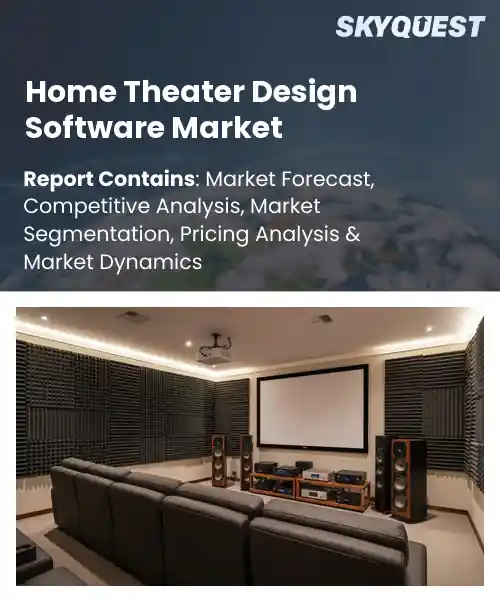
Home Theater Design Software Market
Report ID: SQMIG45E3196
Report ID: SQMIG45E3196
[email protected]
USA +1 351-333-4748
Report ID:
SQMIG45E3196 |
Region:
Global |
Published Date: August, 2026
Pages:
157
|Tables:
118
|Figures:
77


Global Home Theater Design Software Market size was valued at USD 742.0 Million in 2024 and is poised to grow from USD 812.49 Million in 2025 to USD 1679.32 Million by 2033, growing at a CAGR of 9.5% during the forecast period (2026-2033).
Home theater design software encompasses digital tools that enable architects, integrators, and consumers to visualize, plan, and refine audiovisual environments before construction. Its relevance stems from the growing consumer appetite for immersive media experiences and the technical complexity of aligning acoustics, seating, and projection geometry. The market originated in the early 2000s as simple 2‑D layout programs, then evolved through 3‑D rendering engines and cloud‑based collaboration platforms. Companies such as Chief Architect and Autodesk introduced modules that integrate lighting simulation and speaker placement, accelerating adoption among boutique installers. This evolution illustrates how demand for precision and cost‑efficiency has driven innovation. The next critical factor propelling market expansion is the integration of augmented reality (AR) workflows that let stakeholders experience a simulated theater instantly.
When an installer overlays a 3‑D model onto a client’s living room using a headset, design adjustments become immediate, reducing rework and shortening project timelines. This cause‑effect chain boosts profitability for firms and deepens consumer confidence, encouraging larger purchases. Additionally, the rise of streaming platforms has sparked demand for premium home cinema setups, prompting software vendors to add streaming‑content optimization scripts. These capabilities open new revenue streams for developers and create strategic long‑term partnerships with media providers.
How is AI Integration Transforming the Home Theater Design Software Market?
The introduction of AI into this industry has transformed the development software used in designing home theaters. Software products now exist that can analyze room dimensions, model sound projection in a room and provide alternative layouts without any need for calculation. Vendors have used generative design and real-time rendering in order to allow the use of several alternative designs at once. This has shortened the design process, reduced the requirement for expertise, and made quality designs affordable to DIY designers. Some examples of such innovations include AI powered speaker arrangement tips and lighting-aware visualizations for an enhanced planning experience. Recent AI enabled versions of software have improved the workflow process while removing the need for drafting, enabling the designer to concentrate on creative choices and hence speeding up production, thereby fostering market growth and improving efficiency.
Market snapshot - (2026-2033)
Global Market Size
USD 742.0 Million
Largest Segment
Fastest Growth
Growth Rate
9.5% CAGR
To get more insights on this market click here to Request a Free Sample Report
Global home theater design software market is segmented by deployment, software type, application, end user and region. Based on deployment, the market is segmented into Cloud-Based and On-Premises. Based on software type, the market is segmented into 2D Design Software, 3D Design & Visualization Software and Integrated Simulation Software. Based on application, the market is segmented into Room Layout & Acoustic Design, Audio System Design, Video Display Design and Lighting & Automation Design. Based on end user, the market is segmented into Residential Designers, Commercial AV Integrators, Home Theater Installers and Architects & Interior Designers. Based on region, the market is segmented into North America, Europe, Asia Pacific, Latin America and Middle East & Africa.
Cloud Based segment leads because it removes the need for local hardware, enabling designers to access powerful tools from any device. This flexibility accelerates project iteration, supports real time collaboration among architects, installers, and clients, and simplifies software updates. The ease of scaling resources aligns with the fast paced design cycles of home theater projects, fostering broader adoption across both residential and commercial projects and increasing the speed of decision making for stakeholders.
However, On Premises segment is the most rapidly expanding because enterprises handling confidential acoustic data prefer local control. Growing concerns over data privacy and the need for customized integration with legacy AV hardware drive this shift. As installers demand tighter security and offline capability, the segment fuels new opportunities for specialized licensing and dedicated support services.
3D Design and Visualization Software product line is unique in the way that it turns theoretical concepts into high-resolution images that allow stakeholders to have an experience before the building is constructed. The accuracy in terms of visuals ensures a decrease in misunderstandings, a decrease in time for approval, and also allows for the proper acoustic and lighting design. The inclusion of real time ray tracing functionality in the software helps designers to adjust speakers and screens.
Meanwhile, Integrated Simulation Software segment is witnessing the strongest growth momentum because it combines acoustic modeling with visual rendering, allowing designers to predict sound behavior within virtual rooms. Rising demand for performance optimized home theaters and the emergence of AI driven optimization tools accelerate adoption, creating new revenue streams for software vendors and expanding the market’s technical depth.
To get detailed segments analysis, Request a Free Sample Report
The North American dominance in the Home Theater Design Software market is due to its mature innovation ecosystem of technologies, wide integration with premium entertainment outlets, and premium home entertainment culture. North America can capitalize on the strong relationships between software providers and audio visual companies that help deliver solutions with more features and better usability. Training programs and consultancy companies are also helping in strengthening the market. Moreover, consumer awareness of immersive viewing standards creates a constant demand for sophisticated planning tools, thus making North America leaders in product and service development. The favorable regulation helps deploy visualization features fast, and a strong focus on research and development ensures a steady supply of innovations.
Home Theater Design Software Market United States thrives on close partnerships between leading consumer electronics brands and software innovators, fostering rapid integration of cutting‑edge visualization tools. A vibrant community of professional installers and design studios drives demand for highly customizable solutions, while strong consumer expectations for premium audiovisual experiences push vendors toward continuous enhancement of user interfaces and acoustic modeling precision. The market also benefits from extensive training programs that elevate installer expertise.
Home Theater Design Software Market Canada is shaped by a collaborative network of boutique design firms and major equipment distributors, encouraging the adoption of highly detailed 3‑dimensional planning applications. Consumer preference for integrated smart home ecosystems drives demand for software that can seamlessly interface with lighting, sound and control platforms. The emphasis on energy‑efficient solutions further stimulates innovation in simulation accuracy and user‑friendly workflow design. Regulatory support for home entertainment standards also reinforces market confidence.
The Home Theater Design Software market in Europe has shown rapid growth due to high demand for immersive experience and a developed retail environment that focuses on design. It is characterized by an abundance of engineering specialists and high tradition of accurate acoustics, leading to the emergence of highly precise design tools. Collaboration between software providers, acoustic consultants, and quality fixtures manufacturers helps spread efficient workflows. Moreover, integration of smart home systems and awareness about design space aesthetics prompt consumers to use the latest software solutions that provide accurate visualization and placement of equipment. Legislation supporting sustainability and energy efficiency encourages software producers to develop ecological simulation options, while an abundance of schools specializing in design education creates a constant inflow of specialists who support the implementation of software solutions.
Home Theater Design Software Market Germany benefits from renowned engineering precision and a strong heritage of audio‑visual research, which drives creation of highly detailed acoustic simulation platforms. Major appliance manufacturers collaborate closely with software providers to embed advanced calibration tools directly into consumer products. Germany has an extensive network of specialist showrooms and design consultancies that ensures sophisticated planning solutions receive rapid market uptake among discerning consumers.
Market for Home Theater Design Software United Kingdom is driven by an active and innovative community that embraces the latest visualization techniques and custom entertainment systems. The collaboration of technology hubs and traditional audio companies leads to the quick creation of the design environment. The rising consumer trust in DIY home improvement encourages the usage of intuitive software that helps users to perform complicated acoustic calculations, while the long-standing practice of design consulting gives more credibility to design planning software.
Home Theater Design Software Market France is emerging as a hub for stylish audiovisual integration, where design aesthetics intersect with technical performance. Collaborations between fashion‑inspired interior designers and software engineers generate visually rich planning interfaces that appeal to style‑conscious consumers. The country’s emphasis on sustainable living drives incorporation of energy‑aware simulation features, while a network of boutique theaters and premium home‑cinema outlets accelerates adoption of sophisticated design tools among early adopters.
Asia Pacific has been increasingly playing a significant part in the Home Theater Design Software Market due to the fast pace of consumer digitization, increasing middle class population and a fondness for high-definition entertainment. Local software developers utilize their well-established infrastructure for electronics manufacturing in order to develop design software which is fully in tune with the local hardware requirements. Smart home development schemes introduced by government policies and investment in immersive technologies help foster innovation in visualization techniques. Additionally, collaborations with international partners in the technology sector ensure transfer of knowledge, leading to swift improvement of acoustic modeling and user experience design capabilities. The dynamic retail atmosphere in the region, which comprises of showroom experiences, ensures that the consumer is exposed to advanced design techniques, thereby ensuring a more influential position of Asia Pacific in terms of market evolution.
Japan Home Theater Design Software Market stands out due to a combination of exceptional expertise in consumer electronics and respect for exacting acoustic design planning. Excellent cooperation of top producers of audio and video equipment and innovative software companies contributes to the development of integrated virtual reality preview options which will be appreciated by technology-aware consumers. A natural predisposition towards accuracy and simplicity inspires consumers’ interest in software which provides acoustic tuning opportunities as well as beautiful visualization. Advanced scientific research centers provide additional incentive for ongoing improvements of the simulation algorithms.
Design Software Market for Home Theater South Korea capitalizes on an excellent collaboration of advanced semiconductor production and advanced home entertainment culture, developing design software that puts emphasis on real-time rendering and acoustics calibrations. Collaboration with major display manufacturers helps integrate high-resolution visual planning tools, which comply with high-definition viewing standards prevalent in the country. High interest of consumers in the smart-home ecosystem leads to an increased demand for systems that integrate audio and video and lighting controls. Continuous development of the research and development sector fast-tracks the development of AI-assisted design software.
To know more about the market opportunities by region and country, click here to
Buy The Complete Report
Increasing Consumer Demand for Immersive Audio
Integration of Virtual Reality Visualization
High Cost of Professional Software
Complexity of Acoustic Modeling
Request Free Customization of this report to help us to meet your business objectives.
The competitive landscape is shaped by intensified rivalry as firms pursue M&A, strategic alliances, and AI‑driven design tools to capture premium home‑theater projects. A notable 2024 merger between two European audiovisual integrators unified their design platforms, while a partnership announced in early 2024 between a leading US software provider and a hardware manufacturer accelerated real‑time rendering capabilities, driving market differentiation.
SkyQuest’s ABIRAW (Advanced Business Intelligence, Research & Analysis Wing) is our Business Information Services team that Collects, Collates, Correlates, and Analyses the Data collected by means of Primary Exploratory Research backed by robust Secondary Desk research.
As per SkyQuest analysis, the main drivers behind the growth of the global home theater design software market include increasing consumer preference for audio immersion experience, which results in the usage of the software that helps create accurate models in terms of acoustics and speaker positioning. Another important driver includes the usage of VR visualization that lets the people walk through virtual theaters. Nevertheless, the high price of the professional software is one of the barriers for the further growth of the market. North America dominates the market due to the developed technology infrastructure as well as the culture of premium entertainment at home. The cloud-based deployment segment leads the market.
| Report Metric | Details |
|---|---|
| Market size value in 2024 | USD 742.0 Million |
| Market size value in 2033 | USD 1679.32 Million |
| Growth Rate | 9.5% |
| Base year | 2024 |
| Forecast period | (2026-2033) |
| Forecast Unit (Value) | USD Million |
| Segments covered |
|
| Regions covered | North America (US, Canada), Europe (Germany, France, United Kingdom, Italy, Spain, Rest of Europe), Asia Pacific (China, India, Japan, Rest of Asia-Pacific), Latin America (Brazil, Rest of Latin America), Middle East & Africa (South Africa, GCC Countries, Rest of MEA) |
| Companies covered |
|
| Customization scope | Free report customization with purchase. Customization includes:-
|
To get a free trial access to our platform which is a one stop solution for all your data requirements for quicker decision making. This platform allows you to compare markets, competitors who are prominent in the market, and mega trends that are influencing the dynamics in the market. Also, get access to detailed SkyQuest exclusive matrix.
Table Of Content
Executive Summary
Market overview
Parent Market Analysis
Market overview
Market size
KEY MARKET INSIGHTS
COVID IMPACT
MARKET DYNAMICS & OUTLOOK
Market Size by Region
KEY COMPANY PROFILES
Methodology
For the Home Theater Design Software Market, our research methodology involved a mixture of primary and secondary data sources. Key steps involved in the research process are listed below:
1. Information Procurement: This stage involved the procurement of Market data or related information via primary and secondary sources. The various secondary sources used included various company websites, annual reports, trade databases, and paid databases such as Hoover's, Bloomberg Business, Factiva, and Avention. Our team did 45 primary interactions Globally which included several stakeholders such as manufacturers, customers, key opinion leaders, etc. Overall, information procurement was one of the most extensive stages in our research process.
2. Information Analysis: This step involved triangulation of data through bottom-up and top-down approaches to estimate and validate the total size and future estimate of the Home Theater Design Software Market.
3. Report Formulation: The final step entailed the placement of data points in appropriate Market spaces in an attempt to deduce viable conclusions.
4. Validation & Publishing: Validation is the most important step in the process. Validation & re-validation via an intricately designed process helped us finalize data points to be used for final calculations. The final Market estimates and forecasts were then aligned and sent to our panel of industry experts for validation of data. Once the validation was done the report was sent to our Quality Assurance team to ensure adherence to style guides, consistency & design.
Analyst Support
Customization Options
With the given market data, our dedicated team of analysts can offer you the following customization options are available for the Home Theater Design Software Market:
Product Analysis: Product matrix, which offers a detailed comparison of the product portfolio of companies.
Regional Analysis: Further analysis of the Home Theater Design Software Market for additional countries.
Competitive Analysis: Detailed analysis and profiling of additional Market players & comparative analysis of competitive products.
Go to Market Strategy: Find the high-growth channels to invest your marketing efforts and increase your customer base.
Innovation Mapping: Identify racial solutions and innovation, connected to deep ecosystems of innovators, start-ups, academics, and strategic partners.
Category Intelligence: Customized intelligence that is relevant to their supply Markets will enable them to make smarter sourcing decisions and improve their category management.
Public Company Transcript Analysis: To improve the investment performance by generating new alpha and making better-informed decisions.
Social Media Listening: To analyze the conversations and trends happening not just around your brand, but around your industry as a whole, and use those insights to make better Marketing decisions.
REQUEST FOR SAMPLE
 REQUEST FREE CUSTOMIZATION
Global Home Theater Design Software Market size was valued at USD 742.0 Million in 2024 and is poised to grow from USD 812.49 Million in 2025 to USD 1679.32 Million by 2033, growing at a CAGR of 9.5% during the forecast period (2026-2033).
The competitive landscape is shaped by intensified rivalry as firms pursue M&A, strategic alliances, and AI‑driven design tools to capture premium home‑theater projects. A notable 2024 merger between two European audiovisual integrators unified their design platforms, while a partnership announced in early 2024 between a leading US software provider and a hardware manufacturer accelerated real‑time rendering capabilities, driving market differentiation. 'Autodesk, Inc.', 'Dassault Systèmes SE', 'Trimble Inc.', 'Chief Architect, Inc.', 'IMSI Design, LLC', 'Cedreo SAS', 'RoomSketcher AS', 'Planner 5D UAB', 'Coohom Inc.', 'Foyr LLC', 'Sweet Home 3D', 'Graphisoft SE', 'Vectorworks, Inc.', '2020 Technologies Inc.', 'Punch! Software LLC', 'Home Designer Software, Inc.', 'Live Home 3D LLC', 'Enscape GmbH', 'Epic Games, Inc.', 'The CEDIA Association'
Increasing consumer demand for immersive audio experiences is driving the adoption of home theater design software, as users seek to customize acoustic environments that replicate cinema-quality sound. The software enables precise placement of speakers, acoustic treatment planning, and simulation of sound propagation, allowing enthusiasts to achieve optimal performance without extensive trial and error. This capability reduces installation time and enhances satisfaction, encouraging more homeowners to invest in sophisticated home theater setups, thereby expanding the market for design tools in the near future.
Ai‑Driven Design Automation: Designers are increasingly leveraging artificial intelligence to streamline layout creation, component selection, and acoustic optimization. Machine‑learning algorithms analyze room dimensions, viewer preferences, and speaker characteristics to generate multiple configuration options within seconds. This reduces manual iteration cycles, accelerates project timelines, and enables customization for diverse residential environments. As AI models become more sophisticated, they also incorporate real‑time feedback from virtual reality previews, allowing stakeholders to visualize and adjust designs before physical installation, enhancing client satisfaction and reducing costly rework.
Why does North America Dominate the Global Home Theater Design Software Market? |@12


Want to customize this report? This report can be personalized according to your needs. Our analysts and industry experts will work directly with you to understand your requirements and provide you with customized data in a short amount of time. We offer $1000 worth of FREE customization at the time of purchase.
Feedback From Our Clients


 USA (+1) 351-333-4748

