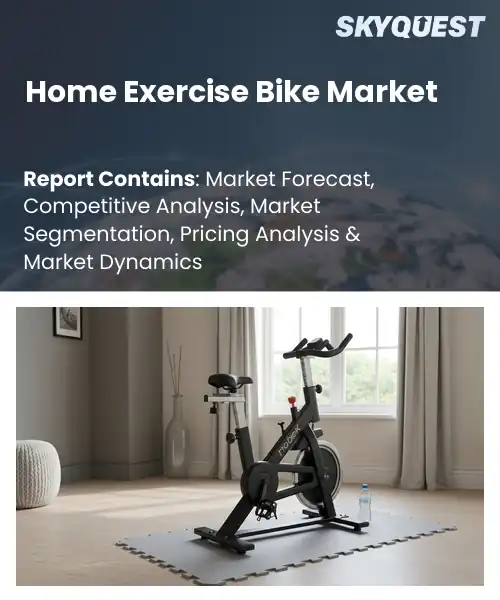
Home Exercise Bike Market
Report ID: SQMIG25J2224
Report ID: SQMIG25J2224
[email protected]
USA +1 351-333-4748
Report ID:
SQMIG25J2224 |
Region:
Global |
Published Date: June, 2026
Pages:
157
|Tables:
143
|Figures:
78


Global Home Exercise Bike Market size was valued at USD 3.52 Billion in 2024 and is poised to grow from USD 3.77 Billion in 2025 to USD 6.52 Billion by 2033, growing at a CAGR of 7.12% during the forecast period (2026-2033).
The demand for interactive home exercise bikes grows as customers strive for personalized data collection, social interactions, and convenient scheduling, making companies implement sensors, artificial intelligence-based resistance, and video libraries into the devices. Such technological developments give rise to new sources of revenue; thus, for instance, subscription-based virtual studios provide monthly fees, which are higher than the cost of hardware within one year and stimulate producers to package equipment along with subscriptions. Moreover, corporations buy fleet licenses to offer their employees fitness activities and save office space in the process. The growing popularity of reimbursement among insurance companies means that doctors prescribe patients to exercise bike routines to address chronic conditions.
Home exercise bikes constitute the worldwide market of stationary bikes that can be bought by customers for their use at home, including regular spin bikes and smart bikes, which broadcast online classes. The importance of the market results from the combination of health consciousness, the pandemic-related closure of gyms, and the progress in training that led to the transformation of people's workouts. Traditionally, the sales volume was low before 2019, however, the emergence of the coronavirus prompted a sudden increase in sales, as companies like Peloton and Schwinn experienced double-digit gains and the lack of stock on the part of retailers.
How is AI-driven Personalization Shaping the Home Exercise Bike Market?
AI-powered customization will transform home fitness exercise bicycles into personalized training machines. The algorithms will determine the rider’s resistance level, interval time, and rest period based on their heartbeat, cadence, and past performances. Personalized training sessions ensure that the users remain motivated and do not require help from outside coaches. Companies will integrate this technology into their connected displays, voice-controlled devices and mobile apps, resulting in a seamless environment through which data exchanges occur between the exercise bicycle, the user’s mobile phone and the cloud-based servers. Through this approach, companies will be able to improve user experience, lower the learning curve, and increase prices for their products. The increasing demands by consumers for advanced home fitness equipment will make personalized AI training essential to product development strategies.
Market snapshot - (2026-2033)
Global Market Size
USD 3.52 Billion
Largest Segment
Upright Exercise Bikes
Fastest Growth
Air Bikes
Growth Rate
7.12% CAGR
To get more insights on this market click here to Request a Free Sample Report
Global home exercise bike market is segmented by type, technology, end-user, distribution, price and region. Based on type, the market is segmented into Upright Exercise Bikes, Recumbent Bikes, Spin/Indoor Cycling Bikes and Air Bikes. Based on technology, the market is segmented into Connected/Smart Bikes and Traditional Bikes. Based on end-user, the market is segmented into Home Users and Fitness Enthusiasts. Based on distribution, the market is segmented into Online Retail, Sporting Goods Stores and Direct-to-Consumer. Based on price, the market is segmented into Budget (Below $300), Mid-Range ($300-$1000) and Premium (Above $1000). Based on region, the market is segmented into North America, Europe, Asia Pacific, Latin America and Middle East & Africa.
The Upright Exercise Bikes Segment enjoys leadership in the market due to the combination of small size with comfortable riding ergonomics. Being the most obvious choice for people living in a limited amount of space, this segment matches the consumer demand for ease of assembly and maintenance which contributes to word of mouth marketing. Thus, retail stores give preference to stocking such products which is another reason why this segment is dominant on the market and why it is perceived as meeting the needs of the largest number of consumers.
Nevertheless, the Recumbent Bikes Segment experiences the highest momentum due to their comfortable seating position, which is attractive for the elderly and for people who use exercise bikes for rehabilitation purposes. The constant improvements in ergonomics and the introduction of health monitoring options attract more customers to this segment.
Connected/smart bike is the dominant segment due to their interactive console, performance tracking in real-time, and integration with apps, which satisfies the increasing trend towards an immersive experience during exercise. The syncing abilities with wearables and live class streaming make the home setting become a connected studio, thereby generating subscription revenue and building community spirit, enhancing loyalty towards the brand. These features not only minimize perceived barriers but also provide individualized routes for the users to be consistently engaged.
The traditional bike is the dominant high-growth segment due to the revival of interest in low-tech bikes among cost-conscious consumers who do not want subscription costs. The ease of use and no electronics involved make this technology very easy to adopt and thus attract more users.
To get detailed segments analysis, Request a Free Sample Report
North America enjoys an advanced fitness culture that incorporates technology and convenience, leading to significant consumer preference for cardio equipment to be used at home. Due to widespread distribution and numerous high-end brands, it is easy to get access to models with connectivity and interactive features. The availability of high disposable incomes ensures consumer readiness to pay for durable equipment, while the convenient shopping experience ensures a smooth purchase process. Public policies aimed at promoting healthy lifestyles, corporate wellness plans, and the trend of personalized fitness also contribute to the increased demand. Moreover, the importance of technology-based workouts in the region ensures additionalconsumer interest. Tech companies often collaborate with retailers in order to offer advanced experiences to consumers.
Home Exercise Bikes in the United States features an advanced audience who places high importance on connectivity, performance analysis, and training experience. Companies are striving to offer software integration, live classes, and ergonomic designs, while retail companies promote tryouts and services. Fitness influencers and wellness programs within corporations boost the usage of such equipment even more, and the culture of personal health ensures constant upgrades towards better technologies and home models.
Market for Home Exercise Bikes in Canada is an indicator of a climate-induced inclination towards indoor workouts along with a heightened realization about wellness holistically. The consumers tend to prefer durable construction along with noiseless bikes that can suit different types of living environments, while the government’s health programs encourage people to be active at home. Energy-efficient bikes and their easy compatibility with widely used online services have become important featuresof retail marketing.
In Europe, there is a synergy of various cultural, regulatory, and technological factors, which drives the rapid growth of home exercise bike product lines. Public health awareness motivates people to engage in physical activities, whereas sustainability programs promote the use of energy-efficient indoor sports machines. Well-developed infrastructure of specialty retailers and e-commerce sites allows consumers to purchase high-quality products featuring multi-language connectivity and online coaching services. People value ergonomics and compatibility of bikes with the European fitness ecosystem, which promotes loyalty to the brands. Manufacturers' collaboration with content providers enables them to provide localized training programs, boosting consumer interest.
Market for Home Exercise Bikes in Germany is based on an astute group of consumers who value precision in engineering and long product life span. Consumers seek machines with solid frame design, noiseless driving systems, and ability to connect with fitness applications in the German language. Stores frequently offer test drives and customer support services, while national insurance providers view home cardio machines as preventative health products, thus encouraging more consumers to purchase them.
United Kingdom Home Exercise Bike Market is influenced by consumer trends that favor smart connectivity and group exercise sessions. Virtual classes give rise to the need for bikes that have an in-built screen, leaderboards, and that can interface withthe UK-based content providers. Space issues in cities contribute to the preference for portable and noiseless machines, while the government’s well-being campaigns encourage home exercise.
The Home Exercise Bike Market in France has been gaining traction because of the need for a bike that combines style and technology by fitness-conscious consumers. The French buyer is interested in bikes that have sleek designs, run silently, and easily connect with the leading health applications available in Europe. This is supported by government incentives on exercising at home and the growing trend of boutique fitness.
Asia Pacific is becoming increasingly strong in the market for home exercise bikes due to a combination of increasing urbanization, changing consumer lifestyles and the uptake of technology. The growing number of middle-class families are placing importance on having fitness tools right at home that are compact and easy to use in small places. Asia Pacific local firms are making huge investments in making technology-based connectivity, artificial intelligence-driven coaching and compact design a reality due to rising demand for advanced but compact fitness tools. Favorable government policies encouraging active lifestyle and digital health fuel market growth. E-commerce channels along with mobile-first approach reach out to tech-savvy consumers, while the creation of collaborative content ecosystem allows for culturally relevant workouts. All these factors contribute to the creation of an ecosystem where the need for integrated, silent and ergonomic home exercise bikes grows.
Japan’s Home Exercise Bike Market is fueled by the country’s culture of precision engineering and strict adherence to fitness regimes. They seek silent mechanical systems, compact foldable structures, and integration into health applications in Japanese language. Campaigns from the government promoting home exercise support the growing love for technology and wellness. In‑store demos and content partnerships based on subscriptions from retailers ensure continued uptake in health-conscioushomes.
The South Korean Market for home exercise bikes reveals the enthusiasm of the country’s population towards engaging workouts. The market targets consumers interested in connectivity features, performance monitoring, and compatibility with Korean streaming fitness services. Portability and noiseless exercise make this product suitable for flat living. Government programs encourage active lifestyle at home to counteract sedentary lifestyle habits. The marketing mix combines online communities and immersive experiences at special stores to allow customers to test new functions.
To know more about the market opportunities by region and country, click here to
Buy The Complete Report
Rising Health Consciousness
Increasingly, consumers place more importance on their well-being, resulting in the trend toward regular cardio workouts indoors. This attitude drives the need for gym equipment which will allow for regular aerobic exercise in a protected environment free from external influences. Ergonomic design and user-friendly interface contribute to the increased consumer confidence and repetition of workouts. As consumers invest in items that help preserve their well-being, the combined result is an accelerated growth of the market through continued purchase intention and word-of-mouth promotion within social circles.
Compact Home Exercise Solutions
Trends in urban living restrict the amount of space that is available, causing consumers to look for exercise bikes with reduced space requirements. The design features folding frame technology, adjustable elements, and streamlined aesthetics in order to be easily incorporated in apartments, home offices, and other multi-purpose spaces. This flexibility ensures that there are fewer obstacles in the way of purchasing an exercise bike and helps people make their initial purchase or upgrade to a space-saving model.
High Initial Purchase Cost
Potential customers may face high upfront costs, which could discourage investment due to future health gains. The high cost of bikes with technological advancements and display system integration poses an obstacle to purchase for economically sensitive customers. This situation makes people put off the purchase or consider other less costly options, leading to reduced penetration rates in the market. Some retailers offer financing solutions, but high cost is still a major consideration, which slows down the adoption process among wider customer groups. Moreover, there are no available subsidies in most regions.
Limited Awareness of Benefits
Majority of consumers lack information on the health benefits that can be derived from riding a bike regularly. Consequently, the value of exercising on home bikes is undervalued. Due to a lack of information about cardiovascular benefits, joint-friendly effects, and mental health benefits, the potential user base may treat it as an extra piece of equipment instead of a necessary one. Such an information gap reduces motivation to purchase, especially for those customers who are used to exercising at gyms.
Request Free Customization of this report to help us to meet your business objectives.
The competitive environment is characterized by fierce competition between existing brands and upcoming companies, forcing quick product differentiation and improvement of technologies. The example of Peloton’s introduction of artificial intelligence-driven workout machines represents a smart move towards advanced analytics, whereas current mergers and acquisitions involve leading fitness companies buying smaller bike producers to expand their ecosystems. Partnership with video streaming services and health-related connectivity become additional factors of competition.
Recent Developments in the Home Exercise Bike Market
Connected Fitness Integration: As consumer expectations move towards a connected digital ecosystem, IoT connectivity, artificial intelligence performance analysis, and streaming media are increasingly integrated into home exercise bikes to offer users real-time coaching, competition with other users, and customized training programs. With the expansion of the fitness platform, the companies producing the home exercise bikes are partnering strategically with content companies to make their equipment act as a conduit for their subscription-based services.
Sustainable Materials Adoption: The practice of environmental stewardship is increasingly emerging as a brand differentiator, compelling bicycle companies to use recycled aluminum, bamboo composites, and low-impact plastics in the manufacture of frames and other parts of bicycles. This is not only helping reduce carbon footprint but also appealing to environmentally conscious consumers who prefer to buy products with reduced negative impact on the environment. Companiesare now using stories about green certification and closed-loop production systems in their marketing campaigns to develop strong brands.
SkyQuest’s ABIRAW (Advanced Business Intelligence, Research & Analysis Wing) is our Business Information Services team that Collects, Collates, Correlates, and Analyses the Data collected by means of Primary Exploratory Research backed by robust Secondary Desk research.
As per SkyQuest analysis, the driving factors in the global home exercise bicycle market include health awareness and the need for a smaller product due to constrained living space. The major barriers in the market include the high cost associated with the purchase of top-end connected bicycles, which limits their adoption by price-sensitive consumers. North America continues to lead in the market owing to its well-established fitness culture, high disposable income, and broad distribution network. In terms of product type, upright exercise bikes continue to dominate the market, as they offer a convenient ride in addition to taking up little space.
| Report Metric | Details |
|---|---|
| Market size value in 2024 | USD 3.52 Billion |
| Market size value in 2033 | USD 6.52 Billion |
| Growth Rate | 7.12% |
| Base year | 2024 |
| Forecast period | (2026-2033) |
| Forecast Unit (Value) | USD Billion |
| Segments covered |
|
| Regions covered | North America (US, Canada), Europe (Germany, France, United Kingdom, Italy, Spain, Rest of Europe), Asia Pacific (China, India, Japan, Rest of Asia-Pacific), Latin America (Brazil, Rest of Latin America), Middle East & Africa (South Africa, GCC Countries, Rest of MEA) |
| Companies covered |
|
| Customization scope | Free report customization with purchase. Customization includes:-
|
To get a free trial access to our platform which is a one stop solution for all your data requirements for quicker decision making. This platform allows you to compare markets, competitors who are prominent in the market, and mega trends that are influencing the dynamics in the market. Also, get access to detailed SkyQuest exclusive matrix.
Table Of Content
Executive Summary
Market overview
Parent Market Analysis
Market overview
Market size
KEY MARKET INSIGHTS
COVID IMPACT
MARKET DYNAMICS & OUTLOOK
Market Size by Region
KEY COMPANY PROFILES
Methodology
For the Home Exercise Bike Market, our research methodology involved a mixture of primary and secondary data sources. Key steps involved in the research process are listed below:
1. Information Procurement: This stage involved the procurement of Market data or related information via primary and secondary sources. The various secondary sources used included various company websites, annual reports, trade databases, and paid databases such as Hoover's, Bloomberg Business, Factiva, and Avention. Our team did 45 primary interactions Globally which included several stakeholders such as manufacturers, customers, key opinion leaders, etc. Overall, information procurement was one of the most extensive stages in our research process.
2. Information Analysis: This step involved triangulation of data through bottom-up and top-down approaches to estimate and validate the total size and future estimate of the Home Exercise Bike Market.
3. Report Formulation: The final step entailed the placement of data points in appropriate Market spaces in an attempt to deduce viable conclusions.
4. Validation & Publishing: Validation is the most important step in the process. Validation & re-validation via an intricately designed process helped us finalize data points to be used for final calculations. The final Market estimates and forecasts were then aligned and sent to our panel of industry experts for validation of data. Once the validation was done the report was sent to our Quality Assurance team to ensure adherence to style guides, consistency & design.
Analyst Support
Customization Options
With the given market data, our dedicated team of analysts can offer you the following customization options are available for the Home Exercise Bike Market:
Product Analysis: Product matrix, which offers a detailed comparison of the product portfolio of companies.
Regional Analysis: Further analysis of the Home Exercise Bike Market for additional countries.
Competitive Analysis: Detailed analysis and profiling of additional Market players & comparative analysis of competitive products.
Go to Market Strategy: Find the high-growth channels to invest your marketing efforts and increase your customer base.
Innovation Mapping: Identify racial solutions and innovation, connected to deep ecosystems of innovators, start-ups, academics, and strategic partners.
Category Intelligence: Customized intelligence that is relevant to their supply Markets will enable them to make smarter sourcing decisions and improve their category management.
Public Company Transcript Analysis: To improve the investment performance by generating new alpha and making better-informed decisions.
Social Media Listening: To analyze the conversations and trends happening not just around your brand, but around your industry as a whole, and use those insights to make better Marketing decisions.
REQUEST FOR SAMPLE
 REQUEST FREE CUSTOMIZATION
Global Home Exercise Bike Market size was valued at USD 3.52 Billion in 2024 and is poised to grow from USD 3.77 Billion in 2025 to USD 6.52 Billion by 2033, growing at a CAGR of 7.12% during the forecast period (2026-2033).
The competitive landscape is shaped by intense rivalry among established brands and emerging players, driving rapid product differentiation and technology upgrades. Peloton’s launch of AI‑powered exercise equipment illustrates a strategic push into advanced analytics, while recent M&A activity sees larger fitness firms acquiring niche bike manufacturers to broaden their ecosystem. Partnerships with streaming content providers and the integration of connected health data are further intensifying competition and expanding market reach. 'Peloton Interactive', 'Bowflex (Nautilus)', 'Schwinn (Nautilus)', 'NordicTrack (iFIT)', 'ProForm (iFIT)', 'Sole Fitness', 'Echelon Fitness', 'MYX Fitness (Beachbody)', 'Sunny Health & Fitness', 'Marcy (IMPEX)', 'Assault Fitness (Rogue Fitness)', 'LifeFitness (KPS Capital)', 'Precor (AMER Sports)', 'Technogym SpA', 'Cybex International (Life Fitness)', 'Concept2', 'Wahoo Fitness', 'Garmin (Tacx)', 'Elite (Smart Trainers)', 'Wattbike Ltd.'
Consumers increasingly prioritize personal well‑being, prompting a shift toward regular indoor cardio routines. This mindset fuels demand for home‑based exercise equipment that can deliver consistent aerobic training without exposure to external variables. Manufacturers respond by integrating ergonomic designs and intuitive interfaces, enhancing user confidence and encouraging repeat usage. As households allocate discretionary spending toward health‑preserving assets, the cumulative effect accelerates market expansion through sustained purchase intent and word‑of‑mouth advocacy among peer networks. Additionally, the convenience of scheduling sessions at any time reinforces long‑term adherence to fitness regimes.
Connected Fitness Integration: Consumers increasingly expect seamless digital ecosystems, prompting manufacturers to embed IoT connectivity, AI-driven performance analytics, and streaming content within home exercise bikes. These capabilities enable real‑time coaching, social competition, and personalized training paths, enhancing user engagement and brand loyalty. As fitness platforms expand, bike makers are forming strategic partnerships with content providers, turning equipment into a gateway for subscription services and data-driven health insights, thereby creating recurring revenue streams beyond the initial hardware sale for manufacturers and investors alike globally.
Why does North America Dominate the Global Home Exercise Bike Market? |@12


Want to customize this report? This report can be personalized according to your needs. Our analysts and industry experts will work directly with you to understand your requirements and provide you with customized data in a short amount of time. We offer $1000 worth of FREE customization at the time of purchase.
Feedback From Our Clients


 USA (+1) 351-333-4748

