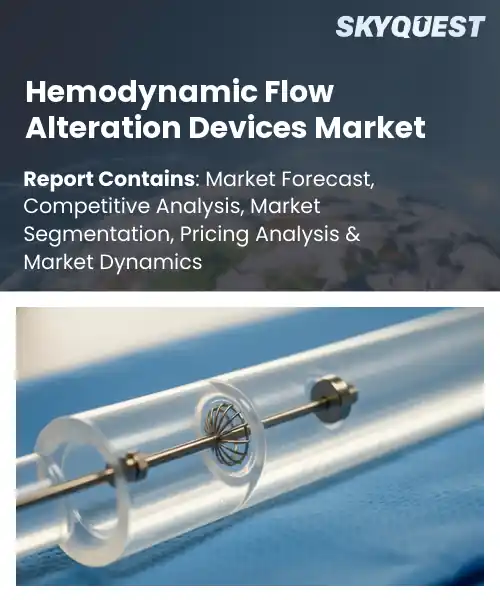
Hemodynamic Flow Alteration Devices Market
Report ID: SQMIG35E2080
Report ID: SQMIG35E2080
[email protected]
USA +1 351-333-4748
Report ID:
SQMIG35E2080 |
Region:
Global |
Published Date: June, 2026
Pages:
157
|Tables:
142
|Figures:
78


Global Hemodynamic Flow Alteration Devices Market size was valued at USD 782.5 Million in 2024 and is poised to grow from USD 832.58 Million in 2025 to USD 1367.6 Million by 2033, growing at a CAGR of 6.4% during the forecast period (2026-2033).
The primary driver of the hemodynamic flow alteration devices market is the increasing prevalence of vascular pathologies and the clinical demand for minimally invasive interventions that reduce morbidity. Hemodynamic flow alteration devices, including flow diverters and intrasaccular implants, work by redirecting blood away from weakened vessel walls which promotes thrombosis within aneurysm sacs and preserves parent vessel patency. This market matters because successful device adoption translates into fewer open surgeries shorter hospital stays and lower long term disability rates with clear benefits for healthcare systems and patients. Early examples such as pipeline embolization devices have catalyzed clinical acceptance worldwide rapidly.Building on clinical acceptance the key factor shaping global market growth is technological innovation that enhances device deliverability and biocompatibility leading clinicians to broaden indications. Improved microcatheter systems and polymer coatings reduce procedural complications which in turn increase physician confidence and accelerate adoption in medium sized and distal aneurysms where open surgery was once standard. Regulatory approvals combined with real world evidence from large registries create reimbursement pathways because payers see lower overall cost per case and improved patient outcomes. Consequently industry investment targets emerging markets and procedural training programs which expands market penetration and fuels iterative device refinement simultaneously.
How is AI improving device placement accuracy in the hemodynamic flow alteration devices market?
AI is improving device placement accuracy in the hemodynamic flow alteration devices market by streamlining imaging, planning, and intraoperative guidance. Key aspects include automated segmentation of vascular anatomy, patient specific hemodynamic simulation, and image fusion that overlays preoperative models on live fluoroscopy. In practice AI suggests optimal landing zones and predicts device behavior to reduce repositioning and malapposition. The current state shows growing integration of AI into vendor planning suites and navigation platforms, which raises procedural consistency, shortens learning curves, and makes complex flow diversion cases more predictable and accessible to more centers. Examples include AI based CFD planning and real time image guidance tied to robotic navigation.Remedy Robotics October 2025, its N1 system completed the first fully remote neurointerventional procedures using AI enabled software to assist catheter navigation and device deployment, demonstrating improved placement precision and workflow efficiency and supporting wider adoption and operational scale in the hemodynamic flow alteration devices market.
Market snapshot - (2026-2033)
Global Market Size
USD 782.5 Million
Largest Segment
Ventricular Assist Devices
Fastest Growth
Ventricular Assist Devices
Growth Rate
6.4% CAGR
To get more insights on this market click here to Request a Free Sample Report
Global hemodynamic flow alteration devices market is segmented by device type, end user, technology, application, material and region. Based on device type, the market is segmented into Intra-Aortic Balloon Pumps, Ventricular Assist Devices and Total Artificial Hearts. Based on end user, the market is segmented into Hospitals, Ambulatory Surgical Centers and Home Care Settings. Based on technology, the market is segmented into Mechanical Devices and Electromechanical Devices. Based on application, the market is segmented into Cardiogenic Shock, Heart Failure and Myocardial Infarction. Based on material, the market is segmented into Biocompatible Materials and Non-biodegradable Materials. Based on region, the market is segmented into North America, Europe, Asia Pacific, Latin America and Middle East & Africa.
Ventricular Assist Devices segment dominates because these systems provide durable hemodynamic support for advanced heart failure and bridging to transplant, driving sustained clinical demand and investment. Their ability to unload ventricles, enable patient mobilization, and integrate with monitoring platforms creates clear clinical value, encouraging clinician adoption and payer support, which in turn fuels incremental device refinement, supply chain scaling, and ecosystem development across acute and chronic care pathways.
However, Total Artificial Hearts are emerging as the most rapidly expanding area due to advances in fully implantable architectures, improved biocompatible surfaces, and progress in long-term patient management. Growing research focus and regulatory momentum are widening patient eligibility and attracting collaboration between device developers and clinical centers, accelerating technology maturation.
Electromechanical Devices segment dominates because integration of motors, sensors, and advanced control software enables precise flow titration and adaptive response to patient hemodynamics, improving safety and therapeutic effectiveness. This technical sophistication reduces complication risk, facilitates remote monitoring, and supports personalized therapy regimens, which drives adoption among specialty centers, attracts development capital, and stimulates complementary innovations in interfaces and power management across the device ecosystem.
However, Mechanical Devices are experiencing the strongest growth momentum as designers refine simplified pump architectures that prioritize durability, ease of sterilization, and cost efficiency. Their lower complexity supports broader deployment in varied care settings, encourages manufacturer diversification, and accelerates adoption where straightforward maintenance and proven reliability expand clinical use.
To get detailed segments analysis, Request a Free Sample Report
North America leads the global market due to a combination of advanced clinical infrastructure, concentrated industry expertise, and strong innovation ecosystems. Robust networks of specialized cardiac centers and interventional neuroradiology units support early adoption and clinical validation of newer flow alteration technologies. Well established regulatory pathways and collaborative ties between technology developers, academic centers, and clinician thought leaders accelerate iterative improvements and real world evidence generation. Comprehensive reimbursement frameworks and high awareness among treating physicians support uptake across complex vascular conditions. Additionally, a dense presence of key device manufacturers and contract research organizations enables rapid commercialization and supply chain resilience, sustaining market leadership and influencing global standards of care. Close collaboration with patient advocacy groups and specialty societies fosters guideline development and clinician education, further embedding flow alteration options into therapeutic pathways. Mature clinical trial infrastructure permits generation of nuanced safety and effectiveness insights that inform practice.
Hemodynamic Flow Alteration Devices Market in United States benefits from clinical research, a strong medtech manufacturing base, and specialized centers that advance adoption of vascular therapies. A culture of rigorous clinical evaluation and structured hospital procurement supports evidence based deployment. Active collaboration between industry and academic hospitals enables device refinement and clinician training. National emphasis on integrated care and governance reinforces clinician confidence and incorporation of flow alteration options into pathways, aiding innovation and dissemination.
Hemodynamic Flow Alteration Devices Market in Canada benefits from integrated public healthcare systems and academic hospital networks that support adoption of specialized flow alteration solutions. Provincial procurement approaches and focused clinical expertise permit measured technology integration aligned with care priorities. Collaboration between local innovation clusters and global manufacturers supports clinical evaluation and training. Centralized centers of excellence promote consistent clinical practice and equitable patient access across the country and coordination.
Europe is experiencing rapid expansion driven by an ecosystem that blends strong clinical expertise, collaborative research networks, and a favorable environment for technology transfer. Increasing emphasis on minimally invasive vascular therapies within national treatment pathways encourages clinicians to evaluate flow alteration options alongside established interventions. Pan regional alignment on clinical standards and cross border research consortia facilitate multicenter evidence generation and best practice dissemination. Robust medtech manufacturing clusters and focused investment in training and specialist centers enable efficient commercialization and clinician uptake. Additionally, payer and hospital procurement models that reward outcomes and cost effective care support integration of devices that demonstrate clear clinical value within complex care pathways. Harmonized regulatory frameworks across jurisdictions simplify market access for innovative devices, while active patient groups and specialty societies promote awareness and guideline incorporation. The combination of demonstrable clinical outcomes and strategic industry partnerships underpins market momentum.
Hemodynamic Flow Alteration Devices Market in Germany benefits from clinical research, a strong medtech manufacturing base, and specialized centers that advance adoption of vascular therapies. A culture of rigorous clinical evaluation and structured hospital procurement supports evidence based deployment. Active collaboration between industry and academic hospitals enables device refinement and clinician training. National emphasis on integrated care and governance reinforces clinician confidence and incorporation of flow alteration options into pathways.
Hemodynamic Flow Alteration Devices Market in United Kingdom is supported by strong clinical leadership, innovation focused regulation, and active specialist centers that adopt new vascular therapies. Close collaboration between industry and academic hospitals accelerates clinical evaluation and training. Centralized procurement and innovation pathways enable timely diffusion when clinical value is demonstrated. Professional networks and specialty societies facilitate guideline uptake and clinician preparedness, scaling flow alteration options across regional centers nationally.
Hemodynamic Flow Alteration Devices Market in France is emerging through targeted investment in specialized hospital networks, research, and pilot programs that evaluate innovative vascular therapies. Collaboration between local medtech firms and academic centers supports device testing and clinician education. Health authority emphasis on cost effective care and structured regional procurement encourages measured adoption. Establishment of centers of expertise and multidisciplinary teams enhances clinical pathways and patient access across regions strategically.
Asia Pacific is strengthening its position by combining expanding clinical expertise, growing local manufacturing capabilities, and proactive industry collaboration with global device developers. Increasing investments in specialized cardiovascular centers and clinical training programs are raising procedural proficiency and clinician familiarity with flow alteration technologies. Regulatory modernization in several markets and targeted support for domestic medtech innovation are facilitating earlier access to novel devices. Strategic partnerships between international manufacturers and regional distributors, along with participation in multicenter clinical initiatives, are accelerating knowledge transfer and underpinning broader adoption across diverse healthcare systems throughout the region. Market momentum is further supported by focused academic programs that cultivate interventional skills, growing patient awareness, and regional forums that disseminate best practices. Improved supply chain links and localized training centers reduce barriers to clinical implementation, enabling more consistent use of flow alteration approaches in complex vascular care across key markets.
Hemodynamic Flow Alteration Devices Market in Japan benefits from advanced medical infrastructure, strong clinical research, and an established domestic medtech sector supporting device development. Concentrated centers of interventional expertise and structured training programs foster clinician proficiency with novel vascular therapies. Clear regulatory pathways and collaboration between industry and academic hospitals promote rigorous evaluation and iterative device refinement, enabling thoughtful integration of flow alteration options into clinical treatment strategies and dissemination.
Hemodynamic Flow Alteration Devices Market in South Korea is supported by a vibrant medtech ecosystem, strong manufacturing, and proactive adoption within tertiary hospitals. Close ties between developers, clinical investigators, and specialized centers accelerate evaluation and device refinement. National initiatives promoting medical innovation and international partnerships attract collaborative programs. Focused clinician training and streamlined procurement channels facilitate efficient implementation and broader clinical use of flow alteration solutions across regional referral networks.
To know more about the market opportunities by region and country, click here to
Buy The Complete Report
Advancements In Device Design
Expanded Research And Clinical Evidence
Reimbursement And Funding Limitations
Technical Complexity And Training Needs
Request Free Customization of this report to help us to meet your business objectives.
The competitive landscape in global hemodynamic flow alteration devices is driven by intense incumbent-startup rivalry, where established medtech firms pursue acquisitions, licensing partnerships and iterative device upgrades while startups pursue differentiated materials and deployment mechanics to displace legacy stents. For example, major firms have released next generation flow diverters and invest in spinouts and university partnerships to secure novel polymer and bioresorbable platforms.
Top Player’s Company Profile
Recent Developments
SkyQuest’s ABIRAW (Advanced Business Intelligence, Research & Analysis Wing) is our Business Information Services team that Collects, Collates, Correlates, and Analyses the Data collected by means of Primary Exploratory Research backed by robust Secondary Desk research. As per SkyQuest analysis, growing prevalence of vascular pathologies and rising demand for minimally invasive interventions is a key driver of the global hemodynamic flow alteration devices market, while uncertain reimbursement and funding limitations remain a significant restraint. North America continues to dominate the market due to advanced clinical infrastructure and strong industry presence, and ventricular assist devices represent the leading segment because of durable support and clinical adoption. A second driver accelerating growth is rapid technological innovation, including AI‑assisted planning and improved device deliverability that expand indications, shorten learning curves, and support broader adoption across care settings. Real world evidence and expanded training programs further underpin uptake across emerging markets.
| Report Metric | Details |
|---|---|
| Market size value in 2024 | USD 782.5 Million |
| Market size value in 2033 | USD 1367.6 Million |
| Growth Rate | 6.4% |
| Base year | 2024 |
| Forecast period | (2026-2033) |
| Forecast Unit (Value) | USD Million |
| Segments covered |
|
| Regions covered | North America (US, Canada), Europe (Germany, France, United Kingdom, Italy, Spain, Rest of Europe), Asia Pacific (China, India, Japan, Rest of Asia-Pacific), Latin America (Brazil, Rest of Latin America), Middle East & Africa (South Africa, GCC Countries, Rest of MEA) |
| Companies covered |
|
| Customization scope | Free report customization with purchase. Customization includes:-
|
To get a free trial access to our platform which is a one stop solution for all your data requirements for quicker decision making. This platform allows you to compare markets, competitors who are prominent in the market, and mega trends that are influencing the dynamics in the market. Also, get access to detailed SkyQuest exclusive matrix.
Table Of Content
Executive Summary
Market overview
Parent Market Analysis
Market overview
Market size
KEY MARKET INSIGHTS
COVID IMPACT
MARKET DYNAMICS & OUTLOOK
Market Size by Region
KEY COMPANY PROFILES
Methodology
For the Hemodynamic Flow Alteration Devices Market, our research methodology involved a mixture of primary and secondary data sources. Key steps involved in the research process are listed below:
1. Information Procurement: This stage involved the procurement of Market data or related information via primary and secondary sources. The various secondary sources used included various company websites, annual reports, trade databases, and paid databases such as Hoover's, Bloomberg Business, Factiva, and Avention. Our team did 45 primary interactions Globally which included several stakeholders such as manufacturers, customers, key opinion leaders, etc. Overall, information procurement was one of the most extensive stages in our research process.
2. Information Analysis: This step involved triangulation of data through bottom-up and top-down approaches to estimate and validate the total size and future estimate of the Hemodynamic Flow Alteration Devices Market.
3. Report Formulation: The final step entailed the placement of data points in appropriate Market spaces in an attempt to deduce viable conclusions.
4. Validation & Publishing: Validation is the most important step in the process. Validation & re-validation via an intricately designed process helped us finalize data points to be used for final calculations. The final Market estimates and forecasts were then aligned and sent to our panel of industry experts for validation of data. Once the validation was done the report was sent to our Quality Assurance team to ensure adherence to style guides, consistency & design.
Analyst Support
Customization Options
With the given market data, our dedicated team of analysts can offer you the following customization options are available for the Hemodynamic Flow Alteration Devices Market:
Product Analysis: Product matrix, which offers a detailed comparison of the product portfolio of companies.
Regional Analysis: Further analysis of the Hemodynamic Flow Alteration Devices Market for additional countries.
Competitive Analysis: Detailed analysis and profiling of additional Market players & comparative analysis of competitive products.
Go to Market Strategy: Find the high-growth channels to invest your marketing efforts and increase your customer base.
Innovation Mapping: Identify racial solutions and innovation, connected to deep ecosystems of innovators, start-ups, academics, and strategic partners.
Category Intelligence: Customized intelligence that is relevant to their supply Markets will enable them to make smarter sourcing decisions and improve their category management.
Public Company Transcript Analysis: To improve the investment performance by generating new alpha and making better-informed decisions.
Social Media Listening: To analyze the conversations and trends happening not just around your brand, but around your industry as a whole, and use those insights to make better Marketing decisions.
REQUEST FOR SAMPLE
 REQUEST FREE CUSTOMIZATION


Want to customize this report? This report can be personalized according to your needs. Our analysts and industry experts will work directly with you to understand your requirements and provide you with customized data in a short amount of time. We offer $1000 worth of FREE customization at the time of purchase.
Feedback From Our Clients


 USA (+1) 351-333-4748

