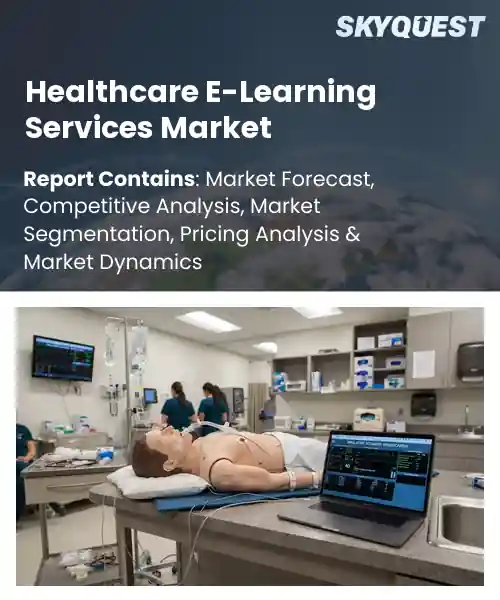
Healthcare E-Learning Services Market
Report ID: SQMIG25R2079
Report ID: SQMIG25R2079
[email protected]
USA +1 351-333-4748
Report ID:
SQMIG25R2079 |
Region:
Global |
Published Date: September, 2026
Pages:
157
|Tables:
121
|Figures:
77


Global Healthcare E-Learning Services Market size was valued at USD 7.85 Billion in 2024 and is poised to grow from USD 8.96 Billion in 2025 to USD 25.94 Billion by 2033, growing at a CAGR of 14.2% during the forecast period (2026-2033).
The global healthcare e‑learning services market comprises platforms that deliver clinical training, compliance modules, and patient‑education content to hospitals, clinics, and professionals. Its importance stems from the need to upskill an expanding workforce while reducing cost and downtime associated with classroom instruction. Since the 2010s, widespread broadband adoption and the COVID‑19 pandemic accelerated migration to virtual formats, prompting providers such as Coursera and MedHub to partner with health systems. For example, a major hospital network cut onboarding time by 30 percent after deploying an interactive e‑learning suite, illustrating how the market has evolved from supplemental webinars to integrated learning ecosystems. Regulatory compliance emerges as a catalyst driving growth in the global healthcare e‑learning services market because stricter accreditation standards force organizations to certify staff continuously. When governments tighten reporting requirements, hospitals must adopt scalable training solutions that can document completion in time, prompting providers to embed analytics dashboards and audit trails. This necessity has opened opportunities for firms such as Skillsoft, which recently launched a HIPAA‑focused module adopted by a European health‑insurance consortium, resulting in a 15 % increase in contract value. Consequently, the market expands not only through mandated learning but also by leveraging personalization that reduces knowledge gaps and accelerates patient‑care improvements.
How is AI-driven personalization reshaping the healthcare e-learning services market?
AI driven personalization is changing how healthcare professionals learn by tailoring content to individual knowledge gaps, preferred learning styles, and clinical roles. Platforms now analyze interaction data to recommend modules, adjust difficulty, and surface relevant case studies in real time. This shift moves training from static curricula to dynamic pathways that keep pace with rapid medical advances. Providers report higher engagement as learners receive just in time resources that align with daily practice. The market is seeing a surge of vendors embedding natural language processing and predictive analytics to create adaptive courses that blend theory with simulation. As institutions seek cost effective ways to upskill staff, personalized e learning is becoming a core strategy.MedBridge March 2024, introduced an AI powered learning pathway that matches clinicians with content based on recent case interactions, reducing time spent searching for relevant material and boosting skill retention. This innovation illustrates how AI personalization drives efficiency and supports market expansion.
Market snapshot - (2026-2033)
Global Market Size
USD 7.85 Billion
Largest Segment
Learning Management Systems
Fastest Growth
Virtual Training & Simulation
Growth Rate
14.2% CAGR
To get more insights on this market click here to Request a Free Sample Report
Global healthcare e-learning services market is segmented by service type, delivery mode, end user, application and region. Based on service type, the market is segmented into Online Courses, Learning Management Systems, Virtual Training & Simulation, Continuing Medical Education and Other Services. Based on delivery mode, the market is segmented into Self-Paced Learning, Instructor-Led Online Learning and Blended Learning. Based on end user, the market is segmented into Healthcare Professionals, Healthcare Institutions, Academic & Research Institutions and Pharmaceutical & Medical Device Companies. Based on application, the market is segmented into Clinical Education, Compliance & Regulatory Training, Professional Development and Patient & Caregiver Education. Based on region, the market is segmented into North America, Europe, Asia Pacific, Latin America and Middle East & Africa.
Continuing Medical Education segment dominates because it aligns directly with licensure renewal requirements, offering accredited content that healthcare providers must periodically complete to maintain practice rights. Providers prioritize these courses due to the built‑in incentive structure, and vendors focus development resources on high‑quality CME modules, creating a virtuous cycle of demand and supply. The need for evidence‑based updates and specialty‑specific guidelines further embeds CME as the core offering within the e‑learning ecosystem.
However, Virtual Training & Simulation is witnessing the strongest growth momentum as immersive technologies enable realistic procedural rehearsals without patient risk. The ability to replicate complex clinical scenarios fuels adoption among teaching hospitals and specialty societies, accelerating market expansion and opening new revenue streams for providers seeking experiential learning solutions.
Blended Learning segment dominates because it merges the flexibility of online modules with the interactive depth of live instruction, delivering a comprehensive learning pathway that mirrors traditional classroom dynamics while preserving self‑directed pacing. This hybrid approach satisfies the complex competency requirements of clinicians, allowing them to practice skills in real time and immediately reinforce knowledge, which drives higher retention and superior performance outcomes across diverse clinical specialties.
On the other hand, Self-Paced Learning is emerging as the key high‑growth area because busy clinicians increasingly seek content they can consume on their own schedules, eliminating the need for synchronized sessions. Advances in micro‑learning design and AI‑curated pathways enhance personalization, driving rapid adoption and expanding the market’s reach into remote and underserved settings.
To get detailed segments analysis, Request a Free Sample Report
North America retains a leading position because it combines mature digital infrastructure with a deep culture of continuous professional development in the health sector. Strong investment from academic institutions and large health system operators fuels sophisticated content creation, while regulatory frameworks encourage adoption of accredited online modules. The presence of technology innovators and a highly skilled workforce ensures rapid integration of immersive tools such as simulation and virtual reality. Moreover, established partnerships between universities, industry groups, and professional societies create a robust ecosystem that promotes standardisation and knowledge sharing across borders. These combined factors generate a resilient market environment that consistently outpaces other regions in both breadth and sophistication of healthcare e‑learning offerings. The region’s focus on patient safety and outcomes also drives demand for up‑to‑date clinical curricula delivered through flexible online platforms.
Healthcare E-Learning Services Market in the United States is characterised by a dense network of leading medical schools and a thriving health‑tech sector that co‑create highly specialised modules. Collaborative research centres and large hospital systems leverage these resources to embed evidence‑based practice into digital curricula, fostering rapid skill acquisition. The market benefits from strong intellectual property protection, encouraging vendors to invest in cutting‑edge instructional design and immersive learning environments.
Healthcare E-Learning Services Market in Canada draws on a public health system that prioritises equitable access to professional development. Provincial health authorities collaborate with universities to deliver online courses that address clinical and administrative competencies. The emphasis on bilingual content expands reach across linguistic communities, while research funding supports innovative pedagogical approaches such as competency‑based assessments and interactive case studies. These dynamics create an environment for growth in health education.
Europe experiences rapid expansion as national health strategies emphasise continuous upskilling and integration of digital solutions across care pathways. Strong collaboration between research universities, professional bodies, and technology firms creates a fertile ground for co‑development of multilingual curricula that meet diverse regulatory requirements. The region’s commitment to patient‑centred care drives demand for interactive modules that replicate real‑world scenarios, while investment in broadband infrastructure ensures reliable delivery. Cultural emphasis on lifelong learning and robust quality assurance frameworks further reinforce trust in online qualifications. Together these elements foster an ecosystem where innovation is
To know more about the market opportunities by region and country, click here to
Buy The Complete Report
Increasing Demand for Continuous Training
Advancements in Digital Learning Technology
Limited Broadband Infrastructure in Rural Areas
Regulatory and Accreditation Complexity
Request Free Customization of this report to help us to meet your business objectives.
Intense competition drives consolidation and innovation in the global healthcare e learning services market. HealthStream’s 2022 acquisition of MedEvolve expanded its clinical simulation library, while Elsevier’s partnership with Microsoft Azure in 2023 enabled AI powered content personalization. These moves illustrate how firms leverage M&A, strategic alliances, and emerging technologies to capture institutional contracts and differentiate offerings.
Top Player’s Company Profile
Recent Developments
SkyQuest’s ABIRAW (Advanced Business Intelligence, Research & Analysis Wing) is our Business Information Services team that Collects, Collates, Correlates, and Analyses the Data collected by means of Primary Exploratory Research backed by robust Secondary Desk research. As per SkyQuest analysis, the market’s rapid expansion is primarily driven by the increasing demand for continuous training that helps healthcare professionals stay current with evolving clinical guidelines, while a second important driver is the adoption of advanced digital learning technologies such as AI‑powered personalization and immersive XR simulations that boost engagement and skill retention. The North American region remains the dominant market due to its mature digital infrastructure, strong regulatory support and deep ecosystem of health‑tech innovators. Within the market, Continuing Medical Education is the leading segment because it directly satisfies licensure renewal requirements. A notable restraint is the limited broadband connectivity in rural areas, which hampers delivery of video‑intensive modules and slows adoption in underserved locations.
| Report Metric | Details |
|---|---|
| Market size value in 2024 | USD 7.85 Billion |
| Market size value in 2033 | USD 25.94 Billion |
| Growth Rate | 14.2% |
| Base year | 2024 |
| Forecast period | (2026-2033) |
| Forecast Unit (Value) | USD Billion |
| Segments covered |
|
| Regions covered | North America (US, Canada), Europe (Germany, France, United Kingdom, Italy, Spain, Rest of Europe), Asia Pacific (China, India, Japan, Rest of Asia-Pacific), Latin America (Brazil, Rest of Latin America), Middle East & Africa (South Africa, GCC Countries, Rest of MEA) |
| Companies covered |
|
| Customization scope | Free report customization with purchase. Customization includes:-
|
To get a free trial access to our platform which is a one stop solution for all your data requirements for quicker decision making. This platform allows you to compare markets, competitors who are prominent in the market, and mega trends that are influencing the dynamics in the market. Also, get access to detailed SkyQuest exclusive matrix.
Table Of Content
Executive Summary
Market overview
Parent Market Analysis
Market overview
Market size
KEY MARKET INSIGHTS
COVID IMPACT
MARKET DYNAMICS & OUTLOOK
Market Size by Region
KEY COMPANY PROFILES
Methodology
For the Healthcare E-Learning Services Market, our research methodology involved a mixture of primary and secondary data sources. Key steps involved in the research process are listed below:
1. Information Procurement: This stage involved the procurement of Market data or related information via primary and secondary sources. The various secondary sources used included various company websites, annual reports, trade databases, and paid databases such as Hoover's, Bloomberg Business, Factiva, and Avention. Our team did 45 primary interactions Globally which included several stakeholders such as manufacturers, customers, key opinion leaders, etc. Overall, information procurement was one of the most extensive stages in our research process.
2. Information Analysis: This step involved triangulation of data through bottom-up and top-down approaches to estimate and validate the total size and future estimate of the Healthcare E-Learning Services Market.
3. Report Formulation: The final step entailed the placement of data points in appropriate Market spaces in an attempt to deduce viable conclusions.
4. Validation & Publishing: Validation is the most important step in the process. Validation & re-validation via an intricately designed process helped us finalize data points to be used for final calculations. The final Market estimates and forecasts were then aligned and sent to our panel of industry experts for validation of data. Once the validation was done the report was sent to our Quality Assurance team to ensure adherence to style guides, consistency & design.
Analyst Support
Customization Options
With the given market data, our dedicated team of analysts can offer you the following customization options are available for the Healthcare E-Learning Services Market:
Product Analysis: Product matrix, which offers a detailed comparison of the product portfolio of companies.
Regional Analysis: Further analysis of the Healthcare E-Learning Services Market for additional countries.
Competitive Analysis: Detailed analysis and profiling of additional Market players & comparative analysis of competitive products.
Go to Market Strategy: Find the high-growth channels to invest your marketing efforts and increase your customer base.
Innovation Mapping: Identify racial solutions and innovation, connected to deep ecosystems of innovators, start-ups, academics, and strategic partners.
Category Intelligence: Customized intelligence that is relevant to their supply Markets will enable them to make smarter sourcing decisions and improve their category management.
Public Company Transcript Analysis: To improve the investment performance by generating new alpha and making better-informed decisions.
Social Media Listening: To analyze the conversations and trends happening not just around your brand, but around your industry as a whole, and use those insights to make better Marketing decisions.
REQUEST FOR SAMPLE
 REQUEST FREE CUSTOMIZATION


Want to customize this report? This report can be personalized according to your needs. Our analysts and industry experts will work directly with you to understand your requirements and provide you with customized data in a short amount of time. We offer $1000 worth of FREE customization at the time of purchase.
Feedback From Our Clients


 USA (+1) 351-333-4748

