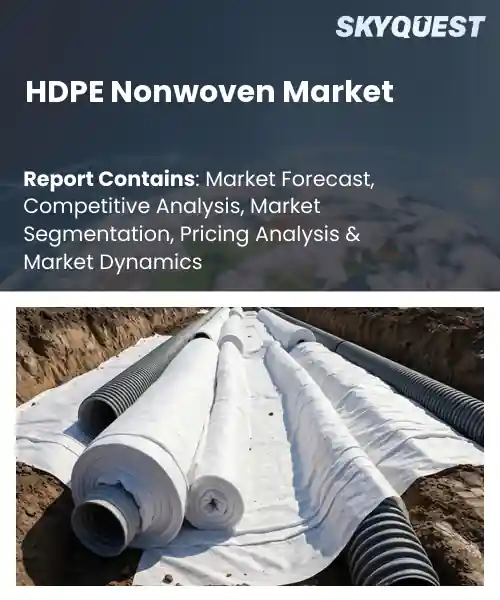
HDPE Nonwoven Market
Report ID: SQMIG15E3635
Report ID: SQMIG15E3635
[email protected]
USA +1 351-333-4748
Report ID:
SQMIG15E3635 |
Region:
Global |
Published Date: June, 2026
Pages:
157
|Tables:
94
|Figures:
76


Global Hdpe Nonwoven Market size was valued at USD 400.15 Million in 2024 and is poised to grow from USD 428.96 Million in 2025 to USD 748.13 Million by 2033, growing at a CAGR of 7.2% during the forecast period (2026-2033).
The primary driver of the hdpe nonwoven market is the convergence of demand for lightweight, chemically resistant textiles and heightened environmental regulation favoring recyclable materials. hdpe nonwovens are engineered sheets created by bonding high-density polyethylene fibers without weaving; they matter because they replace traditional plastics and textiles in applications where durability, moisture resistance, and cost efficiency are essential. Since the 1990s the sector has evolved from low-volume industrial geotextiles to diversified formats used in agriculture cover films, disposable hygiene backings, and construction membranes, exemplified by geotube erosion control and reusable sandbags where performance and lifecycle cost justify adoption broadly accepted.
A key factor propelling global hdpe nonwoven market growth is rising demand for sustainable packaging and infrastructure solutions that reduce lifecycle emissions. As regulators and brand owners restrict single-use multilayer films, companies pursue hdpe nonwoven alternatives because lighter weight and mono-polymer composition enable easier recycling and lower transport emissions. This shift causes manufacturers to invest in production capacity and R&D, which lowers unit costs and expands use into horticultural mulches, pallet liners, medical gowns, and stormwater filtration layers. These real-world applications demonstrate how policy-driven demand creates investment, economies of scale, and further opportunity in circular supply chains and emerging markets.
How is automation enhancing manufacturing efficiency in the HDPE nonwoven market?
Automation is reshaping manufacturing in the HDPE nonwoven market by connecting robotics, advanced process control and inline inspection with traditional web forming and bonding. Key aspects include automated roll handling and changeovers, real time sensor control of melt and tension, and AI driven predictive maintenance that cut downtime and waste. The current state sees producers prioritizing repeatable quality and flexibility to handle recycled feedstocks and varied end uses from geotextiles to protective garments. Industry turnkey line concepts and modernized bonding and needling solutions are making upgrades more practical for mills that must scale output while meeting sustainability goals.
DuPont March 2026, the company introduced the Tyvek APX 400 coverall into commercial production. That move leveraged upgraded automated production lines and digital process controls to stabilize fabric structure and reduce rework, helping speed commercialization and support broader market growth.
Market snapshot - (2026-2033)
Global Market Size
USD 400.15 Million
Largest Segment
Spunbond
Fastest Growth
Meltblown
Growth Rate
7.2% CAGR
To get more insights on this market click here to Request a Free Sample Report
Global hdpe nonwoven market is segmented by technology, application, end-use industry and region. Based on technology, the market is segmented into Spunbond, Flash Spun, Meltblown and Others. Based on application, the market is segmented into Protective Clothing, Medical Packaging and Drapes, Building Envelopes and Insulation, Industrial Packaging and Others. Based on end-use industry, the market is segmented into Healthcare, Construction, Packaging and Logistics and Others. Based on region, the market is segmented into North America, Europe, Asia Pacific, Latin America and Middle East & Africa.
Spunbond segment dominates because its continuous filament formation yields high tensile strength and dimensional stability while enabling fast, low-cost production of uniform fabrics suitable for diverse uses in hdpe nonwoven market. Its process scalability and ease of integration with lamination and coating technologies create reliable barrier and structural properties demanded by protective garments, building covers and industrial wraps, driving widespread adoption among converters and brand owners seeking performance with cost efficiency.
However, meltblown is emerging as the most rapidly expanding technology because its ultrafine fibers provide superior filtration and fluid barrier performance for medical and hygiene uses. Process innovations improving web consistency and throughput, and rising demand for high-performance filtration products, are driving adoption and creating new high-value applications within the hdpe nonwoven market.
Medical Packaging and Drapes segment dominates because hdpe nonwoven materials deliver critical sterile barrier performance, low linting and reliable moisture resistance required by hospitals and surgical environments. Their compatibility with common sterilization processes and ability to form strong, tear-resistant disposable webs meets stringent infection control protocols, while cost and single-use convenience encourage procurement by healthcare providers, pushing manufacturers to optimize product lines around these application-specific performance requirements.
Meanwhile, Protective Clothing is witnessing the strongest growth momentum as demand for breathable, lightweight disposable PPE expands beyond healthcare. Fabric innovations improving comfort and barrier performance, plus regulatory focus on worker safety and increased institutional procurement, are driving rapid adoption and unlocking new application areas that extend hdpe nonwoven market opportunities.
To get detailed segments analysis, Request a Free Sample Report
Asia Pacific dominates through a combination of robust industrial bases concentrated demand centers and integrated value chains that link resin producers converters and end use sectors. Deep manufacturing expertise in polymer processing and nonwoven technologies supports a diverse application spectrum from filtration and agriculture to hygiene and packaging. Strategic proximity to large consumer markets enables efficient distribution and responsiveness to product trends while collaborative research networks and targeted investment in process innovation enhance quality and cost efficiency. Supply chain resilience supported by local raw material availability and strong supplier ecosystems further consolidates regional leadership while ongoing emphasis on customization and technical service creates durable advantages over other markets. Market dynamics also reflect collaborative public private initiatives that facilitate technology transfer and enable scale up of advanced nonwoven grades to meet demanding industrial specifications and sustainability considerations.
HDPE Nonwoven Market in Japan benefits from advanced manufacturing ecosystems strong upstream material expertise and integrated supply chains that support product development and scale. Close collaboration between producers and end use industries fosters tailored solutions for filtration industrial fabrics and hygiene applications. Emphasis on quality regulatory compliance and continuous improvement enables premium positioning while focused investment in process innovation sustains competitiveness and responsiveness to evolving customer requirements and market insights.
HDPE Nonwoven Market in South Korea is shaped by agile manufacturing capabilities strong ties between fabricators and heavy industry and a focus on technical textiles for automotive and filtration uses. Investment in process optimization and material science supports rapid adaptation of product grades while collaborative testing facilities enable accelerated qualification. The market emphasizes reliability cost efficient production and strategic partnerships that strengthen domestic supply chains and support export oriented manufacturers.
North America is experiencing rapid expansion driven by a combination of innovation in nonwoven technologies rising demand in diverse end use sectors and strong industrial investment. A focus on performance oriented applications such as filtration automotive components and protective textiles encourages development of specialized HDPE grades and production methods. Close collaboration between material suppliers converters and large OEMs accelerates product qualification and adoption while strategic manufacturing footprints facilitate distribution across continental markets. Regulatory emphasis on material safety and waste management stimulates interest in recyclable and durable solutions. Supply chain agility supported by advanced logistics and access to technical talent enhances the region ability to convert market needs into scalable manufacturing outcomes. Investment in pilot facilities and collaborative testing hubs supports rapid iteration and customer centric customization.
HDPE Nonwoven Market in United States is characterized by strong demand from filtration healthcare and industrial sectors driving application oriented material engineering. Proximity to leading OEMs and large end use markets incentivizes specialized product development and collaborative supply chain models. Focus on regulatory compliance and process efficiency promotes investment in advanced production technology while emphasis on validation supports adoption across diverse market segments and commercial channels while supporting global customers.
HDPE Nonwoven Market in Canada is defined by close integration with industrial users focus on durable and recyclable solutions and preference for technical collaboration. Regional manufacturers leverage local feedstock availability and strong logistics to serve specialized applications including filtration geotextiles and industrial covers. Emphasis on environmental compliance and lifecycle considerations drives development of higher value grades while partnerships between converters and research centers support product testing customisation and market deployment.
Europe is strengthening its position through a combination of technology driven product development regulatory focus and cross border industrial collaboration. Established chemical and textile centers foster high quality material innovation while converters concentrate on application specific nonwovens for filtration automotive and construction markets. Policy frameworks and industry initiatives encourage sustainable production practices and material circularity which elevates demand for HDPE solutions that balance performance and environmental considerations. Investment in pilot plants testing infrastructure and joint R D programs enables faster commercialization of advanced grades and supports integration with wider European supply chains. Collaborative clusters linking research institutes converters and end users promote standardization and rapid iteration of product specifications. Emphasis on workforce skills quality assurance and accredited testing facilities fosters trust among buyers and accelerates market acceptance. The regional focus on lifecycle assessment and recycled content integration further differentiates offerings and enhances appeal to environmentally conscious purchasers across global markets.
HDPE Nonwoven Market in Germany leverages chemical engineering expertise precision manufacturing and close ties with automotive and construction industries. Local converters concentrate on high performance applications and rigorous quality systems that meet demanding technical specifications. Integration with research institutes and accredited testing centers enables rapid validation of new grades while emphasis on sustainability and material recycling strengthens product appeal and supports reliable delivery of specialized nonwoven solutions to global buyers.
HDPE Nonwoven Market in United Kingdom benefits from strong research capabilities design led innovation and services oriented industrial base that supports rapid product development. Converters emphasize bespoke solutions for healthcare filtration and protective textiles while collaboration with testing laboratories enables validation. Focus on environmental performance and material traceability aligns offerings with procurement requirements. Export orientation and flexible manufacturing models allow producers to respond to complex customer specifications and market expectations.
HDPE Nonwoven Market in France is supported by a diverse converter base design oriented innovation and strong ties to construction and agricultural sectors. Emphasis on material quality sustainability and certification encourages production of application specific HDPE nonwovens for filtration geotextiles and protective coverings. Collaborative networks between industry and academic centers enable technical refinement and product testing. Focus on export readiness and service models helps suppliers meet nuanced buyer requirements globally.
To know more about the market opportunities by region and country, click here to
Buy The Complete Report
Rising Demand For Hygiene Products
Lightweight and Durable Material Preference
Environmental Concerns Over Plastics
Volatility In Raw Material Supply
Request Free Customization of this report to help us to meet your business objectives.
Competition in the global HDPE nonwoven market is intensifying as incumbents pursue consolidation, strategic supply agreements and material innovation to protect spunbond capacity and end-use margins. PFNonwovens consolidation activity illustrates M&A-driven scale plays. Braskem’s collaboration with a major nonwovens converter to adapt bio-based HDPE for spunbond shows supplier–converter partnerships and material differentiation. Circular and bioeconomy scale-ups are forcing new sourcing and technology strategies.
SkyQuest’s ABIRAW (Advanced Business Intelligence, Research & Analysis Wing) is our Business Information Services team that Collects, Collates, Correlates, and Analyses the Data collected by means of Primary Exploratory Research backed by robust Secondary Desk research.
As per SkyQuest analysis, the global HDPE nonwoven market is being propelled by demand for lightweight, recyclable materials that enable sustainable packaging and infrastructure solutions, a key driver that is prompting capacity investment and product innovation. A restraint is growing environmental concern over plastics which pressures brand owners to consider biodegradable alternatives and complicates adoption in certain segments. The dominating region is Asia Pacific, supported by integrated value chains and scale advantages, while the dominating segment is spunbond due to its strength, scalability and cost efficiency. A second driver is rising demand from medical and hygiene applications that favor barrier performance and single use convenience, further expanding market opportunities.
| Report Metric | Details |
|---|---|
| Market size value in 2024 | USD 400.15 Million |
| Market size value in 2033 | USD 748.13 Million |
| Growth Rate | 7.2% |
| Base year | 2024 |
| Forecast period | (2026-2033) |
| Forecast Unit (Value) | USD Million |
| Segments covered |
|
| Regions covered | North America (US, Canada), Europe (Germany, France, United Kingdom, Italy, Spain, Rest of Europe), Asia Pacific (China, India, Japan, Rest of Asia-Pacific), Latin America (Brazil, Rest of Latin America), Middle East & Africa (South Africa, GCC Countries, Rest of MEA) |
| Companies covered |
|
| Customization scope | Free report customization with purchase. Customization includes:-
|
To get a free trial access to our platform which is a one stop solution for all your data requirements for quicker decision making. This platform allows you to compare markets, competitors who are prominent in the market, and mega trends that are influencing the dynamics in the market. Also, get access to detailed SkyQuest exclusive matrix.
Table Of Content
Executive Summary
Market overview
Parent Market Analysis
Market overview
Market size
KEY MARKET INSIGHTS
COVID IMPACT
MARKET DYNAMICS & OUTLOOK
Market Size by Region
KEY COMPANY PROFILES
Methodology
For the HDPE Nonwoven Market, our research methodology involved a mixture of primary and secondary data sources. Key steps involved in the research process are listed below:
1. Information Procurement: This stage involved the procurement of Market data or related information via primary and secondary sources. The various secondary sources used included various company websites, annual reports, trade databases, and paid databases such as Hoover's, Bloomberg Business, Factiva, and Avention. Our team did 45 primary interactions Globally which included several stakeholders such as manufacturers, customers, key opinion leaders, etc. Overall, information procurement was one of the most extensive stages in our research process.
2. Information Analysis: This step involved triangulation of data through bottom-up and top-down approaches to estimate and validate the total size and future estimate of the HDPE Nonwoven Market.
3. Report Formulation: The final step entailed the placement of data points in appropriate Market spaces in an attempt to deduce viable conclusions.
4. Validation & Publishing: Validation is the most important step in the process. Validation & re-validation via an intricately designed process helped us finalize data points to be used for final calculations. The final Market estimates and forecasts were then aligned and sent to our panel of industry experts for validation of data. Once the validation was done the report was sent to our Quality Assurance team to ensure adherence to style guides, consistency & design.
Analyst Support
Customization Options
With the given market data, our dedicated team of analysts can offer you the following customization options are available for the HDPE Nonwoven Market:
Product Analysis: Product matrix, which offers a detailed comparison of the product portfolio of companies.
Regional Analysis: Further analysis of the HDPE Nonwoven Market for additional countries.
Competitive Analysis: Detailed analysis and profiling of additional Market players & comparative analysis of competitive products.
Go to Market Strategy: Find the high-growth channels to invest your marketing efforts and increase your customer base.
Innovation Mapping: Identify racial solutions and innovation, connected to deep ecosystems of innovators, start-ups, academics, and strategic partners.
Category Intelligence: Customized intelligence that is relevant to their supply Markets will enable them to make smarter sourcing decisions and improve their category management.
Public Company Transcript Analysis: To improve the investment performance by generating new alpha and making better-informed decisions.
Social Media Listening: To analyze the conversations and trends happening not just around your brand, but around your industry as a whole, and use those insights to make better Marketing decisions.
REQUEST FOR SAMPLE
 REQUEST FREE CUSTOMIZATION
Global Hdpe Nonwoven Market size was valued at USD 400.15 Million in 2024 and is poised to grow from USD 428.96 Million in 2025 to USD 748.13 Million by 2033, growing at a CAGR of 7.2% during the forecast period (2026-2033).
Competition in the global HDPE nonwoven market is intensifying as incumbents pursue consolidation, strategic supply agreements and material innovation to protect spunbond capacity and end-use margins. PFNonwovens consolidation activity illustrates M&A-driven scale plays. Braskem’s collaboration with a major nonwovens converter to adapt bio-based HDPE for spunbond shows supplier–converter partnerships and material differentiation. Circular and bioeconomy scale-ups are forcing new sourcing and technology strategies. 'DuPont', 'Toray Industries', 'Fibertex Nonwovens', 'Kolon Industries', 'Indra Industries', 'Thrace Group', 'Berry Global', 'Asahi Kasei', 'Mitsui Chemicals', 'Low & Bonar', 'Ahlstrom', 'Johns Manville', 'Freudenberg', 'Kingsafe Group', 'Shandong Hongjun', 'Trevira', 'Gulsan Holding', 'Mogul', 'Spunchem International', 'Don & Low'
HDPE nonwoven's increasing use in disposable hygiene and medical products supports market expansion because its combination of strength, fluid resistance, and cost efficiency aligns with manufacturer priorities for high-volume, reliable materials. Personal care producers favor materials that deliver consistent performance while enabling streamlined processing and packaging, so HDPE nonwovens are specified to meet these needs. Broader acceptance by hygiene brands encourages investment in production capacity and supply chains, reinforcing uptake across end markets and creating a feedback loop that sustains long-term demand growth.
Growing Medical And Hygiene Demand: Demand from medical and hygiene sectors is rising as nonwoven HDPE offers barrier performance, tear resistance and cost-effective disposability for single-use medical gowns, drapes, masks and sanitary products. Manufacturers are focusing on sterile-compatible materials, production scalability and collaborative product development with healthcare OEMs to meet stringent quality standards. Innovations in fiber bonding and surface treatments improve comfort and functionality, enabling broader adoption across hospitals, outpatient clinics and personal care segments while reinforcing supplier emphasis on reliability and traceability and responsiveness.
Why does Asia Pacific Dominate the Global HDPE Nonwoven Market? |@12


Want to customize this report? This report can be personalized according to your needs. Our analysts and industry experts will work directly with you to understand your requirements and provide you with customized data in a short amount of time. We offer $1000 worth of FREE customization at the time of purchase.
Feedback From Our Clients


 USA (+1) 351-333-4748

