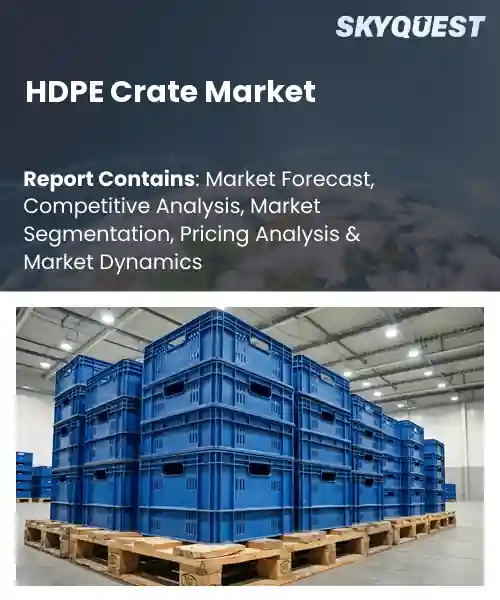
HDPE Crate Market
Report ID: SQMIG20I2886
Report ID: SQMIG20I2886
[email protected]
USA +1 351-333-4748
Report ID:
SQMIG20I2886 |
Region:
Global |
Published Date: April, 2026
Pages:
157
|Tables:
88
|Figures:
76


Global Hdpe Crate Market size was valued at USD 1.15 Billion in 2024 and is poised to grow from USD 1.22 Billion in 2025 to USD 1.1 Billion by 2033, growing at a CAGR of 5.8% during the forecast period (2026-2033).
High-density polyethylene (HDPE) crate market centers on molded and extruded containers used across agriculture, food distribution, retail, and pharmaceuticals, and its primary driver is the intersection of cost-efficiency and durability that reduces total cost of ownership for logistics providers. The market matters because crates replace single-use packaging with reusable assets that lower waste and improve hygiene, which became critical after supply chain disruptions and stricter sanitation standards. Over time demand shifted from wooden and metal pallets to lightweight HDPE designs, illustrated by European fruit packers replacing ventilated wooden boxes with stackable HDPE crates to extend shelf life and streamline handling.Building on hygiene and logistics efficiency, the pivotal factor shaping global HDPE crate growth is the convergence of regulatory pressure for sustainable packaging and the rapid expansion of temperature-sensitive e-commerce distribution, which together create quantifiable cost and compliance incentives. When retailers and pharma distributors face stricter single-use bans and tighter cold-chain requirements, they adopt reusable HDPE crates that withstand laundering and maintain thermal stability, thereby lowering return rates and regulatory risk. Practical outcomes include supermarket chains reducing breakage during rapid replenishment, third-party logistics providers integrating RFID-tagged crates for inventory accuracy, and recyclers creating high-value secondary resin streams that improve margins.
How is IoT improving supply chain visibility in the HDPE crate market?
IoT is raising supply chain visibility for HDPE crates by giving each asset a digital identity through tags and embedded sensors. Key aspects include real time location tracking, condition monitoring for temperature and humidity, and cloud platforms that consolidate crate lifecycle data. Today manufacturers and poolers are fitting reusable HDPE crates with RFID, BLE and simple temperature sensors so operators can trace product provenance, spot delays and speed returns. In a market driven by fresh food and pharmaceuticals and by circular reuse models these capabilities reduce loss, improve routing and enable predictive maintenance making HDPE crates a strategic logistics asset.IFCO and Identiv August 2025, demonstrated this trend with a partnership to develop BLE smart labels that bring real time monitoring to large pools of reusable crates. This IoT innovation supports market efficiency by improving cold chain control reducing unneeded crate loss and enabling data driven routing that accelerates reuse cycles.
Market snapshot - (2026-2033)
Global Market Size
USD 1.15 Billion
Largest Segment
Wrist-mounted Dive Computers
Fastest Growth
Others (Heads-up Displays/HUD)
Growth Rate
5.8% CAGR
To get more insights on this market click here to Request a Free Sample Report
Global hdpe crate market is segmented by product type, user level, distribution channel and region. Based on product type, the market is segmented into Wrist-mounted Dive Computers, Console-mounted/Hose-integrated and Others (Heads-up Displays/HUD). Based on user level, the market is segmented into Recreational Divers (Single Gas/Simple) and Technical & Professional Divers (Trimix/Multi-gas). Based on distribution channel, the market is segmented into Specialty Dive & Sports Shops and Online E-commerce & Marketplace Platforms. Based on region, the market is segmented into North America, Europe, Asia Pacific, Latin America and Middle East & Africa.
Online e commerce & marketplace platforms segment dominates because their wide digital reach and integrated logistics capabilities streamline procurement and ordering of hdpe crates across diverse buyer groups, enabling suppliers to present standardized offerings with configurable options. The platforms encourage efficient inventory management and predictable demand signals, which lead manufacturers to invest in scalable production, optimized packaging designs and faster fulfillment processes that further entrench online channels as primary distribution pathways.
However, Specialty Dive and Sports Shops are rapidly expanding due to retailers providing hands on consultation, bespoke crate configurations and immediate fulfillment for dive operators and gear makers. Frontline feedback accelerates design refinement and accessory bundling, driving adoption of specialized protective hdpe crates for niche applications and creating new demand pathways.
Wrist mounted Dive Computers segment dominates because their compact, high use profile generates steady requirements for small, protective hdpe crates that emphasize lightweight protection, stackability and moisture control. Manufacturers adapt by designing tailored foam inserts, drainage features and standardized crate dimensions that reduce handling complexity and storage costs, prompting consistent tooling investments and quality controls focused on the specific handling and shipping needs of wrist worn devices.
However, Others Heads up Displays HUD are rapidly expanding due to novel display technologies and premium use cases demanding bespoke hdpe crates with enhanced shock isolation and precision foam inserts. Growing professional adoption drives suppliers to innovate advanced materials and modular protection solutions, opening premium application areas and broader opportunities for specialized hdpe crate offerings.
To get detailed segments analysis, Request a Free Sample Report
Asia Pacific dominance is driven by integrated manufacturing ecosystems, proximity to raw material suppliers and strong downstream demand across agriculture, food processing and e-commerce logistics. Established polymer processing clusters enable efficient scale production and cost advantages, while regional manufacturers emphasize design customization and durability tailored to varied handling and hygiene requirements. Trade networks across the region and investments in packaging innovation support rapid product adoption among exporters and domestic users. Regulatory attention to reusable and recyclable packaging encourages substitution toward durable HDPE crates. Collaborative partnerships between manufacturers and logistics providers further accelerate adoption and product refinement across diverse end markets, reinforcing the region as a center of both volume production and product development that shapes global supply chains and standards.
HDPE Crate Market Japan benefits from advanced manufacturing precision, strong quality control practices, close collaboration with food service and packaging suppliers. Emphasis on hygiene, lightweight durability and space efficient designs aligns with demanding retail and fresh produce handling. Local producers focus on material performance and long service life while integrating design refinements that support automation and return logistics. Procurement preferences favor reliable local support and consistent product specifications to meet strict handling standards.
HDPE Crate Market South Korea is characterized by agile production, strong integration with electronics and fisheries supply chains, focusing on durable reusable designs. Manufacturers prioritize rapid tooling changes and modular designs to serve diverse handling and storage needs. Collaboration with logistics operators yields crate designs optimized for automated sorting and stacking. Buyers value suppliers that offer robust product life, efficient return systems and localized technical support for strong domestic distribution.
Europe rapid expansion in HDPE crate adoption reflects converging forces of sustainability preferences, sophisticated retail logistics and strong demand for hygienic reusable packaging. Customers prioritize crates that balance durability and design for automation in cold chain and fresh produce distribution, while regulatory and retailer commitments encourage returnable solutions over single use alternatives. Advanced recycling infrastructure and material circularity initiatives support closed loop thinking among manufacturers and brand owners. Local producers differentiate through customization, certified material sourcing and service models that include pooling and asset tracking. Cross-border trade and high standards for food safety further stimulate product innovation, enabling suppliers to capture complex specification requirements and deepen relationships with grocers, processors and third party logistics providers. Investment in smart packaging, traceability and collaborative pooling schemes is accelerating market sophistication and broadening adoption among diverse end markets.
HDPE Crate Market Germany benefits from organized food supply chains, advanced logistics and emphasis on reusable packaging. Manufacturers and packaging pools deliver robust specifications tailored to fresh produce and bakery distribution. Technical standards and certification preferences favor crates that offer hygiene, stackability and compatibility with automated handling. Procurement emphasizes durability, repairability and collaboration with pooling operators to reduce waste and optimize total cost for retailers and processors across supply chains.
HDPE Crate Market United Kingdom shows strong momentum driven by dynamic retail formats, e-commerce fulfillment and retailer reusable packaging initiatives. Suppliers emphasize lightweight yet durable designs that suit automated pick systems and last mile. Material circularity ambitions and packaging pooling pilots stimulate partnerships among crate manufacturers, logistics providers and food suppliers. Buyers increasingly demand traceability, ease of cleaning and return logistics support, prompting innovation in modular crates and service offerings.
HDPE Crate Market France is emerging through increasing adoption in artisanal food, fresh produce and regional distribution networks where quality and traceability matter. Local manufacturers focus on customizable formats, food contact safety and alignment with retailer and producer requirements. Pilot programs for effective crate pooling and material recovery foster collaboration between suppliers and municipalities. Emphasis on regional supply resilience and reduced packaging waste drives interest in durable, returnable HDPE solutions.
North America is strengthening its position through supply chain modernization, emphasis on circular practices and close collaboration between crate manufacturers and major retail and food service operators. Investment in returnable packaging programs and enhanced crate pooling networks improves asset utilization and reduces reliance on single use options. Manufacturers adapt by offering heavier duty constructions suited to long haul transport as well as modular designs for automated handling and cross docking. Collaboration with recyclers and material suppliers enhances resin sourcing and reclaimed content integration. Adoption of digital tracking, crate tagging and performance monitoring drives operational transparency and supports just in time replenishment, while alignment with food safety guidelines ensures broader acceptance across perishables supply chains. Service offerings such as maintenance, repair and fleet management deepen customer relationships and support long term procurement strategies across diverse agricultural, beverage and industrial sectors.
HDPE Crate Market United States is driven by large scale retail networks, sophisticated third party logistics providers and strong demand for reusable packaging in fresh food and beverage distribution. Suppliers focus on heavy duty constructions, compatibility with automated sortation and integration with asset tracking systems. Pooling models and service contracts are used to manage crate fleets, while collaboration with processors, grocers supports tailored specifications, robust repair programs and reverse logistics.
HDPE Crate Market Canada emphasizes resilience across long distance supply chains and cold chain integrity for agricultural and seafood exporters. Manufacturers tailor crates for rugged handling and nesting to maximize transport efficiency. Interest in pooling and circularity encourages partnerships among producers, logistics firms and co-operatives. Buyers seek crates that provide ease of cleaning, regulatory compliance for food contact and maintenance services to sustain multiuse lifecycles across domestic and export routes.
To know more about the market opportunities by region and country, click here to
Buy The Complete Report
Increasing Demand From Retailers
Shift Toward Reusable Packaging
Regulatory Restrictions on Plastics
High Dependence on Virgin Resin
Request Free Customization of this report to help us to meet your business objectives.
Global HDPE crate competitive landscape shows consolidation through dealmaking and service partnerships, with major pool operators using M&A to secure scale and new entrants pursuing platform and design innovations. Examples include Brambles' 2019 IFCO transaction as portfolio reshaping, retailer pilots with reusable-packaging startups, and manufacturers introducing collapsible and traceable crate designs to improve rotation and lower logistics costs.
Top Player’s Company Profile
Recent Developments
SkyQuest’s ABIRAW (Advanced Business Intelligence, Research & Analysis Wing) is our Business Information Services team that Collects, Collates, Correlates, and Analyses the Data collected by means of Primary Exploratory Research backed by robust Secondary Desk research. As per SkyQuest analysis, the global HDPE crate market is being driven primarily by rising demand from retailers for durable, lightweight reusable handling solutions that cut damage and total cost of ownership, with IoT-enabled tracking and condition monitoring serving as a strong secondary driver by improving visibility and asset utilization. Growth is anchored in Asia Pacific, where integrated manufacturing and downstream demand dominate volumes, while online e-commerce and marketplace platforms lead distribution through broad reach and predictable ordering. A key restraint remains stringent regulatory restrictions on plastics and recycled content requirements that complicate material sourcing and compliance, forcing manufacturers to balance performance with evolving sustainability rules.
| Report Metric | Details |
|---|---|
| Market size value in 2024 | USD 1.15 Billion |
| Market size value in 2033 | USD 1.1 Billion |
| Growth Rate | 5.8% |
| Base year | 2024 |
| Forecast period | (2026-2033) |
| Forecast Unit (Value) | USD Billion |
| Segments covered |
|
| Regions covered | North America (US, Canada), Europe (Germany, France, United Kingdom, Italy, Spain, Rest of Europe), Asia Pacific (China, India, Japan, Rest of Asia-Pacific), Latin America (Brazil, Rest of Latin America), Middle East & Africa (South Africa, GCC Countries, Rest of MEA) |
| Companies covered |
|
| Customization scope | Free report customization with purchase. Customization includes:-
|
To get a free trial access to our platform which is a one stop solution for all your data requirements for quicker decision making. This platform allows you to compare markets, competitors who are prominent in the market, and mega trends that are influencing the dynamics in the market. Also, get access to detailed SkyQuest exclusive matrix.
Table Of Content
Executive Summary
Market overview
Parent Market Analysis
Market overview
Market size
KEY MARKET INSIGHTS
COVID IMPACT
MARKET DYNAMICS & OUTLOOK
Market Size by Region
KEY COMPANY PROFILES
Methodology
For the HDPE Crate Market, our research methodology involved a mixture of primary and secondary data sources. Key steps involved in the research process are listed below:
1. Information Procurement: This stage involved the procurement of Market data or related information via primary and secondary sources. The various secondary sources used included various company websites, annual reports, trade databases, and paid databases such as Hoover's, Bloomberg Business, Factiva, and Avention. Our team did 45 primary interactions Globally which included several stakeholders such as manufacturers, customers, key opinion leaders, etc. Overall, information procurement was one of the most extensive stages in our research process.
2. Information Analysis: This step involved triangulation of data through bottom-up and top-down approaches to estimate and validate the total size and future estimate of the HDPE Crate Market.
3. Report Formulation: The final step entailed the placement of data points in appropriate Market spaces in an attempt to deduce viable conclusions.
4. Validation & Publishing: Validation is the most important step in the process. Validation & re-validation via an intricately designed process helped us finalize data points to be used for final calculations. The final Market estimates and forecasts were then aligned and sent to our panel of industry experts for validation of data. Once the validation was done the report was sent to our Quality Assurance team to ensure adherence to style guides, consistency & design.
Analyst Support
Customization Options
With the given market data, our dedicated team of analysts can offer you the following customization options are available for the HDPE Crate Market:
Product Analysis: Product matrix, which offers a detailed comparison of the product portfolio of companies.
Regional Analysis: Further analysis of the HDPE Crate Market for additional countries.
Competitive Analysis: Detailed analysis and profiling of additional Market players & comparative analysis of competitive products.
Go to Market Strategy: Find the high-growth channels to invest your marketing efforts and increase your customer base.
Innovation Mapping: Identify racial solutions and innovation, connected to deep ecosystems of innovators, start-ups, academics, and strategic partners.
Category Intelligence: Customized intelligence that is relevant to their supply Markets will enable them to make smarter sourcing decisions and improve their category management.
Public Company Transcript Analysis: To improve the investment performance by generating new alpha and making better-informed decisions.
Social Media Listening: To analyze the conversations and trends happening not just around your brand, but around your industry as a whole, and use those insights to make better Marketing decisions.
REQUEST FOR SAMPLE
 REQUEST FREE CUSTOMIZATION


Want to customize this report? This report can be personalized according to your needs. Our analysts and industry experts will work directly with you to understand your requirements and provide you with customized data in a short amount of time. We offer $1000 worth of FREE customization at the time of purchase.
Feedback From Our Clients


 USA (+1) 351-333-4748

