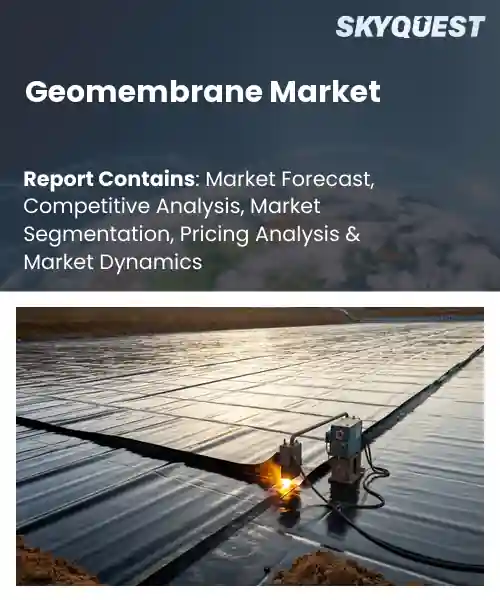
Geomembrane Market
Report ID: SQMIG15E3474
Report ID: SQMIG15E3474
[email protected]
USA +1 351-333-4748
Report ID:
SQMIG15E3474 |
Region:
Global |
Published Date: May, 2026
Pages:
157
|Tables:
121
|Figures:
77


Global Geomembrane Market size was valued at USD 3.82 Billion in 2024 and is poised to grow from USD 4.1 Billion in 2025 to USD 7.22 Billion by 2033, growing at a CAGR of 7.32% during the forecast period (2026-2033).
As government environmental controls continue to become stricter and as industry goes through continuous expansion, the need for geomembrane products has increased greatly, as these engineered polymer liners offer the means of providing reliable containment of both liquids and solids. The geomembrane market includes high-density polyethlene, linear low-density polyethylene, polyvinyl chloride and reinforced composites that are used for landfill, tailings and wastewater containment surfaces. The importance of geomembranes is derived from their ability to protect groundwater from being contaminated, conserve limited water resources, & allow modern mining and waste management processes. As governmental agencies established more stringent leakage requirements, the geomembrane industry evolved from using the basic PVC to more complex and sophisticated welded HDPE liner systems, demonstrating the technological maturation of the industry as well as the worldwide adoption of liner technology.
One of the significant growth drivers in this market is regulatory pressure that forces these businesses to improve their containment systems; this creates expected purchasing patterns that geomembrane manufacturers and contractors can respond to. In cases where governmental agencies tighten regulations regarding landfills and tailings, municipalities in North America and mining companies from Chile and Australia will need to purchase lined cells and/or lined covers, which create a larger market for high performance HDPE and textured membranes and motivate the development of new welding and inspection technologies.
How is AI improving quality control in the geomembrane market?
In the geomembrane industry, quality control is being improved by using AI to create reproducible processes for inspection and testing. Automated visual assessments of images taken from the air and from close range, machine learning used to classify electrical and sonar data and centralized cloud systems used to standardize report information from various locations are important elements of the new AI-driven quality control processes. With stricter regulations governing environmental health and safety in the industry, along with fewer qualified warehouse workers available to perform inspections, early detection of defects is critical. Manufacturers use of drone photogrammetry with thermal imaging, AI-based assessment of electrical leak survey results, and in-factory vision systems to inspect seams all contribute to greater reliability and faster acceptance of geomembranes.
Layfield Group in March 2026, a multilayer containment installation was subjected to an extensive amount of destructive and non-destructive seam testing. The ability to analyze those inspection data using AI will reduce rework and speed approvals for manufacturers, thereby promoting efficiency in the overall market and supporting the increased use of geomembranes by consumers.
Market snapshot - (2026-2033)
Global Market Size
USD 3.82 Billion
Largest Segment
HDPE
Fastest Growth
LLDPE
Growth Rate
7.32% CAGR
To get more insights on this market click here to Request a Free Sample Report
Global geomembrane market is segmented by material type, application, end-use, thickness and region. Based on material type, the market is segmented into HDPE, LLDPE, PVC, EPDM and Others. Based on application, the market is segmented into Waste Containment (Landfills), Water Management, Mining and Agriculture. Based on end-use, the market is segmented into Landfills & Waste, Ponds & Reservoirs, Mining Tailing Ponds and Canal Lining. Based on thickness, the market is segmented into Below 1 mm, 1-2 mm and Above 2 mm. Based on region, the market is segmented into North America, Europe, Asia Pacific, Latin America and Middle East & Africa.
HDPE segment dominates with large geomembrane market share and most widely used material for heavy-duty, on-site containment. Not only is it preferred by contractors and specifiers for its ability to be welded together and compatibility with aggressive waste chemistries, it also minimizes the risk of leaking and makes future maintenance significantly simpler. The extensive availability of HDPE and its familiarity within the industry, supports and drives buyer demand for the material as it relates to gaining acceptance across all regulatory frameworks. It also has given designers the confidence to use HDPE and has facilitated their ability to plan for the complete life cycle of their design installations.
As per geomembrane market outlook, LLDPE is becoming the fastest growing segment in the market due to its greater flexibility and resistance to stress cracking than HDPE, providing better performance when utilizing the two materials on surfaces that are uneven and have intricate geometries. The introduction of new blending variations of resins and advancements in welding technologies will allow these materials to open up more specifications for use in water containment and mining applications.
As per geomembrane market forecast, Above 2 mm segment leads because it has the best mechanical protection and longest service life due to the larger amount of material that is used for very high-stress applications. When designing and utilizing a segment for containment purposes, designers and end-users will prioritize its robustness against puncture, abrasion, and settling. All of these attributes lead to a reduction in the number of times repairs need to be made and a significant reduction in the amount of long-term maintenance associated with a liner system. The reliability of this segment also meets extremely strict containment specifications and provides an opportunity for project owners and engineers to confidently trust the use of thicker, longer-lasting liners. Therefore, project owners and engineers can design with a lifecycle focus.
As per geomembrane market analysis, 1 to 2 mm segment has shown significant growth momentum due to its ability to balance the benefits of durability with ease of handling and speed of installation and offering an opportunity for reasonably priced, reliable liners. Recent advancements in compound formulations and welding techniques have increased the utilization of this segment for both water management and smaller containment construction projects; thus, there are new specification opportunities available to the market.
To get detailed segments analysis, Request a Free Sample Report
Asia Pacific Region has been the primary source of geomembranes owing to the many large-scale construction projects being undertaken, along with its strong manufacturing base and its high level of demand for environmentally sound containment systems. Additionally, rapid urban growth and an increased focus on water security in this region will drive growth for geomembranes in various industries, such as waste management, mining and aquaculture. Local manufacturers are able to provide competitive supply chain systems as well as customized technical assistance to their customers, and there is an increasing emphasis placed on pollution control and durability by regulators, leading to a preference for materials that have advanced properties. There is also cross-border collaboration and local engineering expertise to support further product development and innovation within the geomembrane market. The amount of money being invested into research and development will also enable the development of higher performance membranes and installation techniques that can be applied to all types of climatic and seismic conditions. The partnerships formed between public and private sectors have created an emphasis on protecting long-term assets as well as optimizing life cycle costs by specifying long-lasting liners. The increase in after-sales service networks and local fabrication facilities has decreased lead times and will provide assistance in completing large-scale projects throughout this area.
As per geomembrane market regional forecast, Japan industry is characterized by advanced engineering of geomembranes, rigorous quality standards and a growing demand for high-performance solutions specifically suited to seismic and coastal environments. Innovative manufacturing processes supported by strong cooperation with research institutions have improved product durability and installation methods. The institutional focus on environmental protection and long-lasting assets allows for specification of premium liners for the management of water and waste confinement, and local production of these materials enables the delivery of customized products along with technical support to the end user.
As per geomembrane market regional outlook, South Korea experiences strong demand in the industry sector, utilizes advanced manufacturing technologies and is primarily oriented towards exporting goods. The emphasis of product design and development for industrial waste water treatment, coastal protection and urban infrastructure projects is on providing durable solutions. There is strong cooperation between local manufacturers and International technology partners to facilitate the adaptation of composite membranes and specialized installation techniques. The engineering capability and purchasing practices of the project create specifications for high-quality membranes to be used for Environmental Protection and containment across all divisions of Government.
As per geomembrane industry analysis, a rapidly-growing market in North America is being driven by a variety of needs that include upgrading existing infrastructure, increasing levels of environmental regulation mandating the use of more sophisticated and environmentally-friendly containment solutions as well as the growing emphasis in sustainability for businesses and governments alike. The industries that demand geomembranes range from municipal waste water treatment facilities to landfill remediation to industrial containment, but all have one commonality: They are all reliant upon having long-lasting leak-proof and cost-effective containment, which makes advanced membrane technology a preferred choice. An experienced supply chain of fabricators and installers is in place which provides a solid basis for large-scale installation of membranes. The continuing development of new materials, combined with rigorous performance testing will provide a high degree of confidence to the specifiers of geomembranes. The establishment of cooperative working relationships among regulators, engineers, and private developers, will result in faster approval times and the implementation of best practices. Varied geography and both retrofit and new construction markets provide consistent momentum in the market through a broad range of industries. Continued investment in R&D and enhanced installation practices will continue to elevate performance expectations and enhance the procurement of geomembrane systems throughout their lifecycle.
Geomembrane market within the US is growing due to significant infrastructure projects, a strong regulatory framework, and greater demand for specialized containment systems in the waste management and energy sectors. There is an established network of installers, fabricators, and testing labs that are able to support the needs of complex specifications and ensure the quality of geomembrane products. As demand for retrofit solutions and engineered systems increases, this will continue to drive the use of advanced materials and installation techniques. Furthermore, the collaborative procurement of environmental goals by public agencies in partnership with private contractors will continue to favor the lifecycle performance of geomembrane products and their after-sales service.
Geomembrane market within Canada is being driven by initiatives related to environmental stewardship, continued increases in mining activity, and an increased emphasis on the protection of water resources located in remote areas. This market is targeting specifications for robust geomembranes and installation methods that are suitable for working in harsh weather conditions due to the cold climate conditions and need for reliable containment. Local fabricators and suppliers provide modular solutions for fluid containment and provide field engineering services. The design of projects is being done in conjunction with consulting with local First Nations communities and working within the regulatory framework created by the provinces through a smart approach to project lifecycle management, and through local infrastructure protection efforts.
As per geomembrane market regional outlook, Europe has been significantly positively impacted by the use of rigorous environmental regulations, the adoption of a circular economy approach, and the coordinated efforts to develop infrastructure across the continent by each member state. The emphasis by regulators on performance relative to leak containment and landfill remediation is encouraging the specification of higher quality geomembranes and the use of certified installation practices. In addition to the regulatory changes and requirements, the ongoing development of collaborative research and development programs, harmonized testing protocols and the increased utilization of recycled or composite materials support the overall advancement of geomembrane market. The use of public procurement practices and technical guidelines is facilitating the incorporation of lifecycle thinking into purchasing decisions. Together with experienced contractors and regional fabricators, these elements provide the opportunities for tailored solutions to be available to end-users relative to water management and waste containment and industrial applications. Collectively, this is enhancing the maturity and competitiveness of the geo membrane industry. Investment in certification and installer training programs serves to improve product quality and continuity of production as well as installations.
Germany has the same characteristics that are positively impacting the geomembrane market. Strong engineering management history, stringent requirements for compliance related to quality, and a high level of industry containment and environmental compliance all contribute to the continued increase in demand for geo membranes in Germany. Registered liner systems are needed for a wide variety of applications such as waste-water treatment facilities, landfill remediation projects, and industrial process containment; therefore, the demand to use certified liner materials and document their installation practices will continue to provide positive future growth in the Germany geomembrane market.
As per geomembrane market regional forecast, United Kingdom market is being driven by increased focus on flood defence, coastal protection, sustainable urban drainage systems, others. More emphasis is being placed on water management and landfill restoration which will lead to more demand for reliable containment solutions and experienced installers. In addition to this, the engineering and consulting community are specifying high performance membranes and demanding thorough testing/commissioning of the products. As local supply chains developed for these types of projects, there is also a growing interest in recycled and composite materials that will affect longer-term asset maintenance.
As per geomembrane industry analysis, French geomembrane market reflects the significant level of public investment in water and environmental infrastructure with demand for containment solutions. Many of these solutions are used in wastewater treatment, landfill capping and agricultural applications. Engineering consultancies are driving the specification of tailored membrane systems that meet both national regulation standards and the requirements of the landscape. Local manufacturers and installation experts supply custom fabrication and on-site support. The geomembrane market trend toward sustainable materials and integrated project delivery is increasing the acceptance of advanced geomembrane systems across a number of industries.
To know more about the market opportunities by region and country, click here to
Buy The Complete Report
Infrastructure Development Drives Demand
Environmental Regulations Encourage Adoption
Raw Material Price Volatility
Installation Complexity Limits Uptake
Request Free Customization of this report to help us to meet your business objectives.
The competitive environment is project-based and consolidating, whereby suppliers are either executing M&A, expanding their factories or forming strategic partnerships to obtain large waste and water containment contracts. This can be seen in examples such as CNH Industrial acquiring Raven to leverage their capabilities or Solmax adding production line and facility improvements recently. The market for materials-based competition can also be seen in the launch of a number of products made from resin and fire-retardant geomembranes.
SkyQuest’s ABIRAW (Advanced Business Intelligence, Research & Analysis Wing) is our Business Information Services team that Collects, Collates, Correlates, and Analyses the Data collected by means of Primary Exploratory Research backed by robust Secondary Desk research.
As per SkyQuest analysis, the global geomembrane industry is propelled by regulatory pressure as one key driver which compels owners to upgrade containment systems and creates predictable procurement pipelines while a second driver is worsening water scarcity that boosts demand for lined reservoirs and irrigation channels. One restraint remains raw material price volatility, which can compress margins and delay projects. Asia Pacific is the dominating region due to large infrastructure programs, manufacturing capacity and strong water and waste management demand. The dominating segment is HDPE, favored for chemical resistance, weldability and proven service life in heavy containment applications. Market momentum will hinge on cost stability and installation capabilities.
| Report Metric | Details |
|---|---|
| Market size value in 2024 | USD 3.82 Billion |
| Market size value in 2033 | USD 7.22 Billion |
| Growth Rate | 7.32% |
| Base year | 2024 |
| Forecast period | (2026-2033) |
| Forecast Unit (Value) | USD Billion |
| Segments covered |
|
| Regions covered | North America (US, Canada), Europe (Germany, France, United Kingdom, Italy, Spain, Rest of Europe), Asia Pacific (China, India, Japan, Rest of Asia-Pacific), Latin America (Brazil, Rest of Latin America), Middle East & Africa (South Africa, GCC Countries, Rest of MEA) |
| Companies covered |
|
| Customization scope | Free report customization with purchase. Customization includes:-
|
To get a free trial access to our platform which is a one stop solution for all your data requirements for quicker decision making. This platform allows you to compare markets, competitors who are prominent in the market, and mega trends that are influencing the dynamics in the market. Also, get access to detailed SkyQuest exclusive matrix.
Table Of Content
Executive Summary
Market overview
Parent Market Analysis
Market overview
Market size
KEY MARKET INSIGHTS
COVID IMPACT
MARKET DYNAMICS & OUTLOOK
Market Size by Region
KEY COMPANY PROFILES
Methodology
For the Geomembrane Market, our research methodology involved a mixture of primary and secondary data sources. Key steps involved in the research process are listed below:
1. Information Procurement: This stage involved the procurement of Market data or related information via primary and secondary sources. The various secondary sources used included various company websites, annual reports, trade databases, and paid databases such as Hoover's, Bloomberg Business, Factiva, and Avention. Our team did 45 primary interactions Globally which included several stakeholders such as manufacturers, customers, key opinion leaders, etc. Overall, information procurement was one of the most extensive stages in our research process.
2. Information Analysis: This step involved triangulation of data through bottom-up and top-down approaches to estimate and validate the total size and future estimate of the Geomembrane Market.
3. Report Formulation: The final step entailed the placement of data points in appropriate Market spaces in an attempt to deduce viable conclusions.
4. Validation & Publishing: Validation is the most important step in the process. Validation & re-validation via an intricately designed process helped us finalize data points to be used for final calculations. The final Market estimates and forecasts were then aligned and sent to our panel of industry experts for validation of data. Once the validation was done the report was sent to our Quality Assurance team to ensure adherence to style guides, consistency & design.
Analyst Support
Customization Options
With the given market data, our dedicated team of analysts can offer you the following customization options are available for the Geomembrane Market:
Product Analysis: Product matrix, which offers a detailed comparison of the product portfolio of companies.
Regional Analysis: Further analysis of the Geomembrane Market for additional countries.
Competitive Analysis: Detailed analysis and profiling of additional Market players & comparative analysis of competitive products.
Go to Market Strategy: Find the high-growth channels to invest your marketing efforts and increase your customer base.
Innovation Mapping: Identify racial solutions and innovation, connected to deep ecosystems of innovators, start-ups, academics, and strategic partners.
Category Intelligence: Customized intelligence that is relevant to their supply Markets will enable them to make smarter sourcing decisions and improve their category management.
Public Company Transcript Analysis: To improve the investment performance by generating new alpha and making better-informed decisions.
Social Media Listening: To analyze the conversations and trends happening not just around your brand, but around your industry as a whole, and use those insights to make better Marketing decisions.
REQUEST FOR SAMPLE
 REQUEST FREE CUSTOMIZATION
Global Geomembrane Market size was valued at USD 3.82 Billion in 2024 and is poised to grow from USD 4.1 Billion in 2025 to USD 7.22 Billion by 2033, growing at a CAGR of 7.32% during the forecast period (2026-2033).
Competitive landscape is consolidation-led and project-driven, with suppliers using M&A, factory expansions, strategic partnerships and product innovation to win large waste and water containment contracts; examples include CNH Industrial’s acquisition of Raven for capability integration and Solmax’s recent production line and facility upgrades, while resin and fire-resistant geomembrane launches signal materials-led competition. 'GSE Environmental', 'Solmax International', 'AGRU Kunststofftechnik', 'Carlisle Companies', 'TenCate Geosynthetics (Indorama)', 'Officine Maccaferri', 'Layfield Group', 'NAUE GmbH', 'Nilex Inc.', 'Raven Industries', 'Atarfil SL', 'Environmental Geotechnics', 'Nilex Geosynthetics', 'Polymer Group Inc.', 'Plastika Kritis SA', 'Firestone Building Products', 'Strata Systems', 'Hanes Geo Components', 'Global Synthetics', 'CETCO (Minerals Technologies)'
Infrastructure expansion and renovation projects increase demand for durable containment and lining solutions, positioning geomembranes as preferred materials. Their impermeability, long service life, and adaptability across landfills, water reservoirs, and transportation infrastructure make them integral to modern construction specifications. Project planners and engineers favor geomembranes to mitigate leakage risks, simplify installation sequencing, and reduce maintenance needs, which fosters procurement decisions that prioritize long-term performance. This alignment between infrastructure objectives and geomembrane characteristics supports sustained market uptake and encourages manufacturers to scale supply and innovation.
Circular Economy Integration: Adoption of circular principles is reshaping demand for geomembranes as stakeholders prioritize reusability, recyclability and lifespan extension. Manufacturers are developing formulations and product systems that facilitate repair, material recovery and end-of-life recycling while enabling modular installation and maintenance. Collaboration across waste, water and mining sectors promotes takeback and refurbishment programmes. Buyers increasingly prefer suppliers with transparent lifecycle claims and third-party certifications, creating market advantage for products designed to minimize waste and support corporate sustainability commitments and resilience.
Why does Asia Pacific Dominate the Global Geomembrane Market? |@12


Want to customize this report? This report can be personalized according to your needs. Our analysts and industry experts will work directly with you to understand your requirements and provide you with customized data in a short amount of time. We offer $1000 worth of FREE customization at the time of purchase.
Feedback From Our Clients


 USA (+1) 351-333-4748

