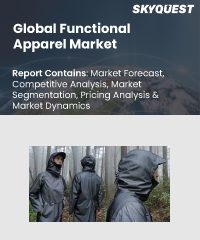
Functional Apparel Market
Report ID: SQMIG25M2031
Report ID: SQMIG25M2031
[email protected]
USA +1 351-333-4748
Report ID:
SQMIG25M2031 |
Region:
Global |
Published Date: December, 2025
Pages:
223
|Tables:
91
|Figures:
76


Global Functional Apparel Market size was valued at USD 480.91 Billion in 2024 and is poised to grow from USD 510.73 Billion in 2025 to USD 826.39 Billion by 2033, growing at a CAGR of 6.2% during the forecast period (2026–2033).
The global functional apparel market continues to evolve, driven by increasing consumer demand for versatile and performance-oriented clothing.
This trend encompasses activewear, athleisure, and specialized garments designed for specific activities or environments.
Technological advancements in fabric innovation, moisture-wicking capabilities, UV protection, and ergonomic designs have propelled the market's growth.
Sustainability concerns have also led to a rise in eco-friendly and responsibly sourced functional apparel.
As health and wellness awareness grows, the market's trajectory remains upward, fueled by the desire for stylish yet practical clothing that seamlessly integrates with modern lifestyles.
US Functional Apparel Market is poised to grow at a sustainable CAGR for the next forecast year.
Market snapshot - 2026-2033
Global Market Size
USD 452.83 billion
Largest Segment
Online retail
Fastest Growth
Specialty stores
Growth Rate
6.2% CAGR
To get more insights on this market click here to Request a Free Sample Report
Global Functional Apparel Market is segmented by Product Type, Fabric Type, Finishing Type, Application, Distribution Channel and region. Based on Product Type, the market is segmented into Sportswear, Outdoor Clothing, Innerwear, Footwear, Socks, Swimwear and Others. Based on Fabric Type, the market is segmented into Conventional and Specialty. Based on Finishing Type, the market is segmented into Water-Resistant, Anti-Microbial, Wicking and Stain-Resistant. Based on Application, the market is segmented into Sports & Fitness, Outdoor Activities, Medical and Industrial. Based on Distribution Channel, the market is segmented into Online and Offline. Based on region, the market is segmented into North America, Europe, Asia Pacific, Latin America and Middle East & Africa.
The largest sector encompasses performance sportswear and activewear, characterized by its ability to offer advanced moisture-wicking, temperature regulation, and enhanced flexibility, making it ideal for athletic and fitness activities. This sector has witnessed consistent growth due to the increasing health and wellness awareness, coupled with the rising popularity of athleisure fashion trends. On the other hand, the fastest-growing sector within functional apparel pertains to smart textiles and wearable technology-infused garments.
The largest sector is currently the men's functional apparel segment. This can be attributed to factors such as increasing participation in sports and fitness activities by men, growing awareness of health and wellness, and the integration of functional features into men's activewear and athleisure styles. On the other hand, the fastest-growing sector within the functional apparel market is the women's segment.
The largest sector is currently online retail, driven by the rapid growth of e-commerce platforms and the increasing preference for convenient and contactless shopping experiences. This channel offers consumers a wide array of functional apparel options and the flexibility to compare and purchase products from the comfort of their homes. On the other hand, the fastest-growing sector in the functional apparel market is specialty stores.
To get detailed segments analysis, Request a Free Sample Report
The global functional apparel market demonstrates diverse regional trends. In North America, technological advancements drive demand for smart and performance-enhancing garments. Europe emphasizes sustainable and fashion-forward functional wear, aligning with eco-conscious consumer preferences. Asia-Pacific showcases robust growth with a focus on innovative fabrics and versatile designs catering to active lifestyles. Meanwhile, Latin America and the Middle East witness rising interest in athleisure and wellness-oriented apparel, reflecting evolving consumer habits. These regional dynamics collectively shape the thriving global functional apparel landscape.
To know more about the market opportunities by region and country, click here to
Buy The Complete Report
Health and Wellness Trends
Athleisure and Casualization
High Costs
Sustainability Challenges
Request Free Customization of this report to help us to meet your business objectives.
The global functional apparel market features a dynamic competitive landscape characterized by a diverse array of established brands and innovative players. Industry leaders such as Nike, Adidas, and Under Armour continue to drive innovation through cutting-edge technologies and performance-enhancing designs, while newer entrants like Lululemon and Outdoor Voices challenge traditional norms with unique offerings. The market's evolution is fueled by consumer demand for versatile, stylish, and purpose-driven clothing, creating opportunities for both established giants and agile newcomers to thrive amidst evolving trends and preferences.
SkyQuest's ABIRAW (Advanced Business Intelligence, Research & Analysis Wing) is our Business Information Product types team that Collects, Collates, Co-relates, and Analyses the Data collected by means of Primary Exploratory Research backed by robust Secondary Desk research.
According to our analysis, the global functional apparel market holds promising prospects as consumer lifestyles increasingly prioritize health, comfort, and versatility. With a growing awareness of fitness and wellness, there is a rising demand for apparel that seamlessly integrates technology, performance-enhancing features, and sustainable materials. This trend is driving innovation in clothing design, leading to the development of smart fabrics, moisture-wicking textiles, temperature-regulating garments, and adaptive wearables. As urbanization and outdoor activities surge, the demand for multifunctional clothing that can transition effortlessly between various environments and activities is set to expand. Furthermore, the emphasis on eco-consciousness is pushing manufacturers to create functional apparel using eco-friendly practices, catering to environmentally conscious consumers. Capitalizing on these trends, the functional apparel market is poised for robust growth, presenting ample opportunities for brands to cater to evolving consumer preferences and shape the future of clothing technology.
| Report Metric | Details |
|---|---|
| Market size value in 2024 | USD 480.91 Billion |
| Market size value in 2033 | USD 826.39 Billion |
| Growth Rate | 6.2% |
| Base year | 2024 |
| Forecast period | 2026-2033 |
| Forecast Unit (Value) | USD Billion |
| Segments covered |
|
| Regions covered | North America (US, Canada), Europe (Germany, France, United Kingdom, Italy, Spain, Rest of Europe), Asia Pacific (China, India, Japan, Rest of Asia-Pacific), Latin America (Brazil, Rest of Latin America), Middle East & Africa (South Africa, GCC Countries, Rest of MEA) |
| Companies covered |
|
| Customization scope | Free report customization with purchase. Customization includes:-
|
To get a free trial access to our platform which is a one stop solution for all your data requirements for quicker decision making. This platform allows you to compare markets, competitors who are prominent in the market, and mega trends that are influencing the dynamics in the market. Also, get access to detailed SkyQuest exclusive matrix.
Table Of Content
Executive Summary
Market overview
Parent Market Analysis
Market overview
Market size
KEY MARKET INSIGHTS
COVID IMPACT
MARKET DYNAMICS & OUTLOOK
Market Size by Region
KEY COMPANY PROFILES
Methodology
For the Functional Apparel Market, our research methodology involved a mixture of primary and secondary data sources. Key steps involved in the research process are listed below:
1. Information Procurement: This stage involved the procurement of Market data or related information via primary and secondary sources. The various secondary sources used included various company websites, annual reports, trade databases, and paid databases such as Hoover's, Bloomberg Business, Factiva, and Avention. Our team did 45 primary interactions Globally which included several stakeholders such as manufacturers, customers, key opinion leaders, etc. Overall, information procurement was one of the most extensive stages in our research process.
2. Information Analysis: This step involved triangulation of data through bottom-up and top-down approaches to estimate and validate the total size and future estimate of the Functional Apparel Market.
3. Report Formulation: The final step entailed the placement of data points in appropriate Market spaces in an attempt to deduce viable conclusions.
4. Validation & Publishing: Validation is the most important step in the process. Validation & re-validation via an intricately designed process helped us finalize data points to be used for final calculations. The final Market estimates and forecasts were then aligned and sent to our panel of industry experts for validation of data. Once the validation was done the report was sent to our Quality Assurance team to ensure adherence to style guides, consistency & design.
Analyst Support
Customization Options
With the given market data, our dedicated team of analysts can offer you the following customization options are available for the Functional Apparel Market:
Product Analysis: Product matrix, which offers a detailed comparison of the product portfolio of companies.
Regional Analysis: Further analysis of the Functional Apparel Market for additional countries.
Competitive Analysis: Detailed analysis and profiling of additional Market players & comparative analysis of competitive products.
Go to Market Strategy: Find the high-growth channels to invest your marketing efforts and increase your customer base.
Innovation Mapping: Identify racial solutions and innovation, connected to deep ecosystems of innovators, start-ups, academics, and strategic partners.
Category Intelligence: Customized intelligence that is relevant to their supply Markets will enable them to make smarter sourcing decisions and improve their category management.
Public Company Transcript Analysis: To improve the investment performance by generating new alpha and making better-informed decisions.
Social Media Listening: To analyze the conversations and trends happening not just around your brand, but around your industry as a whole, and use those insights to make better Marketing decisions.
REQUEST FOR SAMPLE
 REQUEST FREE CUSTOMIZATION


Want to customize this report? This report can be personalized according to your needs. Our analysts and industry experts will work directly with you to understand your requirements and provide you with customized data in a short amount of time. We offer $1000 worth of FREE customization at the time of purchase.
Feedback From Our Clients


 USA (+1) 351-333-4748

