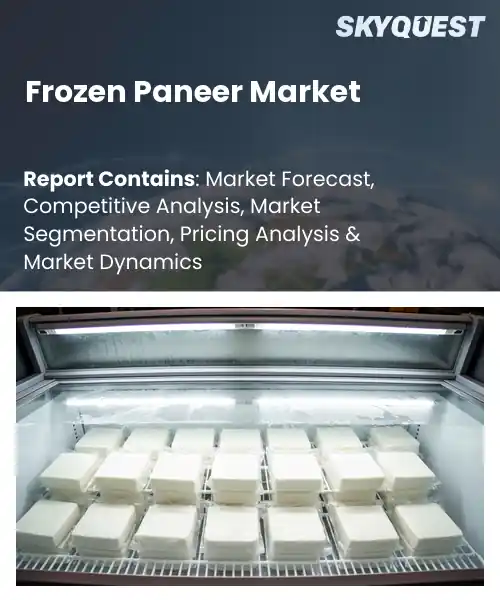
Frozen Paneer Market
Report ID: SQMIG30I2880
Report ID: SQMIG30I2880
[email protected]
USA +1 351-333-4748
Report ID:
SQMIG30I2880 |
Region:
Global |
Published Date: March, 2026
Pages:
157
|Tables:
96
|Figures:
76


Global Frozen Paneer Market size was valued at USD 11.50 Billion in 2024 and is poised to grow from USD 12.79 Billion in 2025 to USD 29.89 Billion by 2033, growing at a CAGR of 11.2% during the forecast period (2026-2033).
Urbanization and changing consumer lifestyles are the primary driver behind the frozen paneer market, as time pressed households demand shelf stable, ready to use dairy proteins preserving taste and offering convenience. The market includes pre-manufactured paneer blocks made by manufacturers, frozen and sold through retail, food service, and e-commerce outlets. Paneer used to only be made fresh by local vendors; however, cold chain infrastructure, food safety standards and packaging improvements will allow manufacturers to produce paneer for a longer period.
Building on improved export access and supermarket presence, a key trend driving the global frozen paneer sector growth is the expansion of cold chain infrastructure and product innovation, because reliable freezing and packaging directly reduce spoilage and enable year-round supply. As a result manufacturers can supply quick service restaurants and catering firms with proportioned paneers that speed kitchen operations and ensures consistency, which cuts labor costs and menu variability. As a result, retailers are adding private label frozen paneer and meal kits that will allow more consumers to try paneer, to efficiently sell their products with value added flavors and convenience formats that can command higher price points.
How is AI Improving Supply Chain Efficiency in the Frozen Paneer Market?
AI is improving supply chain efficiency in the frozen paneer market by enhancing visibility, prediction, and control. Key aspects include demand forecasting for better production planning, inventory optimization to reduce spoilage, real time cold chain monitoring for temperature stability, automated quality checks and smarter route planning for last mile delivery. Producers and distributors use sensor data and machine learning to detect temperature excursions before they spoil stock, to schedule preventive maintenance for refrigerated assets, and to align replenishment with store demand. These changes cut waste, speed replenishment and make frozen paneer more reliably available to retailers and food service buyers.
In March 2026, Milky Mist widely reported cold chain complaint about puffed paneer packs underscored the industry need for smarter monitoring. Predictive alerts from AI-driven temperature sensors will be able to flag temperature excursions and alert maintenance or reroute frozen paneer to be saved from spoilage while also maintaining the trust and growth of the market for frozen paneer.
Market snapshot - (2026-2033)
Global Market Size
USD 11.5 Billion
Largest Segment
Frozen Cubes
Fastest Growth
Frozen Slices
Growth Rate
11.2% CAGR
To get more insights on this market click here to Request a Free Sample Report
Global frozen paneer market is segmented by product type, end user, distribution channel and region. Based on product type, the market is segmented into frozen cubes, frozen blocks, frozen slices, frozen grated, and frozen diced. Based on end user, the market is segmented into household, food service, food processing industry, restaurants and catering services. Based on distribution channel, the market is segmented into supermarkets/hypermarkets, convenience stores, online retail, specialty stores and direct sales. Based on region, the market is segmented into North America, Europe, Asia Pacific, Latin America and Middle East & Africa.
Based on the global frozen paneer market growth, frozen cubes segment dominates because retailers and manufacturers favor small, ready to use portions that preserve paneer's texture and flavor while simplifying cold chain handling. The size of the uniforms reduces the time it takes for the cooks to get ready to prepare the food and also provides consistency in the product they are preparing. The ease of control in portioning and packaging of products has made handling products much easier, reducing the risk of spoilage, thus continuing to be favored by consumers and supply chain partners who prefer to use them for their convenience.
However, frozen grated is witnessing the strongest growth momentum as processors and home cooks favor ready to use formats that speed preparation and broaden culinary applications. Easy to use and packaged well, these products improve texture homogeneousness, reduce prep friction, make it easier to put sauces into ready-to-eat products, allow for faster industrial adoption, and result in more opportunities for new ways to make food products.
Food service segment leads because large scale kitchens and institutional buyers demand consistent quality, standardized portion sizes, and predictable supply that frozen paneer reliably provides. Recurring cycles of purchasing by a buyer drive manufacturers to customize their product formulations and packages for significant bulk handling and rapid thawing, which support the stability of production planning. Close collaboration with an operator allows the supplier to develop product variations to meet the menu requirements of the operator; this has a positive effect on the formal supply chain commitment of both companies and creates a strong incentive for each firm to invest in specialized freezing and distribution facilities for their products.
However, household is emerging as the most rapidly expanding area as consumers seek convenience and consistent paneer quality for home cooking. Growth is driven by smaller retail packs, microwaveable and ready to cook offerings, and expanding e commerce access, which broaden everyday use cases and create new demand pathways for manufacturers.
To get detailed segments analysis, Request a Free Sample Report
As per the global frozen paneer regional share, Asia Pacific dominance is rooted in deep cultural affinity for paneer combined with broad market infrastructure that supports frozen dairy expansion. The steady baseline demand for dairy products arises from the regional dietary pattern and strong vegetarian cooking tradition, whereas localized product innovation utilizes traditional formats to create consumer-friendly options.
Regional dairy supply chains and low-cost manufacturing provide diverse SKU opportunities, and a well-established cold supply chain supports all urban and peri-urban consumer access to these products. The penetration of retail in modern trade, growth of e-commerce grocery services, and established partnerships with foodservice operators create opportunities for both visibility and trial of these products. Exporters from the region are using integrated distribution corridors to access neighboring markets, and major retailers' private label introduction assists in enhancing the ability to display these products on store shelves.
Frozen paneer market in Japan reflects premium positioning and culinary experimentation that cater to discerning consumers. Local tastes affect how retailers and specialty importers curate their varieties, and chefs use their creativity in food preparation at casual or fusion restaurants to drive trial of meals made with the product paneer. Small-batch production and specialty products benefit from a solid cold chain implementation to support their launch, while working with culinary institutions to improve texture and seasoning will assist both manufacturers and culinary institutions to create better products with regulated and controlled qualities.
Frozen paneer market in South Korea is shaped by rapid adaptation of ethnic flavors and demand for convenient protein options. Supermarkets and online grocery stores now offer many forms of paneer in ready-to-cook meal options, and food service providers are creating fusion items that incorporate local flavors with South Asian influences. There is excellent supply chain expertise, as well as strong retailer-manufacturer partnerships which allow companies to rapidly introduce new products along with significant promotional support.
Based on the global frozen paneer regional forecast, rapid expansion in Europe is driven by a convergence of demographic change, culinary diversification, and retail modernization that favors frozen ethnic offerings. As familiarity with South Asian cuisine increases among mainstream consumers, along with continued growth among ethnic communities there will be an ongoing need for a consistent supply of paneer.
Retailers are also looking for other products they can offer that provide these same benefits (high-protein, ready-to-cook, etc.) to help their customers prepare multi-ethnic meals. Product innovation such as ready-to-cook packs and flavored varieties will lead to more purchases by time-sensitive shoppers. In addition, the use of private label products and specialist importers working in conjunction with larger supermarkets will provide a broader selection of products. Improvements to the cold chain and food safety standards will allow for broader distribution of foods across countries.
Frozen paneer market share in Germany is characterized by dynamic retail and product development activity that supports rapid category growth. Discerning consumers respond to high-quality and convenience-led offerings, and retailers expand frozen ethnic assortments to meet evolving meal preferences. Specialist importers and private-label programs introduce accessible formats, while foodservice experimentation in urban centers raises awareness. By using a well-planned logistics system and by obtaining promotional support from retailers, paneers have achieved rapid market share through a high rate of diffusion across the entire frozen dairy and convenience market.
Frozen paneer market in United Kingdom benefits from deep cultural familiarity and extensive retail integration that sustain leadership within Europe. Grocery stores and specialist retailers sell a wide variety of paneers, while the food service industry (from restaurants to takeaway/fast food) is adding paneer to its main menu options. The strong supply chains and the developed e-Commerce grocery channel will ensure that customers can get paneer as easily as possible. Paneer is developed by brands and retailers through collaboration, resulting in a large number of SKU variations being produced for the many different types of customers.
Frozen paneer market trends in France is emerging through a premium and chef-led pathway that aligns with local gastronomic preferences. Artisan producers promote paneer as a unique ingredient for fusion dishes and higher-end restaurants. Culinary authorities like chefs and social media influencers also promote paneer in creative ways to help increase the appeal of this versatile cheese. Grocery and specialty retailers have enabled customers to purchase paneer through both grocery store and gourmet e-commerce channels, now allowing customers to find and enjoy paneer. The market evolves through curated launches and experiential promotions that gradually build mainstream recognition.
As per the global frozen paneer regional outlook, North America is strengthening its role through a blend of import diversification, domestic product development, and expanding retail and foodservice support. With growing consumer interest in ethnic protein sources and convenience foods such as frozen cheese, retailers have begun expanding their frozen cheese offerings to include paneer (fresh cheese) to provide more ethnic variety within both traditional grocery and specialty markets.
Manufacturers have begun to provide formulations developed specifically for the local market as well as frozen formats that are ready for use in meal kits or prepared meals. The investment in cold chain distribution and targeted marketing towards multicultural consumers and healthy consumers will only further help strengthen the presence of paneer in these two channels. When taken together, these efforts will result in greater integration into the market and increased usage of paneer across grocery and foodservice channels.
Frozen paneer market in United States reflects accelerated retail and culinary adoption driven by diverse consumer demand and innovation in convenience formats. Foodservice formats, such as fast-casual restaurants and meal kit services, are also introducing paneer on accessible menus, thus increasing exposure for paneer products. Strong distribution partnerships and reliable cold chain distribution across the country will help to ensure that there is a wide selection of paneer products being sold in both the retail and foodservice channels across the country.
Frozen paneer market in Canada shows steady enhancement through targeted product introductions and strong multicultural demand. Urban retailers and special/ethnic grocery stores supply market needs with selected paneer options. Manufacturers emphasize developing flavors that appeal to their local markets. Foodservice testing in many foodservice venues encourages the first and second time trial of paneer, while a strong logistics infrastructure assures continuous availability of paneer within specific geographic regions. Through coordinated marketing and collaboration between retailers, the phase of gradual acceptance of paneer will grow from only core Ethnic communities to all consumers.
To know more about the market opportunities by region and country, click here to
Buy The Complete Report
Increasing Demand For Convenience
Adoption By Foodservice Operators
Perception Of Freshness Loss
Supply Chain Cold Storage Costs
Request Free Customization of this report to help us to meet your business objectives.
Competition in the global frozen paneer market outlook is intensifying as brands pursue retail distribution, ingredient innovation and co manufacturing to win freezer shelf space. Competitive dynamics are shaped more by strategic retail partnerships, food technology research and development, and so on than solely by price. Examples of these types of partnerships include Agrocorp's HerbYvore launch to grow the relationship between SIT and House of Kajaana, which has provided them with access to key consumers through retail outlets such as FreshDirect and Whole Foods (via UNFI). These types of partnerships and product development will influence how competitors respond competitively.
SkyQuest’s ABIRAW (Advanced Business Intelligence, Research & Analysis Wing) is our Business Information Services team that Collects, Collates, Correlates, and Analyses the Data collected by means of Primary Exploratory Research backed by robust Secondary Desk research.
As per SkyQuest analysis, the global frozen paneer industry is gaining momentum driven primarily by urbanization and changing consumer lifestyles that favor convenient, ready-to-use dairy proteins. A key driver is this shift toward time-pressed households seeking shelf-stable, easy-to-prepare ingredients while a second driver is the expansion of cold chain infrastructure and product innovation that enable reliable year-round supply and premium formats. A restraint is persistent consumer perception that frozen paneer lacks the fresh taste and texture of artisanal products. Asia Pacific currently dominates the market thanks to cultural affinity and scalable dairy networks, and frozen cubes lead product adoption due to portion control and handling efficiency.
| Report Metric | Details |
|---|---|
| Market size value in 2024 | USD 11.5 Billion |
| Market size value in 2033 | USD 29.9 Billion |
| Growth Rate | 11.2% |
| Base year | 2024 |
| Forecast period | (2026-2033) |
| Forecast Unit (Value) | USD Billion |
| Segments covered |
|
| Regions covered | North America (US, Canada), Europe (Germany, France, United Kingdom, Italy, Spain, Rest of Europe), Asia Pacific (China, India, Japan, Rest of Asia-Pacific), Latin America (Brazil, Rest of Latin America), Middle East & Africa (South Africa, GCC Countries, Rest of MEA) |
| Companies covered |
|
| Customization scope | Free report customization with purchase. Customization includes:-
|
To get a free trial access to our platform which is a one stop solution for all your data requirements for quicker decision making. This platform allows you to compare markets, competitors who are prominent in the market, and mega trends that are influencing the dynamics in the market. Also, get access to detailed SkyQuest exclusive matrix.
Table Of Content
Executive Summary
Market overview
Parent Market Analysis
Market overview
Market size
KEY MARKET INSIGHTS
COVID IMPACT
MARKET DYNAMICS & OUTLOOK
Market Size by Region
KEY COMPANY PROFILES
Methodology
For the Frozen Paneer Market, our research methodology involved a mixture of primary and secondary data sources. Key steps involved in the research process are listed below:
1. Information Procurement: This stage involved the procurement of Market data or related information via primary and secondary sources. The various secondary sources used included various company websites, annual reports, trade databases, and paid databases such as Hoover's, Bloomberg Business, Factiva, and Avention. Our team did 45 primary interactions Globally which included several stakeholders such as manufacturers, customers, key opinion leaders, etc. Overall, information procurement was one of the most extensive stages in our research process.
2. Information Analysis: This step involved triangulation of data through bottom-up and top-down approaches to estimate and validate the total size and future estimate of the Frozen Paneer Market.
3. Report Formulation: The final step entailed the placement of data points in appropriate Market spaces in an attempt to deduce viable conclusions.
4. Validation & Publishing: Validation is the most important step in the process. Validation & re-validation via an intricately designed process helped us finalize data points to be used for final calculations. The final Market estimates and forecasts were then aligned and sent to our panel of industry experts for validation of data. Once the validation was done the report was sent to our Quality Assurance team to ensure adherence to style guides, consistency & design.
Analyst Support
Customization Options
With the given market data, our dedicated team of analysts can offer you the following customization options are available for the Frozen Paneer Market:
Product Analysis: Product matrix, which offers a detailed comparison of the product portfolio of companies.
Regional Analysis: Further analysis of the Frozen Paneer Market for additional countries.
Competitive Analysis: Detailed analysis and profiling of additional Market players & comparative analysis of competitive products.
Go to Market Strategy: Find the high-growth channels to invest your marketing efforts and increase your customer base.
Innovation Mapping: Identify racial solutions and innovation, connected to deep ecosystems of innovators, start-ups, academics, and strategic partners.
Category Intelligence: Customized intelligence that is relevant to their supply Markets will enable them to make smarter sourcing decisions and improve their category management.
Public Company Transcript Analysis: To improve the investment performance by generating new alpha and making better-informed decisions.
Social Media Listening: To analyze the conversations and trends happening not just around your brand, but around your industry as a whole, and use those insights to make better Marketing decisions.
REQUEST FOR SAMPLE
 REQUEST FREE CUSTOMIZATION
Global Frozen Paneer Market size was valued at USD 11.5 Billion in 2024 and is poised to grow from USD 12.79 Billion in 2025 to USD 29.9 Billion by 2033, growing at a CAGR of 11.2% during the forecast period (2026-2033).
Competition in the global frozen paneer market is intensifying as brands pursue retail distribution, ingredient innovation and co manufacturing to win freezer shelf space. Competitive dynamics are driven by strategic retail partnerships and food tech R&D rather than price alone. Examples include Agrocorp’s HerbYvore launch and SIT collaboration, and House of Kajaana’s FreshDirect and Whole Foods/UNFI retail rollouts, which show partnerships and product innovation shaping competitive moves. 'Amul', 'Mother Dairy', 'Britannia Industries', 'Nandini', 'Haldiram's', 'Parag Milk Foods', 'Gopi Paneer', 'Milky Mist', 'Verka', 'Thirumala Milk Products', 'Vikas Dairy', 'Aavik', 'Doodhraj', 'Pure Foods', 'Shreeji Dairy', 'Krishna Dairy', 'Suyog Dairy', 'Srikrishna Agro', 'Dairy Craft', 'Panchavati Gaurav'
The growing preference for convenient, ready-to-use dairy ingredients among urban consumers encourages manufacturers and retailers to expand frozen paneer offerings, as it simplifies meal preparation and reduces in-home processing time. Foodservice operators appreciate consistent quality and extended shelf life that frozen paneer delivers, allowing easier inventory management and menu variation. Retail channels respond by stocking a wider variety and packaging sizes, improving product visibility. This consumer-driven demand for convenience thus motivates production scaling, distribution investments, and targeted marketing efforts that collectively support market expansion.
Premium And Value Added Variants: Manufacturers are expanding offerings beyond basic frozen blocks into premium value variants that improve convenience and perceived quality. Innovations include marinated, pre seasoned, grilled and portion controlled formats designed for on the go consumers and foodservice operators seeking consistency. Emphasis on clean label ingredients, artisanal positioning and premium packaging supports higher margin strategies and brand differentiation. Retailers promote private label lines to capture loyalty, while collaborations with chefs create products broadening appeal across younger busy consumers and upscale dining channels.
Why does Asia Pacific Dominate the Global Frozen Paneer Market? |@12


Want to customize this report? This report can be personalized according to your needs. Our analysts and industry experts will work directly with you to understand your requirements and provide you with customized data in a short amount of time. We offer $1000 worth of FREE customization at the time of purchase.
Feedback From Our Clients


 USA (+1) 351-333-4748

