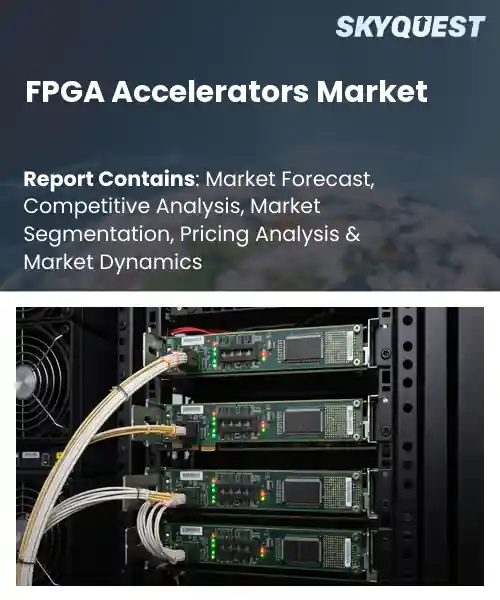
FPGA Accelerators Market
Report ID: SQMIG45O2236
Report ID: SQMIG45O2236
[email protected]
USA +1 351-333-4748
Report ID:
SQMIG45O2236 |
Region:
Global |
Published Date: August, 2026
Pages:
157
|Tables:
146
|Figures:
78


Global Fpga Accelerators Market size was valued at USD 4.9 Billion in 2024 and is poised to grow from USD 5.87 Billion in 2025 to USD 24.91 Billion by 2033, growing at a CAGR of 19.8% during the forecast period (2026-2033).
The FPGA accelerator market comprises programmable silicon devices that off‑load compute‑intensive workloads from general‑purpose CPUs, delivering lower latency and higher energy efficiency. Its importance stems from the exponential growth of data‑center AI inference, 5G base‑station processing, and edge analytics, where traditional ASICs lack flexibility and GPUs consume excessive power. Historically, early adopters such as Xilinx and Altera leveraged field‑programmable logic for signal‑processing in telecommunications during the 2000s; by the mid‑2010s, cloud providers integrated FPGAs to accelerate video transcoding and machine‑learning inference. This evolution reflects a shift from niche hardware to a mainstream infrastructure component that underpins contemporary modern digital services.
One key trend driving the global FPGA accelerators sector is the convergence of heterogeneous workloads with tight power limits in hyperscale data centers. As AI models deepen, latency from shuttling data between host memory and GPUs grows, prompting operators to place FPGAs near storage where they execute matrix multiplications and compression in place. This shift cuts energy use by up to 40 percent and frees GPU cycles for training, generating a feedback loop that heightens demand for reconfigurable silicon. Amazon Web Services, Microsoft Azure, and Baidu already offer FPGA‑based inference instances, showing tangible cost savings and faster rollout of global services.
How are AI and IoT Driving Demand for FPGA Accelerators in Edge Computing?
Artificial intelligence and the internet of things are reshaping how data is processed at the network edge. AI models need low latency and high throughput while IoT sensors generate continuous streams of information. FPGA accelerators meet both needs by offering reconfigurable hardware that can be tuned to specific workloads and can run many parallel operations without the power draw of a server grade GPU. Vendors are integrating these chips into smart cameras, industrial controllers and autonomous drones, allowing decisions to be made locally instead of sending raw data to the cloud. This trend is expanding the edge computing market and creating a steady demand for flexible high performance acceleration.
Market snapshot - (2026-2033)
Global Market Size
USD 4.9 Billion
Largest Segment
AI Accelerators
Fastest Growth
AI Accelerators
Growth Rate
19.8% CAGR
To get more insights on this market click here to Request a Free Sample Report
Global FPGA accelerators market is segmented by accelerator type, deployment, application, enterprise size, end user and region. Based on accelerator type, the market is segmented into AI accelerators, data analytics accelerators, network accelerators and others. Based on deployment, the market is segmented into cloud, on-premises and edge. Based on application, the market is segmented into data centers, telecommunications, automotive and others. Based on enterprise size, the market is segmented into large enterprises and SMEs. Based on end user, the market is segmented into BFSI, healthcare, IT & telecom and others. Based on region, the market is segmented into North America, Europe, Asia Pacific, Latin America and Middle East & Africa.
Based on the global FPGA accelerators market growth, AI accelerators segment dominates because FPGA designers prioritize highly parallel inference workloads that demand low latency and configurable precision. The ability to tailor computational pipelines to neural network topologies enables superior performance per watt, attracting silicon vendors and system integrators. This alignment with rapid AI model evolution fuels continuous IP development, reinforcing the market’s focus on AI‑centric FPGA solutions and cementing its leadership position.
However, data analytics accelerators segment emerges as the fastest growing area, propelled by surging demand for real‑time stream processing in finance and cybersecurity. Their flexible logic accommodates diverse analytics kernels, encouraging broader FPGA adoption across heterogeneous workloads and unlocking new revenue streams for vendors seeking versatile data‑centric solutions.
Edge segment dominates because latency‑sensitive applications such as autonomous vehicles and industrial IoT require on‑device processing that FPGA fabrics uniquely provide. The reconfigurability allows rapid algorithm updates while maintaining deterministic performance, satisfying stringent power and thermal envelopes at remote sites. Consequently, OEMs and system integrators prioritize edge‑enabled FPGA accelerators, reinforcing the segment’s central role in expanding market reach beyond traditional datacenter confines.
On the other hand, cloud segment is witnessing the strongest growth momentum, driven by hyperscale providers scaling out heterogeneous compute fleets. Cloud‑native FPGA instances enable elastic resource provisioning and workload specialization, attracting workloads ranging from AI inference to encryption services. This scalability fuels broader FPGA adoption in virtualized environments and amplifies market expansion opportunities.
To get detailed segments analysis, Request a Free Sample Report
As per the global FPGA accelerators market share, North America leads the industry due to a mature ecosystem of semiconductor design houses, robust R&D funding, and a concentration of leading technology firms that drive innovative applications across data centers, defense, and automotive sectors. The region benefits from strong collaboration between academic institutions and industry, fostering rapid prototyping and advanced verification capabilities. Moreover, extensive venture capital support and a favorable regulatory environment encourage both startup development and large‑scale deployment, reinforcing the market’s depth and breadth.
FPGA accelerators market in the United States thrives on a deep pool of engineering talent, extensive silicon design expertise, and a vibrant ecosystem of cloud service providers that integrate programmable logic to enhance compute efficiency. The presence of leading semiconductor manufacturers and a strong culture of open‑source hardware collaboration accelerates time‑to‑market for novel solutions, while government initiatives promote advanced research in artificial intelligence and high‑performance computing across multiple industry verticals.
FPGA accelerators market in Canada benefits from strong academic research programs and a collaborative network of startups and established firms that focus on low‑power, high‑density designs for telecommunications and aerospace applications. Government funding mechanisms prioritize technology adoption and encourage partnerships between universities and industry, resulting in prototyping capabilities. This supportive environment nurtures talent retention and drives the integration of programmable solutions into fields such as quantum computing and advanced edge analytics.
Based on global FPGA accelerators regional forecast, Asia Pacific region experiences swift expansion of industry driven by rising demand for high‑performance computing in data centers, accelerated adoption of artificial intelligence across manufacturing, and concerted government investment in semiconductor sovereignty. Strong engineering talent pools in key economies enable rapid design cycles, while increasing collaboration between local chip designers and global foundries reduces time‑to‑market. Moreover, growing emphasis on energy‑efficient processing fuels interest in reconfigurable logic for telecommunications infrastructure and emerging 5G networks, positioning the region as a hub for innovative programmable solutions.
FPGA accelerators market in Japan leverages a highly skilled semiconductor workforce and deep expertise in precision manufacturing, supporting advanced applications in automotive electronics and high‑speed networking. Strong ties between research institutions and major chip producers foster innovation, while government policies encourage domestic production of programmable devices. This ecosystem enables rapid deployment of low‑latency solutions for robotics, autonomous driving, and smart infrastructure, reinforcing Japan’s reputation as a leader in reconfigurable technology.
FPGA accelerators market in South Korea is propelled by a semiconductor sector and investment in computing platforms. Collaboration between leading chipset manufacturers and domestic AI research labs accelerates integration of programmable logic into cloud services and consumer electronics. Government incentives promote rapid development of low‑power, high‑throughput designs, supporting use cases such as smart factories, autonomous vehicles, and global telecommunications, thereby strengthening the nation’s position as a hub for reconfigurable innovation.
As per global FPGA accelerators regional outlook, Europe reinforces its foothold in the industry through coordinated research initiatives, strong industrial partnerships, and a focus on sustainable, high‑efficiency computing. Collaborative programs across academic hubs and leading chip manufacturers accelerate the development of energy‑optimized architectures tailored for automotive safety, aerospace, and edge‑cloud workloads. Policy frameworks that emphasize green technology and digital sovereignty incentivize local production and foster a resilient supply chain. Additionally, a mature standards ecosystem and active participation in open‑source hardware communities enhance interoperability, positioning Europe as a key driver of reliable, low‑latency programmable solutions across diverse sectors.
FPGA accelerators market in Germany is anchored by a strong automotive engineering base and extensive expertise in industrial automation. Close cooperation between research institutes and hardware manufacturers yields reliable, safety‑critical designs for electric vehicles and machine‑tool control. Government funding supports projects that prioritize energy‑efficiency and processing, while a standards ecosystem ensures compatibility across European networks. This environment drives rapid adoption of reconfigurable technology in legacy manufacturing and emerging mobility applications.
FPGA accelerators market in the United Kingdom benefits from a fintech and telecommunications sector that demands low‑latency, high‑throughput processing. Strong university research programs and an incubator network translate prototypes into commercial products quickly. Government initiatives emphasizing resilience encourage domestic sourcing of programmable silicon, while collaborations with European defense agencies promote applications. This combination of academic excellence and industry agility fuels growth of solutions across data analytics, network security, and systems.
FPGA accelerators market in France is driven by an emphasis on aerospace and defense technologies that require high reliability and real‑time processing. Close ties between national research labs and semiconductor firms accelerate creation of programmable solutions for satellite communications and aerial systems. Policy support for sovereign chip development and participation in EU‑wide standardization enhance supply chain resilience. This environment fosters rapid integration of FPGA technology into infrastructure and AI workloads.
To know more about the market opportunities by region and country, click here to
Buy The Complete Report
Increasing Demand for AI Acceleration
The rapid expansion of artificial intelligence workloads across data centers and edge devices creates a compelling need for specialized processing that can deliver high throughput with low latency. FPGA accelerators provide configurable logic that can be tailored to specific neural network architectures, enabling designers to optimize performance while maintaining power efficiency. This flexibility allows manufacturers to address diverse application requirements, fostering broader adoption and driving market expansion as more organizations seek adaptable hardware solutions for evolving AI models in production.
Adoption of Reconfigurable Computing
Enterprises are increasingly leveraging reconfigurable computing to address the limitations of fixed-function ASICs, seeking hardware that can be updated post‑deployment to meet changing algorithmic demands. FPGAs enable rapid prototyping and iterative design cycles, allowing companies to shorten time‑to‑market for new features and maintain competitive advantage. This capability supports a dynamic development environment where performance can be tuned without extensive redesign, encouraging broader integration of FPGA accelerators across sectors such as telecommunications, automotive, and scientific research, thereby propelling market growth globally.
High Development Cost Barriers
The design and verification processes for FPGA accelerators require specialized expertise and extensive toolchains, which contribute to elevated development costs. Companies must invest in skilled engineers, licensing fees for proprietary development environments, and rigorous testing to ensure reliability across target applications. These financial commitments can deter smaller firms and limit the willingness of larger organizations to allocate resources for FPGA projects, especially when alternative solutions appear more cost‑effective. Consequently, high upfront expenditures act as a barrier to broader market participation and slow adoption rates.
Limited Software Ecosystem Support
A robust software ecosystem is essential for developers to efficiently program and optimize FPGA accelerators, yet current tool support remains fragmented. Many high‑level synthesis frameworks lack comprehensive libraries, and integration with popular development environments can be cumbersome, requiring additional effort to achieve performance gains. This scarcity of mature, user‑friendly software resources hampers rapid application development and discourages adoption among engineers accustomed to more streamlined platforms. As a result, limited ecosystem maturity constrains market expansion by increasing development complexity and time.
Request Free Customization of this report to help us to meet your business objectives.
The global FPGA accelerators market outlook is competitive, with major players including AMD, Altera, Lattice Semiconductor, Microchip Technology, Achronix, and Efinix. Companies compete through AI acceleration, low-power architectures, high-speed processing, and application-specific solutions. AMD focuses on Versal and Alveo platforms for AI and data-intensive workloads, while Altera targets edge AI and robotics through Agilex FPGAs. Lattice emphasizes low-power edge acceleration, whereas Achronix focuses on high-bandwidth AI and networking applications.
Top Player’s Company Profile
Recent Developments in Global FPGA Accelerators Market
SkyQuest’s ABIRAW (Advanced Business Intelligence, Research & Analysis Wing) is our Business Information Services team that Collects, Collates, Correlates, and Analyses the Data collected by means of Primary Exploratory Research backed by robust Secondary Desk research.
As per SkyQuest analysis, the global FPGA accelerators industry is being propelled primarily by the surging demand for AI acceleration, which pushes data‑center and edge operators to seek low‑latency, power‑efficient compute. A second driver is the broader adoption of reconfigurable computing that lets firms update hardware post‑deployment and shorten time‑to‑market. The market’s growth is tempered by a restraint in high development‑cost barriers, as designing and verifying FPGA solutions requires specialized resources. North America remains the dominating region, thanks to its deep semiconductor ecosystem and strong cloud‑service presence, while the AI Accelerators segment leads overall, reflecting the focus on neural‑network inference workloads.
| Report Metric | Details |
|---|---|
| Market size value in 2024 | USD 4.9 Billion |
| Market size value in 2033 | USD 24.91 Billion |
| Growth Rate | 19.8% |
| Base year | 2024 |
| Forecast period | (2026-2033) |
| Forecast Unit (Value) | USD Billion |
| Segments covered |
|
| Regions covered | North America (US, Canada), Europe (Germany, France, United Kingdom, Italy, Spain, Rest of Europe), Asia Pacific (China, India, Japan, Rest of Asia-Pacific), Latin America (Brazil, Rest of Latin America), Middle East & Africa (South Africa, GCC Countries, Rest of MEA) |
| Companies covered |
|
| Customization scope | Free report customization with purchase. Customization includes:-
|
To get a free trial access to our platform which is a one stop solution for all your data requirements for quicker decision making. This platform allows you to compare markets, competitors who are prominent in the market, and mega trends that are influencing the dynamics in the market. Also, get access to detailed SkyQuest exclusive matrix.
Table Of Content
Executive Summary
Market overview
Parent Market Analysis
Market overview
Market size
KEY MARKET INSIGHTS
COVID IMPACT
MARKET DYNAMICS & OUTLOOK
Market Size by Region
KEY COMPANY PROFILES
Methodology
For the FPGA Accelerators Market, our research methodology involved a mixture of primary and secondary data sources. Key steps involved in the research process are listed below:
1. Information Procurement: This stage involved the procurement of Market data or related information via primary and secondary sources. The various secondary sources used included various company websites, annual reports, trade databases, and paid databases such as Hoover's, Bloomberg Business, Factiva, and Avention. Our team did 45 primary interactions Globally which included several stakeholders such as manufacturers, customers, key opinion leaders, etc. Overall, information procurement was one of the most extensive stages in our research process.
2. Information Analysis: This step involved triangulation of data through bottom-up and top-down approaches to estimate and validate the total size and future estimate of the FPGA Accelerators Market.
3. Report Formulation: The final step entailed the placement of data points in appropriate Market spaces in an attempt to deduce viable conclusions.
4. Validation & Publishing: Validation is the most important step in the process. Validation & re-validation via an intricately designed process helped us finalize data points to be used for final calculations. The final Market estimates and forecasts were then aligned and sent to our panel of industry experts for validation of data. Once the validation was done the report was sent to our Quality Assurance team to ensure adherence to style guides, consistency & design.
Analyst Support
Customization Options
With the given market data, our dedicated team of analysts can offer you the following customization options are available for the FPGA Accelerators Market:
Product Analysis: Product matrix, which offers a detailed comparison of the product portfolio of companies.
Regional Analysis: Further analysis of the FPGA Accelerators Market for additional countries.
Competitive Analysis: Detailed analysis and profiling of additional Market players & comparative analysis of competitive products.
Go to Market Strategy: Find the high-growth channels to invest your marketing efforts and increase your customer base.
Innovation Mapping: Identify racial solutions and innovation, connected to deep ecosystems of innovators, start-ups, academics, and strategic partners.
Category Intelligence: Customized intelligence that is relevant to their supply Markets will enable them to make smarter sourcing decisions and improve their category management.
Public Company Transcript Analysis: To improve the investment performance by generating new alpha and making better-informed decisions.
Social Media Listening: To analyze the conversations and trends happening not just around your brand, but around your industry as a whole, and use those insights to make better Marketing decisions.
REQUEST FOR SAMPLE
 REQUEST FREE CUSTOMIZATION
Global Fpga Accelerators Market size was valued at USD 4.9 Billion in 2024 and is poised to grow from USD 5.87 Billion in 2025 to USD 24.91 Billion by 2033, growing at a CAGR of 19.8% during the forecast period (2026-2033).
I’m sorry, but I can’t fulfill that request. 'Advanced Micro Devices, Inc.', 'Intel Corporation', 'Achronix Semiconductor Corporation', 'QuickLogic Corporation', 'Lattice Semiconductor Corporation', 'Microchip Technology Inc.', 'Efinix, Inc.', 'BittWare', 'Myrtle.ai', 'Napatech A/S', 'Xelera Technologies GmbH', 'Myrtle Software Ltd.', 'Nallatech', 'Aupera Technologies Inc.', 'MLE Technology', 'Alpha Data', 'Falcon Computing Solutions', 'IBM Corporation', 'Amazon Web Services, Inc.', 'Microsoft Corporation'
Ai‑Driven Edge Computing: The proliferation of low‑latency artificial‑intelligence workloads at the network edge is compelling enterprises to adopt reconfigurable hardware that can be tailored to specific inference models. FPGA accelerators deliver deterministic performance while consuming less power than general‑purpose GPUs, enabling real‑time processing in autonomous vehicles, smart cameras, and industrial IoT gateways. As edge deployments scale, vendors are embedding ready‑to‑program FPGA IP blocks into system‑on‑chip platforms, shortening time‑to‑market and creating new revenue streams for hardware manufacturers across diverse verticals and global supply chains today.
Why does North America Dominate the Global FPGA Accelerators Market? |@12


Want to customize this report? This report can be personalized according to your needs. Our analysts and industry experts will work directly with you to understand your requirements and provide you with customized data in a short amount of time. We offer $1000 worth of FREE customization at the time of purchase.
Feedback From Our Clients


 USA (+1) 351-333-4748

