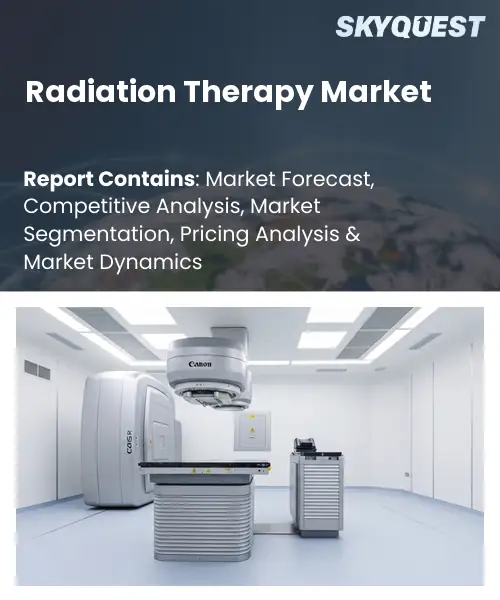
Radiation Therapy Market
Report ID: SQMIG35D2455
Report ID: SQMIG35D2455
[email protected]
USA +1 351-333-4748
Report ID:
SQMIG35D2455 |
Region:
Global |
Published Date: May, 2026
Pages:
157
|Tables:
185
|Figures:
79


Global Radiation Therapy Market size was valued at USD 7.5 Billion in 2024 and is poised to grow from USD 7.97 Billion in 2025 to USD 12.89 Billion by 2033, growing at a CAGR of 6.2% during the forecast period (2026-2033).
At the core of the radiation therapy market sits the rising global cancer burden combined with continuous technological progress, a primary driver reshaping demand and investment. Radiation therapy encompasses systems, planning software, services and consumables used to deliver ionizing radiation to treat malignant and benign conditions, and it matters because it remains a curative or palliative option for about half of cancer patients. Historically the market evolved from cobalt teletherapy and basic orthovoltage units to modern linear accelerators, intensity-modulated techniques and proton therapy centers, with regulatory approvals, reimbursement shifts and clinical evidence driving adoption across hospitals and cancer centers worldwide.
The principal factor accelerating global radiation therapy growth is the rapid diffusion of precision technologies, prompting payer support and provider investment. When stereotactic body radiotherapy delivers high-dose focused treatment for early-stage lung cancer, cure rates rival surgery and justify higher reimbursement that funds new linear accelerators. Similarly proton therapy reduces pediatric late toxicities, encouraging referrals to proton centers and driving demand for capacity. As vendors supply MR-Linacs and AI planning tools, workflow efficiency and treatment personalization improve, causing hospital systems to expand programs and creating opportunities for equipment manufacturers, software vendors and managed service providers and supporting broader global access.
How is AI improving treatment planning accuracy in the radiation therapy market?
AI improves treatment planning accuracy in radiation therapy by automating and standardizing several crucial steps. Key aspects include automatic image segmentation that yields more consistent contours and AI driven dose prediction that refines how beams are shaped to match patient anatomy. The current state shows growing clinical integration where AI supports adaptive replanning and reduces variability between planners. Market momentum favors vendors who embed intelligent workflows into treatment planning systems because these tools make plans more reproducible and enable care teams to spend more time on patient specific decisions. Real world instances include AI contouring, AI accelerated dose engines and online adaptive workflows that together raise plan quality and clinical consistency.
Siemens Healthineers May 2026, announced CE marking for AI contouring integrated with the Eclipse planning system which automates structure delineation and streamlines planning workflows thereby supporting wider adoption of AI guided planning and improved clinic efficiency.
Market snapshot - (2026-2033)
Global Market Size
USD 7.5 Billion
Largest Segment
External Beam Radiation Therapy (EBRT)
Fastest Growth
Systemic Radiation Therapy
Growth Rate
6.2% CAGR
To get more insights on this market click here to Request a Free Sample Report
Global radiation therapy market is segmented by type, technology, application, equipment type, end user, procedure type and region. Based on type, the market is segmented into External Beam Radiation Therapy (EBRT), Internal Radiation Therapy (Brachytherapy), Systemic Radiation Therapy and Others. Based on technology, the market is segmented into Intensity-Modulated Radiation Therapy (IMRT), Image-Guided Radiation Therapy (IGRT), Stereotactic Radiation Therapy, Proton Therapy, Tomotherapy and Others. Based on application, the market is segmented into Breast Cancer, Lung Cancer, Prostate Cancer, Colorectal Cancer, Cervical Cancer, Brain Tumors and Others. Based on equipment type, the market is segmented into Linear Accelerators, Proton Therapy Systems, Gamma Knife Systems, Brachytherapy Afterloaders and Others. Based on end user, the market is segmented into Hospitals, Cancer Treatment Centers, Ambulatory Radiotherapy Centers, Research Institutes and Others. Based on procedure type, the market is segmented into Curative Radiation Therapy, Palliative Radiation Therapy, Adjuvant Radiation Therapy, Neoadjuvant Radiation Therapy and Others. Based on region, the market is segmented into North America, Europe, Asia Pacific, Latin America and Middle East & Africa.
Intensity-Modulated Radiation Therapy (IMRT) segment dominates because its ability to precisely modulate radiation dose enables clinicians to deliver conformal treatment to complex tumor geometries while sparing adjacent healthy tissue. This precision reduces treatment related toxicity and improves therapeutic ratios, driving clinician preference. Broad clinical acceptance, robust vendor support, integration with treatment planning and imaging workflows, and established reimbursement pathways reinforce institutional adoption and sustained market leadership.
However, Stereotactic Radiation Therapy segment is witnessing strongest growth as improved delivery accuracy and motion control enable ultrahypofractionated single session treatments for small targets. Expanding indications across lung, liver and brain, together with investments in specialized platforms and clinician adoption, are accelerating market uptake and opening new high value treatment opportunities.
Proton Therapy Systems segment dominates because the unique depth dose properties allow precise energy deposition that spares surrounding healthy tissue, making it especially attractive for pediatric cases and anatomically complex tumors. This clinical differentiation drives high value referrals and institutional investment, supported by vendor turnkey solutions, strong clinical research momentum and long term service agreements, which together create durable demand and strategic positioning within comprehensive cancer programs and technological customization for complex modalities.
Meanwhile, Linear Accelerators segment is growing fastest because continual hardware and software upgrades, integration with advanced image guidance and AI, and flexible financing reduce barriers for providers. Expanding clinical use for techniques like intensity modulation and volumetric delivery, alongside scalable installation models, accelerate adoption and broaden treatment access and vendor opportunity.
To get detailed segments analysis, Request a Free Sample Report
North America dominates the global radiation therapy market due to an integrated ecosystem of advanced clinical infrastructure, concentrated technology providers, and funding environments that support adoption of high complexity treatment modalities. A strong research base within academic centers and collaborative clinical networks speeds clinical validation and diffusion of innovations such as image guided delivery, stereotactic approaches, and particle therapy. Established reimbursement pathways and access to capital facilitate procurement and timely upgrades, while integrated cancer care delivery and specialist training sustain utilization. Robust partnerships between industry and clinical investigators enable early commercialization of novel platforms, and regulatory clarity combined with active professional societies helps align practice guidelines and reduce implementation friction across diverse care settings.
Radiation Therapy Market in United States benefits from a dense network of academic medical centers and private providers, high levels of clinical research activity, and early adoption of advanced delivery and imaging technologies. Payer frameworks and capital availability support investment in linear accelerators and proton systems, while integrated care pathways and specialist training contribute to broad clinical utilization across complex oncology cases and multidisciplinary treatment models reinforce referral networks nationally.
Radiation Therapy Market in Canada benefits from a publicly funded health framework and provincial cancer networks that enable coordinated procurement and treatment standards. Specialized cancer centers concentrate expertise and support adoption of image guidance and stereotactic delivery. Health technology assessment and centralized planning influence equipment investment, promoting consistent access across broad territories. Collaborative relationships between clinical programs and academic centers advance technology evaluation and implementation while emphasizing equitable patient pathways.
Europe is experiencing rapid expansion in the radiation therapy market driven by modernization of oncology services, cross border collaboration in research, and increasing emphasis on precision radiotherapy within national cancer strategies. Investment in upgrading delivery equipment and adoption of advanced planning systems reflect efforts to reduce variability in treatment quality. Evolving payer recognition of value based approaches encourages uptake in specialized centers. A combination of domestic manufacturing strength and partnerships with international suppliers supports localized service capabilities, while workforce training initiatives and harmonized clinical guidelines enhance clinician confidence and accelerate diffusion of advanced modalities throughout diverse healthcare systems. European funding mechanisms and intergovernmental initiatives also facilitate pooled procurement and pilot deployments that extend capacity in peripheral hospitals.
Radiation Therapy Market in Germany is anchored by a dense network of university hospitals and specialized clinics that promote early adoption of advanced delivery and imaging systems. Strong domestic manufacturing expertise supports localized maintenance and tailored solutions, while coordinated reimbursement pathways and evidence driven health technology assessments guide procurement. Collaborative research consortia and clinician training programs drive implementation and optimization of complex techniques across public and private oncology providers nationwide.
Radiation Therapy Market in United Kingdom is characterized by centralized health service structures and national cancer strategies that prioritize standardization and equity of access. Regional centers of excellence and networked cancer alliances support rollout of stereotactic and image guided techniques, while collaborative procurement and targeted capital programs enable upgrades. Strengthening clinical trial activity and partnerships with technology vendors drive localized innovation and skills development, positioning the market as influential adopter.
Radiation Therapy Market in France is marked by proactive modernization efforts and targeted investment in regional cancer centers that accelerate uptake of advanced modalities. Strengthening links between public hospitals and private specialist clinics foster technology diffusion and operational synergies. Emphasis on multidisciplinary care pathways and clinical program accreditation supports rapid integration of stereotactic and adaptive radiotherapy techniques. Growing domestic innovation and focused training initiatives contribute to heightened adoption and dynamism.
Asia Pacific is strengthening its position in the radiation therapy market through a combination of domestic innovation, strategic hospital investments, and growing collaboration with global technology suppliers. Markets such as Japan and South Korea leverage strong engineering capabilities and supportive regulatory pathways to deploy advanced modalities, while clinical centers emphasize integration of imaging, planning software, and quality assurance to elevate treatment precision. Government and private hospital investment in specialized centers, coupled with active training programs and research networks, enhance clinical expertise. Export oriented manufacturers and service providers adapt solutions for regional needs, fostering a competitive environment that supports broader adoption across neighboring healthcare systems. Intensifying translational research collaborations and incorporation of artificial intelligence into planning workflows position the region to advance precision radiotherapy and to influence global technology trends through competitive exports and service models.
Radiation Therapy Market in Japan benefits from strong domestic engineering and a clinical environment that supports adoption of high precision delivery systems and integrated imaging solutions. Academic medical centers and specialized cancer hospitals lead collaborative research and training initiatives that inform practice and refine technologies. Regulatory pathways and supportive hospital investment strategies facilitate deployment of advanced modalities, while manufacturers tailor systems to local clinical requirements, enhancing serviceability and operational sustainability.
Radiation Therapy Market in South Korea is propelled by rapid clinical adoption of advanced delivery and planning systems supported by tertiary hospitals and research institutes. Strong industry collaboration with clinical teams accelerates translation of innovations, including adaptive techniques and imaging integration. Government and hospital investment in specialized centers enhances access to particle therapy and stereotactic approaches, while a skilled workforce supports regional expansion and technology refinement and export capability development.
To know more about the market opportunities by region and country, click here to
Buy The Complete Report
Advancements In Radiotherapy Technology
Growing Cancer Incidence And Survival
High Capital Investment Requirements
Regulatory And Reimbursement Hurdles
Request Free Customization of this report to help us to meet your business objectives.
The competitive landscape is defined by rapid consolidation and tech differentiation, where large pharma pursue acquisitions and partnerships to secure radiopharmaceutical pipelines while device firms advance delivery and verification platforms. Notable strategies include major M&A deals such as Bristol Myers Squibb acquiring RayzeBio and Eli Lilly acquiring Point Biopharma, growing interest in FLASH and proton verification technologies, and cross-sector collaborations to scale manufacturing and clinical translation.
Top Player’s Company Profile
Recent Developments
SkyQuest’s ABIRAW (Advanced Business Intelligence, Research & Analysis Wing) is our Business Information Services team that Collects, Collates, Correlates, and Analyses the Data collected by means of Primary Exploratory Research backed by robust Secondary Desk research. As per SkyQuest analysis, the global radiation therapy market is driven principally by a rising cancer burden that increases demand for curative and palliative treatments, while high capital investment requirements constrain adoption. North America remains the dominating region thanks to advanced infrastructure and payer support, and intensity-modulated radiation therapy stands out as the dominating segment because of its precision and clinical acceptance. A secondary driver accelerating growth is the rapid diffusion of precision technologies and AI-enabled treatment planning that improve workflow efficiency and plan quality, creating opportunities for equipment, software and service providers across hospitals and cancer centers worldwide and supporting sustained market expansion.
| Report Metric | Details |
|---|---|
| Market size value in 2024 | USD 7.5 Billion |
| Market size value in 2033 | USD 12.89 Billion |
| Growth Rate | 6.2% |
| Base year | 2024 |
| Forecast period | (2026-2033) |
| Forecast Unit (Value) | USD Billion |
| Segments covered |
|
| Regions covered | North America (US, Canada), Europe (Germany, France, United Kingdom, Italy, Spain, Rest of Europe), Asia Pacific (China, India, Japan, Rest of Asia-Pacific), Latin America (Brazil, Rest of Latin America), Middle East & Africa (South Africa, GCC Countries, Rest of MEA) |
| Companies covered |
|
| Customization scope | Free report customization with purchase. Customization includes:-
|
To get a free trial access to our platform which is a one stop solution for all your data requirements for quicker decision making. This platform allows you to compare markets, competitors who are prominent in the market, and mega trends that are influencing the dynamics in the market. Also, get access to detailed SkyQuest exclusive matrix.
Table Of Content
Executive Summary
Market overview
Parent Market Analysis
Market overview
Market size
KEY MARKET INSIGHTS
COVID IMPACT
MARKET DYNAMICS & OUTLOOK
Market Size by Region
KEY COMPANY PROFILES
Methodology
For the Radiation Therapy Market, our research methodology involved a mixture of primary and secondary data sources. Key steps involved in the research process are listed below:
1. Information Procurement: This stage involved the procurement of Market data or related information via primary and secondary sources. The various secondary sources used included various company websites, annual reports, trade databases, and paid databases such as Hoover's, Bloomberg Business, Factiva, and Avention. Our team did 45 primary interactions Globally which included several stakeholders such as manufacturers, customers, key opinion leaders, etc. Overall, information procurement was one of the most extensive stages in our research process.
2. Information Analysis: This step involved triangulation of data through bottom-up and top-down approaches to estimate and validate the total size and future estimate of the Radiation Therapy Market.
3. Report Formulation: The final step entailed the placement of data points in appropriate Market spaces in an attempt to deduce viable conclusions.
4. Validation & Publishing: Validation is the most important step in the process. Validation & re-validation via an intricately designed process helped us finalize data points to be used for final calculations. The final Market estimates and forecasts were then aligned and sent to our panel of industry experts for validation of data. Once the validation was done the report was sent to our Quality Assurance team to ensure adherence to style guides, consistency & design.
Analyst Support
Customization Options
With the given market data, our dedicated team of analysts can offer you the following customization options are available for the Radiation Therapy Market:
Product Analysis: Product matrix, which offers a detailed comparison of the product portfolio of companies.
Regional Analysis: Further analysis of the Radiation Therapy Market for additional countries.
Competitive Analysis: Detailed analysis and profiling of additional Market players & comparative analysis of competitive products.
Go to Market Strategy: Find the high-growth channels to invest your marketing efforts and increase your customer base.
Innovation Mapping: Identify racial solutions and innovation, connected to deep ecosystems of innovators, start-ups, academics, and strategic partners.
Category Intelligence: Customized intelligence that is relevant to their supply Markets will enable them to make smarter sourcing decisions and improve their category management.
Public Company Transcript Analysis: To improve the investment performance by generating new alpha and making better-informed decisions.
Social Media Listening: To analyze the conversations and trends happening not just around your brand, but around your industry as a whole, and use those insights to make better Marketing decisions.
REQUEST FOR SAMPLE
 REQUEST FREE CUSTOMIZATION
Global Radiation Therapy Market size was valued at USD 7.5 Billion in 2024 and is poised to grow from USD 7.97 Billion in 2025 to USD 12.89 Billion by 2033, growing at a CAGR of 6.2% during the forecast period (2026-2033).
The competitive landscape is defined by rapid consolidation and tech differentiation, where large pharma pursue acquisitions and partnerships to secure radiopharmaceutical pipelines while device firms advance delivery and verification platforms. Notable strategies include major M&A deals such as Bristol Myers Squibb acquiring RayzeBio and Eli Lilly acquiring Point Biopharma, growing interest in FLASH and proton verification technologies, and cross-sector collaborations to scale manufacturing and clinical translation. 'Varian Medical Systems, Inc.', 'Elekta AB', 'Accuray Incorporated', 'Siemens Healthineers AG', 'GE HealthCare Technologies Inc.', 'Philips Healthcare', 'Canon Medical Systems Corporation', 'Hitachi, Ltd.', 'IBA Worldwide', 'Mevion Medical Systems, Inc.', 'ViewRay Technologies, Inc.', 'Panacea Medical Technologies Pvt. Ltd.', 'RaySearch Laboratories AB', 'Brainlab AG', 'ZAP Surgical Systems, Inc.', 'Mitsubishi Electric Corporation', 'Shinva Medical Instrument Co., Ltd.', 'Neusoft Medical Systems Co., Ltd.', 'Isoray, Inc.', 'Provision Healthcare, LLC'
Innovation in radiation delivery, imaging integration, and software intelligence has improved treatment precision and reduced collateral tissue exposure, enabling clinicians to offer more effective and safer therapies. These technological improvements increase clinician confidence and expand the clinical indications for radiotherapy, encouraging investment by providers and adoption by referral networks. As platforms become more adaptable and interoperable with hospital infrastructure, institutions are motivated to upgrade capabilities to enhance patient outcomes and workflow efficiency, which in turn stimulates market demand for advanced radiation therapy systems.
Ai Enabled Personalization: Clinical decision support and treatment planning increasingly incorporate artificial intelligence to tailor radiotherapy regimens to individual patient anatomy and tumor biology. Algorithms assist image segmentation adaptive planning and predictive toxicity assessments while enabling streamlined workflows across imaging and electronic records. Adoption emphasizes human oversight explainability and interoperability with existing platforms rather than replacement of clinicians. This trend is driving partnerships between technology vendors and providers to demonstrate clinical utility integrate multimodal data support more consistent treatment customization across care settings.
Why does North America Dominate the Global Radiation Therapy Market? |@12


Want to customize this report? This report can be personalized according to your needs. Our analysts and industry experts will work directly with you to understand your requirements and provide you with customized data in a short amount of time. We offer $1000 worth of FREE customization at the time of purchase.
Feedback From Our Clients


 USA (+1) 351-333-4748

