
Global Artificial Intelligence (AI) Chipsets Market
Artificial Intelligence (AI) Chipsets Market

Report ID: SQMIG45N2128

sales@skyquestt.com
USA +1 351-333-4748

Artificial Intelligence (AI) Chipsets Market Size, Share, and Growth Analysis

Global Artificial Intelligence (AI) Chipsets Market

Artificial Intelligence (AI) Chipsets Market By Chipset (CPU, GPU, FPGA, ASIC), By Workload Domain (Training, Inference), By Computing Technology (Cloud AI Computing, Edge AI Computing), By Vertical, By Region -Industry Forecast 2026-2033


Report ID: SQMIG45N2128 | Region: Global | Published Date: August, 2025
Pages: 181 |Tables: 119 |Figures: 70

Format - word format excel data power point presentation

Artificial Intelligence (AI) Chipsets Market Insights

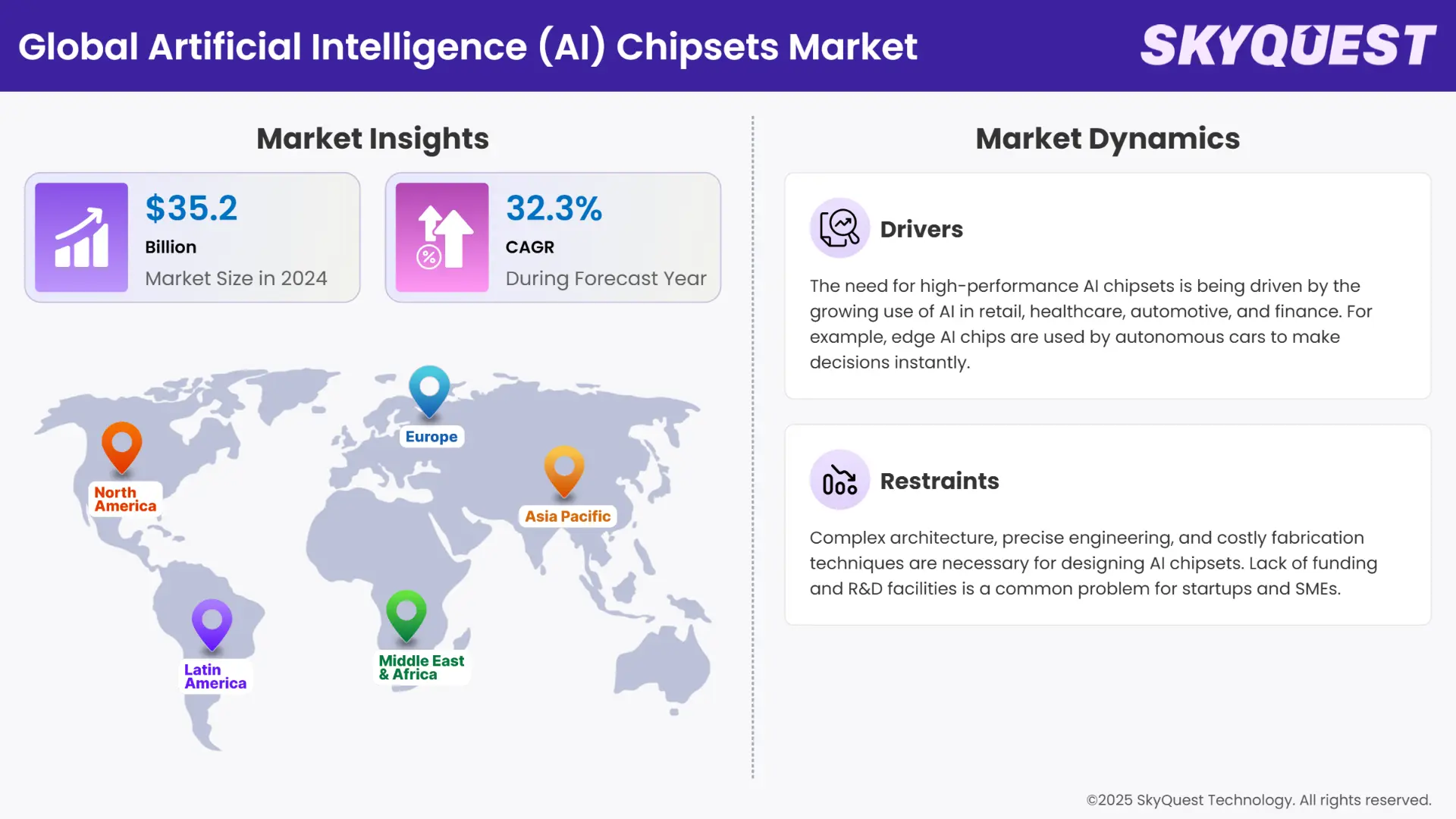
Global Artificial Intelligence (AI) Chipsets Market size was valued at USD 35.2 Billion in 2024 and is poised to grow from USD 46.57 Billion in 2025 to USD 437.1 Billion by 2033, growing at a CAGR of 32.3% during the forecast period (2026–2033).

Key Takeaways: Market Trends & Insights

  • North America dominated the Artificial Intelligence (AI) Chipsets market with a largest market share in 2025.
  • The U.S. Artificial Intelligence (AI) Chipsets market is expected to grow significantly over the forecast period.
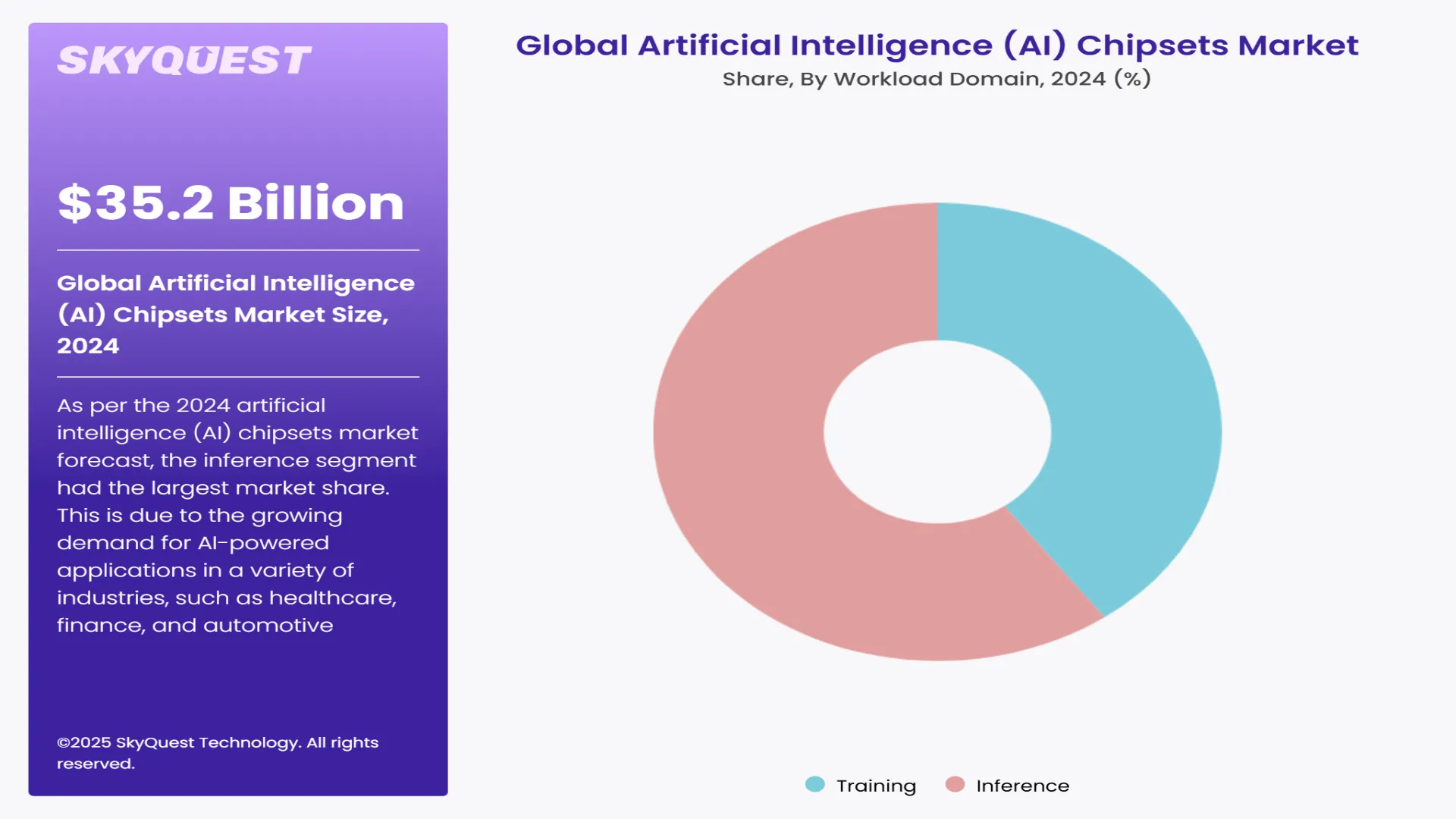
  • By Workload Domain, the Inference segment held the largest Artificial Intelligence (AI) Chipsets market share in 2024.
  • The Training segment held the highest growing market over the forecast period.
  • North America: Largest Market in 2025
  • Asia Pacific: Fastest Growing Market
  • 2025 Market Size: USD 46.57 Billion
  • 2026 Projected Market Size: USD 61.61 Billion
  • 2033 Projected Market Size: USD 437.1 Billion
  • CAGR (2026-2033): 32.3%

The global trend toward smart homes and smart cities is significantly increasing the demand for AI chipsets. AI chipsets, which power a range of devices in smart homes, including smart speakers, thermostats, security systems, and home appliances, enable voice recognition, energy management, and personalized user experiences.

AI chipsets are also used in smart cities for infrastructure management, traffic control, and public safety. AI can process enormous volumes of data and make decisions instantly. The global artificial intelligence (AI) chipsets market growth is largely driven by the integration of AI in household applications and urban planning, which is being driven by the need for energy efficiency, enhanced security, and improved living standards.

  • In April 2024, the Seoul Metropolitan Government expanded its "Smart Seoul" initiative by implementing AI-powered traffic control and energy optimization systems across multiple districts. These systems use edge AI chipsets, such as NVIDIA's Jetson Orin Nano, to process real-time data from CCTV cameras, traffic signals, and IoT-enabled street infrastructure. The city aims to improve safety and urban mobility while reducing public utility energy use by 20% by December 2025.

How are AI Chipsets Enhancing Edge Computing Capabilities?

AI chipset integration is revolutionizing computing by providing devices with the ability to perform complex tasks like image recognition, natural language processing, predictive analytics, and real-time decisions, without relying only on cloud-based systems. The AI chipsets include core architectures like GPUs, TPUs, NPUs, FPGAs, and custom ASICs and are designed for workloads requiring parallel processing and machine learning.
  • In March 2024, Intel partnered with Mayo Clinic to introduce AI-enabled diagnostic imaging devices at select sites. The systems utilize an Intel Gaudi 2 AI accelerator, which enables real-time interpretation of high-resolution medical imaging and, by processing data locally, reduced the diagnostic imaging time from prior methods using the cloud by 30%, improved patient outcomes, and reduced radiologists' workload.
Artificial Intelligence (AI) Chipsets Market Infographics

To get more insights on this market click here to Request a Free Sample Report

Artificial Intelligence (AI) Chipsets Market Segments Analysis

The global artificial intelligence (AI) chipsets market is segmented into chipset, workload domain, computing technology, vertical, and region. By chipset, the market is divided into CPU, GPU, FPGA, and ASIC. Depending on workload domain, it is bifurcated into training and inference. According to computing technology, the market is classified into cloud AI computing and edge AI computing. As per vertical, it is categorized into consumer electronics, marketing, healthcare, manufacturing, automotive, retail & e-commerce, and BFSI. Regionally, it is analyzed across North America, Europe, Asia-Pacific, Latin America, and the Middle East and Africa.

What Makes GPUs the Go-To Choice for AI Workloads?

As per the 2024 artificial intelligence (AI) chipsets market analysis, the GPU segment captured over 30.9% of revenue and is largely due to GPUs' unique processing ability that is conducive to the computationally intensive aspect of AI, like deep learning and neural networks. Due to its ability to process a large amount of data rapidly, and its growth in application in several sectors, like consumer electronics, healthcare, and automotive, a GPU represents one of the most desirable segments of the artificial intelligence chipsets market.

  • For instance, in August 2024, Intel announced the release of a discrete graphics processing unit called the "Intel Arc Graphics for Automotive." The company's AI-driven software-defined vehicle system-on-chips (SoCs) solutions are enhanced by this new platform, which provides automakers with a scalable and adaptable platform to ensure superior in-car experiences.

The ASIC segment is expected to have the highest artificial intelligence (AI) chipsets market share during the forecast period. This is due to the increasing demand for ASICs designed to specifically handle specific AI workloads. When compared to general-purpose GPUs and CPUs, ASICs offer superior performance, power efficiency, and affordability, making them a better option for large-scale AI deployments. The growing usage of ASICs in cloud data centers has further fueled this market's growth.

How are Inference Workloads Powering Real-Time Decision Making?

As per the 2024 artificial intelligence (AI) chipsets market forecast, the inference segment had the largest market share. This is due to the growing demand for AI-powered applications in a variety of industries, such as healthcare, finance, and automotive, which primarily rely on inference workloads to interpret and make decisions based on learned models. Inference workloads, a crucial component of AI deployment, require high-performance chipsets that can efficiently process complex algorithms and large datasets in real time.

The training category is expected to grow at a substantial CAGR from 2025 to 2032. This is due to the increasing demand for high-performance chipsets that can efficiently handle demanding machine learning (ML) and deep learning (DL) workloads. Training, the process of developing and refining AI models, is a critical use case for AI chipsets and requires massive amounts of memory, processing power, and data processing. Together with the explosion in the development of new AI models brought about by the growing application of AI in critical industries, there is a growing demand for training-optimized chipsets. Additionally, strategic mergers and acquisitions of top AI solution providers have created promising growth prospects for the artificial intelligence (AI) chipsets industry.
  • For instance, in August 2024, AMD declared that it had reached an agreement to purchase ZT Systems, a business that provides AI infrastructure to leading hyperscale computing firms. By offering state-of-the-art solutions for AI model training and inference, AMD is advancing its overarching goal of becoming a leader in AI technology.
Global Artificial Intelligence (AI) Chipsets Market By Workload Domain 2026-2033
Artificial Intelligence (AI) Chipsets Market Segments Analysis

To get detailed segments analysis, Request a Free Sample Report

Artificial Intelligence (AI) Chipsets Market Regional Insights

How is Government Support Driving AI Chipset Innovation in North America?

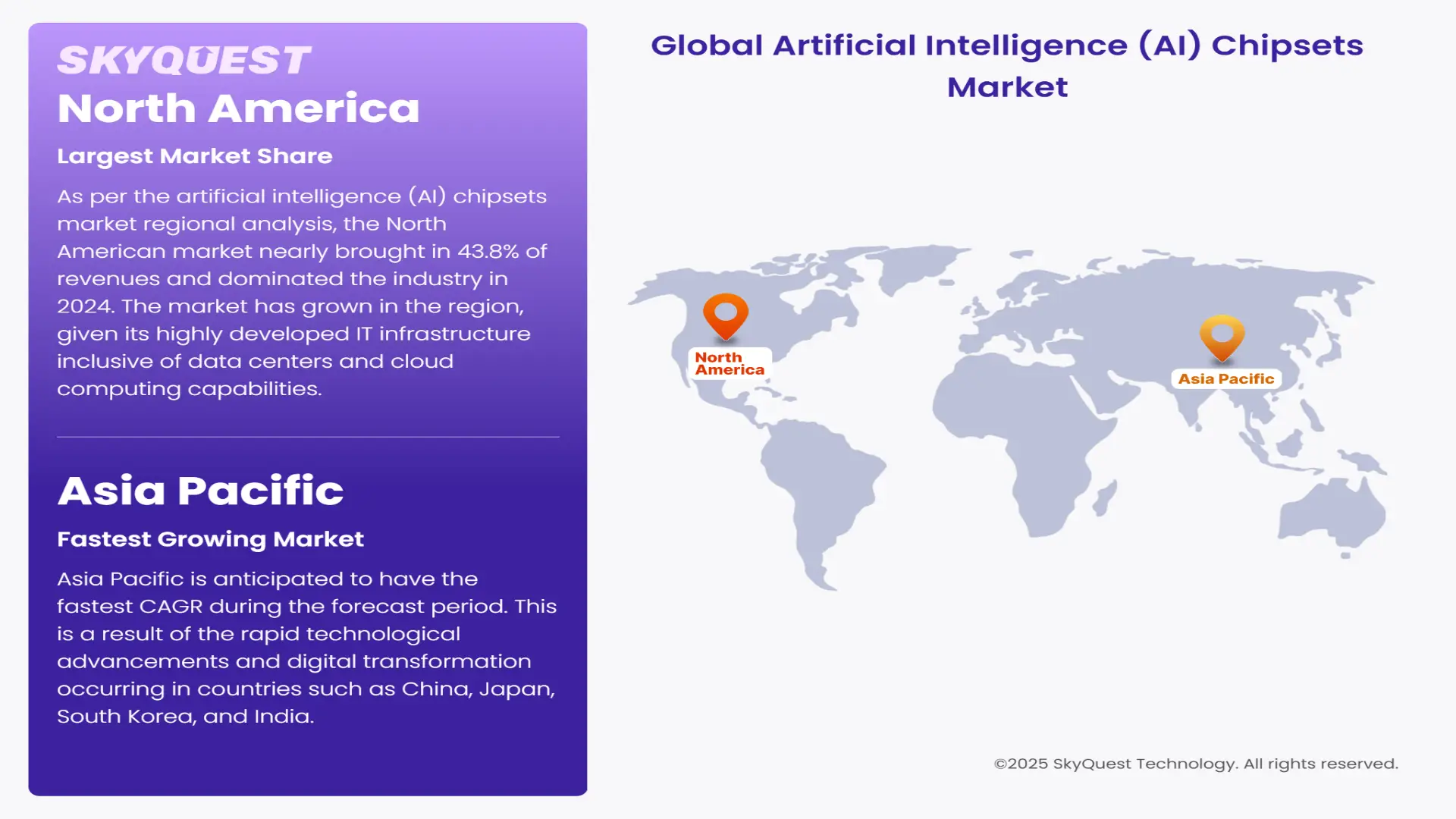
As per the artificial intelligence (AI) chipsets market regional analysis, the North American market nearly brought in 43.8% of revenues and dominated the industry in 2024. The market has grown in the region, given its highly developed IT infrastructure inclusive of data centers and cloud computing capabilities. The region continues to grow as undiscovered areas of the manufacturing sector, and the automotive sector is working with software service providers to build unique applications of AI software to reduce production facility losses and operational downtime. An example of this collaboration is Eigen Innovations Inc.'s Intel-powered OneView AI platform. Eigen Innovations Inc.'s product identifies defective products early on and reduces losses of manufacturing facilities.

Artificial Intelligence (AI) Chipsets in the U.S.

The United States dominated the artificial intelligence (AI) chipsets sector in 2024. This is due to the fact that prominent AI chipset vendors, such as NVIDIA, AMD, Intel, and Google, have their headquarters in the country. The economy's thriving ecosystem of technology companies, academic institutions, and venture capital firms has laid a strong foundation for the development and adoption of AI chipsets. Furthermore, the widespread use of AI-powered applications in industries like healthcare, finance, and automotive has increased demand for high-performance AI chipsets.

Artificial Intelligence (AI) Chipsets in Canada

Government-sponsored smart city initiatives and funding for AI research are driving growth in Canada's AI chipset market. An AI-powered traffic control system that uses NVIDIA's Jetson platforms to cut down on traffic was unveiled in Toronto in February 2024. The need for inference chipsets in the transportation and healthcare industries is being bolstered by the government's ongoing funding under the Pan-Canadian AI Strategy 2.0, which includes CAD 443 million through 2025.

How is Europe Balancing AI Chipset Innovation with Regulatory Oversight?

Europe held a sizable share of the artificial intelligence (AI) chipsets industry in 2024. The highly advanced automotive and industrial sectors in the region, particularly in areas like autonomous vehicles, smart manufacturing, and predictive maintenance, have increased demand for AI chipsets. Europe's commitment to AI adoption is further evidenced by initiatives such as the European Union's AI Strategy, which aims to promote AI development and deployment across the region. Additionally, innovative applications of AI in the broadcasting and entertainment sectors have opened new avenues for expansion in this field. For instance, Intel's 5th Gen and 4th Gen Xeon processors, paired with servers driven by Intel AI accelerators, were used to broadcast the 2024 Summer Olympics in 8K over-the-top.

Artificial Intelligence (AI) Chipsets in UK

The UK held a sizable share of the European artificial intelligence (AI) chipsets market. The UK's top-notch research institutes and universities have facilitated regular collaboration between academia and industry, which has accelerated the development of AI chipsets. Furthermore, a steady supply of next-generation IPUs has been ensured by the economy's presence of multinational semiconductor manufacturers like Graphcore. Furthermore, the UK's strong emphasis on privacy and data protection has led to the development of AI chipsets that prioritize data security and compliance.

Artificial Intelligence (AI) Chipsets in France

Growing levels of automation in industry and healthcare are driving the French AI chipsets market. The French Ministry of Health implemented AI diagnostic tools in five Parisian hospitals in June 2024 using Intel's Gaudi 2 chips. Chipset adoption is encouraged by the government's AI investment plan, France 2030, which allots euro 1.5 billion for AI research and development through 2025. This is especially true for real-time medical inference and predictive maintenance.

Artificial Intelligence (AI) Chipsets in Germany

The German AI chipsets market is expanding because of the country's emphasis on AI in industrial automation and automobiles. BMW began incorporating NVIDIA DRIVE chips for in-car artificial intelligence capabilities into its next-generation electric cars in September 2024. Furthermore, through 2025, the demand for edge and inference chipsets in smart manufacturing and mobility solutions is being driven by Germany's High-Tech Strategy 2025, which has allocated over Euro 3 billion for AI.

What Makes Asia-Pacific a Hotspot for Edge AI and High-Performance Chipsets?

Asia Pacific is anticipated to have the fastest CAGR during the forecast period. This is a result of the rapid technological advancements and digital transformation occurring in countries such as China, Japan, South Korea, and India. The region's growing demand for AI-powered applications, like industrial automation, driverless cars, and smart cities, has fueled the adoption of high-performance AI chipsets. Software companies in this field are also collaborating with renowned AI solution providers to enhance their AI capabilities.

  • For instance, in May 2024, Intel partnered with Chinese software companies ThunderSoft and Neusoft to create state-of-the-art solutions for intelligent cockpits in future cars. To ensure that automakers can provide safe and easy driving experiences, the project will integrate each company's hardware, software, and technological know-how using Intel's state-of-the-art AI-enhanced SDV SoC.

Artificial Intelligence (AI) Chipsets in India

The Indian artificial intelligence chipset market accounted for a sizeable share of the regional market in 2024. Growing investments in AI research and development, along with government initiatives like the Design Linked Incentive (DLI) Scheme, have accelerated the production of semiconductor chipsets. Artificial intelligence is finding new applications in the economy thanks to technological advancements. For instance, Calsoft, a technology solutions provider, uses the NVIDIA Jetson edge AI modules and NVIDIA A100 Tensor Core GPUs to develop its AI products.

Artificial Intelligence (AI) Chipsets in China

The AI chipsets market is dominated by China because of their widespread application in driverless cars, smart cities, and surveillance. Baidu's new Apollo Go robo-taxi service, which uses Huawei Ascend AI chips, was introduced in Beijing in April 2025. Large-scale inference chipset deployment in AI-enabled urban and transportation ecosystems is still being driven by China's New Infrastructure Plan, which allots more than USD 1.4 trillion through 2025.
Global Artificial Intelligence (AI) Chipsets Market By Geography, 2026-2033
Artificial Intelligence (AI) Chipsets Market Regional Analysis

To know more about the market opportunities by region and country, click here to
Buy The Complete Report

Artificial Intelligence (AI) Chipsets Market Dynamics

Artificial Intelligence (AI) Chipsets Market Drivers

Growing AI Utilization in Various Industries

  • The need for high-performance AI chipsets is being driven by the growing use of AI in retail, healthcare, automotive, and finance. For example, edge AI chips are used by autonomous cars to make decisions instantly. Hospitals also use AI-powered imaging diagnostics, which increases the demand for GPUs and NPUs. Due to its widespread use, businesses are compelled to invest in specialized processors that boost the processing power, speed, and accuracy of AI applications.

Growth in IoT and Edge AI Devices

  • The global artificial intelligence (AI) chipsets market penetration is being driven by the use of edge computing, particularly for low-latency applications like industrial IoT, smart cities, and surveillance. Edge devices with AI chipsets improve real-time decision-making and lessen the need for cloud computing. Prime examples of the shift toward on-device intelligence, which necessitates optimized and power-efficient AI chipsets, are Google's Tensor processor in Pixel phones and Amazon's edge AI in Alexa.

Artificial Intelligence (AI) Chipsets Market Restraints

Exorbitant Production and Development Expenses

  • Complex architecture, precise engineering, and costly fabrication techniques are necessary for designing AI chipsets. Lack of funding and R&D facilities is a common problem for startups and SMEs. Even established companies need to make large upfront investments to develop next-generation chips. Particularly in regions where costs are a concern, this financial barrier hinders innovation and makes it more challenging to widely integrate custom AI chipsets.

Interruptions in the Supply Chain and Semiconductor Shortages

  • The manufacturing and distribution of AI chipsets have been hampered by ongoing shortages in semiconductors worldwide. The geopolitical issues, such as the tech dispute between the US and China, have revealed supply chain vulnerabilities. These issues hinder implementation across industries that depend on timely and affordable AI hardware by affecting chipset availability, lengthening lead times, and raising costs.


Request Free Customization of this report to help us to meet your business objectives.

Artificial Intelligence (AI) Chipsets Market Competitive Landscape

In the competitive AI chipsets market, companies are concentrating on internal chip development, partnerships, and vertical integration. Nvidia and AMD are investing in GPUs with an AI focus, while Google, Amazon, and Apple are developing their own AI chips to gain full-stack control. Intel is diversifying its interests by purchasing AI companies. Advanced chip production is accelerated through collaborations between foundries and AI companies such as Tenstorrent and TSMC.

  • Graphcore was established in 2016. The Intelligence Processing Unit (IPU) is a type of processor architecture designed specifically for AI and machine learning workloads and is developed by UK-based semiconductor company Graphcore. With memory optimization and enhanced ability for parallel processing, the IPU allows for faster model training. Graphcore is also known for its presence in the AI Accelerator market with its processors, through cloud and enterprise AI.
  • Tenstorrent was established in 2016. A Canadian company called Tenstorrent is creating RISC-V-based processors for high-performance AI applications in data centers and edge devices. Their chips are power-efficient and scalable for both training and inference tasks. Tenstorrent helps diversify the AI hardware ecosystem and makes alternatives to x86- and ARM-based solutions possible through its sophisticated architecture and open-source instruction set.

Top Player’s Company Profile

  • Qualcomm Technologies, Inc.
  • Apple Inc.
  • Google LLC (Alphabet Inc.)
  • Amazon Web Services, Inc.
  • Samsung Electronics Co., Ltd.
  • IBM Corporation
  • Huawei Technologies Co., Ltd.
  • MediaTek Inc.
  • Arm Ltd.
  • Cerebras Systems

Recent Developments in Artificial Intelligence (AI) Chipsets Market

  • AMD had a successful acquisition of the European AI lab Silo AI in August 2024. With the background work of the Silo AI scientists and engineers, who have all worked with a deep bench of well-known clients, AMD looks to build their portfolio of AI models. The Silo AI team (okay, not team, researchers, they did not work with the formal structure of a team) had a history of creating and leveraging open source, multilanguage, LLMs on AMD platforms such as Poro and Viking.
  • Qualcomm announced on July 2024 that Samsung's next generation of high-end smartphones, the Galaxy Z Flip6 and Galaxy Z Fold6 series - will feature Qualcomm Qualcomm's flagship mobile device processor, the Snapdragon 8 Gen 3. With the addition of Galaxy AI, the new processor will have the ability to support complex creative and productive computing, such as gaming, camera, and connectivity, which will also give the device enhanced performance once the user activates it.
  • Intel introduced its Xeon 6 processors - its new line of artificial intelligence chips for data centers, in June 2024 at the Computex tech seminar in Taiwan. The Xeon 6 processors provide improved performance and power efficiency to meet the data centres unique high-intensity workloads.

Artificial Intelligence (AI) Chipsets Key Market Trends

Artificial Intelligence (AI) Chipsets Market SkyQuest Analysis

SkyQuest’s ABIRAW (Advanced Business Intelligence, Research & Analysis Wing) is our Business Information Services team that Collects, Collates, Correlates, and Analyses the Data collected by means of Primary Exploratory Research backed by robust Secondary Desk research.

As per SkyQuest analysis, the rapid rise in AI applications across many sectors is having a significant impact on the artificial intelligence (AI) chipsets market outlook. Improvements made in energy efficiency, the continuing increase in edge AI demand, and the tech giants' push to create even more unique chips is changing the competition. Development costs are high, and the supply chain continues to face disruptions, so challenges remain. Incumbents are focused on vertical integration, but new entrants like Graphcore and Cerebras are pushing performance boundaries. Global market expansion is likely as AI grows in data management, smart devices, autonomous systems, and cloud computing, but it will be slow. In the coming years, government support, collaborative engagement on R&D, and investment strategies will be necessary to foster innovation and improve supply chain resiliency.

Report Metric Details
Market size value in 2024 USD 35.2 Billion
Market size value in 2033 USD 437.1 Billion
Growth Rate 32.3%
Base year 2024
Forecast period 2026-2033
Forecast Unit (Value) USD Billion
Segments covered
  • Chipset
    • CPU, GPU, FPGA, ASIC
  • Workload Domain
    • Training and Inference
  • Computing Technology
    • Cloud AI Computing, Edge AI Computing
  • Vertical
    • Consumer Electronics, Marketing, Healthcare, Manufacturing, Automotive, Retail & E-Commerce, BFSI
Regions covered North America (US, Canada), Europe (Germany, France, United Kingdom, Italy, Spain, Rest of Europe), Asia Pacific (China, India, Japan, Rest of Asia-Pacific), Latin America (Brazil, Rest of Latin America), Middle East & Africa (South Africa, GCC Countries, Rest of MEA)
Companies covered
  • Qualcomm Technologies, Inc.
  • Apple Inc.
  • Google LLC (Alphabet Inc.)
  • Amazon Web Services, Inc.
  • Samsung Electronics Co., Ltd.
  • IBM Corporation
  • Huawei Technologies Co., Ltd.
  • MediaTek Inc.
  • Arm Ltd.
  • Cerebras Systems
Customization scope

Free report customization with purchase. Customization includes:-

  • Segments by type, application, etc
  • Company profile
  • Market dynamics & outlook
  • Region

To get a free trial access to our platform which is a one stop solution for all your data requirements for quicker decision making. This platform allows you to compare markets, competitors who are prominent in the market, and mega trends that are influencing the dynamics in the market. Also, get access to detailed SkyQuest exclusive matrix.

Table Of Content

Executive Summary

Market overview

  • Exhibit: Executive Summary – Chart on Market Overview
  • Exhibit: Executive Summary – Data Table on Market Overview
  • Exhibit: Executive Summary – Chart on Artificial Intelligence (AI) Chipsets Market Characteristics
  • Exhibit: Executive Summary – Chart on Market by Geography
  • Exhibit: Executive Summary – Chart on Market Segmentation
  • Exhibit: Executive Summary – Chart on Incremental Growth
  • Exhibit: Executive Summary – Data Table on Incremental Growth
  • Exhibit: Executive Summary – Chart on Vendor Market Positioning

Parent Market Analysis

Market overview

Market size

  • Market Dynamics
    • Exhibit: Impact analysis of DROC, 2021
      • Drivers
      • Opportunities
      • Restraints
      • Challenges
  • SWOT Analysis

KEY MARKET INSIGHTS

  • Technology Analysis
    • (Exhibit: Data Table: Name of technology and details)
  • Pricing Analysis
    • (Exhibit: Data Table: Name of technology and pricing details)
  • Supply Chain Analysis
    • (Exhibit: Detailed Supply Chain Presentation)
  • Value Chain Analysis
    • (Exhibit: Detailed Value Chain Presentation)
  • Ecosystem Of the Market
    • Exhibit: Parent Market Ecosystem Market Analysis
    • Exhibit: Market Characteristics of Parent Market
  • IP Analysis
    • (Exhibit: Data Table: Name of product/technology, patents filed, inventor/company name, acquiring firm)
  • Trade Analysis
    • (Exhibit: Data Table: Import and Export data details)
  • Startup Analysis
    • (Exhibit: Data Table: Emerging startups details)
  • Raw Material Analysis
    • (Exhibit: Data Table: Mapping of key raw materials)
  • Innovation Matrix
    • (Exhibit: Positioning Matrix: Mapping of new and existing technologies)
  • Pipeline product Analysis
    • (Exhibit: Data Table: Name of companies and pipeline products, regional mapping)
  • Macroeconomic Indicators

COVID IMPACT

  • Introduction
  • Impact On Economy—scenario Assessment
    • Exhibit: Data on GDP - Year-over-year growth 2016-2022 (%)
  • Revised Market Size
    • Exhibit: Data Table on Artificial Intelligence (AI) Chipsets Market size and forecast 2021-2027 ($ million)
  • Impact Of COVID On Key Segments
    • Exhibit: Data Table on Segment Market size and forecast 2021-2027 ($ million)
  • COVID Strategies By Company
    • Exhibit: Analysis on key strategies adopted by companies

MARKET DYNAMICS & OUTLOOK

  • Market Dynamics
    • Exhibit: Impact analysis of DROC, 2021
      • Drivers
      • Opportunities
      • Restraints
      • Challenges
  • Regulatory Landscape
    • Exhibit: Data Table on regulation from different region
  • SWOT Analysis
  • Porters Analysis
    • Competitive rivalry
      • Exhibit: Competitive rivalry Impact of key factors, 2021
    • Threat of substitute products
      • Exhibit: Threat of Substitute Products Impact of key factors, 2021
    • Bargaining power of buyers
      • Exhibit: buyers bargaining power Impact of key factors, 2021
    • Threat of new entrants
      • Exhibit: Threat of new entrants Impact of key factors, 2021
    • Bargaining power of suppliers
      • Exhibit: Threat of suppliers bargaining power Impact of key factors, 2021
  • Skyquest special insights on future disruptions
    • Political Impact
    • Economic impact
    • Social Impact
    • Technical Impact
    • Environmental Impact
    • Legal Impact

Market Size by Region

  • Chart on Market share by geography 2021-2027 (%)
  • Data Table on Market share by geography 2021-2027(%)
  • North America
    • Chart on Market share by country 2021-2027 (%)
    • Data Table on Market share by country 2021-2027(%)
    • USA
      • Exhibit: Chart on Market share 2021-2027 (%)
      • Exhibit: Market size and forecast 2021-2027 ($ million)
    • Canada
      • Exhibit: Chart on Market share 2021-2027 (%)
      • Exhibit: Market size and forecast 2021-2027 ($ million)
  • Europe
    • Chart on Market share by country 2021-2027 (%)
    • Data Table on Market share by country 2021-2027(%)
    • Germany
      • Exhibit: Chart on Market share 2021-2027 (%)
      • Exhibit: Market size and forecast 2021-2027 ($ million)
    • Spain
      • Exhibit: Chart on Market share 2021-2027 (%)
      • Exhibit: Market size and forecast 2021-2027 ($ million)
    • France
      • Exhibit: Chart on Market share 2021-2027 (%)
      • Exhibit: Market size and forecast 2021-2027 ($ million)
    • UK
      • Exhibit: Chart on Market share 2021-2027 (%)
      • Exhibit: Market size and forecast 2021-2027 ($ million)
    • Rest of Europe
      • Exhibit: Chart on Market share 2021-2027 (%)
      • Exhibit: Market size and forecast 2021-2027 ($ million)
  • Asia Pacific
    • Chart on Market share by country 2021-2027 (%)
    • Data Table on Market share by country 2021-2027(%)
    • China
      • Exhibit: Chart on Market share 2021-2027 (%)
      • Exhibit: Market size and forecast 2021-2027 ($ million)
    • India
      • Exhibit: Chart on Market share 2021-2027 (%)
      • Exhibit: Market size and forecast 2021-2027 ($ million)
    • Japan
      • Exhibit: Chart on Market share 2021-2027 (%)
      • Exhibit: Market size and forecast 2021-2027 ($ million)
    • South Korea
      • Exhibit: Chart on Market share 2021-2027 (%)
      • Exhibit: Market size and forecast 2021-2027 ($ million)
    • Rest of Asia Pacific
      • Exhibit: Chart on Market share 2021-2027 (%)
      • Exhibit: Market size and forecast 2021-2027 ($ million)
  • Latin America
    • Chart on Market share by country 2021-2027 (%)
    • Data Table on Market share by country 2021-2027(%)
    • Brazil
      • Exhibit: Chart on Market share 2021-2027 (%)
      • Exhibit: Market size and forecast 2021-2027 ($ million)
    • Rest of South America
      • Exhibit: Chart on Market share 2021-2027 (%)
      • Exhibit: Market size and forecast 2021-2027 ($ million)
  • Middle East & Africa (MEA)
    • Chart on Market share by country 2021-2027 (%)
    • Data Table on Market share by country 2021-2027(%)
    • GCC Countries
      • Exhibit: Chart on Market share 2021-2027 (%)
      • Exhibit: Market size and forecast 2021-2027 ($ million)
    • South Africa
      • Exhibit: Chart on Market share 2021-2027 (%)
      • Exhibit: Market size and forecast 2021-2027 ($ million)
    • Rest of MEA
      • Exhibit: Chart on Market share 2021-2027 (%)
      • Exhibit: Market size and forecast 2021-2027 ($ million)

KEY COMPANY PROFILES

  • Competitive Landscape
    • Total number of companies covered
      • Exhibit: companies covered in the report, 2021
    • Top companies market positioning
      • Exhibit: company positioning matrix, 2021
    • Top companies market Share
      • Exhibit: Pie chart analysis on company market share, 2021(%)

Methodology

For the Artificial Intelligence (AI) Chipsets Market, our research methodology involved a mixture of primary and secondary data sources. Key steps involved in the research process are listed below:

1. Information Procurement: This stage involved the procurement of Market data or related information via primary and secondary sources. The various secondary sources used included various company websites, annual reports, trade databases, and paid databases such as Hoover's, Bloomberg Business, Factiva, and Avention. Our team did 45 primary interactions Globally which included several stakeholders such as manufacturers, customers, key opinion leaders, etc. Overall, information procurement was one of the most extensive stages in our research process.

2. Information Analysis: This step involved triangulation of data through bottom-up and top-down approaches to estimate and validate the total size and future estimate of the Artificial Intelligence (AI) Chipsets Market.

3. Report Formulation: The final step entailed the placement of data points in appropriate Market spaces in an attempt to deduce viable conclusions.

4. Validation & Publishing: Validation is the most important step in the process. Validation & re-validation via an intricately designed process helped us finalize data points to be used for final calculations. The final Market estimates and forecasts were then aligned and sent to our panel of industry experts for validation of data. Once the validation was done the report was sent to our Quality Assurance team to ensure adherence to style guides, consistency & design.

Analyst Support

Customization Options

With the given market data, our dedicated team of analysts can offer you the following customization options are available for the Artificial Intelligence (AI) Chipsets Market:

Product Analysis: Product matrix, which offers a detailed comparison of the product portfolio of companies.

Regional Analysis: Further analysis of the Artificial Intelligence (AI) Chipsets Market for additional countries.

Competitive Analysis: Detailed analysis and profiling of additional Market players & comparative analysis of competitive products.

Go to Market Strategy: Find the high-growth channels to invest your marketing efforts and increase your customer base.

Innovation Mapping: Identify racial solutions and innovation, connected to deep ecosystems of innovators, start-ups, academics, and strategic partners.

Category Intelligence: Customized intelligence that is relevant to their supply Markets will enable them to make smarter sourcing decisions and improve their category management.

Public Company Transcript Analysis: To improve the investment performance by generating new alpha and making better-informed decisions.

Social Media Listening: To analyze the conversations and trends happening not just around your brand, but around your industry as a whole, and use those insights to make better Marketing decisions.

$5,300

REQUEST FOR SAMPLE

Please verify that you're not a robot to proceed!
Want to customize this report? REQUEST FREE CUSTOMIZATION

FAQs

Global Artificial Intelligence (AI) Chipsets Market size was valued at USD 35.2 Billion in 2024 and is poised to grow from USD 46.57 Billion in 2025 to USD 437.1 Billion by 2033, growing at a CAGR of 32.3% during the forecast period (2026–2033).

In the competitive AI chipsets market, companies are concentrating on internal chip development, partnerships, and vertical integration. Nvidia and AMD are investing in GPUs with an AI focus, while Google, Amazon, and Apple are developing their own AI chips to gain full-stack control. Intel is diversifying its interests by purchasing AI companies. Advanced chip production is accelerated through collaborations between foundries and AI companies such as Tenstorrent and TSMC. 'Nvidia Corporation', 'Intel Corporation', 'Advanced Micro Devices (AMD), Inc.', 'Qualcomm Technologies, Inc.', 'Apple Inc.', 'Google LLC (Alphabet Inc.)', 'Amazon Web Services, Inc.', 'Samsung Electronics Co., Ltd.', 'IBM Corporation', 'Huawei Technologies Co., Ltd.', 'MediaTek Inc.', 'Arm Ltd.', 'Cerebras Systems'

The need for high-performance AI chipsets is being driven by the growing use of AI in retail, healthcare, automotive, and finance. For example, edge AI chips are used by autonomous cars to make decisions instantly. Hospitals also use AI-powered imaging diagnostics, which increases the demand for GPUs and NPUs. Due to its widespread use, businesses are compelled to invest in specialized processors that boost the processing power, speed, and accuracy of AI applications.

Growth of Custom AI Chipsets by Technical Giants: Leading companies such as Apple, Amazon, and Google are developing custom AI chipsets for their ecosystems. Examples of these customized chipsets include Google's TPU, Apple's Neural Engine, and Amazon's Inferentia. These custom chips are built for specific functions around tasks including natural language processing, picture recognition, etc. This artificial intelligence (AI) chipsets industry trend indicates a shift towards vertical integration due to cost and performance benefits over traditional use of general-purpose chips.

How is Government Support Driving AI Chipset Innovation in North America?
AGC3x.webp
Aisin3x.webp
ASKA P Co. LTD3x.webp
BD3x.webp
BILL & MELIDA3x.webp
BOSCH3x.webp
CHUNGHWA TELECOM3x.webp
DAIKIN3x.webp
DEPARTMENT OF SCIENCE & TECHNOLOGY3x.webp
ETRI3x.webp
Fiti Testing3x.webp
GERRESHEIMER3x.webp
HENKEL3x.webp
HITACHI3x.webp
HOLISTIC MEDICAL CENTRE3x.webp
Institute for information industry3x.webp
JAXA3x.webp
JTI3x.webp
Khidi3x.webp
METHOD.3x.webp
Missul E&S3x.webp
MITSUBISHI3x.webp
MIZUHO3x.webp
NEC3x.webp
Nippon steel3x.webp
NOVARTIS3x.webp
Nttdata3x.webp
OSSTEM3x.webp
PALL3x.webp
Panasonic3x.webp
RECKITT3x.webp
Rohm3x.webp
RR KABEL3x.webp
SAMSUNG ELECTRONICS3x.webp
SEKISUI3x.webp
Sensata3x.webp
SENSEAIR3x.webp
Soft Bank Group3x.webp
SYSMEX3x.webp
TERUMO3x.webp
TOYOTA3x.webp
UNDP3x.webp
Unilever3x.webp
YAMAHA3x.webp
Yokogawa3x.webp

Want to customize this report? This report can be personalized according to your needs. Our analysts and industry experts will work directly with you to understand your requirements and provide you with customized data in a short amount of time. We offer $1000 worth of FREE customization at the time of purchase.

Feedback From Our Clients


