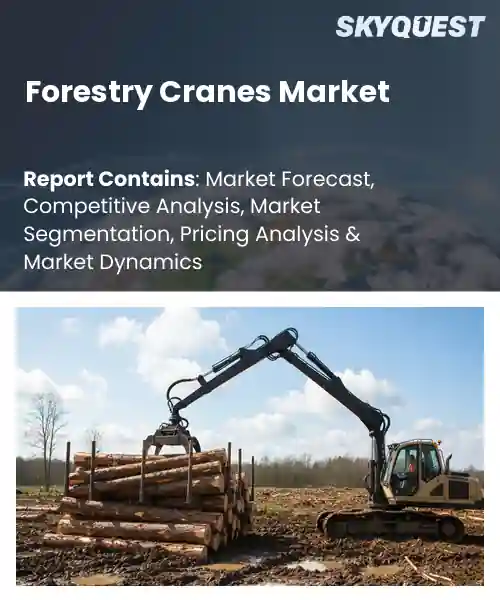
Forestry Cranes Market
Report ID: SQMIG20I3400
Report ID: SQMIG20I3400
[email protected]
USA +1 351-333-4748
Report ID:
SQMIG20I3400 |
Region:
Global |
Published Date: July, 2026
Pages:
157
|Tables:
150
|Figures:
78


Global Forestry Cranes Market size was valued at USD 1.5 Billion in 2024 and is poised to grow from USD 1.59 Billion in 2025 to USD 2.54 Billion by 2033, growing at a CAGR of 6.0% during the forecast period (2026-2033).
The global forestry cranes market includes crawler cranes engineered to lift logs, timber bundles, and forest equipment in woodland environments. Its significance lies in enabling efficient timber extraction while reducing labor intensity and safety risks, thereby supporting wood processing supply chain. The primary driver behind market expansion has been the surge in sustainable construction demand, which fuels consumption of certified timber. Over the past decade, regions such as Scandinavia and Canada have invested in mechanized logging, illustrated by 2018 introduction of Liebherr 200 EC‑XL, capable of handling 250‑ton loads. This evolution reflects shift from manual winching to new crane solutions.
Another key trend driving the global forestry cranes sector is the acceleration of digitalization and telematics integration, which translates into productivity gains for logging operators. By embedding sensors and GPS modules into crane hydraulics, firms can monitor load cycles, fuel use, and equipment health in time, enabling maintenance that reduces downtime by up to 30 percent. This capability has encouraged large timber conglomerates such as Stora Enso to adopt monitoring platforms, justifying higher investment in crane models. Consequently, manufacturers are expanding lines with IoT‑ready options, creating a growth avenue that aligns with Industry 4.0 initiatives and promises to open markets in emerging forestry economies.
How is AI-Driven Automation Impacting Efficiency in the Forestry Cranes Market?
AI-driven automation is reshaping forestry crane operations by embedding intelligent sensors and machine‑learning algorithms into the equipment. These systems continuously monitor hydraulic pressure, engine performance and load weight, allowing the crane to adjust lift speeds in real time. Operators benefit from predictive maintenance alerts that prevent unexpected breakdowns, while remote diagnostics reduce the need for on‑site visits. The technology also streamlines workflow by coordinating multiple cranes on a logging site, ensuring that each unit works at its optimal capacity. As forests become more regulated and sustainability targets tighten, the ability to extract timber efficiently with minimal waste is becoming a decisive competitive edge for service providers.
In May 2026, Liebherr launched a new forestry crane that leverages AI‑driven automation to fine‑tune load handling, cut cycle times and boost overall site productivity, reinforcing market growth.
Market snapshot - (2026-2033)
Global Market Size
USD 1.5 Billion
Largest Segment
Forwarder Cranes
Fastest Growth
Trailer Cranes
Growth Rate
6.0% CAGR
To get more insights on this market click here to Request a Free Sample Report
Global forestry cranes market is segmented by product type, boom type, lifting capacity, end user, distribution channel and region. Based on product type, the market is segmented into forwarder cranes, loader cranes, trailer cranes, truck-mounted cranes and others. Based on boom type, the market is segmented into knuckle boom, straight boom, telescopic boom and others. Based on lifting capacity, the market is segmented into light duty, medium duty, heavy duty and others. Based on end user, the market is segmented into logging contractors, forestry companies, sawmills and others. Based on distribution channel, the market is segmented into OEM, dealers & distributors, aftermarket and others. Based on region, the market is segmented into North America, Europe, Asia Pacific, Latin America and Middle East & Africa.
Based on the global forestry cranes market growth, forwarder cranes segment dominates because they integrate hauling and loading functions into a single machine, eliminating the need for separate equipment on steep forest terrain. This functional consolidation reduces operational cycles, enhances crew productivity, and minimizes ground disturbance, which is critical for sustainable logging practices. Their versatility across varied tree sizes and ability to operate on narrow, uneven tracks make them the preferred choice for high volume timber extraction operations.
Meanwhile, loader cranes segment is the fastest growing because manufacturers are integrating advanced hydraulic controls and lightweight materials that improve maneuverability in dense stand conditions. This innovation expands their applicability for selective logging and site preparation, driving broader adoption and creating new opportunities for operators seeking flexible, cost effective lifting solutions.
Logging contractors segment dominates because they are the primary purchasers of forestry cranes, directly aligning equipment specifications with on ground operational constraints. Their need for rapid repositioning, rugged durability, and adaptable lifting configurations drives demand for robust crane designs that can withstand forest floor variability. Consequently, they shape product development priorities, influencing manufacturers to focus on reliability, ease of maintenance, and integrated safety features essential for day to day timber harvesting.
On the other hand, sawmills segment is the fastest growing because processing now requires precise handling and higher lift capacities. Advanced telescopic booms enable efficient loading of processed lumber onto transport units, cutting turnaround times. This demand spurs investment in specialized crane solutions, making sawmills a key catalyst for innovation and market expansion.
To get detailed segments analysis, Request a Free Sample Report
As per the global forestry cranes market share, Asia Pacific dominance in the industry stems from a combination of abundant forest cover, accelerating timber demand, and a strong commitment to advanced mechanization. Manufacturers in the region have integrated cutting‑edge hydraulic and electronic controls, delivering equipment that meets diverse terrain challenges. Government initiatives encourage sustainable harvesting practices while supporting investment in high‑efficiency machinery. Skilled engineering workforces and a culture of continuous innovation enable rapid product development and customization for both commercial logging and reforestation projects. The region also serves as an export hub, supplying cranes to emerging markets where mechanized logging is expanding. Supply‑chain networks and collaboration between OEMs and component suppliers reduce lead times and enhance service quality. Growing emphasis on climate‑resilient forestry practices drives adoption of cranes with lower emissions and improved fuel efficiency, further reinforcing the region’s competitive advantage.
Forestry cranes market in Japan benefits from a long tradition of precision engineering and a high value placed on sustainable timber utilization. Domestic manufacturers focus on compact, high‑performance machines that can navigate steep, forested terrain while meeting strict environmental standards. Close collaboration with research institutes accelerates the introduction of advanced control systems, and a mature logistics network ensures rapid deployment to logging sites across the main islands throughout the country.
Forestry cranes market in South Korea is driven by strong governmental support for modernizing its forest sector and by a growing awareness of eco‑friendly harvesting techniques. Local firms emphasize modular designs that can be quickly adapted to varying slope conditions and integrate tele‑monitoring for safety and efficiency. An established supply base for high‑strength steel and hydraulic components reduces reliance on imports, enabling competitive pricing for domestic operators and sustained industry growth.
Based on global forestry cranes regional forecast, North America expands rapidly due to a confluence of high timber consumption, increasing automation, and a strong focus on sustainable resource management. Operators are adopting mechanized solutions to improve safety and reduce labor constraints, especially in remote and rugged regions. Industry leaders invest heavily in research that blends advanced sensor technology with eco‑efficient powertrains, delivering cranes that lower fuel use while maintaining productivity. Policy frameworks encourage reforestation and responsible harvesting, creating demand for versatile equipment capable of both logging and restoration tasks. Collaborative initiatives between forest owners and equipment suppliers further accelerate adoption, as customized crane configurations address specific regional species and terrain challenges. The emphasis on low‑emission technologies aligns with broader environmental targets, attracting both public and private investment into modern logging infrastructure.
Forestry cranes market in the United States is propelled by expansive commercial timber operations and a strong emphasis on technological integration. Manufacturers prioritize rugged designs capable of handling diverse climates, from the Pacific Northwest to the southeastern pine forests. Emerging telematics platforms enable performance monitoring, enhancing operational efficiency and safety. A mature financing ecosystem supports acquisition of equipment, while regulatory incentives for sustainable practices encourage the shift toward mechanized harvesting solutions.
Forestry cranes market in Canada reflects the nation’s boreal forest assets and a commitment to responsible harvesting. Equipment providers focus on cold‑weather resilience, ensuring hydraulic and electronic components function reliably in sub‑zero conditions. Integration of GPS‑guided positioning aids tree extraction, reducing waste and disturbance. Research programs with forestry institutes foster innovations such as hybrid power solutions, aligning with Canada’s climate objectives and reinforcing the adoption of crane technology across provincial operations.
As per global forestry cranes regional outlook, Europe strengthens its position in the industry through a blend of rigorous sustainability standards, advanced engineering expertise, and coordinated policy support. Manufacturers prioritize low‑emission powertrains and modular designs that can be swiftly adapted to the continent’s varied topographies, from Alpine slopes to the dense woodlands of Scandinavia. Strong collaboration between academic institutions and equipment producers accelerates the adoption of smart‑control systems, enhancing precision and safety. EU directives encouraging responsible forest management and reforestation create steady demand for versatile cranes capable of both commercial logging and ecosystem restoration. Additionally, a well‑integrated supply chain and extensive service networks ensure rapid maintenance and parts availability, reinforcing Europe’s reputation for reliability and technological leadership in mechanized forestry operations. The emphasis on circular economy principles encourages refurbishment programmes, extending equipment lifecycles and reducing environmental impact, further solidifying Europe’s competitive advantage.
Forestry cranes market in Germany is driven by a tradition of precision engineering and a strong focus on eco‑friendly technologies. Local manufacturers emphasize high‑efficiency hydraulic systems paired with emissions‑reduction measures to meet stringent national environmental regulations. Collaborative projects with technical universities foster development of autonomous features that improve operator safety. Germany’s extensive rail and road infrastructure facilitates swift delivery of equipment to timber‑rich regions throughout the country and reliable service support.
Forestry cranes market in the United Kingdom reflects the country’s emphasis on safety standards and low‑impact harvesting methods. Manufacturers develop lightweight yet sturdy crane frames designed for the rolling hills and mixed‑species woodlands common across England, Scotland, and Wales. Advanced telematics provide real‑time diagnostics, supporting predictive maintenance and minimizing downtime. Partnerships with governmental forestry programs encourage the deployment of equipment that meets strict emission limits while supporting sustainable yield objectives.
Forestry cranes market in France benefits from a robust forestry sector and a national commitment to sustainable land management. Companies prioritize adaptable crane configurations that can handle the diverse terrain of the Pyrenees, Alps, and extensive forested plains. Integration of renewable‑energy‑compatible power modules aligns with France’s carbon‑neutral objectives. Close ties with research institutes promote continuous improvement in ergonomics and precision control, enhancing productivity while reducing environmental footprints through advanced material science.
To know more about the market opportunities by region and country, click here to
Buy The Complete Report
Rising Demand For Green Forestry
Advancements In Crane Automation
High Capital Investment Costs
Stringent Environmental Regulation Compliance
Request Free Customization of this report to help us to meet your business objectives.
The competitive landscape in the global forestry cranes market outlook is shaped by a handful of innovative firms leveraging advanced sensor integration, AI analytics, and strategic alliances to differentiate their forestry crane solutions, while incumbents pursue acquisitions to broaden product portfolios and geographic reach. Recent examples include a partnership between a leading crane manufacturer and a data‑analytics startup to embed real‑time load monitoring, and the acquisition of a niche European crane specialist by a global equipment group to enhance its forest‑operations line.
Top Player’s Company Profile
Recent Developments
SkyQuest’s ABIRAW (Advanced Business Intelligence, Research & Analysis Wing) is our Business Information Services team that Collects, Collates, Correlates, and Analyses the Data collected by means of Primary Exploratory Research backed by robust Secondary Desk research.
As per SkyQuest analysis the global forestry cranes industry is being propelled primarily by the rising demand for green forestry, as timber producers seek low‑impact, low‑emission equipment to meet certification standards, while a second strong driver comes from rapid advancements in crane automation and digital integration that boost productivity and safety. Forwarder cranes continue to dominate the product landscape because they combine hauling and loading, reducing cycles on steep terrain. Asia Pacific leads the market thanks to abundant forest cover, strong mechanisation policies and an export‑focused manufacturing base. However, the sector’s expansion is tempered by the high capital investment required for specialized crane units, which can deter smaller operators.
| Report Metric | Details |
|---|---|
| Market size value in 2024 | USD 1.5 Billion |
| Market size value in 2033 | USD 2.54 Billion |
| Growth Rate | 6.0% |
| Base year | 2024 |
| Forecast period | (2026-2033) |
| Forecast Unit (Value) | USD Billion |
| Segments covered |
|
| Regions covered | North America (US, Canada), Europe (Germany, France, United Kingdom, Italy, Spain, Rest of Europe), Asia Pacific (China, India, Japan, Rest of Asia-Pacific), Latin America (Brazil, Rest of Latin America), Middle East & Africa (South Africa, GCC Countries, Rest of MEA) |
| Companies covered |
|
| Customization scope | Free report customization with purchase. Customization includes:-
|
To get a free trial access to our platform which is a one stop solution for all your data requirements for quicker decision making. This platform allows you to compare markets, competitors who are prominent in the market, and mega trends that are influencing the dynamics in the market. Also, get access to detailed SkyQuest exclusive matrix.
Table Of Content
Executive Summary
Market overview
Parent Market Analysis
Market overview
Market size
KEY MARKET INSIGHTS
COVID IMPACT
MARKET DYNAMICS & OUTLOOK
Market Size by Region
KEY COMPANY PROFILES
Methodology
For the Forestry Cranes Market, our research methodology involved a mixture of primary and secondary data sources. Key steps involved in the research process are listed below:
1. Information Procurement: This stage involved the procurement of Market data or related information via primary and secondary sources. The various secondary sources used included various company websites, annual reports, trade databases, and paid databases such as Hoover's, Bloomberg Business, Factiva, and Avention. Our team did 45 primary interactions Globally which included several stakeholders such as manufacturers, customers, key opinion leaders, etc. Overall, information procurement was one of the most extensive stages in our research process.
2. Information Analysis: This step involved triangulation of data through bottom-up and top-down approaches to estimate and validate the total size and future estimate of the Forestry Cranes Market.
3. Report Formulation: The final step entailed the placement of data points in appropriate Market spaces in an attempt to deduce viable conclusions.
4. Validation & Publishing: Validation is the most important step in the process. Validation & re-validation via an intricately designed process helped us finalize data points to be used for final calculations. The final Market estimates and forecasts were then aligned and sent to our panel of industry experts for validation of data. Once the validation was done the report was sent to our Quality Assurance team to ensure adherence to style guides, consistency & design.
Analyst Support
Customization Options
With the given market data, our dedicated team of analysts can offer you the following customization options are available for the Forestry Cranes Market:
Product Analysis: Product matrix, which offers a detailed comparison of the product portfolio of companies.
Regional Analysis: Further analysis of the Forestry Cranes Market for additional countries.
Competitive Analysis: Detailed analysis and profiling of additional Market players & comparative analysis of competitive products.
Go to Market Strategy: Find the high-growth channels to invest your marketing efforts and increase your customer base.
Innovation Mapping: Identify racial solutions and innovation, connected to deep ecosystems of innovators, start-ups, academics, and strategic partners.
Category Intelligence: Customized intelligence that is relevant to their supply Markets will enable them to make smarter sourcing decisions and improve their category management.
Public Company Transcript Analysis: To improve the investment performance by generating new alpha and making better-informed decisions.
Social Media Listening: To analyze the conversations and trends happening not just around your brand, but around your industry as a whole, and use those insights to make better Marketing decisions.
REQUEST FOR SAMPLE
 REQUEST FREE CUSTOMIZATION
Global Forestry Cranes Market size was valued at USD 1.5 Billion in 2024 and is poised to grow from USD 1.59 Billion in 2025 to USD 2.54 Billion by 2033, growing at a CAGR of 6.0% during the forecast period (2026-2033).
The competitive landscape is shaped by a handful of innovative firms leveraging advanced sensor integration, AI analytics, and strategic alliances to differentiate their forestry crane solutions, while incumbents pursue acquisitions to broaden product portfolios and geographic reach. Recent examples include a partnership between a leading crane manufacturer and a data‑analytics startup to embed real‑time load monitoring, and the acquisition of a niche European crane specialist by a global equipment group to enhance its forest‑operations line. 'Kesla Oyj', 'John Deere', 'Komatsu Forest AB', 'Ponsse Plc', 'Cranab AB', 'Palfinger AG', 'Hiab Corporation', 'Tajfun Planina d.o.o.', 'Livab AB', 'Nokka Oy', 'FTG Mowi AB', 'Stepa Farmkran GmbH', 'Binderberger Maschinenbau GmbH', 'HMF Group A/S', 'Ferri S.r.l.', 'Penz Crane GmbH', 'Fassi Gru S.p.A.', 'Jonsered Cranes AB', 'Nisula Forest Oy', 'Patu Cranes'
Forestry operators are increasingly seeking equipment that minimizes soil disturbance and reduces emissions, because sustainable harvesting practices are becoming a core requirement for certification and market acceptance. Crane systems designed for low-impact load handling meet these expectations, enabling contractors to access timber without extensive ground infrastructure. This alignment with environmental priorities encourages investment in specialized forestry cranes, as purchasers view such technology as essential for maintaining access to premium markets and for demonstrating corporate responsibility in an era of heightened ecological awareness.
Digital Integration Accelerates Operations: Forestry crane manufacturers are embedding advanced telematics, sensor networks, and AI-driven diagnostics into equipment, enabling real‑time performance monitoring and predictive maintenance. Operators gain instant visibility into load cycles, fuel consumption, and component health, which reduces unplanned downtime and extends service life. This connectivity also supports remote assistance and over‑the‑air software updates, lowering the need for on‑site visits. As digital ecosystems mature, data‑rich insights facilitate optimized scheduling, improved safety protocols, and greater overall fleet efficiency across diverse logging environments worldwide today.
Why does Asia Pacific Dominate the Global Forestry Cranes Market? |@12


Want to customize this report? This report can be personalized according to your needs. Our analysts and industry experts will work directly with you to understand your requirements and provide you with customized data in a short amount of time. We offer $1000 worth of FREE customization at the time of purchase.
Feedback From Our Clients


 USA (+1) 351-333-4748

