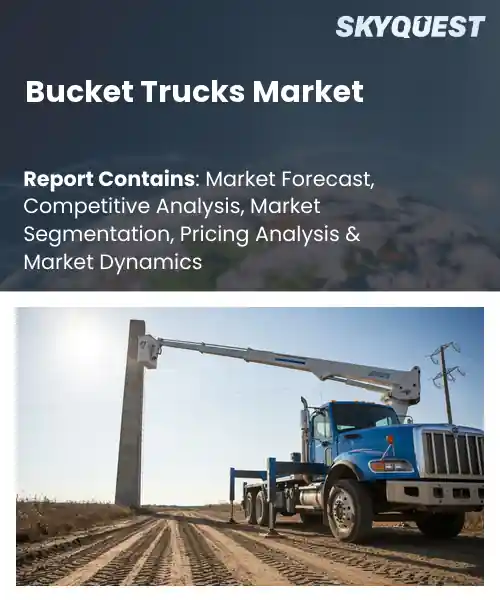
Bucket Trucks Market
Report ID: SQMIG20C2202
Report ID: SQMIG20C2202
[email protected]
USA +1 351-333-4748
Report ID:
SQMIG20C2202 |
Region:
Global |
Published Date: May, 2026
Pages:
157
|Tables:
189
|Figures:
79


Global Bucket Trucks Market size was valued at USD 1.60 Billion in 2024 and is poised to grow from USD 1.80 Billion in 2025 to USD 4.58 Billion by 2033, growing at a CAGR of 12.4% during the forecast period (2026-2033).
Electricity and telecommunications companies are driving demand for bucket trucks market rends in the form of electric and telecommunications infrastructure expansion. This is causing many companies to acquire higher capacity aerial devices as part of their fleets. The bucket trucks are specific vehicles with insulated upper boom arms and upper stowable baskets that allow workers to safely perform elevated work, including electrical power line repairs, servicing streetlights, installing and servicing fiber and 5G technology. Improving operational safety, crew productivity, and outage response is one way bucket trucks influence an organization. The product mix for bucket trucks has shifted from relatively basic hydraulic lifts to either typical articulated boom type units or typical telescoping boom type units, and OEM's are starting to produce fully electric battery powered and hybrid style bucket trucks to meet increasing environmental regulations and market waits in receptiveness to various 3rd party vehicles.
The modernization of fleets will be an important driver for the global bucket truck market growth, as many fleet operators are updating to newer and safer equipment, and providing support for the rollout and installation of complicated networks. The use of insulated articulating booms by utilities will help improve the time it takes to restore power and reduce utility costs related to outages, which will encourage increased spending on capital projects. At the same time, the rollout of 5G by telecommunications companies will create a greater demand for lightweight elevated platforms that can be used to install more compact small cell sites. The electrification of fleets will help reduce operational costs and create retrofit and lease opportunities for owners of bucket trucks, while the growing use of telematic and predictive maintenance services in the aftermarket will create recurring revenue and expand OEM service networks.
How is IoT Improving Safety and Efficiency in the Bucket Trucks Market?
The internet of (IoT) is providing significant usage support to the bucket trucks market share by connecting telematics, cameras, and sensors, enabling companies to monitor their vehicles remotely, maintain them based on predictive maintenance, and receive real-time alerts. Included in the benefits of using IoT-enabled bucket trucks is issuing improved safety for operators through video recorded onboard and ability to track assets, diagnose using conditions-based technology, and increase the speed in which they respond to incidents. Fleet managers and manufactures now have access to historical data regarding the battery life and maintenance of the bucket trucks they operate through these telematics. They can utilize this information along with their operational processes to reduce unplanned downtime and/or minimize job site idling time, while promoting a safe work environment for crews working around the bucket trucks and providing the ability for crews to utilize tools/equipment more effectively.
In January of 2026, Altec launched OP Ready report services on JEMS to assist in monitoring battery faults and service events on their bucket trucks. By utilizing IoT, this service improves remote diagnostics and scheduled maintenance of the vehicles, which enables fleets to deploy crews more effectively as well as increase fleet readiness.
Market snapshot - (2026-2033)
Global Market Size
USD 1.6 Billion
Largest Segment
Insulated Bucket Trucks
Fastest Growth
Telescopic Boom Bucket Trucks
Growth Rate
12.4% CAGR
To get more insights on this market click here to Request a Free Sample Report
Global bucket trucks market is segmented by vehicle type, propulsion type, working height, mounting type, application, end user and region. Based on vehicle type, the market is segmented into insulated bucket trucks, non-insulated bucket trucks, articulating boom bucket trucks, telescopic boom bucket trucks, overcenter bucket trucks, material handling bucket trucks, forestry bucket trucks and others. Based on propulsion type, the market is segmented into diesel bucket trucks, gasoline bucket trucks, hybrid bucket trucks and electric bucket trucks. Based on working height, the market is segmented into below 30 feet, 30–50 feet, 50–70 feet and above 70 feet. Based on mounting type, the market is segmented into class 3–5 chassis mounted, class 6–7 chassis mounted and class 8 heavy-duty chassis mounted. Based on application, the market is segmented into electrical utility maintenance, telecommunications infrastructure, tree care & forestry, construction & infrastructure maintenance, signage & lighting maintenance, municipal services, rail & transit maintenance, disaster recovery & emergency services and others. Based on end user, the market is segmented into utility companies, telecom service providers, government & municipal authorities, construction contractors, fleet rental companies, tree care service providers, industrial facilities and others. Based on region, the market is segmented into North America, Europe, Asia Pacific, Latin America and Middle East & Africa.
The leading section of the bucket trucks market forecast is currently made up of diesel-powered vehicles as operators prefer the proven durability, extended driving range, and ease of refueling that these trucks offer for repeated aerial work. Diesel engines provide consistent performance over long periods of idle while holding enough weight to support large bucket elevation systems. This type of engine design has supported the continued use of diesel trucks for many years, as the fleets of trucks are maintained with currently existing maintenance systems and service support through established national and regional supply chains means that diesel trucks will continue to serve as the preferred choice for utilities and contractors looking for reliable payloads and uptime when performing their work in a variety of duty cycle types.
However, electric bucket trucks have become the fastest growing sub-category of the bucket trucks market outlook. The continued focus on reducing emissions, as well as increasing overall cost efficiency and lower noise levels, are prompted by changing requirements for municipal and utility fleet replacement. Changes in batteries and the added infrastructure for charging them have decreased the range of worry for fleet operators. This has, in-turn, driven the growth of electric fleets and improved the motivation for truck manufacturers to invest in expanded electric truck platforms and supporting operational support systems.
The telescopic boom bucket trucks segment is dominant in the bucket trucks market analysis, due to their ability to have a long linear reach and ease of extension. This makes Telescopic Boom Bucket Trucks the preferred choice of contractors and utilities for jobs requiring flexibility in reach while avoiding complex articulation. The ability for manufacturers to offer higher lift ratings with a precise extension mechanism combined with an easy-to-use structure allows manufacturers the ability to easily train operators. The durable parts of the Telescopic Boom Bucket Truck and their ease of service reduce total cost of ownership, enable large fleet operations across the many different applications they are used for.
Articulating boom bucket trucks are experiencing the most growth in the bucket trucks market penetration, due to access issues in dense urban and confined job sites. Articulating Boom Bucket Trucks provide a lot of maneuverability and can access around obstacles due to their knuckle joints, which increases their applications in telecom and tree care. Additionally, improvements in both compact mounts and the introduction of new safety controls are helping to drive fleet buyers looking for operational agility.
To get detailed segments analysis, Request a Free Sample Report
Large utility structure and continual infrastructure maintenance, along with a mature fleet and rental service industry, North America has a stronghold on the global bucket trucks market. With extensive OEM and dealer networks, product availability and service response times are optimized. Strict regulations and safety guidelines have led to an increase in specialized insulated and utility products. Best practices are utilized to ensure fleet renewals occur in a timely manner and maintenance is executed in a preventive manner to elongate the useable life of their equipment, resulting in consistent replacement demand and aftermarket sales. There are established parts supply chains and a qualified workforce of technicians to assist in keeping equipment operational, producing competitive advantages for the region. Telemetry, training for operators and financing options have lowered the barriers to entry for municipalities and private businesses, and have allowed for larger than anticipated growth trajectories for the bucket truck sector.
Bucket trucks market regional outlook in the United States are being created due to many features such as the amount of utilities needed, how often those utilities require maintenance, and by having a large amount of rentals and services available. Manufacturers (OEMs) have strong positions in this market by offering product options from many different manufacturers for all applications of heavy use. The growing emphasis on Introducing Safety Standards and Depending on Training has led to increased expectations for insulation and the ability to control the operator's load. The availability of parts throughout the country and support networks for technicians minimizes equipment downtime and encourages fleet owners to increase their investment in equipment throughout both the municipal and commercial sectors.
Bucket trucks market regional forecast in Canada is influenced by the country's extensive transmission and distribution networks, remote service areas, and the weather-resistant requirements of the vehicles. Operators are looking for vehicles that can operate in all types of weather, are resistant to corrosion, and will have a long service life. Local distribution networks in Canada provide access to equipment with flexibility, while dedicated preventative maintenance programs contribute to operational reliability. Operator training with respect to safety and compliance with utility requirements helps motivate operators to purchase specialized articulated models that have adequate insulation for installation onto many different types of terrain and climates.
The European bucket truck market is growing quickly because of large-scale infrastructure upgrades, improved distribution networks, and increasing installation of renewable energy and telecommunications facilities. Safety, environmental, and urban access regulations are making it necessary for cities and operators to look for low-emissions, small and highly mobile working aerial equipment. The thriving rental market combined with specialized services has reduced ownership barriers to acquiring this type of aerial platform. Local manufacturers and modular designs support custom solutions to restricted urban street width and various types of utility standards. Better operator training and telematics based maintenance enable improved equipment uptime and lifecycle economics, and support utility and contractor purchases of these types of aerial platforms. Working closely together, suppliers and municipalities develop customized solutions for historical city centres and restricted access areas to enhance innovation throughout the region for aerial lift platforms.
Bucket trucks market analysis in Germany the demand is driven by the number of grid modernization efforts happening and the importance placed on Precision Engineering to produce specialized, high reliable Aerial Work Platforms. There is also an emphasis placed on Occupational Safety, Vehicle Standards and Vocational Training that ensure Specification Purchases are made at a High Level. The local Supply Chain and Aftermarket Services allow for Maintenance/Customization on both Heavy Industrial or Municipal applications.
Bucket trucks industry in the United Kingdom is driven by city centre urban renewal and environmental (energy) initiatives. In cities with strict emissions regulations, operators look for compact, easy to manoeuvre, and low-emission aerial platforms that can be used in narrow streets where increased congestion exists. There are strong rental companies with developed networks, and innovative manufacturers producing customised solutions for this sector of the market. Investment into operator training and telematics-based fleet management to increase operator safety and usage is rapidly growing. There is a diversification in bucket truck demand across various industries including public utility,telecommunication (telecom), and municipal service.
Bucket trucks industry analysis in France is evolving, as utilities focus on enhancing services through the modernization of both urban and rural systems. Increased demand is being driven by the desire to limit the environmental impact of each truck and the need to operate in historically constrained urban environments, so compact, quiet work platforms are critical. Local manufacturers and rental operators are growing their range of products to address these specific insulation and maneuverability requirements. The importance of training and service support increases the likelihood that contractors will purchase versatile aerial work platforms for both utility and local municipal work.
Growth of bucket truck market in Asia Pacific is ongoing primarily because of collective investments in utility infrastructure; faster development of urban areas; and the ongoing rollout of telecommunications and renewable energy projects. Manufacturers in the region are increasing production levels and modifying designs for the narrow streets, local landscapes, and climate conditions; existing service networks and rental models are being broadened to enhance the accessibility of equipment to operators. There is increasing emphasis from manufacturers on operator safety, telematics to manage fleets of equipment, and localized aftermarket support to improve uptime and lifecycle value. Both governmental entities and industry associations are focusing on providing more consistent standards and creating workforce development programs to enhance operator competencies and maintenance procedures. Lastly, the introduction of incentives and financing programs from the public and private sectors have mitigated barriers to procuring advanced platforms (i.e. hybrid powertrains and battery-powered vehicles) and enabled greater use of specialized boom configurations across the region.
Bucket trucks industry outlook in Japan is focused on producing products with precision engineering, utilizing compact designs, and incorporating advanced safety features. These new products will also be designed for the high-density urban landscapes that constrain many bucket trucks from being used on site. Domestic manufacturers are developing lightweight, manoeuvrable aerial platforms that will incorporate integrated telematics and energy-efficient powertrains. In addition, a strong availability of parts and maintenance networks, as well as operator training programs, will be available to ensure fleet reliability and serviceability. Ultimately, there will be a wide range of applications for these trucks, such as utility companies, governmental municipalities and private contractors; all of which require durable, high-quality equipment designed to handle narrow streets and specific climate conditions.
Bucket trucks market in South Korea is developing through its strong local manufacturing capabilities, integration of technology, and emphasis on compact aerial platforms. Demand will be met by utility upgrades, as well as industrial projects with special boom configurations. In addition, manufacturers are partnering with global companies to rollout electrified, telematics-enabled product solutions; while service networks and training projects assist customers with operability. The market is showing a growing trend toward versatile, high-specification equipment for public and private industry use.
To know more about the market opportunities by region and country, click here to
Buy The Complete Report
Infrastructure Development And Modernization
Electrification And Hybrid Adoption
High Initial Acquisition Cost
Workforce Skill And Training Shortages
Request Free Customization of this report to help us to meet your business objectives.
The competitive landscape within the global boom truck marketplace is focused around three core areas: electrification, retrofit partnerships, and distributor consolidation. Driven by OEM consolidation efforts and the emergence of new entrants through M&A activity, partnerships, and innovative powertrains, these are all active areas of competition for OEMs within the global boom truck market. For example, amongst other electrification initiatives, Terex Corporation has integrated electric PTO (power take-off) systems into its respected product line, ZEVX has developed a partnership with a telecommunications company to deploy a fully electric light-duty aerial boom truck, and groups of access equipment manufacturers have combined their distributor networks so that they may create a stronger service footprint across their product lines.
Top Player’s Company Profile
Recent Developments in the Bucket Trucks Market
SkyQuest’s ABIRAW (Advanced Business Intelligence, Research & Analysis Wing) is our Business Information Services team that Collects, Collates, Correlates, and Analyses the Data collected by means of Primary Exploratory Research backed by robust Secondary Desk research.
As per SkyQuest analysis, the demand for higher-capability aerial platforms and fleet upgrades has been driven by an increase in infrastructure development and fleet modernization while there is a constraint on the ability of smaller contractors to acquire high initial costs associated with procurement, which slows down replacement cycles. North America leads as the dominant region due to mature utility networks, established OEM/dealer footprints, and comprehensive aftermarket support for diesel bucket trucks, which provide proven torque, range of performance, and service ecosystems. Electrification/hybrid adoption has also been a key driver by providing motivation for OEM investment in low emission aerial platforms as well as transferring either to quieter machinery with a low lifecycle cost.
| Report Metric | Details |
|---|---|
| Market size value in 2024 | USD 1.6 Billion |
| Market size value in 2033 | USD 4.58 Billion |
| Growth Rate | 12.4% |
| Base year | 2024 |
| Forecast period | (2026-2033) |
| Forecast Unit (Value) | USD Billion |
| Segments covered |
|
| Regions covered | North America (US, Canada), Europe (Germany, France, United Kingdom, Italy, Spain, Rest of Europe), Asia Pacific (China, India, Japan, Rest of Asia-Pacific), Latin America (Brazil, Rest of Latin America), Middle East & Africa (South Africa, GCC Countries, Rest of MEA) |
| Companies covered |
|
| Customization scope | Free report customization with purchase. Customization includes:-
|
To get a free trial access to our platform which is a one stop solution for all your data requirements for quicker decision making. This platform allows you to compare markets, competitors who are prominent in the market, and mega trends that are influencing the dynamics in the market. Also, get access to detailed SkyQuest exclusive matrix.
Table Of Content
Executive Summary
Market overview
Parent Market Analysis
Market overview
Market size
KEY MARKET INSIGHTS
COVID IMPACT
MARKET DYNAMICS & OUTLOOK
Market Size by Region
KEY COMPANY PROFILES
Methodology
For the Bucket Trucks Market, our research methodology involved a mixture of primary and secondary data sources. Key steps involved in the research process are listed below:
1. Information Procurement: This stage involved the procurement of Market data or related information via primary and secondary sources. The various secondary sources used included various company websites, annual reports, trade databases, and paid databases such as Hoover's, Bloomberg Business, Factiva, and Avention. Our team did 45 primary interactions Globally which included several stakeholders such as manufacturers, customers, key opinion leaders, etc. Overall, information procurement was one of the most extensive stages in our research process.
2. Information Analysis: This step involved triangulation of data through bottom-up and top-down approaches to estimate and validate the total size and future estimate of the Bucket Trucks Market.
3. Report Formulation: The final step entailed the placement of data points in appropriate Market spaces in an attempt to deduce viable conclusions.
4. Validation & Publishing: Validation is the most important step in the process. Validation & re-validation via an intricately designed process helped us finalize data points to be used for final calculations. The final Market estimates and forecasts were then aligned and sent to our panel of industry experts for validation of data. Once the validation was done the report was sent to our Quality Assurance team to ensure adherence to style guides, consistency & design.
Analyst Support
Customization Options
With the given market data, our dedicated team of analysts can offer you the following customization options are available for the Bucket Trucks Market:
Product Analysis: Product matrix, which offers a detailed comparison of the product portfolio of companies.
Regional Analysis: Further analysis of the Bucket Trucks Market for additional countries.
Competitive Analysis: Detailed analysis and profiling of additional Market players & comparative analysis of competitive products.
Go to Market Strategy: Find the high-growth channels to invest your marketing efforts and increase your customer base.
Innovation Mapping: Identify racial solutions and innovation, connected to deep ecosystems of innovators, start-ups, academics, and strategic partners.
Category Intelligence: Customized intelligence that is relevant to their supply Markets will enable them to make smarter sourcing decisions and improve their category management.
Public Company Transcript Analysis: To improve the investment performance by generating new alpha and making better-informed decisions.
Social Media Listening: To analyze the conversations and trends happening not just around your brand, but around your industry as a whole, and use those insights to make better Marketing decisions.
REQUEST FOR SAMPLE
 REQUEST FREE CUSTOMIZATION
Global Bucket Trucks Market size was valued at USD 1.6 Billion in 2024 and is poised to grow from USD 1.8 Billion in 2025 to USD 4.58 Billion by 2033, growing at a CAGR of 12.4% during the forecast period (2026-2033).
Competition in the global bucket trucks market centers on electrification, retrofit alliances and dealer consolidation as OEMs and new entrants pursue M&A, strategic partnerships and powertrain innovation. Concrete moves include Terex integrating electric PTO solutions, ZEVX partnering with a cable operator to field a fully electric light aerial bucket truck, and access-equipment groups consolidating distributor networks to secure service footprints. 'Terex Corporation', 'Altec Industries, Inc.', 'Oshkosh Corporation', 'Aichi Corporation', 'Tadano Ltd.', 'Palfinger AG', 'Versalift', 'Ruthmann Holdings GmbH', 'CTE Group', 'Bronto Skylift Oy Ab', 'Time Manufacturing Company', 'Dur-A-Lift, Inc.', 'Socage S.r.l.', 'France Elévateur', 'Elliott Equipment Company', 'Niftylift Limited', 'Manitex International, Inc.', 'Teupen Maschinenbau GmbH', 'Haulotte Group', 'Linamar Corporation'
Increasing investment in power distribution networks, telecommunications expansion, and urban development drives demand for bucket trucks by expanding the number and complexity of overhead utility tasks that require safe elevated access. As cities modernize infrastructure, utilities and contractors must adopt specialized vehicles to perform installation, inspection, and repair work efficiently. The availability of versatile aerial work platforms reduces manual risk and improves operational productivity, encouraging fleet upgrades and procurement decisions that support market growth through sustained project pipelines and institutional focus on asset renewal.
Electrification And Battery Platforms: Manufacturers are prioritizing electric drivetrains and scalable battery architectures to address sustainability mandates and reduce operating emissions. Development focuses on integrating durable energy storage, vehicle weight optimization, and modular platforms that accommodate varying lift configurations. This transition drives collaboration across suppliers, utilities, and fleet operators to ensure charging availability and lifecycle management. Demand for electric bucket trucks is influenced by corporate environmental commitments and urban low emission zones, encouraging procurement of quieter, cleaner vehicles that align with fleet decarbonization strategies.
Why does North America Dominate the Global Bucket Trucks Market? |@12


Want to customize this report? This report can be personalized according to your needs. Our analysts and industry experts will work directly with you to understand your requirements and provide you with customized data in a short amount of time. We offer $1000 worth of FREE customization at the time of purchase.
Feedback From Our Clients


 USA (+1) 351-333-4748

