Footwear Market
Report ID: SQMIG25L2017
Report ID: SQMIG25L2017
[email protected]
USA +1 351-333-4748
Report ID:
SQMIG25L2017 |
Region:
Global |
Published Date: May, 2025
Pages:
191
|Tables:
91
|Figures:
71


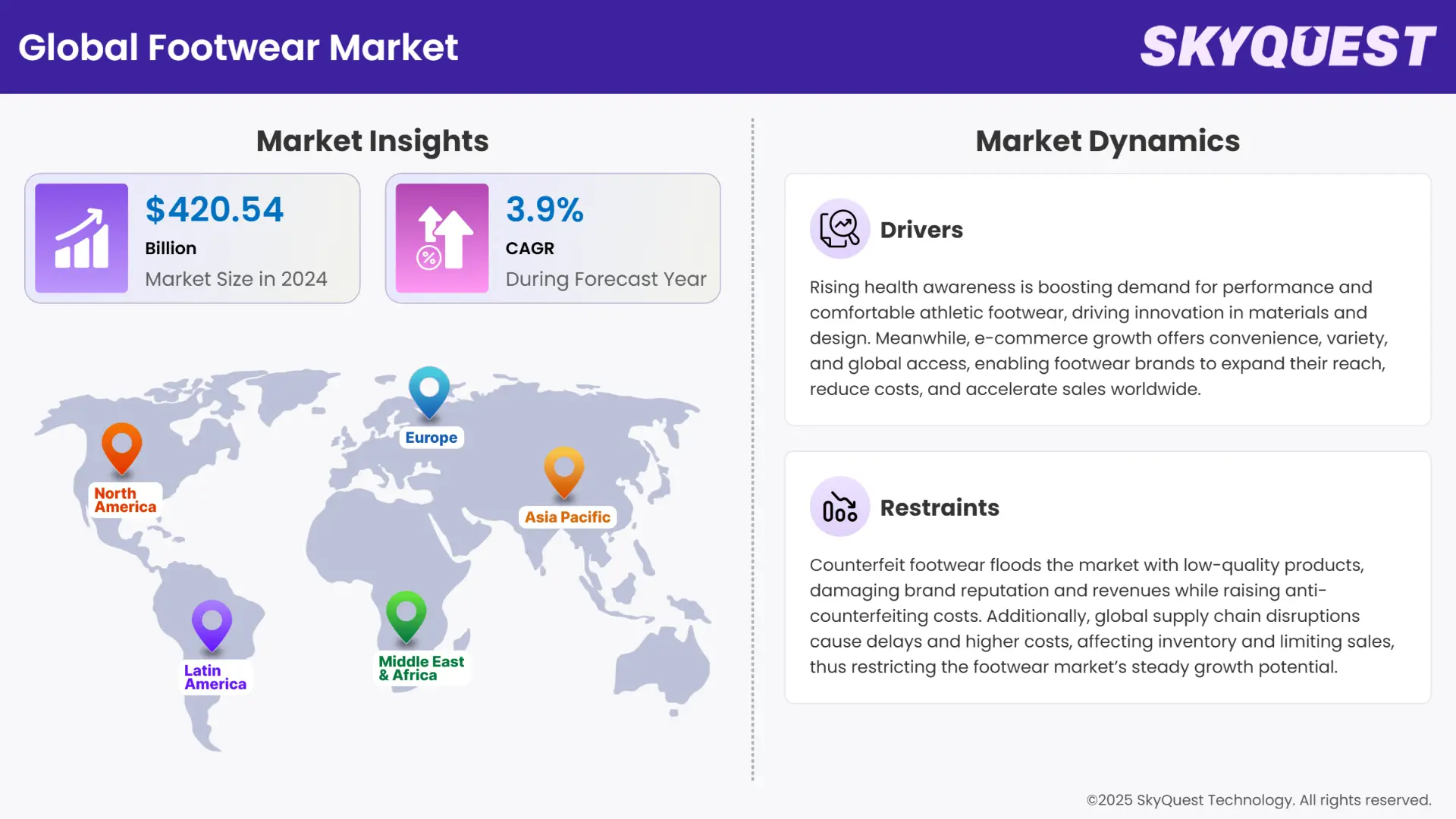
Global Footwear Market size was valued at USD 420.54 Billion in 2024 poised to grow from USD 436.94 Billion in 2025 to USD 593.39 Billion by 2033, growing at a CAGR of 3.9% in the forecast period (2026–2033).
Health consciousness around the world has convinced many people to be active in more physical pursuits, including running, going to the gym, participating in yoga classes and engaging in outdoor sports and activities. Overall, this evolution in consumer behavior arises from growing concerns about obesity, chronic disease, and health and wellness. Thus, consumers are on the hunt for quality footwear with performance, comfort, and injury prevention features. In turn, footwear companies are using ergonomic designs, and breathable materials with various cushioning technologies. The increased health-based consumer behavior impacts demand for athletic and performance footwear in the marketplace, demonstrating that consumer awareness of health and fitness is a major contributor of continuous growth of the global footwear market.
Through changing fashions, consumer decisions are influenced as a contributing factor to global footwear industry penetration. The hybridization of athleisure and streetwear have created a continuum between athletic and casual footwear, which, in turn, has fueled demand for shoes that are fashionable and functional. Shoes are not expected to only be used for their intended purpose; consumers want footwear that speaks to their individuality and identity and can be re-invented as a fashionable and flexible option.
In response, footwear brands launch seasonal collections effecting celebrities, influencers and prevalent culture. Subsequently, this means footwear becomes quickly stale, and the number of purchases is driven by multiple purchases on behalf of the consumer, particularly with younger consumers. The sheer element of fashion means that demand and brand involvement is sustained across footwear categories.
How does AI Reduce Return Rates in the Footwear Industry?
Artificial Intelligence is transforming how the global footwear sector works, leading to great personalization and greater operational efficiencies. As newly developed footwear products with customized designs get demanded by consumers, AI-enabled brands construct footwear tailored to the individual foot based on consumers' gleaned biometric data, which in turn supports comfort while reducing returns. Syntilay recently launched the first AI-designed, 3D-printed shoe that conforms to everyone's distinct foot fee, made through scans from consumers' smartphone cameras. Further, AI-enabled predictive analytics provide sportswear companies, like Nike, the ability to accurately predict demand and manage inventory, eliminating years of overproduction and dissipating cost structures.
To get more insights on this market click here to Request a Free Sample Report
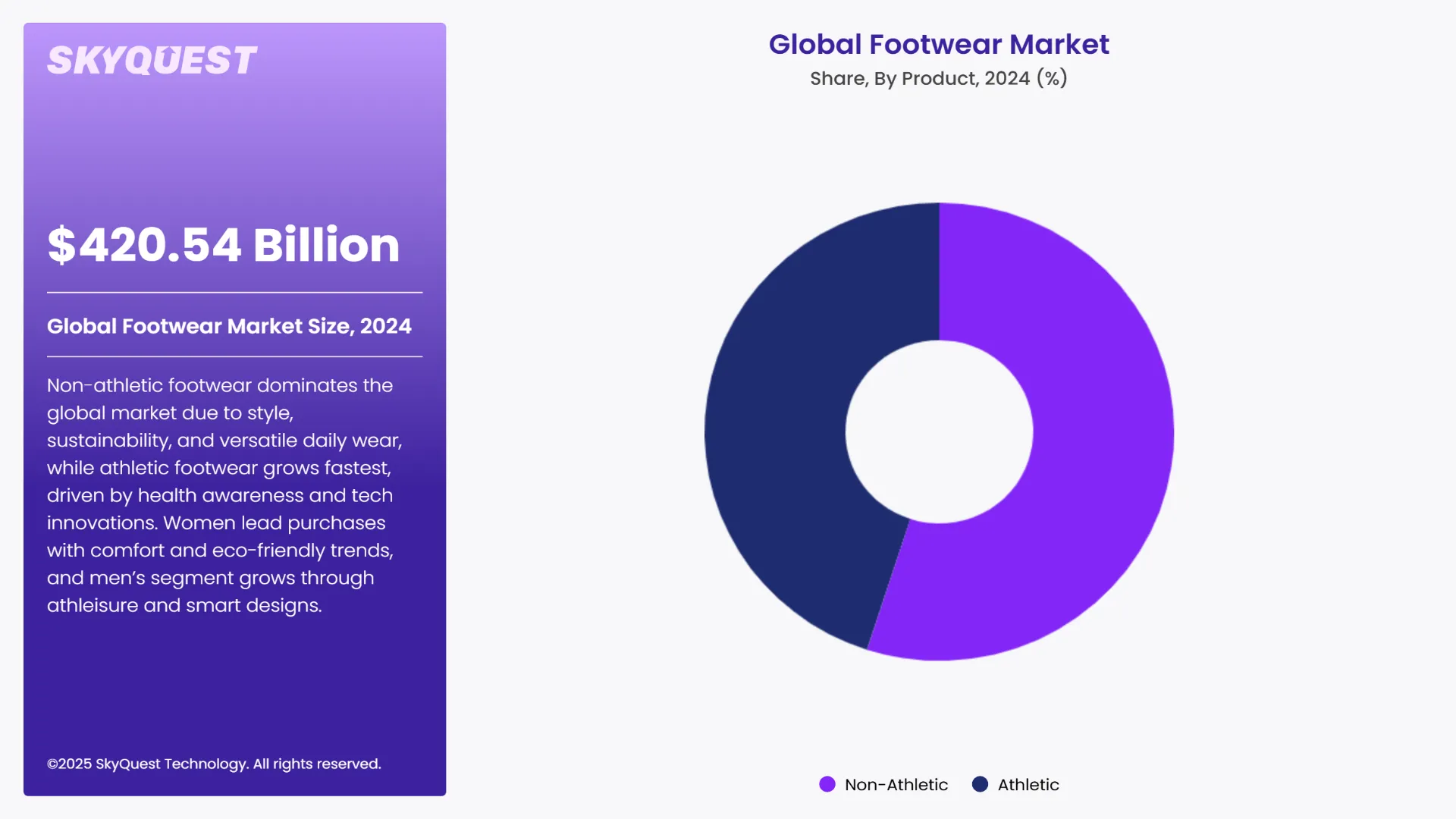
The global footwear market is segmented based on product, end user, distribution channel, and regions. In terms of product, the market is divided into athletic and non-athletics. Based on end user, the market is trifurcated into men, women, and children. Based on distribution channel, the market is grouped into online retail, department stores, specialty stores, supermarkets, and brand outlets. Based on region, the market is segmented into North America, Europe, Asia-Pacific, Central & South America and the Middle East & Africa.
Based on the global footwear market forecast, Non-athletic footwear dominates the industry, as it focusses on style, sustainability, and smart materials, with brands adopting eco-friendly components like recycled leather and biodegradable soles. Fashion-forward designs and collaborations with influencers are also driving appeal. Non-athletic products dominate the global footwear market due to their versatility in daily wear, rapid trend cycles, and strong demand across demographics, making them essential in casual, work, and lifestyle segments compared to more niche athletic categories.
Athletic footwear is poised to be the fastest-growing segment in the global footwear market due to rising worldwide health awareness, increasing participation in sports and fitness activities, and growing demand for athleisure wear. Technological advancements in performance-enhancing materials and smart shoes further fuel growth, appealing to both athletes and style-conscious consumers seeking comfort and functionality.
The women's segment leads the footwear market, driven by innovations emphasizing comfort, sustainability, and style. Brands are introducing ergonomic designs, such as orthotic and flat footwear, to address common foot issues among women. Sustainable materials, like recycled plastics, are increasingly used, reflecting eco-conscious consumer preferences. The dominance of this segment stems from women's higher purchase frequency, influenced by fashion trends, diverse lifestyle needs, and a growing emphasis on health and wellness.
The men's footwear segment is projected to be the fastest growing in the footwear market, driven by rising health consciousness, increased participation in sports and fitness activities, and the growing popularity of athleisure wear. Technological advancements, such as smart shoes and custom-fit designs, are attracting consumers seeking both performance and style.
To get detailed segments analysis, Request a Free Sample Report
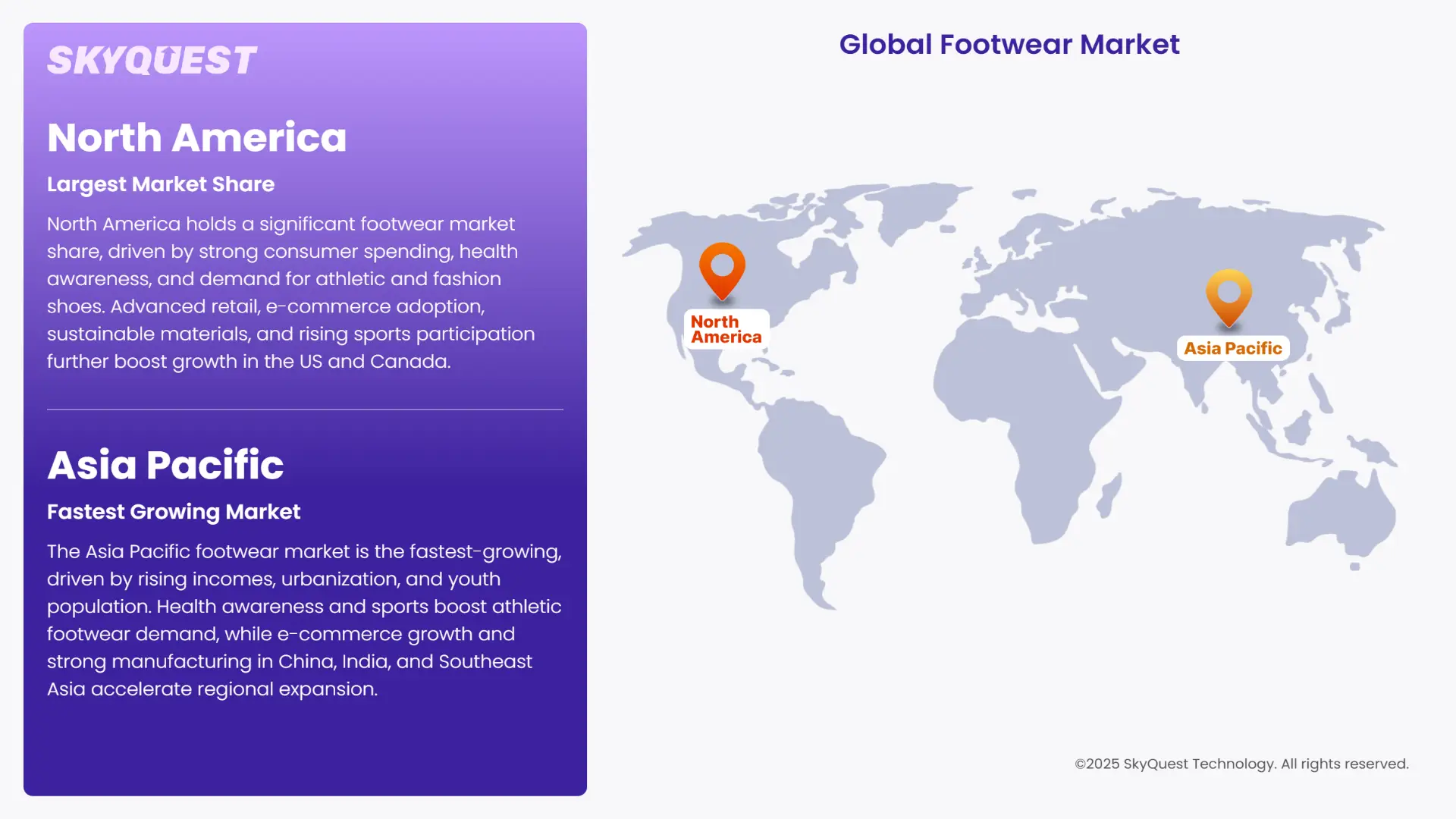
As per the global footwear market analysis, North America holds a significant share in the industry, driven by strong consumer spending, rising health awareness, and a growing demand for both athletic and fashion footwear. The region benefits from advanced retail infrastructure, widespread adoption of e-commerce, and innovation in sustainable materials. The presence of major brands investing in R&D and marketing further boosts market growth. Additionally, increasing participation in sports and fitness activities fuels demand for performance-oriented footwear across the US and Canada.
US Footwear Market
The United States is the largest contributor to North America’s footwear market share, driven by high consumer purchasing power and a strong culture of fitness and fashion. Major footwear brands and retailers are headquartered here, fostering innovation and marketing reach. The country’s diverse consumer base demands a wide variety of footwear styles, from athletic to luxury. Growing e-commerce and sustainability trends also boost market growth significantly.
Canada Footwear Market
Canada contributes steadily to North America’s footwear market growth, supported by rising health awareness and increasing participation in sports and outdoor activities. Canadian consumers value comfort, quality, and eco-friendly materials, influencing brand offerings. The country’s expanding urban population and retail modernization, including digital sales channels, enhance market accessibility. Seasonal demand fluctuations and cross-border trade with the US also impact Canada’s footwear market dynamics.
The Asia Pacific region is the fastest-growing market in the global footwear market share, fueled by rising disposable incomes, urbanization, and a young population. Increasing health awareness and sports participation drive demand for athletic footwear, while rapid e-commerce growth expands market reach. Countries like China, India, and Southeast Asia lead innovations in affordable, stylish, and sustainable footwear. Strong manufacturing capabilities and expanding retail infrastructure further accelerate regional market expansion.
Japan Footwear Market
Japan contributes significantly to the Asia Pacific’s footwear market demand through its emphasis on innovation, quality, and comfort. Japanese consumers favor technologically advanced shoes, including ergonomic and performance-enhancing footwear. The country’s strong domestic brands blend traditional craftsmanship with modern design. Rising health consciousness and an aging population increase demand for orthopedic and casual footwear. Japan’s well-developed retail and e-commerce sectors further support market growth and global export opportunities.
South Korea Footwear Market
South Korea plays an important role in the Asia Pacific’s footwear market growth, driven by fashion-forward trends and rapid adoption of athleisure styles. Korean consumers prioritize trendy, comfortable, and multifunctional footwear, influenced by K-pop and street fashion culture. The country’s tech-savvy population accelerates online sales, while local brands emphasize sustainability and innovation. South Korea’s growing interest in fitness activities also boosts demand for athletic shoes, enhancing its regional and global market presence.
Europe is a key region in the footwear market, driven by strong fashion consciousness and a preference for high-quality, sustainable products. Countries like Germany, Italy, and the UK lead in innovation and luxury footwear production. Growing urbanization, increased sports participation, and rising disposable incomes boost demand for both athletic and casual footwear. Additionally, the rise of e-commerce and eco-friendly materials accelerates market expansion across European countries.
Germany Footwear Market
Germany is a major player in the Europe’s footwear market share, known for its engineering precision and focus on high-quality, durable footwear. The country emphasizes functional and orthopedic shoes alongside fashion footwear. Strong retail networks, rising sports participation, and sustainability trends drive demand. Germany also serves as a hub for innovative materials and manufacturing technologies, supporting both domestic consumption and exports to other European markets.
France Footwear Market
France significantly influences the Europe’s footwear market growth through its luxury and fashion footwear segments. Paris, a global fashion capital, drives demand for stylish, high-end shoes and collaborations with renowned designers. French consumers prioritize quality, craftsmanship, and trendsetting styles. The growing athleisure trend and eco-conscious purchasing behavior are expanding the market, while strong domestic brands and robust retail infrastructure sustain France’s leading role in regional outlook.
UK Footwear Market
The UK contributes substantially to Europe’s footwear market demand with a focus on both fashion-forward and athletic footwear. British consumers are drawn to innovative designs, comfort, and sustainability, boosting demand for eco-friendly products. The UK’s diverse population drives varied footwear needs, supported by widespread e-commerce adoption. Additionally, sports participation and casual wear trends fuel growth, while local brands and international retailers maintain a strong market presence.
To know more about the market opportunities by region and country, click here to
Buy The Complete Report
Rising Health and Fitness Awareness
Growth of E-commerce Platforms
Counterfeit and Imitation Products
Supply Chain Disruptions
Request Free Customization of this report to help us to meet your business objectives.
The global footwear market outlook is highly competitive, dominated by international companies like Nike, Adidas, Puma, and Skechers. These brands focus on innovation, sustainability, and digital transformation to maintain market leadership. Nike emphasizes personalized products using AI, while Adidas invests heavily in eco-friendly materials. Puma leverages celebrity endorsements and collaborations, and Skechers targets comfort-driven designs. Continuous product innovation, strong branding, and expanding e-commerce presence are key strategies shaping the competitive landscape.
As per the global footwear industry analysis, the startup ecosystem is rapidly evolving, driven by innovations in sustainability, technology, and customization. Startups focus on eco-friendly materials, digital design, and on-demand manufacturing, challenging traditional methods. Their agility allows quick adaptation to consumer preferences for ethical and personalized products. This dynamic environment encourages established players to innovate, accelerating industry-wide shifts toward greener, tech-enabled footwear solutions, ultimately transforming the global market landscape.
Sustainability Driving Consumer Choices
Rise of Customization and Smart Footwear
SkyQuest’s ABIRAW (Advanced Business Intelligence, Research & Analysis Wing) is our Business Information Services team that Collects, Collates, Correlates, and Analyses the Data collected by means of Primary Exploratory Research backed by robust Secondary Desk research.
As per SkyQuest analysis, the global footwear industry is dynamically shaped by rising health consciousness, evolving fashion trends, and cutting-edge AI innovations. Increasing participation in fitness activities fuels demand for performance-oriented, comfortable shoes, while athleisure styles merge function with fashion. AI-driven personalization and supply chain efficiencies revolutionized design and production, enhancing customer satisfaction and sustainability.
Regional markets like North America, Asia-Pacific, and Europe reflect diverse consumer preferences, with strong growth in emerging economies and mature markets alike. Sustainability and technological advancements remain central to competitive strategies, driving both established brands and startups. Overall, the global footwear market share continues to expand through innovation, consumer-centric customization, and eco-conscious efforts, ensuring robust growth and adaptation to changing global lifestyles and values.
| Report Metric | Details |
|---|---|
| Market size value in 2024 | USD 420.54 Billion |
| Market size value in 2033 | USD 593.39 Billion |
| Growth Rate | 3.9% |
| Base year | 2024 |
| Forecast period | 2026–2033 |
| Forecast Unit (Value) | USD Billion |
| Segments covered |
|
| Regions covered | North America (US, Canada), Europe (Germany, France, United Kingdom, Italy, Spain, Rest of Europe), Asia Pacific (China, India, Japan, Rest of Asia-Pacific), Latin America (Brazil, Rest of Latin America), Middle East & Africa (South Africa, GCC Countries, Rest of MEA) |
| Companies covered | |
| Customization scope | Free report customization with purchase. Customization includes:-
|
To get a free trial access to our platform which is a one stop solution for all your data requirements for quicker decision making. This platform allows you to compare markets, competitors who are prominent in the market, and mega trends that are influencing the dynamics in the market. Also, get access to detailed SkyQuest exclusive matrix.
Table Of Content
Executive Summary
Market overview
Parent Market Analysis
Market overview
Market size
KEY MARKET INSIGHTS
COVID IMPACT
MARKET DYNAMICS & OUTLOOK
Market Size by Region
KEY COMPANY PROFILES
Methodology
For the Footwear Market, our research methodology involved a mixture of primary and secondary data sources. Key steps involved in the research process are listed below:
1. Information Procurement: This stage involved the procurement of Market data or related information via primary and secondary sources. The various secondary sources used included various company websites, annual reports, trade databases, and paid databases such as Hoover's, Bloomberg Business, Factiva, and Avention. Our team did 45 primary interactions Globally which included several stakeholders such as manufacturers, customers, key opinion leaders, etc. Overall, information procurement was one of the most extensive stages in our research process.
2. Information Analysis: This step involved triangulation of data through bottom-up and top-down approaches to estimate and validate the total size and future estimate of the Footwear Market.
3. Report Formulation: The final step entailed the placement of data points in appropriate Market spaces in an attempt to deduce viable conclusions.
4. Validation & Publishing: Validation is the most important step in the process. Validation & re-validation via an intricately designed process helped us finalize data points to be used for final calculations. The final Market estimates and forecasts were then aligned and sent to our panel of industry experts for validation of data. Once the validation was done the report was sent to our Quality Assurance team to ensure adherence to style guides, consistency & design.
Analyst Support
Customization Options
With the given market data, our dedicated team of analysts can offer you the following customization options are available for the Footwear Market:
Product Analysis: Product matrix, which offers a detailed comparison of the product portfolio of companies.
Regional Analysis: Further analysis of the Footwear Market for additional countries.
Competitive Analysis: Detailed analysis and profiling of additional Market players & comparative analysis of competitive products.
Go to Market Strategy: Find the high-growth channels to invest your marketing efforts and increase your customer base.
Innovation Mapping: Identify racial solutions and innovation, connected to deep ecosystems of innovators, start-ups, academics, and strategic partners.
Category Intelligence: Customized intelligence that is relevant to their supply Markets will enable them to make smarter sourcing decisions and improve their category management.
Public Company Transcript Analysis: To improve the investment performance by generating new alpha and making better-informed decisions.
Social Media Listening: To analyze the conversations and trends happening not just around your brand, but around your industry as a whole, and use those insights to make better Marketing decisions.
REQUEST FOR SAMPLE
 REQUEST FREE CUSTOMIZATION
A shift in fashion preference, namely the blend of athleisure and streetwear, is affecting the demand for functional fashionable footwear. The trend cycles happen so fast that young consumers typically purchase multiples of a versatile style.
E-commerce is transforming footwear retail by providing greater flexibility, selection, variety, and a global consumer reach. E-commerce allows brands to create personalized consumer experiences, manage inventory successfully and fulfill consumer demand quickly and respond to market shift trends in real time.
The fastest growing category is athletic footwear with growing global awareness of fitness and participation in sports and athleisure influenced style. New materials and design concepts, beyond, performance and fashion has gained appeal among consumers looking for value and quality.
Footwear brands seem to be utilizing more sustainable processes and utilizing recycled and biodegradable materials. Eco-friendly designs like Allbirds and Rothy’s are fostering innovation while attracting eco-conscious consumers to explore greener product alternatives.
The biggest challenges include counterfeits ruining brand trust, along with global supply chain interruptions, which causes increased costs and delays, creating inventory levels that restrict momentum and profitability of market growth.
Economic variables are affecting consumer spending on footwear as increases of inflation and disposable income will definitely influence consumer purchasing power. Higher levels of disposable income will have an impact on high demand for premium products and fashion forward footwear. Conversely consumer perceptions about risk related to inflation may shift their focus to affordability and better value.
Global Footwear Market size was valued at USD 420.54 Billion in 2024 poised to grow from USD 436.94 Billion in 2025 to USD 593.39 Billion by 2033, growing at a CAGR of 3.9% in the forecast period (2026–2033).
Nike (USA), Adidas (Germany), Puma (Germany), Skechers (USA), New Balance (USA), Under Armour (USA), Asics (Japan), Reebok (USA), Vans (USA), Clarks (United Kingdom), Bata (Switzerland), Salomon (France), Mizuno (Japan), Li-Ning (China), Anta Sports (China)
The key driver of the footwear market is the increasing demand for stylish, comfortable, and functional footwear, fueled by rising disposable incomes, growing fashion consciousness, active lifestyles, and the expansion of retail and e-commerce channels globally.
A key market trend in the footwear market is the growing popularity of sustainable and eco-friendly footwear, including products made from recycled materials, vegan alternatives, and innovative manufacturing processes, driven by consumer demand for environmentally responsible and ethically produced shoes.
North America accounted for the largest share in the Footwear Market due to high consumer spending on athletic, casual, and premium footwear, strong brand presence, and growing fashion consciousness. The region’s well-established retail infrastructure, increasing demand for performance footwear, and rising adoption of e-commerce channels further support market dominance.


Want to customize this report? This report can be personalized according to your needs. Our analysts and industry experts will work directly with you to understand your requirements and provide you with customized data in a short amount of time. We offer $1000 worth of FREE customization at the time of purchase.
Feedback From Our Clients


 USA (+1) 351-333-4748

