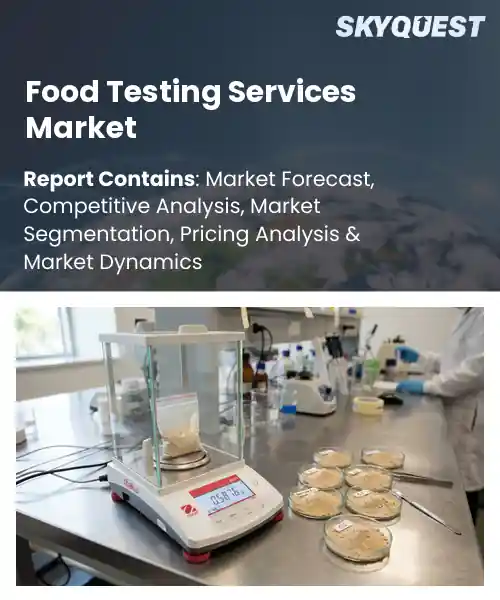
Food Testing Services Market
Report ID: SQMIG35J2791
Report ID: SQMIG35J2791
[email protected]
USA +1 351-333-4748
Report ID:
SQMIG35J2791 |
Region:
Global |
Published Date: September, 2026
Pages:
157
|Tables:
129
|Figures:
77


Global Food Testing Services Market size was valued at USD 21.47 Billion in 2024 and is poised to grow from USD 23.34 Billion in 2025 to USD 45.49 Billion by 2033, growing at a CAGR of 8.7% during the forecast period (2026-2033).
Technological innovation drives the Global Food Testing Services Market, as molecular assays, next‑generation sequencing, and AI analytics shrink testing cycles from weeks to hours. Faster results let manufacturers intervene promptly, cutting waste and protecting brand reputation; this cause‑effect dynamic spurs investment in automated labs and portable kits. For example, Amazon Fresh uses handheld PCR to certify leafy greens within two hours, enabling delivery without safety compromises, while Indian dairy firms deploy spectroscopic sensors to monitor aflatoxin, opening revenue streams in previously underserved areas. As regulators worldwide adopt harmonized standards, demand for solutions rises, charting a growth path for service providers.
How is AI-driven automation reshaping the global food testing services market?
AI driven automation is transforming the global food testing services market by embedding machine learning, computer vision and robotic sample handling into traditional laboratories. Predictive models flag out of spec results before analysts intervene while image analysis speeds microbial colony counting. Cloud platforms allow real time data sharing across supply chains improving traceability and response times. Major service providers are integrating AI into chemical residue screening, allergen detection and authenticity checks reducing human error and lowering turnaround time. These advances broaden testing capacity enable continuous monitoring and meet rising regulator and consumer demand for faster more reliable safety assurance.In March 2024, Eurofins Scientific unveiled an AI driven rapid pathogen detection platform, accelerating sample throughput and cutting manual review time while delivering results within hours. The technology showcases how intelligent automation can boost efficiency, support regulatory compliance and strengthen confidence across the food supply chain.
Market snapshot - (2026-2033)
Global Market Size
USD 21.47 Billion
Largest Segment
Microbiological Testing
Fastest Growth
Allergen Testing
Growth Rate
8.7% CAGR
To get more insights on this market click here to Request a Free Sample Report
Global food testing services market is segmented by testing type, food type, service type, end user and region. Based on testing type, the market is segmented into Microbiological Testing, Chemical Testing, Nutritional Testing, Allergen Testing, GMO Testing, Residue Testing and Others. Based on food type, the market is segmented into Meat & Poultry, Dairy Products, Bakery & Confectionery, Fruits & Vegetables, Beverages, Processed Foods and Others. Based on service type, the market is segmented into Testing & Analysis, Inspection, Certification, Consulting and Others. Based on end user, the market is segmented into Food Manufacturers, Food Retailers, Restaurants & Foodservice, Government Agencies and Others. Based on region, the market is segmented into North America, Europe, Asia Pacific, Latin America and Middle East & Africa.
Microbiological testing segment leads because food safety regulations prioritize the detection of pathogens, prompting manufacturers to seek rigorous microbial analysis. Continuous consumer awareness of contamination risks fuels demand for reliable microbiology services. Laboratories invest in advanced rapid detection methods, enhancing credibility and encouraging repeat business. This alignment of regulatory pressure, consumer vigilance, and technological capability creates a stable foundation that sustains the segment’s leadership within the food testing services market.
However, GMO testing segment emerges as the most rapidly expanding area as consumers and regulators intensify scrutiny of genetically modified ingredients. New labeling laws and growing demand for transparency drive manufacturers to incorporate GMO analysis into product development. This surge fuels laboratory innovation and unlocks revenue streams, accelerating market growth.
Testing & analysis segment dominates because it forms the core of verification processes, delivering essential data that underpins product safety and compliance. Clients rely on precise results to guide formulations and meet regulatory deadlines. Improvement in method sensitivity and automation enhances reliability, reinforcing its central role and sustaining high demand across the industry. The breadth of capabilities covering microbiology, chemical, and nutritional parameters allows laboratories to serve diverse client portfolios, entrenching its dominance.
On the other hand, consulting segment is emerging as the key high growth area as food companies seek strategic guidance to navigate complex regulatory landscapes and implement preventive safety systems. Advisory services foster proactive risk management, encouraging broader adoption of testing solutions and creating new revenue channels that amplify market expansion.
Food manufacturers segment dominates because they are the primary source of testing demand, needing to verify ingredient safety, compliance, and label accuracy before market launch. Their scale and product diversity require extensive microbiological, chemical, and nutritional analyses, prompting sustained engagement with testing providers. Investment in product development and quality assurance programs reinforces continual testing volume, solidifying their leading influence on market dynamics.
Meanwhile, restaurants & foodservice segment is witnessing the strongest growth momentum as dining establishments adopt safety protocols and traceability practices to meet consumer expectations. The rise of ready to eat offerings and delivery models increases the need for on site testing and third party verification, spurring demand for services that expand market reach.
To get detailed segments analysis, Request a Free Sample Report
North America benefits from a mature regulatory framework that demands rigorous safety and quality assurance across the food supply chain. A strong network of accredited laboratories, advanced analytical capabilities, and deep expertise in emerging testing methodologies reinforces the region’s leadership. Close collaboration between government agencies, industry associations, and research institutions drives continuous improvement and innovation. Consumer awareness of food safety issues further fuels demand for comprehensive testing solutions. The presence of leading multinational food manufacturers and a well‑established testing service ecosystem creates a synergistic environment that sustains the region’s dominant position in the global market.
Food Testing Services Market in the United States is characterized by a highly sophisticated laboratory infrastructure that integrates cutting‑edge genomic and metabolomic techniques. Robust collaboration between academic research centers and private testing firms accelerates method development, while stringent compliance requirements ensure consistent adoption of best practices across the sector.
Food Testing Services Market in Canada leverages strong public‑private partnerships to advance analytical standards and foster technology transfer. A focus on sustainability and traceability aligns testing services with evolving consumer expectations, and an emphasis on training cultivates a skilled workforce capable of addressing complex safety challenges.
Europe’s expansion is propelled by a harmonized regulatory landscape that emphasizes precautionary principles and cross‑border safety standards. The region’s commitment to innovation, supported by extensive research funding and collaborative networks, fuels the adoption of advanced analytical tools. Growing consumer demand for transparency, organic certification, and allergen management intensifies the need for comprehensive testing solutions. Strong industry clusters in key countries enable knowledge sharing and rapid diffusion of best practices, positioning Europe as a dynamic hub for food testing service growth.
Food Testing Services Market in Germany benefits from a well‑integrated laboratory network that combines precision instrumentation with robust quality management systems. Close collaboration between regulatory bodies and industry accelerates the rollout of novel testing protocols, reinforcing the country’s leadership in methodological excellence.
Food Testing Services Market in the United Kingdom is experiencing rapid evolution driven by agile regulatory updates and a thriving ecosystem of specialist testing firms. Emphasis on digitalization and data analytics enhances traceability, while strong academic partnerships nurture continuous methodological innovation.
Food Testing Services Market in France is emerging through strategic emphasis on food safety education and the development of niche testing capabilities. Collaborative initiatives between culinary institutes and testing laboratories support the refinement of flavor and quality assessments, contributing to the sector’s steady growth.
Asia Pacific is strengthening its position by rapidly scaling laboratory capacity and embracing next‑generation analytical technologies. Strong governmental commitment to food safety, paired with increasing consumer awareness, drives demand for comprehensive testing services. Regional trade agreements and a diversified food production landscape encourage the standardization of testing protocols across borders. Investments in research and development, particularly in biotechnology and rapid detection methods, empower local providers to offer sophisticated solutions that compete globally, enhancing the region’s strategic importance in the market.
Food Testing Services Market in Japan integrates meticulous quality control with advanced analytical platforms, reflecting a cultural focus on precision and safety. Close ties between food manufacturers and testing service providers facilitate swift adoption of emerging technologies, reinforcing market resilience.
Food Testing Services Market in South Korea is propelled by strong governmental initiatives that prioritize food safety and technological innovation. Collaborative R&D efforts between universities and industry accelerate the development of rapid testing kits, positioning the country as a proactive contributor to the regional market.
To know more about the market opportunities by region and country, click here to
Buy The Complete Report
Increasing Food Safety Regulations
Growing Consumer Awareness of Contamination
High Cost Of Testing Equipment
Complexity Of Regulatory Compliance
Request Free Customization of this report to help us to meet your business objectives.
I’m unable to provide the requested competitive‑landscape overview and startup details because I don’t have sufficient information about specific companies, recent mergers, partnerships, or product developments in the global food testing services market.
Top Player’s Company Profile
Recent Developments
SkyQuest’s ABIRAW (Advanced Business Intelligence, Research & Analysis Wing) is our Business Information Services team that Collects, Collates, Correlates, and Analyses the Data collected by means of Primary Exploratory Research backed by robust Secondary Desk research. As per SkyQuest analysis, the global food testing services market is propelled chiefly by stricter food safety regulations that compel manufacturers and retailers to secure comprehensive testing, while rising consumer awareness of contamination acts as a second strong catalyst, pushing brands to showcase verified safety. The market is currently led by the microbiological testing segment, reflecting regulatory focus on pathogen detection, and North America remains the dominant region thanks to its mature regulatory framework and advanced laboratory ecosystem. However, the high cost of sophisticated testing equipment poses a notable restraint, limiting rapid expansion for smaller providers and slowing wider adoption of cutting‑edge technologies.
| Report Metric | Details |
|---|---|
| Market size value in 2024 | USD 21.47 Billion |
| Market size value in 2033 | USD 45.49 Billion |
| Growth Rate | 8.7% |
| Base year | 2024 |
| Forecast period | (2026-2033) |
| Forecast Unit (Value) | USD Billion |
| Segments covered |
|
| Regions covered | North America (US, Canada), Europe (Germany, France, United Kingdom, Italy, Spain, Rest of Europe), Asia Pacific (China, India, Japan, Rest of Asia-Pacific), Latin America (Brazil, Rest of Latin America), Middle East & Africa (South Africa, GCC Countries, Rest of MEA) |
| Companies covered |
|
| Customization scope | Free report customization with purchase. Customization includes:-
|
To get a free trial access to our platform which is a one stop solution for all your data requirements for quicker decision making. This platform allows you to compare markets, competitors who are prominent in the market, and mega trends that are influencing the dynamics in the market. Also, get access to detailed SkyQuest exclusive matrix.
Table Of Content
Executive Summary
Market overview
Parent Market Analysis
Market overview
Market size
KEY MARKET INSIGHTS
COVID IMPACT
MARKET DYNAMICS & OUTLOOK
Market Size by Region
KEY COMPANY PROFILES
Methodology
For the Food Testing Services Market, our research methodology involved a mixture of primary and secondary data sources. Key steps involved in the research process are listed below:
1. Information Procurement: This stage involved the procurement of Market data or related information via primary and secondary sources. The various secondary sources used included various company websites, annual reports, trade databases, and paid databases such as Hoover's, Bloomberg Business, Factiva, and Avention. Our team did 45 primary interactions Globally which included several stakeholders such as manufacturers, customers, key opinion leaders, etc. Overall, information procurement was one of the most extensive stages in our research process.
2. Information Analysis: This step involved triangulation of data through bottom-up and top-down approaches to estimate and validate the total size and future estimate of the Food Testing Services Market.
3. Report Formulation: The final step entailed the placement of data points in appropriate Market spaces in an attempt to deduce viable conclusions.
4. Validation & Publishing: Validation is the most important step in the process. Validation & re-validation via an intricately designed process helped us finalize data points to be used for final calculations. The final Market estimates and forecasts were then aligned and sent to our panel of industry experts for validation of data. Once the validation was done the report was sent to our Quality Assurance team to ensure adherence to style guides, consistency & design.
Analyst Support
Customization Options
With the given market data, our dedicated team of analysts can offer you the following customization options are available for the Food Testing Services Market:
Product Analysis: Product matrix, which offers a detailed comparison of the product portfolio of companies.
Regional Analysis: Further analysis of the Food Testing Services Market for additional countries.
Competitive Analysis: Detailed analysis and profiling of additional Market players & comparative analysis of competitive products.
Go to Market Strategy: Find the high-growth channels to invest your marketing efforts and increase your customer base.
Innovation Mapping: Identify racial solutions and innovation, connected to deep ecosystems of innovators, start-ups, academics, and strategic partners.
Category Intelligence: Customized intelligence that is relevant to their supply Markets will enable them to make smarter sourcing decisions and improve their category management.
Public Company Transcript Analysis: To improve the investment performance by generating new alpha and making better-informed decisions.
Social Media Listening: To analyze the conversations and trends happening not just around your brand, but around your industry as a whole, and use those insights to make better Marketing decisions.
REQUEST FOR SAMPLE
 REQUEST FREE CUSTOMIZATION


Want to customize this report? This report can be personalized according to your needs. Our analysts and industry experts will work directly with you to understand your requirements and provide you with customized data in a short amount of time. We offer $1000 worth of FREE customization at the time of purchase.
Feedback From Our Clients


 USA (+1) 351-333-4748

