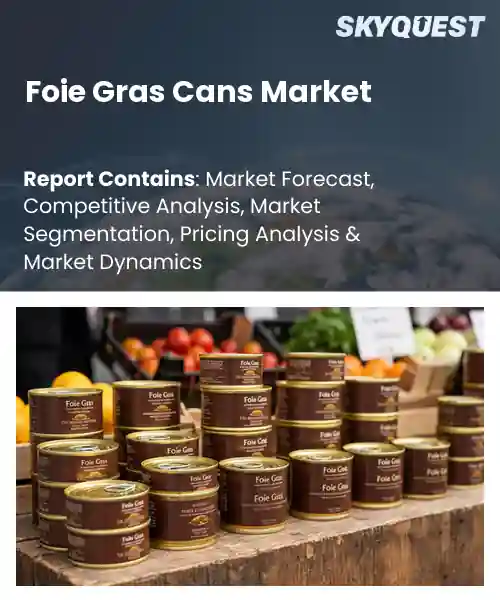
Foie Gras Cans Market
Report ID: SQMIG15G2196
Report ID: SQMIG15G2196
[email protected]
USA +1 351-333-4748
Report ID:
SQMIG15G2196 |
Region:
Global |
Published Date: July, 2026
Pages:
157
|Tables:
173
|Figures:
79


Global Foie Gras Cans Market size was valued at USD 624.3 Million in 2024 and is poised to grow from USD 682.36 Million in 2025 to USD 1389.88 Million by 2033, growing at a CAGR of 9.3% during the forecast period (2026-2033).
The foie gras cans industry includes liver pâté that is ready-to-eat and packed in sealed cans for consumers and food-service operators. Its significance is in combining gourmet heritage with convenience, enabling retailers to market a shelf-stable product without refrigeration. This path is driven by a major trend of increasing consumer willingness to pay a premium for experiential food that can be stored and served quickly, which is driving significant capacity expansion across Europe and North America.
The growth in the tourism industry is a major driver of demand for the foie gras cans market, which is increasing the preference for gourmet experiences in hotels, cruise lines, and airline lounges. Now travellers can purchase canned versions of French delicacies – same flavour but easier to store than fresh terrine. Orders from hospitality chains are increasing and manufacturers are investing in sophisticated can-lining technology that maintains texture. Better quality means retail outlets in duty-free outlets and upscale grocery stores where consumers buy cans as souvenirs or ready-to-serve appetizers. Thus, the link between tourism and procurement and technological upgrades creates a positive feedback loop of expanding market reach.
How is AI-driven Automation Reshaping Production Efficiency in the Foie Gras Canned Market?
AI-driven automation is changing the way foie gras cans are made, connecting sensor data, machine learning and robotic handling. The technology monitors liver quality and predicts ideal cooking times, and can change filling speed in real time, minimizing waste and achieving uniform texture. Vision systems sort foie gras blocks on production lines and predictive maintenance alerts prevent unexpected downtime. These capabilities allow manufacturers to scale output without compromising the delicate flavor profile that is the product’s defining characteristic. As consumers want more premium ready to eat products, firms that put AI into their canning process have a clear efficiency advantage.
Changhao Biotechnology in June 2026, launched an AI controlled can filling line with automatic temperature and pressure calibration for each batch to shorten changeover cycles and improve product consistency to support faster market expansion.
Market snapshot - (2026-2033)
Global Market Size
USD 624.3 Million
Largest Segment
Corner Cube Retroreflector Arrays
Fastest Growth
Others
Growth Rate
9.3% CAGR
To get more insights on this market click here to Request a Free Sample Report
The global foie gras cans market is segmented by product type, foie gras type, distribution channel, end user, packaging size, and region. Based on product type, the market is segmented into Whole Foie Gras, Foie Gras Block, Foie Gras Mousse, Foie Gras Pâté, and Others. Based on foie gras type, the market is segmented into Duck Foie Gras and Goose Foie Gras. Based on distribution channel, the market is segmented into Supermarkets & Hypermarkets, Specialty Stores, Online Retail, Foodservice Distributors, and Others. Based on end user, the market is segmented into Households, Restaurants, Hotels, Catering Services, and Others. Based on packaging size, the market is segmented into Small Cans, Medium Cans, and Large Cans. Based on region, the market is segmented into North America, Europe, Asia Pacific, Latin America, and the Middle East & Africa.
Why Does Whole Foie Gras Dominate the Global Foie Gras Cans Market?
Whole foie gras segment dominates with global foie gras cans market share because it is regarded as the highest-quality and most premium form of foie gras, offering superior texture, authentic flavor, and minimal processing. It is widely preferred by luxury restaurants, gourmet retailers, and high-income consumers seeking premium culinary experiences. Strong demand during festive seasons and fine dining occasions further strengthens its leading market position.
The foie gras mousse segment is witnessing the fastest growth due to rising consumer demand for convenient, ready-to-eat gourmet spreads. Its smooth texture, affordability compared to whole foie gras, and versatility in appetizers and snacks make it increasingly popular among younger consumers and households, while expanding retail availability further supports market growth.
Why Does Duck Foie Gras Dominate the Market?
Duck foie gras segment holds the largest market share because duck foie gras is more widely produced, cost-effective, and readily available than goose foie gras. It offers a rich flavor while maintaining competitive pricing, making it the preferred choice for both foodservice establishments and retail consumers across major markets.
Goose foie gras segment is expected to witness the fastest growth as demand for ultra-premium gourmet products increases among luxury consumers. Its delicate taste and exclusivity appeal to high-end restaurants and specialty food retailers, particularly in premium hospitality and fine dining markets.
To get detailed segments analysis, Request a Free Sample Report
Europe maintains leadership in the foie gras cans market because of deep‑rooted culinary heritage that embraces foie gras as a benchmark of gourmet expression. Consumers across the continent appreciate premium preserved products that combine convenience with authentic taste, driving consistent demand in upscale retail and hospitality channels. Production capabilities are anchored in centuries‑old processing expertise, modernized to meet stringent food‑safety standards while preserving the delicate texture of the pâté. Strong distribution networks connect artisanal producers with high‑end supermarkets, specialty shops, and luxury hotels, ensuring rapid shelf availability. Moreover, a collaborative regulatory framework encourages innovation in sustainable sourcing and packaging, reinforcing Europe’s reputation as a benchmark for quality and ethical stewardship in the segment.
As per foie gras cans market regional outlook, Germany reflects a sophisticated consumer base that values refined convenience foods. Retail corridors in major cities showcase premium canned offerings alongside traditional charcuterie, while high‑end hotels integrate the product into contemporary menus. Local producers leverage advanced canning technology to preserve flavor integrity, aligning with stringent quality expectations. Culinary schools and gastronomy events further embed the product within the nation’s modern gastronomy narrative.
As per foie gras cans market regional forecast, United Kingdom benefits from a vibrant fine‑dining scene that seeks dependable premium ingredients for tasting menus. Upscale supermarket chains allocate dedicated shelf space, and boutique retailers highlight artisanal canned selections. British food innovators focus on refined flavor profiles and elegant presentation, catering to discerning palates. Collaborative efforts between producers and culinary institutes foster continual product refinement, reinforcing the market’s relevance across both traditional and contemporary British cuisine.
France builds upon a historic reverence for foie gras as a culinary icon. Premium canned variants provide chefs with a convenient, high‑quality alternative that preserves the traditional richness of the delicacy. French gourmet retailers and specialty delis prominently feature the product, while luxury hotels incorporate it into classic and modern dishes. Ongoing research into sustainable duck and goose sourcing strengthens the sector’s alignment with evolving consumer expectations.
North America experiences swift expansion of the market driven by a convergence of lifestyle evolution, culinary curiosity, and premiumization of convenience foods. Consumers increasingly seek high‑quality gourmet experiences that fit busy schedules, prompting retailers to broaden premium canned assortments. Food‑service operators adopt the product to enhance menu innovation, while specialty distributors emphasize traceable sourcing and ethical production. Collaborative efforts among chefs, retailers, and producers foster product adaptations that reflect regional taste preferences, reinforcing the market’s appeal across both mainstream and niche channels. Strong branding around artisanal heritage and sustainable practices further amplifies consumer confidence, positioning the segment for sustained momentum throughout the continent.
United States thrives on a dynamic food culture that embraces experimental gastronomy and upscale convenience. Premium grocery chains dedicate prominent shelf space, and high‑end restaurants integrate the canned offering into inventive plating concepts. Domestic producers emphasize meticulous canning processes that capture the delicate essence of foie gras, aligning with discerning consumer expectations. Cross‑industry collaborations with culinary schools and hospitality groups drive continuous refinement, ensuring the product remains a favored component of modern American fine dining.
Canada reflects a growing appetite for refined, ready‑to‑serve delicacies among discerning diners. Boutique food retailers and upscale supermarket aisles showcase curated selections, while luxury hotels incorporate the product into seasonal menus. Canadian producers focus on sustainable sourcing and precision in canning to uphold the high sensory standards demanded by the market. Partnerships with culinary institutes foster knowledge exchange, enhancing product quality and reinforcing the market’s reputation for excellence across the nation.
Asia Pacific is strengthening its foothold in the market through strategic adoption of premium culinary trends and targeted expansion of gourmet retail channels. Consumers in the region exhibit heightened interest in international delicacies, prompting retailers to allocate premium shelf space for high‑quality canned offerings. Food‑service establishments, ranging from upscale hotels to specialty bistros, incorporate the product to differentiate menu narratives, while local producers invest in advanced canning technology to ensure authentic flavor preservation. Collaborative initiatives with culinary schools and gastronomic festivals elevate awareness and skill development, positioning the region as an emerging hub for refined convenience gastronomy. Emphasis on sustainable sourcing and refined packaging further aligns the market with evolving consumer expectations for ethical premium products.
Japan benefits from a sophisticated palate that values meticulous craftsmanship and subtle flavor balance. High‑end department store food halls and specialty gourmet boutiques prominently feature the product, while luxury ryokan and Michelin‑starred establishments integrate it into refined tasting menus. Japanese producers adopt precision canning techniques that honor the delicate texture of foie gras, resonating with expectations for immaculate quality. Collaborative culinary workshops with master chefs reinforce product credibility and drive continued enthusiasm within the market.
South Korea thrives amid a vibrant fusion of traditional and contemporary dining experiences. Upscale hypermarkets allocate dedicated sections for premium canned delicacies, and trendy gastropubs incorporate the product into innovative small‑plate offerings. Korean manufacturers emphasize controlled canning processes that safeguard the nuanced richness of foie gras, meeting the exacting standards of discerning consumers. Partnerships with culinary academies and food‑trend events amplify market visibility, nurturing a growing appreciation for the refined convenience that the product delivers.
To know more about the market opportunities by region and country, click here to
Buy The Complete Report
Increasing Gourmet Demand
Convenient Shelf‑Stable Packaging
Animal Welfare Regulatory Concerns
High Production Cost Constraints
Request Free Customization of this report to help us to meet your business objectives.
The competitive landscape of the global foie gras cans industry is shaped by rapid product innovation and strategic capital moves. Lab‑grown specialist Gourmey leveraged a $48 million Series A round to scale its cell‑culture technology for canned offerings, while legacy French producers are expanding their canned portfolios through acquisitions of boutique brands and joint‑venture agreements with cultivated‑meat firms, intensifying rivalry on price, quality and shelf‑life.
SkyQuest’s ABIRAW (Advanced Business Intelligence, Research & Analysis Wing) is our Business Information Services team that Collects, Collates, Correlates, and Analyses the Data collected by means of Primary Exploratory Research backed by robust Secondary Desk research.
As per SkyQuest analysis, the global foie gras cans market growth is being propelled primarily by rising gourmet demand, as consumers seek premium ready‑to‑eat delicacies, while convenient shelf‑stable packaging acts as a second strong driver by simplifying distribution and storage. However, animal‑welfare regulatory concerns pose a notable restraint, potentially limiting production volumes. Europe remains the dominating region due to its culinary heritage and robust supply chains, and the corner cube retroreflector arrays segment leads in technology adoption, offering reliable optical precision for inventory tracking and process integration and delivering attractive margins for manufacturers. The global foie gras cans market trend driven by increasing consumer demand for premium, shelf-stable gourmet foods that offer convenience without compromising quality.
| Report Metric | Details |
|---|---|
| Market size value in 2024 | USD 624.3 Million |
| Market size value in 2033 | USD 1389.88 Million |
| Growth Rate | 9.3% |
| Base year | 2024 |
| Forecast period | (2026-2033) |
| Forecast Unit (Value) | USD Million |
| Segments covered |
|
| Regions covered | North America (US, Canada), Europe (Germany, France, United Kingdom, Italy, Spain, Rest of Europe), Asia Pacific (China, India, Japan, Rest of Asia-Pacific), Latin America (Brazil, Rest of Latin America), Middle East & Africa (South Africa, GCC Countries, Rest of MEA) |
| Companies covered |
|
| Customization scope | Free report customization with purchase. Customization includes:-
|
To get a free trial access to our platform which is a one stop solution for all your data requirements for quicker decision making. This platform allows you to compare markets, competitors who are prominent in the market, and mega trends that are influencing the dynamics in the market. Also, get access to detailed SkyQuest exclusive matrix.
Table Of Content
Executive Summary
Market overview
Parent Market Analysis
Market overview
Market size
KEY MARKET INSIGHTS
COVID IMPACT
MARKET DYNAMICS & OUTLOOK
Market Size by Region
KEY COMPANY PROFILES
Methodology
For the Foie Gras Cans Market, our research methodology involved a mixture of primary and secondary data sources. Key steps involved in the research process are listed below:
1. Information Procurement: This stage involved the procurement of Market data or related information via primary and secondary sources. The various secondary sources used included various company websites, annual reports, trade databases, and paid databases such as Hoover's, Bloomberg Business, Factiva, and Avention. Our team did 45 primary interactions Globally which included several stakeholders such as manufacturers, customers, key opinion leaders, etc. Overall, information procurement was one of the most extensive stages in our research process.
2. Information Analysis: This step involved triangulation of data through bottom-up and top-down approaches to estimate and validate the total size and future estimate of the Foie Gras Cans Market.
3. Report Formulation: The final step entailed the placement of data points in appropriate Market spaces in an attempt to deduce viable conclusions.
4. Validation & Publishing: Validation is the most important step in the process. Validation & re-validation via an intricately designed process helped us finalize data points to be used for final calculations. The final Market estimates and forecasts were then aligned and sent to our panel of industry experts for validation of data. Once the validation was done the report was sent to our Quality Assurance team to ensure adherence to style guides, consistency & design.
Analyst Support
Customization Options
With the given market data, our dedicated team of analysts can offer you the following customization options are available for the Foie Gras Cans Market:
Product Analysis: Product matrix, which offers a detailed comparison of the product portfolio of companies.
Regional Analysis: Further analysis of the Foie Gras Cans Market for additional countries.
Competitive Analysis: Detailed analysis and profiling of additional Market players & comparative analysis of competitive products.
Go to Market Strategy: Find the high-growth channels to invest your marketing efforts and increase your customer base.
Innovation Mapping: Identify racial solutions and innovation, connected to deep ecosystems of innovators, start-ups, academics, and strategic partners.
Category Intelligence: Customized intelligence that is relevant to their supply Markets will enable them to make smarter sourcing decisions and improve their category management.
Public Company Transcript Analysis: To improve the investment performance by generating new alpha and making better-informed decisions.
Social Media Listening: To analyze the conversations and trends happening not just around your brand, but around your industry as a whole, and use those insights to make better Marketing decisions.
REQUEST FOR SAMPLE
 REQUEST FREE CUSTOMIZATION
Global Foie Gras Cans Market size was valued at USD 624.3 Million in 2024 and is poised to grow from USD 682.36 Million in 2025 to USD 1389.88 Million by 2033, growing at a CAGR of 9.3% during the forecast period (2026-2033).
The competitive landscape of the global Foie Gras Cans market is shaped by rapid product innovation and strategic capital moves. Lab‑grown specialist Gourmey leveraged a $48 million Series A round to scale its cell‑culture technology for canned offerings, while legacy French producers are expanding their canned portfolios through acquisitions of boutique brands and joint‑venture agreements with cultivated‑meat firms, intensifying rivalry on price, quality and shelf‑life. 'Exail SAS', 'Thales Alenia Space', 'Airbus Defence and Space', 'Lockheed Martin Corporation', 'Northrop Grumman Corporation', 'Teledyne Technologies Incorporated', 'L3Harris Technologies, Inc.', 'Honeywell International Inc.', 'Ball Aerospace & Technologies Corp.', 'Mitsubishi Electric Corporation', 'Canon Electronics Inc.', 'Japan Aerospace Exploration Agency Commercial Partners', 'Space Exploration Technologies Corp.', 'Blue Origin LLC', 'Rocket Lab USA, Inc.', 'Redwire Corporation', 'OHB SE', 'Beyond Gravity Holding AG', 'Leonardo S.p.A.', 'Sierra Space Corporation'
The rising appreciation for luxury culinary experiences drives consumers to seek premium products such as foie gras, and canned formats provide an accessible entry point. Retailers respond by expanding shelf space, while chefs incorporate the product into innovative menus, creating a feedback loop that fuels demand. This growing gourmet interest also encourages brands to invest in premium branding, reinforcing consumer perception of value and motivating repeat purchases across diverse market segments. The trend further strengthens brand loyalty as consumers associate the convenience of cans with high‑quality gastronomy experiences.
Premium Convenience Growth: The rising demand for ready‑to‑eat gourmet products is driving premium convenience consumption, and canned foie gras is positioned as a luxurious, shelf‑stable alternative to fresh offerings. Consumers seeking indulgence without extensive preparation appreciate the product’s ease of storage, long shelf life, and consistent quality. Retailers respond by expanding shelf space in upscale supermarkets and specialty food aisles, while chefs incorporate the canned format into fine‑dining menus, reinforcing the perception of convenience as a hallmark of premium modern today’s culinary experiences.
Why does Europe Dominate the Global Foie Gras Cans Market? |@12


Want to customize this report? This report can be personalized according to your needs. Our analysts and industry experts will work directly with you to understand your requirements and provide you with customized data in a short amount of time. We offer $1000 worth of FREE customization at the time of purchase.
Feedback From Our Clients


 USA (+1) 351-333-4748

