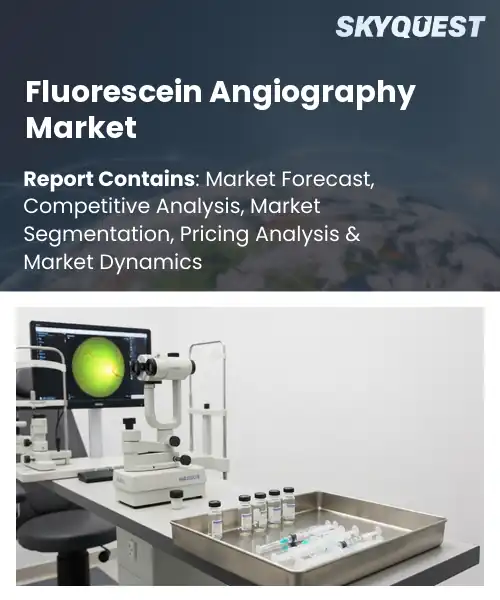
Fluorescein Angiography Market
Report ID: SQMIG35A3883
Report ID: SQMIG35A3883
[email protected]
USA +1 351-333-4748
Report ID:
SQMIG35A3883 |
Region:
Global |
Published Date: June, 2026
Pages:
157
|Tables:
127
|Figures:
77


Global Fluorescein Angiography Market size was valued at USD 869.8 Million in 2024 and is poised to grow from USD 943.56 Million in 2025 to USD 1809.53 Million by 2033, growing at a CAGR of 8.48% during the forecast period (2026-2033).
Fluorescein angiography refers to a diagnostic imaging procedure used to visualize retinal and choroidal vasculature after intravenous injection of sodium fluorescein, and the global market encompasses devices, contrast agents, imaging software, and service provision. Its significance stems from widespread prevalence of retinal diseases such as diabetic retinopathy and age‑related macular degeneration, which demand early detection to prevent vision loss. Over the last three decades the market evolved from film‑based cameras to high‑resolution digital fundus cameras and integrated OCT angiography hybrids, enabling faster workflows and richer datasets. Regulatory approvals, reimbursement policies, and rising clinical guidelines adoption remain primary drivers of demand.Building on regulatory and guideline momentum, technological innovation functions as key factor accelerating global fluorescein angiography market growth because improved sensors, software analytics, and hybrid imaging increase diagnostic yield.
As a result clinics replace legacy cameras with digital fundus systems capable of synchronized angiography and OCT, which shortens appointment times and supports higher patient throughput in diabetic screening programs. Pharmaceutical trials targeting retinal vascular disorders also drive demand for standardized imaging endpoints, prompting vendors to offer validated acquisition and analysis tools.
How is AI enhancing diagnostic accuracy in the fluorescein angiography market?
AI is improving diagnostic accuracy in fluorescein angiography by automating image interpretation and reducing subjective variability. Key aspects include automated detection of vascular leakage non perfusion and optic disc hyperfluorescence image enhancement and standardized scoring of inflammatory signs. The current state is a shift from manual grading to AI assisted workflows that speed reads and support clinical decisions. Market dynamics favor imaging platforms that embed analytics to improve throughput and enable larger clinical studies. For example research teams have developed deep learning frameworks such as UveAI that align automated scores with expert grading on widefield fluorescein angiography.
Heidelberg Engineering in May 2026, announced integration with RetinaAI to deliver automated analysis of fluorescein angiography images which improves lesion detection consistency and streamlines reporting to support wider clinical adoption and operational efficiency.
Market snapshot - (2026-2033)
Global Market Size
USD 869.8 Million
Largest Segment
Fundus Camera Systems (FA Imaging Systems)
Fastest Growth
Imaging Software
Growth Rate
8.48% CAGR
To get more insights on this market click here to Request a Free Sample Report
Global fluorescein angiography market is segmented by product type, procedure type, application, end user and region. Based on product type, the market is segmented into Fundus Camera Systems (FA Imaging Systems), Fluorescein Dye Kits, Imaging Software, Accessories & Consumables and Others. Based on procedure type, the market is segmented into Intravenous Fluorescein Angiography, Oral Fluorescein Angiography, Indocyanine Green Angiography (ICG-A) Assisted FA and Others. Based on application, the market is segmented into Diabetic Retinopathy, Age-related Macular Degeneration (AMD), Retinal Vein Occlusion, Retinal Artery Occlusion, Uveitis, Ocular Tumors and Others. Based on end user, the market is segmented into Hospitals, Ophthalmic Clinics, Ambulatory Surgical Centers, Diagnostic Imaging Centers, Research & Academic Institutes and Others. Based on region, the market is segmented into North America, Europe, Asia Pacific, Latin America and Middle East & Africa.
Imaging software segment dominates with large fluorescein angiography market share because sophisticated software platforms centralize image acquisition, processing and analysis, enabling clearer vascular visualization and automated leak detection that improve diagnostic confidence. Integration with imaging hardware and electronic medical records streamlines clinical workflows and supports teleophthalmology, driving clinician preference. Advanced analytics and AI driven pattern recognition translate into actionable insights, reducing interpretation variability and facilitating earlier intervention, which in turn sustains demand for software led fluorescein angiography solutions.
As per fluorescein angiography market outlook, fundus camera systems (FA imaging systems) are witnessing the strongest growth momentum as manufacturers introduce higher resolution, widefield and portable devices that expand clinical utility and enable point of care angiography. Clinician preference for integrated multimodal platforms and simpler bedside imaging accelerates adoption across care settings, creating procurement cycles that open new market opportunities.
As per fluorescein angiography market analysis, intravenous fluorescein angiography segment dominates because established intravenous administration provides rapid, reliable dye transit and high contrast vascular imaging that remains the clinical reference for retinal perfusion assessment. Familiar protocols, clinician training and established safety monitoring foster routine adoption in diagnostic pathways. Its predictability and compatibility with existing imaging platforms drive frequent utilization for complex cases and longitudinal monitoring, making intravenous techniques the foundational procedure shaping device and dye development in fluorescein angiography.
Meanwhile, oral fluorescein angiography is emerging as the key high growth segment due to improved oral dye formulations and noninvasive protocols that appeal to outpatient screening and pediatric cohorts. Reduced procedural complexity and better safety perception drive adoption in preventive programs and community settings, expanding use cases and motivating vendors to develop tailored delivery systems and outpatient compatible imaging workflows.
To get detailed segments analysis, Request a Free Sample Report
As per fluorescein angiography market regional outlook, North America leads the market. Clinical demand is driven by a broad network of academic institutions and specialty clinics, which also encourages strong cooperation between opinion leaders and device manufacturers. In order to boost clinician confidence, top manufacturers retain a significant commercial presence and make investments in integrated imaging systems, training, and service support. Advanced systems can enter the market on time because to the region's generally straightforward and predictable regulatory routes. The region is positioned as a major source of innovation and market pull due to high awareness among the ophthalmology and retinal care communities, structured patient referral patterns, and varied purchasing channels across hospitals and outpatient centers.
As per fluorescein angiography market regional forecast, United States is driven by concentration of retina specialists, advanced clinical infrastructure, and high clinician familiarity with imaging protocols. Established distribution and service networks support widespread access across hospital systems and outpatient clinics. Collaborative studies between clinical centers and manufacturers refine system usability while reimbursement clarity encourages procurement. Opinion leaders guide adoption through peer education and demonstration of diagnostic value, shaping purchasing and training priorities.
Canada is characterized by centralized specialist services concentrated in major urban centers and coordinated care pathways that link primary clinics with retinal specialists. Procurement decisions reflect budgetary governance within public health institutions, with emphasis on service delivery and maintenance relationships. Growth is supported by cross provincial collaboration, academic programs, and training initiatives that enhance imaging skillsets among ophthalmology teams, improving diagnostic reach and patient management pathways.
Strong clinical networks, a growing focus on early retinal disease diagnosis, and coordinated health technology assessment that facilitates the implementation of proven imaging methods are driving the rapid rise of the fluorescein angiography market in Europe. While diverse procurement channels across public and commercial providers generate need for flexible imaging solutions, national and regional centers of excellence promote knowledge transfer and multi-center clinical efforts. Manufacturers engage in local training and service capabilities in order to customize offers to comply with national variations in clinical practice and regulations.
Germany is anchored by extensive hospital networks and established retinal centers that set clinical standards. Strong ties between clinical opinion leaders and industry support adoption of advanced imaging systems, while defined health technology assessment and procurement processes guide investment. A local manufacturing presence and reliable service infrastructure improve equipment availability. Emphasis on guideline driven care and multidisciplinary collaboration reinforces routine use and refinement of imaging workflows.
United Kingdom is driven by clinician engagement, NHS innovation pilots, and a vibrant private provider segment that accelerate adoption of modern imaging workflows. Focus on generating clinical evidence through collaborative programs informs procurement. Suppliers build service partnerships and train clinicians to support outpatient integration. Emphasis on community screening and integrated retinal pathways further expand diagnostic reach and strengthen coordination between primary care and specialist services.
France is emerging through investments in regional ophthalmology centers and strong collaboration between hospital departments and private clinics. Health authority engagement in evaluating diagnostic value supports procurement, while manufacturers focus on adaptable platforms suited to public and private care settings. Training programs and partnerships promote clinician proficiency. Emphasis on early detection initiatives and community referral pathways encourages wider clinical use and integration within retinal care practices.
Through focused investments in diagnostic infrastructure, the growth of specialist clinics, and increased cooperation with international producers to localize goods and service models, Asia Pacific is bolstering its position in the fluorescein angiography market. Growing networks of skilled retina specialists and increased focus on screening programs in urban areas boost clinical adoption. While localized training and service hubs increase device uptime, technology transfer and regional alliances allow systems to be adapted for clinic workflows and telemedicine use. Initiatives from the public and private sectors working together, as well as targeted clinical education, are expanding access to diagnostic imaging in a variety of care settings and improving market depth.
Japan is supported by strong medical device ecosystem and specialized ophthalmology centers linked to clinical research institutions and industry. High clinician familiarity with advanced imaging facilitates adoption across hospital and outpatient networks. Suppliers prioritize localized service and clinician training to meet clinical expectations, while coordinated screening initiatives in partnership with diabetes care programs broaden routine use. Regulatory clarity and focus on clinical evidence underpin market activity.
South Korea reflects a technology receptive clinical community, strong hospital networks, and partnerships between device makers and academic centers. Modernization of outpatient ophthalmology services and integration of imaging into diagnostic pathways drive utilization. Manufacturers focus on reliable service, modular platforms, and clinician training adapted to clinic workflows. Public health initiatives and collaborative clinical research further validate clinical value and facilitate deployment across hospital and community settings.
To know more about the market opportunities by region and country, click here to
Buy The Complete Report
Increasing Prevalence of Retinal Diseases
Advancements In Imaging Technology
Limited Availability Of Trained Personnel
Concerns Over Dye Related Reactions
Request Free Customization of this report to help us to meet your business objectives.
Competitive activity in the global fluorescein angiography industry is intensifying as device makers add FA-capable modalities, pharmaceutical entrants secure dye rights, and specialist imaging firms pursue acquisitions and partnerships that change channel dynamics; concrete examples include device launches expanding FA support, a pharma firm relaunching a key fluorescein product, and neonatal imaging M&A reshaping procurement and clinical workflows.
SkyQuest’s ABIRAW (Advanced Business Intelligence, Research & Analysis Wing) is our Business Information Services team that Collects, Collates, Correlates, and Analyses the Data collected by means of Primary Exploratory Research backed by robust Secondary Desk research.
As per SkyQuest analysis, the global fluorescein angiography market growth is positioned for steady growth driven by clinical demand and innovation. A key driver is the rising prevalence of retinal diseases that increases need for diagnostic imaging, while a major restraint is the limited availability of trained personnel to perform and interpret angiography. The market is dominated by North America and the imaging software segment dominates product adoption by centralizing acquisition, analysis and integration with workflows. A second driver is rapid advancements in imaging technology and AI that enhance image quality, automate interpretation and improve throughput, enabling wider adoption across hospitals and outpatient clinics. The global fluorescein angiography market trend driven by the increasing prevalence of retinal disorders such as diabetic retinopathy, age-related macular degeneration (AMD), retinal vein occlusion, and other ophthalmic diseases that require detailed retinal vascular imaging.
| Report Metric | Details |
|---|---|
| Market size value in 2024 | USD 869.8 Million |
| Market size value in 2033 | USD 1809.53 Million |
| Growth Rate | 8.48% |
| Base year | 2024 |
| Forecast period | (2026-2033) |
| Forecast Unit (Value) | USD Million |
| Segments covered |
|
| Regions covered | North America (US, Canada), Europe (Germany, France, United Kingdom, Italy, Spain, Rest of Europe), Asia Pacific (China, India, Japan, Rest of Asia-Pacific), Latin America (Brazil, Rest of Latin America), Middle East & Africa (South Africa, GCC Countries, Rest of MEA) |
| Companies covered |
|
| Customization scope | Free report customization with purchase. Customization includes:-
|
To get a free trial access to our platform which is a one stop solution for all your data requirements for quicker decision making. This platform allows you to compare markets, competitors who are prominent in the market, and mega trends that are influencing the dynamics in the market. Also, get access to detailed SkyQuest exclusive matrix.
Table Of Content
Executive Summary
Market overview
Parent Market Analysis
Market overview
Market size
KEY MARKET INSIGHTS
COVID IMPACT
MARKET DYNAMICS & OUTLOOK
Market Size by Region
KEY COMPANY PROFILES
Methodology
For the Fluorescein Angiography Market, our research methodology involved a mixture of primary and secondary data sources. Key steps involved in the research process are listed below:
1. Information Procurement: This stage involved the procurement of Market data or related information via primary and secondary sources. The various secondary sources used included various company websites, annual reports, trade databases, and paid databases such as Hoover's, Bloomberg Business, Factiva, and Avention. Our team did 45 primary interactions Globally which included several stakeholders such as manufacturers, customers, key opinion leaders, etc. Overall, information procurement was one of the most extensive stages in our research process.
2. Information Analysis: This step involved triangulation of data through bottom-up and top-down approaches to estimate and validate the total size and future estimate of the Fluorescein Angiography Market.
3. Report Formulation: The final step entailed the placement of data points in appropriate Market spaces in an attempt to deduce viable conclusions.
4. Validation & Publishing: Validation is the most important step in the process. Validation & re-validation via an intricately designed process helped us finalize data points to be used for final calculations. The final Market estimates and forecasts were then aligned and sent to our panel of industry experts for validation of data. Once the validation was done the report was sent to our Quality Assurance team to ensure adherence to style guides, consistency & design.
Analyst Support
Customization Options
With the given market data, our dedicated team of analysts can offer you the following customization options are available for the Fluorescein Angiography Market:
Product Analysis: Product matrix, which offers a detailed comparison of the product portfolio of companies.
Regional Analysis: Further analysis of the Fluorescein Angiography Market for additional countries.
Competitive Analysis: Detailed analysis and profiling of additional Market players & comparative analysis of competitive products.
Go to Market Strategy: Find the high-growth channels to invest your marketing efforts and increase your customer base.
Innovation Mapping: Identify racial solutions and innovation, connected to deep ecosystems of innovators, start-ups, academics, and strategic partners.
Category Intelligence: Customized intelligence that is relevant to their supply Markets will enable them to make smarter sourcing decisions and improve their category management.
Public Company Transcript Analysis: To improve the investment performance by generating new alpha and making better-informed decisions.
Social Media Listening: To analyze the conversations and trends happening not just around your brand, but around your industry as a whole, and use those insights to make better Marketing decisions.
REQUEST FOR SAMPLE
 REQUEST FREE CUSTOMIZATION
Global Fluorescein Angiography Market size was valued at USD 869.8 Million in 2024 and is poised to grow from USD 943.56 Million in 2025 to USD 1809.53 Million by 2033, growing at a CAGR of 8.48% during the forecast period (2026-2033).
Competitive activity in the global fluorescein angiography market is intensifying as device makers add FA-capable modalities, pharmaceutical entrants secure dye rights, and specialist imaging firms pursue acquisitions and partnerships that change channel dynamics; concrete examples include device launches expanding FA support, a pharma firm relaunching a key fluorescein product, and neonatal imaging M&A reshaping procurement and clinical workflows. 'Topcon Corporation', 'Carl Zeiss Meditec AG', 'Heidelberg Engineering GmbH', 'NIDEK Co., Ltd.', 'Canon Inc.', 'Kowa Company, Ltd.', 'Optos plc', 'Nikon Corporation', 'Haag-Streit Group', 'CenterVue SpA', 'Volk Optical Inc.', 'Appasamy Associates Private Limited', 'OCULUS Optikgeräte GmbH', 'Mediso Ltd.', 'Boston Scientific Corporation', 'Bausch + Lomb Corporation', 'Alcon Inc.', 'Optomed Oy', 'Clarity Medical Systems, Inc.', 'Escalon Medical Corp.'
The rising incidence of retinal disorders has expanded the clinical need for diagnostic imaging, prompting healthcare providers to incorporate fluorescein angiography more routinely into ophthalmic workflows. This imaging modality facilitates precise visualization of retinal vasculature, enabling clinicians to identify pathology, guide therapeutic decisions, and monitor response to treatment. As a result, demand for angiography services and related equipment grows, supported by increased referrals, heightened awareness among specialists, and integration into standard care pathways for managing complex retinal conditions and facilitating earlier intervention strategies.
Advances In Imaging Platforms: Rapid evolution of imaging platforms is enabling higher resolution, multimodal retinal visualization and streamlined angiography workflows. Manufacturers focus on compact, user friendly systems that integrate fluorescein angiography with OCT and wide field imaging, improving diagnostic confidence and throughput. Software enhancements emphasize automated image stitching, enhanced contrast visualization, and interoperable data formats to support disease monitoring. It drives adoption among ophthalmology centers seeking efficiency and better patient experiences, opening opportunities for service based offerings and vendor partnerships centered on imaging solutions.
Why does North America Dominate the Global Fluorescein Angiography Market? |@12


Want to customize this report? This report can be personalized according to your needs. Our analysts and industry experts will work directly with you to understand your requirements and provide you with customized data in a short amount of time. We offer $1000 worth of FREE customization at the time of purchase.
Feedback From Our Clients


 USA (+1) 351-333-4748

