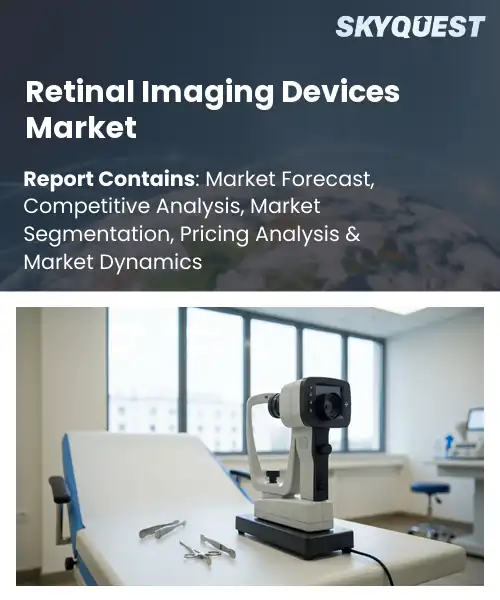
Retinal Imaging Devices Market
Report ID: SQMIG35A4007
Report ID: SQMIG35A4007
[email protected]
USA +1 351-333-4748
Report ID:
SQMIG35A4007 |
Region:
Global |
Published Date: June, 2026
Pages:
157
|Tables:
125
|Figures:
77


Global Retinal Imaging Devices Market size was valued at USD 4.6 Billion in 2024 and is poised to grow from USD 4.82 Billion in 2025 to USD 7.01 Billion by 2033, growing at a CAGR of 4.8% during the forecast period (2026-2033).
The key factor driving the retinal imaging devices market is the rising prevalence of retinal diseases. This, in turn, creates more of a need for early diagnosis and monitoring, and consequently, investments in imaging technologies. The market includes fundus cameras, optical coherence tomography systems, OCT angiography modules and ultra-widefield scanners that are used by ophthalmologists, optometrists and screening programs. This is important because timely retinal imaging prevents sight loss and reduces costs to the healthcare system. The history of retinal imaging is a timeline of technological milestones from film-based retinal photography to high-resolution OCT and AI-enabled analysis. Development of portable OCT, diabetic retinopathy screening programs and regulatory approvals that broaden clinical use accelerated adoption.
The confluence of AI-driven image analysis and expanded screening programs is a major driver of the demand for retinal imaging. Algorithmic triage can increase throughput and reduce the workload on specialists, making large scale programs economically feasible. With the rising prevalence of diabetes and an aging population, the burden of AMD is increasing. Health systems are deploying teleophthalmology and portable fundus cameras to extend care to underserved areas and establishing clear use cases, such as automated diabetic retinopathy screening in primary care and tele-screening hubs in rural areas. The regulatory approvals and payment for AI-enabled services further encourage device makers to integrate hardware, cloud analytics and EHR integration. This results in product differentiation and new revenue streams.
How is AI improving diagnostic accuracy in the retinal imaging devices market?
AI improves the quality of retinal images, identifies subtle lesions, quantifies biomarkers and standardizes the interpretation of images acquired by different devices, hence improving the accuracy of diagnosis. Deep learning models are integrated with fundus and OCT systems to automatically flag high-risk findings and prioritize cases for specialist review. This decreases human variability and time to actionable diagnosis for diabetic retinopathy and age related macular degeneration. Market trends Device manufacturers and software vendors are weaving AI into clinical and remote workflows for scalable screening and more frequent monitoring. Real world programs are converting frequent patient generated scans into clinician-ready alerts that improve continuity and decision making.
In January 2026, Optomed and Aireen announced the approval of an AI diabetic retinopathy algorithm on a handheld retinal camera. This is a good example of embedded AI for easy detection and telehealth screening, leading to more efficiency and adoption in the retinal imaging devices market.
Market snapshot - (2026-2033)
Global Market Size
USD 4.6 Billion
Largest Segment
Optical Coherence Tomography (OCT) Devices
Fastest Growth
Optical Coherence Tomography (OCT) Devices
Growth Rate
4.8% CAGR
To get more insights on this market click here to Request a Free Sample Report
Global retinal imaging devices market is segmented by product type, modality, application, end user and region. Based on product type, the market is segmented into Fundus Cameras, Optical Coherence Tomography (OCT) Devices, Scanning Laser Ophthalmoscopes (SLO), Fundus Fluorescein Angiography (FFA) Systems, Indocyanine Green Angiography (ICGA) Systems, Retinal Ultrasound Imaging Systems and Others. Based on modality, the market is segmented into Tabletop Systems and Handheld/Portable Systems. Based on application, the market is segmented into Diabetic Retinopathy, Age-Related Macular Degeneration (AMD), Glaucoma, Retinal Detachment, Retinal Vascular Disorders and Others. Based on end user, the market is segmented into Hospitals, Ophthalmology Clinics, Ambulatory Surgical Centers (ASCs), Academic & Research Institutes and Others. Based on region, the market is segmented into North America, Europe, Asia Pacific, Latin America and Middle East & Africa.
Optical Coherence Tomography (OCT) Devices segment is expected to dominate the market owing to its depth resolved cross sectional imaging which provides an unparalleled tissue characterization that directly informs diagnosis, monitoring and therapeutic decisions across retinal diseases. Clinicians love OCT because it can detect subtle structural changes and guide intervention, driving purchase and integration into clinical pathways. Continued refinement of the technology, integration with analytic software, and multimodal compatibility are further establishing OCT as the clinical imaging foundation for retinal care.
Fundus Cameras, however, is the fastest growing segment in retinal imaging, owing to compact optics and smartphone integration that enable cost effective screening and teleophthalmology. Portable fundus devices extend point of care screening and referral workflows, accelerating adoption in primary care and outreach and opening new opportunities for early detection and service delivery.
The Tabletop Systems segment is projected to account for the largest share in the market during the forecast period. This is mainly attributed to the stable platforms and better imaging performance of the tabletop systems that help in comprehensive multimodal diagnostics and efficient clinical throughput in retinal care settings. Topical units are favored by specialty clinics and hospitals as high resolution optics, integrated stabilization and automated capture features decrease operator variability and facilitate complex procedures. Compatibility with advanced modules and clinician workflows sustains institutional purchasing and long term service contracts, reinforcing tabletop systems as the primary workhorse for retinal diagnostics.
However, the Handheld/Portable Systems segment is the fastest growing as miniaturization, improved sensor performance and telemedicine platforms enable point of care diagnostics outside traditional clinics. The increasing demand for community screening, mobile outreach, and home monitoring, along with easier reimbursement pathways and rapid device innovation, drives deployment and offers significant opportunities for decentralized retinal care delivery.
To get detailed segments analysis, Request a Free Sample Report
North America takes the lead, with a perfect storm of strong clinical research ecosystems, a high concentration of specialized eye care providers and a mature medical device industry that drives continuous innovation. Established reimbursement frameworks and professional training pathways support the clinical use of advanced imaging modalities in outpatient clinics and hospital networks. Industry–academic-center and clinical investigator collaborations allow for rigorous validation and iterative product improvement. Strong post market surveillance and focus on interoperability give clinicians more confidence to seamlessly integrate imaging platforms into care pathways and support market leadership through continued device refinement and broad clinical adoption.
Retinal Imaging apparatus Benefits market Concentration of leading device manufacturers Strong clinical research infrastructure Dense networks of specialty clinics and academic centers which facilitates rapid technology adoption Reimbursement frameworks and professional training programs support the integration of advanced imaging into routine ophthalmic care. The collaboration between industry and clinical stakeholders leads to iterative device refinement and real world validation, enhancing market penetration and raising standards of care in diverse practice settings.
Centralized Healthcare Delivery Models Interoperable imaging platforms are being deployed with increased emphasis on equitable access and preventive ophthalmic screening. Cross provincial collaborations support sharing of clinical expertise and community clinics and specialized centres are adopting with an emphasis on patient centric care pathways. Strategic investment in teleophthalmology and integration with primary care broadens access to underserved populations and facilitates early detection and ongoing management of retinal disease.
This rapid uptake is due to a coordinated clinical adoption in Europe of regulatory frameworks that balance innovation with patient safety and a robust network of specialized ophthalmology centers focused on early detection. Collaborative transnational clinical studies and harmonized guidelines accelerate the adoption of advanced imaging modalities, and integrated care pathways and teleophthalmology initiatives extend the footprint of specialists. Established manufacturers and nimble technology companies will be engaged to develop localized innovations and tailor-made solutions to suit the various structures of health systems. Targeted reimbursement pathways and public-private partnerships can demonstrate real world value through pilot deployments. Funding of clinician training and academic uptake allows for sustainable use and iterative improvement of imaging platforms for a variety of clinical workflows.
Retinal Imaging Systems Strong medical technology manufacturing base in Germany and leading research hospitals to support clinical validation and practical adoption. Integrated procurement pathways and rigorous technical standards allow the deployment of interoperable imaging solutions across hospital networks. Guideline informed use is supported by collaborative initiatives between industry, academic centers and clinical societies that promote incorporation of advanced retinal imaging technologies into diagnostic and treatment workflows throughout diverse care settings.
The UK market is fuelled by investment in retina imaging equipment and a booming start-up scene. Use teleophthalmology models to bring specialists to areas outside of urban centers. Clinicians have been engaged in national clinical networks and training programmes on new imaging modalities. With the pilot, you can work with the pilot to deliver tailor-made imaging workflows aligned with care pathways and patient needs, supported by the collaboration between the healthcare provider and the technology developer and flexible procurement models.
Imaging Devices, Retinal The French market is defined by an increasing focus on preventive eye care and the adoption of imaging in primary and specialty practices. Innovation hubs and dedicated funding enable the development of imaging solutions that are suitable for the local context and for diverse clinical settings. The use of telemedicine and coordinated care pathways allows for a faster spread of imaging capacity. The collaboration between manufacturers and professional societies facilitates training and guideline informed uptake that fortifies market potential.
Asia Pacific is solidifying its position with strategic investments in advanced high-precision manufacturing, strong electronics and optics capabilities, and close collaboration between tech firms and clinical research institutions. Regulatory pathways are evolving in leading markets to enable safe introduction of advanced imaging platforms and pragmatic adoption models are leveraging telehealth and integrated care solutions to reach dispersed populations. Local innovation ecosystems have focused on miniaturization, software integration and cost effective system design to adapt to a wide variety of care settings. Global suppliers and regional companies enter into strategic partnerships that expedite localization of offerings and enable scalable deployment across hospital networks and community clinics. Public private initiatives and clinician training programs strengthen real world evidence generation and support payer engagement in demonstrating clinical utility across care pathways. The emphasis is on interoperability and data integration to allow for long term adoption and continuous device improvement.
Retinal Imaging Device Japan’s market is defined by a mature precision manufacturing ecosystem and robust interdisciplinary collaboration between optics engineers and electronics firms and clinical researchers that accelerates device innovation. Work with leading medical technology companies and academic centers on validation and integration of sophisticated imaging platforms. The focus on miniaturization, software optimization and high quality components enables the development of reliable systems suitable for complex hospital environments and ambulatory care pathways nationally.
Retinal Imaging Instrument The South Korean market shows a strong focus on advanced imaging research and rapid integration of artificial intelligence driven analysis. Collaborative relationships between technology companies and clinical institutions promote applied innovation. Across specialized centers, manufacturers and research hospitals are piloting novel imaging platforms. Government and industry initiatives are supporting the translation of prototypes into clinically validated products. Focusing on interoperability and export readiness makes for a more marketable and competitive product.
To know more about the market opportunities by region and country, click here to
Buy The Complete Report
Growing Prevalence Of Retinal Diseases
AI Integration and Image Analysis
High Equipment and Implementation Costs
Regulatory and Reimbursement Challenges
Request Free Customization of this report to help us to meet your business objectives.
The global retinal imaging devices market is highly competitive with increased product innovation and consolidation. The established players are actively involved in acquisitions and strategic partnerships, while the startups are trying to establish their position by developing portable and home-based OCT technologies. Recent M&A activity such as Bayer’s acquisition of innovative ophthalmology assets and established vendors expanding their advanced imaging portfolios demonstrate a competitive landscape driven by device convergence and AI analytics. Companies are establishing clinical collaborations and obtaining regulatory designations to expedite adoption and distribution.
SkyQuest’s ABIRAW (Advanced Business Intelligence, Research & Analysis Wing) is our Business Information Services team that Collects, Collates, Correlates, and Analyses the Data collected by means of Primary Exploratory Research backed by robust Secondary Desk research.
As per SkyQuest analysis, the global retinal imaging devices market is driven primarily by the rising prevalence of retinal disorders, which increases demand for early diagnosis and monitoring, while a second major driver is integration of AI-driven image analysis that improves diagnostic accuracy and enables scalable screening. North America remains the dominant region due to strong clinical research, reimbursement frameworks and dense specialist networks, and Optical Coherence Tomography devices lead the product landscape because of superior tissue characterization and clinical utility. A notable restraint is high equipment and implementation costs that limit adoption in smaller clinics and resource constrained settings, tempering short term market penetration despite clear clinical benefits.
| Report Metric | Details |
|---|---|
| Market size value in 2024 | USD 4.6 Billion |
| Market size value in 2033 | USD 7.01 Billion |
| Growth Rate | 4.8% |
| Base year | 2024 |
| Forecast period | (2026-2033) |
| Forecast Unit (Value) | USD Billion |
| Segments covered |
|
| Regions covered | North America (US, Canada), Europe (Germany, France, United Kingdom, Italy, Spain, Rest of Europe), Asia Pacific (China, India, Japan, Rest of Asia-Pacific), Latin America (Brazil, Rest of Latin America), Middle East & Africa (South Africa, GCC Countries, Rest of MEA) |
| Companies covered |
|
| Customization scope | Free report customization with purchase. Customization includes:-
|
To get a free trial access to our platform which is a one stop solution for all your data requirements for quicker decision making. This platform allows you to compare markets, competitors who are prominent in the market, and mega trends that are influencing the dynamics in the market. Also, get access to detailed SkyQuest exclusive matrix.
Table Of Content
Executive Summary
Market overview
Parent Market Analysis
Market overview
Market size
KEY MARKET INSIGHTS
COVID IMPACT
MARKET DYNAMICS & OUTLOOK
Market Size by Region
KEY COMPANY PROFILES
Methodology
For the Retinal Imaging Devices Market, our research methodology involved a mixture of primary and secondary data sources. Key steps involved in the research process are listed below:
1. Information Procurement: This stage involved the procurement of Market data or related information via primary and secondary sources. The various secondary sources used included various company websites, annual reports, trade databases, and paid databases such as Hoover's, Bloomberg Business, Factiva, and Avention. Our team did 45 primary interactions Globally which included several stakeholders such as manufacturers, customers, key opinion leaders, etc. Overall, information procurement was one of the most extensive stages in our research process.
2. Information Analysis: This step involved triangulation of data through bottom-up and top-down approaches to estimate and validate the total size and future estimate of the Retinal Imaging Devices Market.
3. Report Formulation: The final step entailed the placement of data points in appropriate Market spaces in an attempt to deduce viable conclusions.
4. Validation & Publishing: Validation is the most important step in the process. Validation & re-validation via an intricately designed process helped us finalize data points to be used for final calculations. The final Market estimates and forecasts were then aligned and sent to our panel of industry experts for validation of data. Once the validation was done the report was sent to our Quality Assurance team to ensure adherence to style guides, consistency & design.
Analyst Support
Customization Options
With the given market data, our dedicated team of analysts can offer you the following customization options are available for the Retinal Imaging Devices Market:
Product Analysis: Product matrix, which offers a detailed comparison of the product portfolio of companies.
Regional Analysis: Further analysis of the Retinal Imaging Devices Market for additional countries.
Competitive Analysis: Detailed analysis and profiling of additional Market players & comparative analysis of competitive products.
Go to Market Strategy: Find the high-growth channels to invest your marketing efforts and increase your customer base.
Innovation Mapping: Identify racial solutions and innovation, connected to deep ecosystems of innovators, start-ups, academics, and strategic partners.
Category Intelligence: Customized intelligence that is relevant to their supply Markets will enable them to make smarter sourcing decisions and improve their category management.
Public Company Transcript Analysis: To improve the investment performance by generating new alpha and making better-informed decisions.
Social Media Listening: To analyze the conversations and trends happening not just around your brand, but around your industry as a whole, and use those insights to make better Marketing decisions.
REQUEST FOR SAMPLE
 REQUEST FREE CUSTOMIZATION
Global Retinal Imaging Devices Market size was valued at USD 4.6 Billion in 2024 and is poised to grow from USD 4.82 Billion in 2025 to USD 7.01 Billion by 2033, growing at a CAGR of 4.8% during the forecast period (2026-2033).
Competitive landscape in global retinal imaging devices is defined by intensifying product innovation and consolidation, where incumbents pursue acquisitions and strategic partnerships while startups push portable and home OCT technologies to differentiate. Recent M&A such as Bayer acquiring innovative ophthalmology assets and established vendors expanding advanced imaging portfolios show competition driven by device convergence and AI analytics. Firms secure clinical partnerships and regulatory designations to speed adoption and distribution. 'Topcon Healthcare', 'Carl Zeiss Meditec', 'NIDEK Co., Ltd.', 'Optos plc', 'Heidelberg Engineering GmbH', 'Canon Medical Systems Corporation', 'CenterVue S.p.A.', 'Visionix', 'Kowa Company, Ltd.', 'Remidio Innovative Solutions Pvt. Ltd.', 'Eyenuk, Inc.', 'Forus Health Pvt. Ltd.', 'Clarus Vision', 'Epipole Ltd.', 'Phoenix Technology Group, LLC', 'iCare Finland Oy', 'Briot USA, Inc.', 'Volk Optical Inc.', 'Optomed Plc', 'Bosch + Lomb Corporation'
Retinal diseases increasing in populations raise demand for diagnostic and monitoring tools, prompting healthcare providers to prioritize retinal imaging integration within clinical workflows. As awareness of early detection benefits expands among clinicians and patients, investment in advanced imaging systems becomes a strategic response to improve diagnostic accuracy and patient management. Manufacturers respond by enhancing device capabilities and accessibility, while training programs support wider adoption. This sustained clinical emphasis on early intervention and improved care pathways directly stimulates market expansion through greater utilization of retinal imaging technologies.
Ai Driven Image Interpretation: Adoption of advanced artificial intelligence is reshaping retinal imaging by automating image analysis, prioritizing cases, and providing decision support that augments clinician interpretation. Vendors increasingly embed validated algorithms into imaging platforms and cloud services to accelerate screening and streamline referral pathways. Focus on explainability, interoperability with electronic health records, and clinical workflow integration builds clinician trust and facilitates adoption. Collaborative models between device manufacturers, software developers, and healthcare providers drive continuous improvement, enabling earlier detection and more consistent monitoring while reducing diagnostic variability across care settings.
Why does North America Dominate the Global Retinal Imaging Devices Market? |@12


Want to customize this report? This report can be personalized according to your needs. Our analysts and industry experts will work directly with you to understand your requirements and provide you with customized data in a short amount of time. We offer $1000 worth of FREE customization at the time of purchase.
Feedback From Our Clients


 USA (+1) 351-333-4748

