Filament Nonwoven Market
Report ID: SQMIG25M2102
Report ID: SQMIG25M2102
[email protected]
USA +1 351-333-4748
Report ID:
SQMIG25M2102 |
Region:
Global |
Published Date: March, 2026
Pages:
157
|Tables:
119
|Figures:
77


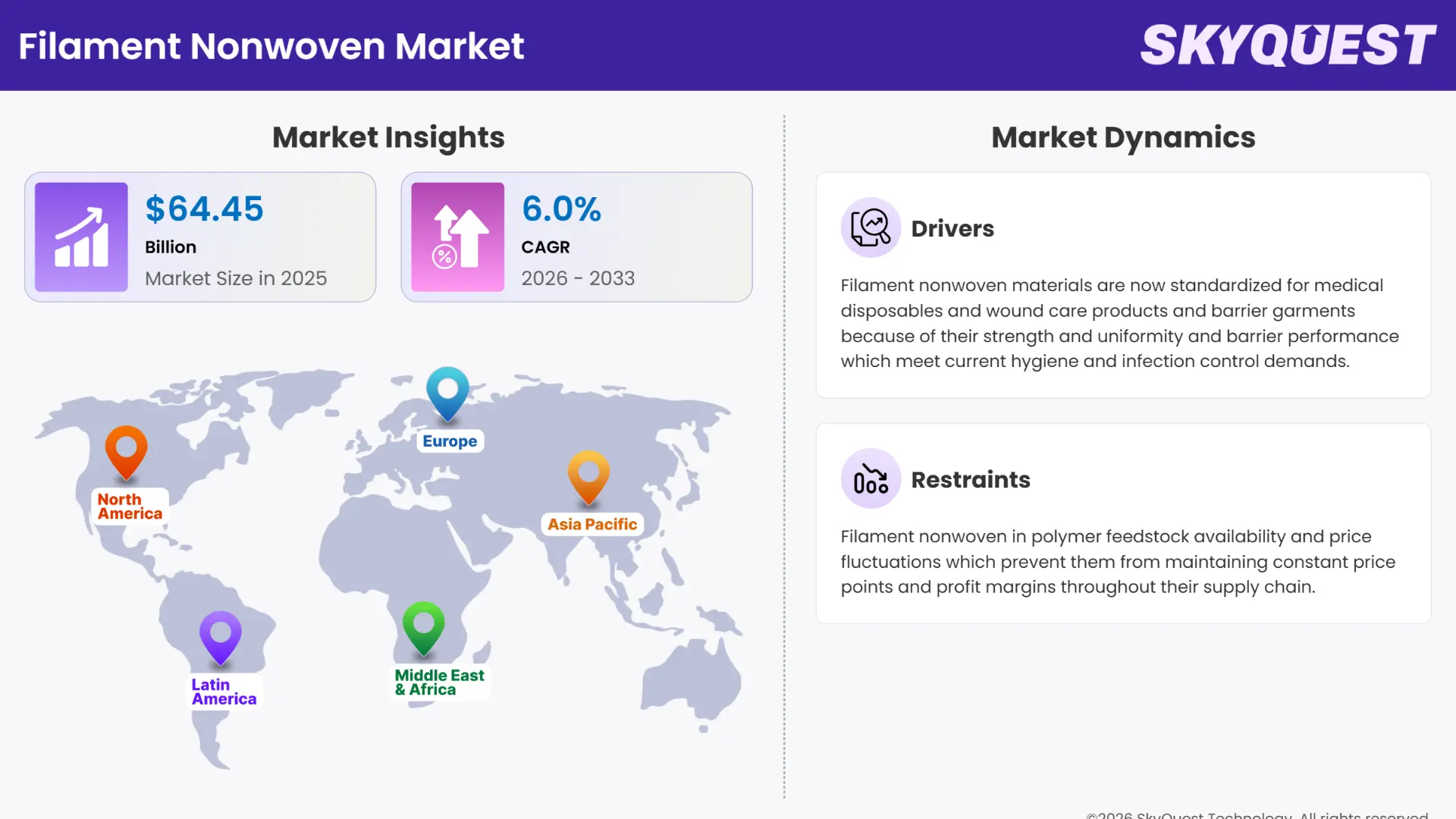
Global Filament Nonwoven Market size was valued at USD 60.80 Billion in 2024 and is poised to grow from USD 64.45 Billion in 2025 to USD 102.72 Billion by 2033, growing at a CAGR of 6.0% during the forecast period (2026-2033).
The global filament nonwoven industry consists of fabrics created through spunbond, meltblown, and spunlace processes which produce continuous polymer filaments. The market supports products that range from medical masks and gowns to filtration media and geotextiles used throughout the world.
The primary driver for the global filament nonwoven market growth arises from increasing requirements for high-performance disposable products which depend on continuous filaments to provide unchanging tensile strength and filtration efficiency and affordable production costs. Over the past decades manufacturers developed the market from staple fiber webs to filament-based technologies because they wanted to achieve better production consistency and scalability.
In addition, the filament nonwoven market experiences growth because sustainable feedstocks and circular manufacturing create new business opportunities which drive market expansion. Producers need to reformulate their filaments away from single-use plastics because regulators enforce plastic ban and consumers prefer eco-friendly products; their materials now require recycled polypropylene and biopolymer and renewable content. The new equipment and production lines and strategic partnerships with collectors enable the development of compostable wet wipes and recycled-polymer geotextiles and lower-carbon filtration media applications.
How is AI Improving Quality Control in the Filament Nonwoven Market?
The system uses inline vision systems with sensor fusion and predictive analytics to detect formation flaws and contamination issues and bond irregularities during standard operation in filament nonwoven production. The existing system has transitioned from rule-based inspection to a training model which identifies defects through learning various material combinations while linking machine settings to specific anomalies. The filament nonwoven market requires uniform web formation and stable bonds to meet filtering needs and produce geotextiles and industrial fabrics. The production process begins with vendors and converters who implement AI inspection and analytics to enhance their output efficiency while decreasing operational waste and constructing traceable quality records which help them achieve precise standards and solve problems more quickly.
The X Pro crosslapper and neXloom A Type needleloom which were launched by ANDRITZ in December 2025 deliver improved web consistency through their new equipment which includes process control features. The system enables filament nonwoven producers to achieve better consistency while decreasing their need for rework and producing high-quality products through their efficient operational process.
To get more insights on this market click here to Request a Free Sample Report
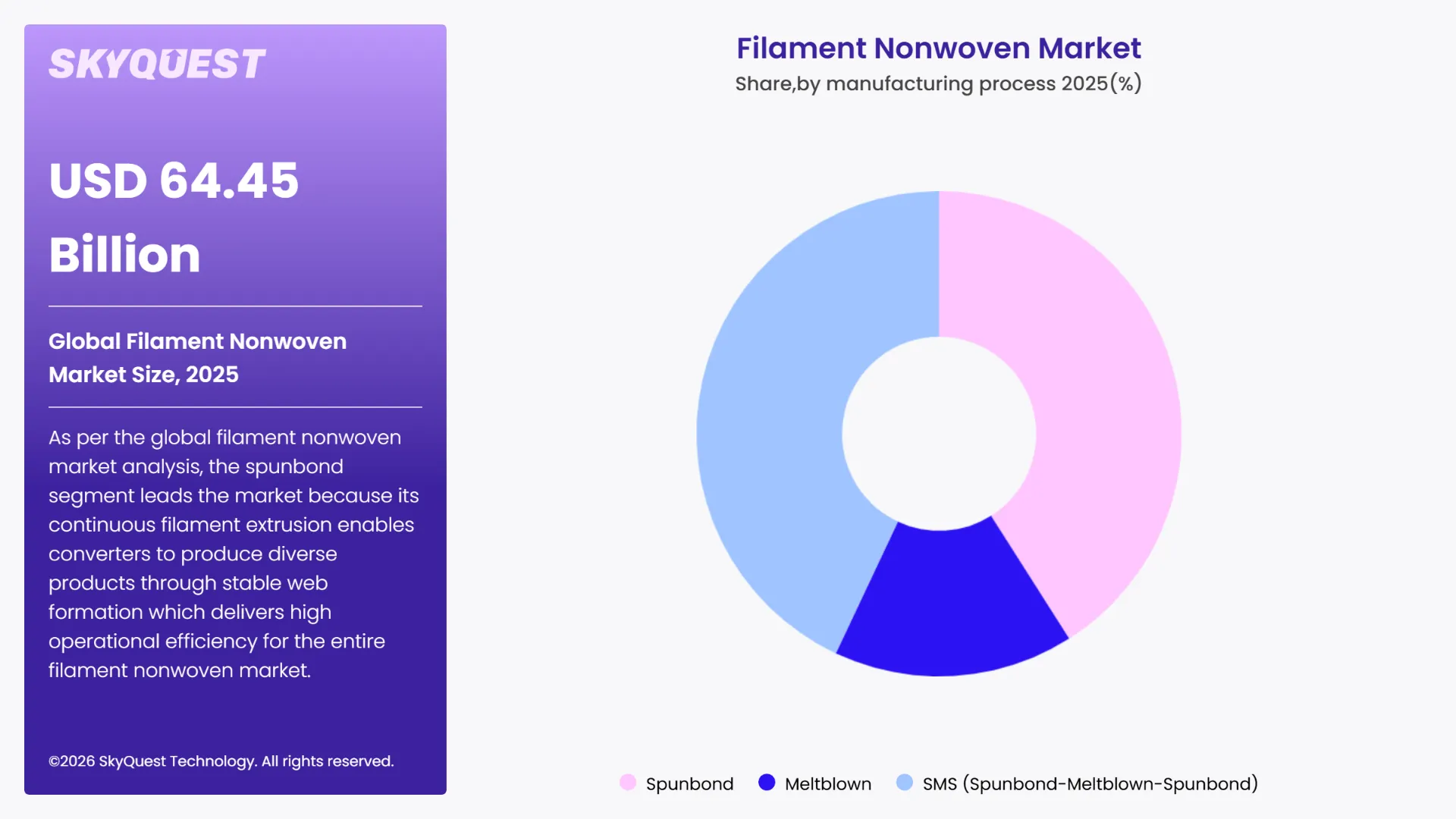
The global filament nonwoven market is segmented based on manufacturing process, material type, fabric weight, end-use application, and region. By manufacturing process, the market includes spunbond, meltblown, and SMS (spunbond–meltblown–spunbond). In terms of material type, it is categorized into polypropylene (PP), polyester (PET), polyethylene (PE), and biopolymers (PLA). Based on fabric weight, the market is divided into lightweight, medium-weight, and heavy-weight segments. By end-use application, the market covers hygiene, medical, geotextiles and construction, as well as filtration and industrial uses. Regionally, the market is analyzed across North America, Europe, Asia Pacific, Latin America, and the Middle East & Africa.
As per the global filament nonwoven market analysis, the spunbond segment leads the market because its continuous filament extrusion enables converters to produce diverse products through stable web formation which delivers high operational efficiency for the entire filament nonwoven market. The process produces uniform fiber distribution which delivers constant tensile properties that enable simple bonding and finishing procedures. The production system delivers reliable output which enables businesses to lower operational costs while maintaining their capacity to expand across various market sectors.
However, the meltblown production has developed into the most successful manufacturing process because it can create ultrafine fibers which deliver superior filtration capabilities to both medical and high-efficiency filtration markets. The industry experiences better productivity and consistent results through improved electrostatic charging and die design and process control which also expands the market through new high-value applications that require additional capital investment.
According to the global filament nonwoven market forecast, filament nonwoven production needs polypropylene because its material properties allow processing through melt methods while maintaining low production costs which enables creation of multiple product types. Filtration manufacturers and hygiene users rely on the technology's development which employs common technologies to deliver mechanical and hydrophobic qualities that meet their requirements. The established supply chain and converter familiarity with the technology enable faster development of new product variants.
Whereas the PLA segment is anticipated to have the highest filament nonwoven market share because both biodegradable filament nonwovens and products which create less carbon footprint have gained increased demand. Bioresin formulation and processing aid improvement projects enable better thermal performance and mechanical strength which allows PLA to serve hygiene and filtration needs while driving converter investment and wider product distribution.
To get detailed segments analysis, Request a Free Sample Report
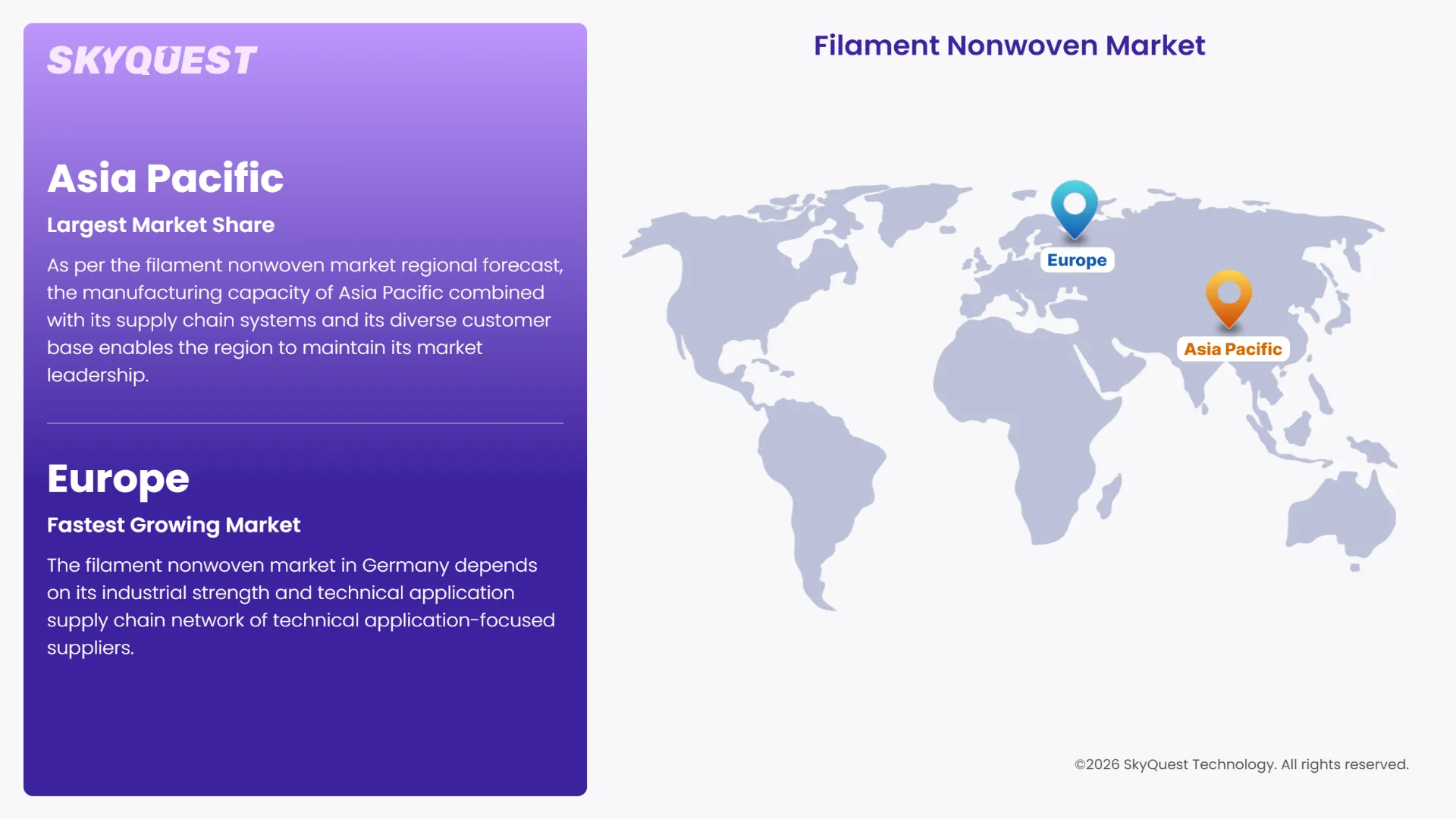
As per the filament nonwoven market regional forecast, the manufacturing capacity of Asia Pacific combined with its supply chain systems and its diverse customer base enables the region to maintain its market leadership. The area contains an extensive network of polymer manufacturers and filament extruders and converters which enable effective material distribution while maintaining competitive pricing. The textile and hygiene and medical and automotive and electronics industries create steady product demand which leads to full production capacity and ongoing research and development work. Advanced processing technologies and functionalization methods enable businesses to create high-quality products for specialized technical uses. Suppliers can reach international clients through regional trade networks and export markets while industrial policy measures and infrastructure development help maintain their competitive advantage. The combination of established excellence centers and expanding manufacturing facilities creates a system that supports the development of filament nonwoven production and application research.
The Japanese filament nonwoven market focuses on high performance and technical applications which require precise material quality. The manufacturer produces engineered nonwovens which they use in filtration systems and automotive interior parts and medical devices and special industrial applications. Producers and research institutes and end users collaborate closely to create functional coatings and fine deniers and multilayer construction materials. Companies achieve premium market status through its emphasis on process control and system reliability and adherence to strict quality regulations which enables it to serve specialized global markets and high-value distribution networks.
The filament nonwoven market in South Korea benefits from its strong polymer production capacity and active electronics and automotive manufacturing operations. The manufacturer implements integrated production methods which enable fast transition to automated systems while creating specialized hygiene and filtration products for advanced industrial markets. Brand owners work with converters to establish strategic partnerships which help them develop custom products while speeding up their product launch process. The market uses its operational efficiency and technology adoption to become a flexible supplier base for both regional and international customers who export their goods.
The European filament nonwoven market penetration is driven rapidly because three factors transform production capabilities while businesses prioritize sustainable practices and high-value applications. Manufacturers are investing in recycling friendly processes, bio-based feedstocks, and lightweight solutions that align with regulatory expectations and corporate sustainability commitments. The healthcare, personal care, filtration, and technical textile industries create strong product demand which leads businesses to develop specialized and high-end offerings. Industrial clusters and engineering expertise enable converters and fiber producers and brand owners to work together on developing advanced structures and functional treatments which lead to successful product commercialization. Companies invest in new equipment, and they form partnerships to comply with circularity policy frameworks which help them boost their operational capacity and strengthen their competitive edge in high-margin filament nonwoven market segments.
The filament nonwoven market in Germany depends on its industrial strength and technical application supply chain network of technical application-focused suppliers. The producer develops engineered solutions for the automotive and filtration and industrial nonwoven markets which focus on creating long-lasting products with high performance standards. The close relationships between manufacturers and machinery suppliers and research organizations enable fast implementation of precision manufacturing techniques and quality control systems. The market supports special product creation which builds industry-specific requirements through value-added products and custom development work.
The United Kingdom filament nonwoven market creates innovation-based growth through its development of specialized applications. A network of technology startups and research centres and converters creates advanced hygiene and medical and filtration products. Suppliers can adjust their offerings to match customer needs through production flexibility and their commitment to using sustainable materials. Business models often prioritize partnership with brand owners and integrators to deliver specialized solutions which enable fast product creation for new market opportunities.
The filament nonwoven market in France is growing quickly because companies invest in sustainable fibers and circular manufacturing methods. Industry initiatives and partnerships with innovation centers promote substitution of traditional materials with recyclable and bio-based alternatives. The health care and personal care markets create strong demand for capacity growth and product line expansion through their industrial development programs. The market drives businesses to create responsible supply chain solutions which combine environmental credentials with technical performance characteristics.
North America enhances its position through capacity upgrades and technology investments and supply chain strategic realignment. Companies give priority to production systems which enable fast product adjustments and efficient operation for essential end products including medical and hygienic and air filtration items. The focus on sustainability together with circularity drives companies to use recycled materials while they create new methods for material recovery and recyclability. The combination of industry partnerships with research organizations and customer collaborations leads to faster creation of advanced filament materials which possess superior performance capabilities. The combination of cross border supply routes and specific capital investment enables companies to bring back operations while building regional resilience which allows them to meet local market needs while continuing to export specialized products.
The United States filament nonwoven market operates through technological advancement together with performance-based requirements for healthcare filtration and industrial applications. Manufacturers focus on fast development of new material structures and functional treatments while they work to implement sustainable practices which fulfill both customer and regulatory requirements. The market grows because of its broad supplier network which works closely with customers to create specific solutions for their challenging requirements. Automation investment together with advanced manufacturing methods leads to efficiency gains which help businesses create unique products across various industries.
The Canadian filament nonwoven market trends specializes in providing nonwovens and converters which fulfill local requirements for nonwoven products which are used in international supply chains. Environmental standards need to be followed while materials should be sourced responsible for developing different filtration systems and protective clothing and industrial separation applications. Companies work together with research institutions and industry partners to foster new developments in eco-friendly raw materials and improved industrial methods. The market focuses on delivering high-quality products through partnerships which help companies access essential raw materials and reach their principal customers in North America.
To know more about the market opportunities by region and country, click here to
Buy The Complete Report
Rising Demand from Healthcare
Advances In Production Technology
Raw Material Price Volatility
Environmental Disposal Concerns
Request Free Customization of this report to help us to meet your business objectives.
The global filament nonwoven market has reached higher competitive levels because manufacturers now use M&A and strategic stakes and polymer partnerships to obtain feedstock and sustainability verification while technology companies bring surface and filament products to the market. The existing situation contains three key elements which include pandemic driven changes to meltblown production capacity and Fitesa's acquisition of strategic stakes for hygiene market strengthening and Polymateria's collaboration with Fitesa to develop biotransformation methods for nonwoven materials.
SkyQuest’s ABIRAW (Advanced Business Intelligence, Research & Analysis Wing) is our Business Information Services team that Collects, Collates, Correlates, and Analyses the Data collected by means of Primary Exploratory Research backed by robust Secondary Desk research.
As per SkyQuest analysis, the global filament nonwoven market grows because healthcare and high-performance disposable products demand more of these materials while sustainable feedstock and circular manufacturing systems create new product premium opportunities. Raw material price volatility prevents growth because it creates investment barriers and pricing security problems throughout the entire value chain. Asia Pacific maintains its market leadership because of its production capacity which includes complete supply chain systems and high demand from end-users while spunbond manufacturing leads production because it achieves efficient output through its cost-effective process which creates uniform web patterns. The main business opportunities focus on sustainable product development and the development of more efficient production methods.
| Report Metric | Details |
|---|---|
| Market size value in 2024 | USD 60.80 Billion |
| Market size value in 2033 | USD 102.72 Billion |
| Growth Rate | 6.0% |
| Base year | 2024 |
| Forecast period | 2026-2033 |
| Forecast Unit (Value) | USD Billion |
| Segments covered |
|
| Regions covered | North America (US, Canada), Europe (Germany, France, United Kingdom, Italy, Spain, Rest of Europe), Asia Pacific (China, India, Japan, Rest of Asia-Pacific), Latin America (Brazil, Rest of Latin America), Middle East & Africa (South Africa, GCC Countries, Rest of MEA) |
| Companies covered |
|
| Customization scope | Free report customization with purchase. Customization includes:-
|
To get a free trial access to our platform which is a one stop solution for all your data requirements for quicker decision making. This platform allows you to compare markets, competitors who are prominent in the market, and mega trends that are influencing the dynamics in the market. Also, get access to detailed SkyQuest exclusive matrix.
Table Of Content
Executive Summary
Market overview
Parent Market Analysis
Market overview
Market size
KEY MARKET INSIGHTS
COVID IMPACT
MARKET DYNAMICS & OUTLOOK
Market Size by Region
KEY COMPANY PROFILES
Methodology
For the Filament Nonwoven Market, our research methodology involved a mixture of primary and secondary data sources. Key steps involved in the research process are listed below:
1. Information Procurement: This stage involved the procurement of Market data or related information via primary and secondary sources. The various secondary sources used included various company websites, annual reports, trade databases, and paid databases such as Hoover's, Bloomberg Business, Factiva, and Avention. Our team did 45 primary interactions Globally which included several stakeholders such as manufacturers, customers, key opinion leaders, etc. Overall, information procurement was one of the most extensive stages in our research process.
2. Information Analysis: This step involved triangulation of data through bottom-up and top-down approaches to estimate and validate the total size and future estimate of the Filament Nonwoven Market.
3. Report Formulation: The final step entailed the placement of data points in appropriate Market spaces in an attempt to deduce viable conclusions.
4. Validation & Publishing: Validation is the most important step in the process. Validation & re-validation via an intricately designed process helped us finalize data points to be used for final calculations. The final Market estimates and forecasts were then aligned and sent to our panel of industry experts for validation of data. Once the validation was done the report was sent to our Quality Assurance team to ensure adherence to style guides, consistency & design.
Analyst Support
Customization Options
With the given market data, our dedicated team of analysts can offer you the following customization options are available for the Filament Nonwoven Market:
Product Analysis: Product matrix, which offers a detailed comparison of the product portfolio of companies.
Regional Analysis: Further analysis of the Filament Nonwoven Market for additional countries.
Competitive Analysis: Detailed analysis and profiling of additional Market players & comparative analysis of competitive products.
Go to Market Strategy: Find the high-growth channels to invest your marketing efforts and increase your customer base.
Innovation Mapping: Identify racial solutions and innovation, connected to deep ecosystems of innovators, start-ups, academics, and strategic partners.
Category Intelligence: Customized intelligence that is relevant to their supply Markets will enable them to make smarter sourcing decisions and improve their category management.
Public Company Transcript Analysis: To improve the investment performance by generating new alpha and making better-informed decisions.
Social Media Listening: To analyze the conversations and trends happening not just around your brand, but around your industry as a whole, and use those insights to make better Marketing decisions.
REQUEST FOR SAMPLE
 REQUEST FREE CUSTOMIZATION
Global Filament Nonwoven Market size was valued at USD 60.8 Billion in 2024 and is poised to grow from USD 64.45 Billion in 2025 to USD 102.72 Billion by 2033, growing at a CAGR of 6.0% during the forecast period (2026-2033).
Competitive intensity in the global filament nonwoven market has risen as manufacturers pursue M&A, strategic stakes and polymer partnerships to secure feedstock and sustainability claims, while technology providers commercialize surface and filament innovations. Recent moves include pandemic driven reshaping of meltblown capacity, Fitesa’s strategic stake acquisitions to reinforce hygiene positions, and Polymateria partnerships to apply biotransformation treatments to nonwovens. 'Berry Global', 'Freudenberg Performance Materials', 'Ahlstrom-Munksjö', 'Kimberly-Clark', 'DuPont de Nemours', 'Toray Industries', 'Asahi Kasei', 'Fitesa', 'Johns Manville (Berkshire Hathaway)', 'TWE Group', 'Suominen Corporation', 'Glatfelter', 'Low & Bonar', 'PFNonwovens', 'Lydall', 'Avgol Nonwovens', 'Mitsui Chemicals', 'Fibertex Personal Care', 'Gulsan Holding', 'Hollingsworth & Vose'
Filament nonwoven materials are increasingly specified for medical disposables, wound care products, and barrier garments because of their strength, uniformity, and barrier performance, which align with heightened attention to hygiene and infection control. This preference prompts healthcare and medical device producers to specify filament nonwovens for critical applications, encouraging suppliers to expand capacity and develop tailored products. The clear pathway from application requirements to procurement decisions sustains demand for specialized filament nonwovens and supports ongoing market growth through product adoption and supply chain commitment.
Circular Product Design: Manufacturers are prioritizing circular product design to extend lifecycle value and enable material recovery pathways. Design strategies emphasize modularity, recyclability, and selection of mono-material systems to simplify separation and reuse. Collaboration across supply chains and with brand owners fosters take-back programs and closed-loop initiatives that shift market focus from disposability to durability. This transition supports differentiated propositions, enhances regulatory alignment, and opens new revenue models such as leasing and service-based offerings that monetize longevity and quality rather than single-use consumption.
Asia Pacific Dominate the Global Filament Nonwoven Market?


Want to customize this report? This report can be personalized according to your needs. Our analysts and industry experts will work directly with you to understand your requirements and provide you with customized data in a short amount of time. We offer $1000 worth of FREE customization at the time of purchase.
Feedback From Our Clients


 USA (+1) 351-333-4748

