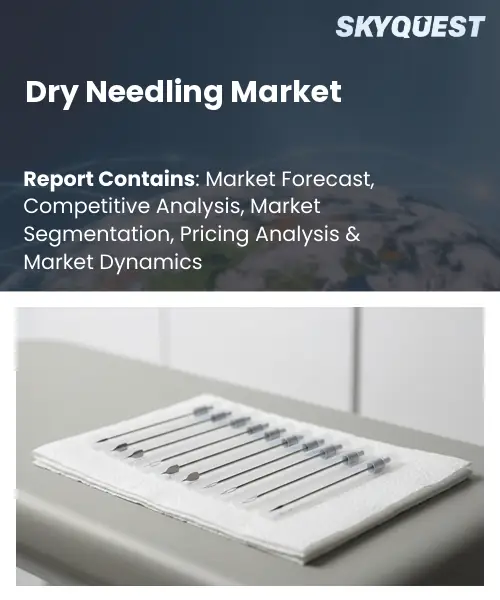
Dry Needling Market
Report ID: SQMIG35D2610
Report ID: SQMIG35D2610
[email protected]
USA +1 351-333-4748
Report ID:
SQMIG35D2610 |
Region:
Global |
Published Date: July, 2026
Pages:
157
|Tables:
151
|Figures:
78


Global Dry Needling Market size was valued at USD 842.6 Million in 2024 and is poised to grow from USD 925.17 Million in 2025 to USD 1954.54 Million by 2033, growing at a CAGR of 9.8% during the forecast period (2026-2033).
High prevalence of musculoskeletal disorders, increasing demand for non-pharmacological pain management, rising adoption of dry needling in physical therapy, expanding clinical evidence supporting treatment efficacy, and favorable regulatory developments are driving demand for dry needling.
Growing incidence of chronic musculoskeletal pain and sports-related injuries coupled with increasing preference for drug-free pain management is expected to primarily drive dry needling market growth. Rising clinical evidence demonstrating the effectiveness of dry needling in reducing pain and improving functional outcomes is encouraging wider adoption across physiotherapy, chiropractic, and sports medicine practices. Expanding reimbursement coverage, clearer certification guidelines, and broader scope-of-practice regulations are strengthening patient confidence and increasing treatment volumes. Growing use of dry needling in rehabilitation programs for athletes, advancements in ergonomic needling devices, and integration with comprehensive physical therapy services are also expected to create new growth opportunities for the dry needling market.
However, limited reimbursement in several countries, shortage of certified practitioners, concerns regarding treatment safety and effectiveness, and varying regulatory frameworks across regions are anticipated to slow down dry needling market penetration in the long run.
How is AI-driven Automation Reshaping Clinical Protocols In Dry Needling Procedures?
The dry needling market is revolutionized through the application of artificial intelligence as the latter enables efficient treatment planning, needle precision and better patient outcomes. Artificial intelligence algorithms will assess patient history, muscle anatomy and pain points in order to determine optimal insertion points for needles. Artificial intelligence will ensure that the needling treatment is done efficiently and accurately through imaging and sensors, without the dependency of practitioner experience. Decision support software will help to identify any risks associated with the treatment and make necessary recommendations.
Market snapshot - (2026-2033)
Global Market Size
USD 842.6 Million
Largest Segment
Dry Needling Needles
Fastest Growth
Dry Needling Kits
Growth Rate
9.8% CAGR
To get more insights on this market click here to Request a Free Sample Report
Global dry needling market is segmented by product type, application, end user, needle length, distribution channel, and region. Based on product type, the market is segmented into dry needling needles, dry needling kits, needle accessories, and others. Based on application, the market is segmented into musculoskeletal pain, sports injuries, myofascial trigger points, neurological rehabilitation, and others. Based on end user, the market is segmented into physiotherapy clinics, hospitals, sports medicine centers, rehabilitation centers, and others. Based on needle length, the market is segmented into short, medium, long, and others. Based on distribution channel, the market is segmented into direct sales, medical device distributors, online medical suppliers, and others. Based on region, the market is segmented into North America, Europe, Asia Pacific, Latin America, and Middle East & Africa.
The dry needling needles segment is forecasted to account for the highest global dry needling market share going forward. These are the key consumables needed in all procedures, hence there is constant demand from all medical facilities. Simplicity, dependability, and ease of integration into current procedures make them the ideal choice for doctors and therefore ensure regular buying patterns. The basic nature of needles creates a guaranteed income source that forms the foundation of market stability. Also, easy access to the industry creates a large number of suppliers.
However, dry needling kits segment is witnessing the strongest growth momentum due to their inclusion of needles with ergonomic handles, sterilization kits and instruction guides, which appeal to clinics interested in a simplified approach. This makes the product less difficult to implement, easy to adopt for new users, and creates additional cross selling opportunities.
The musculoskeletal pain segment is expected to lead the global dry needling market revenue generation in the future. It is the most common problem that dry needling aims to solve, thus guaranteeing consistent attention from both doctors and patients. The wide range of conditions associated with pain guarantees the regular use of the procedure and therefore constant turnover. Scientific proof of the link between the procedure and pain relief builds confidence in doctors, while medical insurance for pain management keeps the segment alive.
On the other hand, myofascial trigger point is emerging as the key high growth segment as per this dry needling market forecast, because the efficacy of this technique is becoming clear for local dysfunction. Improved diagnostics and increased education are increasing knowledge, creating new applications and, thus, increasing demand, which leads to growth in the market.
To get detailed segments analysis, Request a Free Sample Report
The dry needling industry in North America is the most advanced in the world as a result of the synergy of highly developed healthcare systems, solid scientific research, and wide acceptance of dry needling by the practitioners. In the U.S. and Canada, there exist policies encouraging the use of dry needling as part of physiotherapy and sports medicine procedures; additionally, there are payment models motivating the application of dry needling. There is a well-developed program of training offered by academic institutions and professional organizations, which results in a knowledgeable workforce promoting scientific practice. The public’s interest in minimally invasive pain relief treatments and existence of big device producers in the region ensure the availability of devices.
Dry Needling Market in the United States benefits from a well‑established physiotherapy infrastructure and widespread acceptance among clinicians treating musculoskeletal disorders. Intensive certification programs and continuing education platforms keep practitioners current with emerging techniques. Insurance providers often include dry needling as a reimbursable service, lowering cost barriers for patients. Partnerships between academic research centers and commercial device firms drive product refinement, while high visibility in professional conferences amplifies practitioner confidence and patient referrals.
Dry Needling Market in Canada is shaped by a collaborative health‑care model that emphasizes interdisciplinary treatment pathways. Provincial regulatory bodies endorse dry needling as a complementary modality within physiotherapy, encouraging integration across hospitals and community clinics. Strong emphasis on evidence‑based practice is reinforced by university‑led research initiatives, which support practitioner credibility. Public health programs and private insurers increasingly recognize the therapeutic value of dry needling, facilitating broader patient access and supporting steady growth in practitioner adoption.
Rapid development of the dry needling market in Europe is driven by harmonized health care standards, increased professional recognition, and unified educational programs among the member states. German, British, and French professional associations promote the development of unified guidelines, which increase the level of trust in the technique among practitioners and patients. Several health care systems in Europe have begun developing reimbursement policies that incorporate dry needling in the package of physiotherapeutic services, thus lowering the barriers to access. University hospitals conduct joint multicenter research that produces an evidential basis that impacts clinical practice. Conferences and distance learning platforms enable the transfer of knowledge across borders and fasten the adoption process.
Dry Needling Market in Germany enjoys a leading position owing to its deep integration within university‑affiliated physiotherapy programs and strong support from national health authorities. Comprehensive certification pathways ensure high practitioner competency, while large hospital networks incorporate dry needling into postoperative rehabilitation protocols. Collaborative research initiatives between clinical centers and biomedical firms foster continual innovation in needle designs and treatment protocols. Health‑insurance schemes increasingly acknowledge the cost‑effectiveness of dry needling, expanding patient eligibility and reinforcing Germany’s status as a benchmark for clinical excellence in this field.
Dry Needling Market in the United Kingdom is characterized by swift adoption driven by a proactive regulatory environment and vigorous professional advocacy. The National Health Service has introduced pilot schemes that embed dry needling within community physiotherapy services, showcasing its therapeutic benefits. Educational institutions offer specialized postgraduate courses, rapidly expanding the pool of qualified therapists. Media coverage and patient testimonials heighten public awareness, stimulating demand. Industry partnerships accelerate the introduction of novel devices, while ongoing clinical trials underscore its efficacy, cementing the United Kingdom’s reputation as a dynamic growth engine for dry needling.
Dry Needling Market in France is emerging as a promising segment propelled by increasing interest among physiotherapists and sports medicine specialists. National guidelines are gradually incorporating dry needling as an adjunctive technique, encouraging its trial in private and public clinics. French research hospitals are initiating collaborative projects that evaluate treatment outcomes, thereby building a scientific foundation for broader acceptance. Insurance providers are beginning to explore reimbursement options, which could lower barriers for patients seeking minimally invasive pain relief. Growing educational workshops further equip clinicians with the skills needed to integrate dry needling into routine practice.
The Asia Pacific region is building its standing in the dry needling market on the basis of increasing clinical awareness, investment in training practitioners and incorporation into the world of sports and physiotherapy. In countries like Japan and South Korea, there is an increasing interest by athletes and health conscious individuals in evidence-based and minimal-invasive treatments for the musculoskeletal system. Health authorities in government institutions are promoting trials of the efficiency of dry needling, whereas leading universities are developing courses for training physiotherapists. Manufacturers of the needles are setting up subsidiaries in the Asia Pacific region, which allows for rapid acquisition of high-end needle technology.
Dry Needling Market in Japan is advancing as leading sports medicine centers and university hospitals adopt the technique for injury prevention and recovery. Structured training modules within physiotherapy schools emphasize evidence‑based practice, producing a generation of clinicians proficient in needle therapy. Collaborative research between academic institutions and medical device firms yields innovative approaches tailored to Japanese patient populations. Insurance providers are exploring coverage models that incorporate dry needling into comprehensive rehabilitation packages. Patient education campaigns highlight the benefits of minimally invasive treatment, driving increasing acceptance among active individuals seeking rapid functional restoration.
Dry Needling Market in South Korea is gaining momentum through targeted professional development programs and incorporation into modern rehabilitation clinics. National physiotherapy associations endorse rigorous certification standards, fostering high practitioner competence. Hospitals specializing in orthopedic and neurological care integrate dry needling into multidisciplinary treatment plans, reflecting confidence in its therapeutic value. Technology firms partner with clinical experts to adapt needle devices to local practice preferences, enhancing usability. Health insurance frameworks are gradually expanding reimbursable services to include dry needling, reducing cost concerns for patients. Growing public awareness, driven by success stories in elite sports, further propels adoption across the broader population.
To know more about the market opportunities by region and country, click here to
Buy The Complete Report
Increasing Acceptance Among Clinicians
Integration Into Multimodal Pain Management
Limited Reimbursement Policies
Insufficient Clinical Evidence Base
Request Free Customization of this report to help us to meet your business objectives.
The global dry‑needling market is shaped by intense competition among emerging medtech innovators and established device manufacturers, with recent M&A activity, strategic distribution partnerships, and rapid technology upgrades driving market dynamics; for example, SecondWave Systems secured Series A funding and US clearance for its therapeutic platform, while Resolve Medical announced a US launch partnership for its next‑gen dry‑needling device.
SkyQuest’s ABIRAW (Advanced Business Intelligence, Research & Analysis Wing) is our Business Information Services team that Collects, Collates, Correlates, and Analyses the Data collected by means of Primary Exploratory Research backed by robust Secondary Desk research.
As per SkyQuest analysis, increasing demand for non-pharmacological pain management, and rising adoption of dry needling in physical therapy are anticipated to drive the demand for dry needling going forward. However, limited reimbursement in several countries, shortage of certified practitioners, and varying regulatory frameworks are slated to slow down the adoption of dry needling in the future. North America is slated to spearhead the demand for dry needling owing to high prevalence of musculoskeletal disorders, strong adoption of physical therapy, and well-established sports medicine and rehabilitation infrastructure. Development of AI-enabled needle guidance systems, integration of imaging technologies with dry needling procedures, and expansion of certification and practitioner training programs are anticipated to be key trends driving the dry needling market in the future.
| Report Metric | Details |
|---|---|
| Market size value in 2024 | USD 842.6 Million |
| Market size value in 2033 | USD 1954.54 Million |
| Growth Rate | 9.8% |
| Base year | 2024 |
| Forecast period | (2026-2033) |
| Forecast Unit (Value) | USD Million |
| Segments covered |
|
| Regions covered | North America (US, Canada), Europe (Germany, France, United Kingdom, Italy, Spain, Rest of Europe), Asia Pacific (China, India, Japan, Rest of Asia-Pacific), Latin America (Brazil, Rest of Latin America), Middle East & Africa (South Africa, GCC Countries, Rest of MEA) |
| Companies covered |
|
| Customization scope | Free report customization with purchase. Customization includes:-
|
To get a free trial access to our platform which is a one stop solution for all your data requirements for quicker decision making. This platform allows you to compare markets, competitors who are prominent in the market, and mega trends that are influencing the dynamics in the market. Also, get access to detailed SkyQuest exclusive matrix.
Table Of Content
Executive Summary
Market overview
Parent Market Analysis
Market overview
Market size
KEY MARKET INSIGHTS
COVID IMPACT
MARKET DYNAMICS & OUTLOOK
Market Size by Region
KEY COMPANY PROFILES
Methodology
For the Dry Needling Market, our research methodology involved a mixture of primary and secondary data sources. Key steps involved in the research process are listed below:
1. Information Procurement: This stage involved the procurement of Market data or related information via primary and secondary sources. The various secondary sources used included various company websites, annual reports, trade databases, and paid databases such as Hoover's, Bloomberg Business, Factiva, and Avention. Our team did 45 primary interactions Globally which included several stakeholders such as manufacturers, customers, key opinion leaders, etc. Overall, information procurement was one of the most extensive stages in our research process.
2. Information Analysis: This step involved triangulation of data through bottom-up and top-down approaches to estimate and validate the total size and future estimate of the Dry Needling Market.
3. Report Formulation: The final step entailed the placement of data points in appropriate Market spaces in an attempt to deduce viable conclusions.
4. Validation & Publishing: Validation is the most important step in the process. Validation & re-validation via an intricately designed process helped us finalize data points to be used for final calculations. The final Market estimates and forecasts were then aligned and sent to our panel of industry experts for validation of data. Once the validation was done the report was sent to our Quality Assurance team to ensure adherence to style guides, consistency & design.
Analyst Support
Customization Options
With the given market data, our dedicated team of analysts can offer you the following customization options are available for the Dry Needling Market:
Product Analysis: Product matrix, which offers a detailed comparison of the product portfolio of companies.
Regional Analysis: Further analysis of the Dry Needling Market for additional countries.
Competitive Analysis: Detailed analysis and profiling of additional Market players & comparative analysis of competitive products.
Go to Market Strategy: Find the high-growth channels to invest your marketing efforts and increase your customer base.
Innovation Mapping: Identify racial solutions and innovation, connected to deep ecosystems of innovators, start-ups, academics, and strategic partners.
Category Intelligence: Customized intelligence that is relevant to their supply Markets will enable them to make smarter sourcing decisions and improve their category management.
Public Company Transcript Analysis: To improve the investment performance by generating new alpha and making better-informed decisions.
Social Media Listening: To analyze the conversations and trends happening not just around your brand, but around your industry as a whole, and use those insights to make better Marketing decisions.
REQUEST FOR SAMPLE
 REQUEST FREE CUSTOMIZATION
Global Dry Needling Market size was valued at USD 842.6 Million in 2024 and is poised to grow from USD 925.17 Million in 2025 to USD 1954.54 Million by 2033, growing at a CAGR of 9.8% during the forecast period (2026-2033).
The global dry‑needling market is shaped by intense competition among emerging medtech innovators and established device manufacturers, with recent M&A activity, strategic distribution partnerships, and rapid technology upgrades driving market dynamics; for example, SecondWave Systems secured Series A funding and US clearance for its therapeutic platform, while Resolve Medical announced a US launch partnership for its next‑gen dry‑needling device. 'DJO Global, Inc.', 'Zimmer MedizinSysteme GmbH', 'ITO Co., Ltd.', 'SEIRIN Corporation', 'DongBang Acupuncture Inc.', 'Suzhou Medical Appliance Factory', 'Cloud & Dragon Medical', 'Hwato Medical', 'AcuMedic Ltd.', 'Asia-Med GmbH', 'Vinco Medical Supplies', 'Lhasa OMS, Inc.', 'Pure Pro', 'Helio USA Inc.', 'Tewa Temperature Sensors SP. z o.o.', 'Neomedic Limited', 'Energetics Europe GmbH', 'Phoenix Healthcare Products', 'Schwa-Medico GmbH', 'B. Braun SE'
The growing confidence of physical therapists and medical practitioners in dry needling technique drives broader adoption across outpatient and acute care settings, as clinicians recognize its ability to alleviate musculoskeletal pain and improve functional outcomes. This acceptance encourages integration into treatment protocols, stimulates demand for specialized training programs, and fosters collaborative research efforts, thereby expanding the overall market footprint and reinforcing continuous product innovation within the therapeutic device sector. Positive patient outcomes also generate media coverage that raises public awareness and supports market expansion.
Integrative Care Adoption Surge: Clinicians across physiotherapy, chiropractic, and sports medicine are increasingly incorporating dry needling into broader multimodal treatment protocols, driven by patient demand for non‑pharmaceutical pain relief and faster functional recovery. This cultural shift encourages cross‑disciplinary training programs, collaborative research initiatives, and integrated service offerings within outpatient clinics and wellness centers. As practitioners recognize complementary benefits with manual therapy, exercise prescription, and neuromuscular re‑education, the market expands through heightened patient throughput, repeated visits, and broader referral networks and sustained revenue growth for providers.
Why does North America Dominate the Global Dry Needling Market? |@12


Want to customize this report? This report can be personalized according to your needs. Our analysts and industry experts will work directly with you to understand your requirements and provide you with customized data in a short amount of time. We offer $1000 worth of FREE customization at the time of purchase.
Feedback From Our Clients


 USA (+1) 351-333-4748

