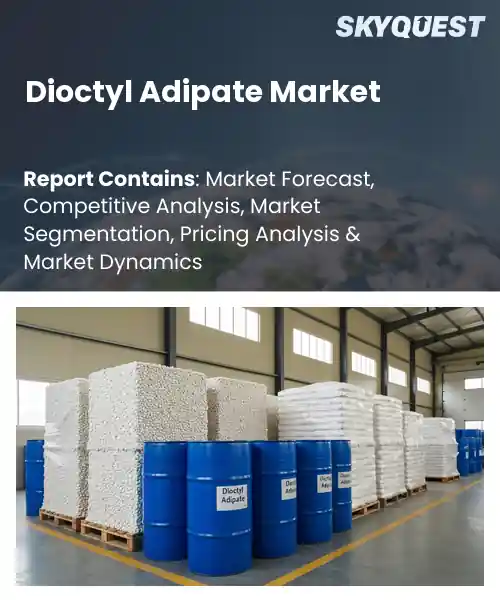
Dioctyl Adipate Market
Report ID: SQMIG15E3905
Report ID: SQMIG15E3905
[email protected]
USA +1 351-333-4748
Report ID:
SQMIG15E3905 |
Region:
Global |
Published Date: July, 2026
Pages:
157
|Tables:
127
|Figures:
77


Global Dioctyl Adipate Market size was valued at USD 2.55 Billion in 2024 and is poised to grow from USD 2.69 Billion in 2025 to USD 4.06 Billion by 2033, growing at a CAGR of 5.3% during the forecast period (2026-2033).
The dioctyl adipate (DOA) market encompasses the production and distribution of a plasticizer used primarily in PVC formulations, automotive interiors, and hydraulic fluids. Its significance stems from the ability of DOA to impart flexibility and performance while meeting environmental regulations. Historically, demand grew alongside the expansion of the automotive and construction sectors in the 2000s, when manufacturers sought alternatives to phthalate‑based plasticizers. For example, European carmakers adopted DOA in seat‑belt covers to comply with REACH standards, prompting a measurable uptick in shipments. This evolution reflects a broader shift toward safer additives, establishing DOA as a cornerstone of modern polymer engineering. One key factor driving the global DOA market forward is the rising demand for energy‑efficient hydraulic systems in renewable‑energy installations, where the plasticizer’s volatility reduces power loss and extends equipment life. As wind‑farm turbines employ gearboxes, manufacturers replace traditional oils with DOA‑based fluids, a change that lowers maintenance cycles and improves net‑capacity factors. This advantage opens opportunities for DOA suppliers to partner with OEMs in the wind and solar sectors, creating new revenue streams beyond automotive applications. Consequently, investment in advanced DOA formulations that meet higher viscosity‑temperature specifications accelerates, reinforcing market expansion and prompting broader adoption across sustainable‑technology supply chains.
How is AI-driven automation influencing the Dioctyl adipate market?
AI driven automation is reshaping how dioctyl adipate is produced and delivered. Machine learning models now monitor reactor conditions in real time, allowing plants to fine tune temperature and feed rates without manual intervention. Predictive maintenance algorithms anticipate equipment wear, cutting downtime and waste. Digital twins simulate formulation changes, helping chemists achieve target performance faster. Supply chain platforms use AI to forecast demand spikes, aligning raw material purchases with market needs. Together these tools improve efficiency, lower costs and boost the reliability of a market that is expanding to meet growing plasticizer demand.BASF SE March 2026, introduced an AI powered reactor optimization system that reduces energy use and improves product consistency, accelerating production cycles and supporting market growth. The system integrates sensor data with machine learning to adjust feed composition, cutting off spec batches and shortening changeover times for faster time to market.
Market snapshot - (2026-2033)
Global Market Size
USD 2.55 Billion
Largest Segment
Technical Grade
Fastest Growth
Medical Grade
Growth Rate
5.3% CAGR
To get more insights on this market click here to Request a Free Sample Report
Global dioctyl adipate market is segmented by grade, purity type, application, end user and region. Based on grade, the market is segmented into Technical Grade, Food Grade and Medical Grade. Based on purity type, the market is segmented into 98% Purity, 99% Purity, 99.5% Purity and Above 99.5% Purity. Based on application, the market is segmented into Polymer Plasticizer, Rubber Additive, Paint Formulation, Coatings Additive, Varnishes Component and Others. Based on end user, the market is segmented into Packaging Industries, Cable Manufacturing, Wiring Manufacturing, Consumer Goods, Medical Applications, Wall Coverings, Flooring Production, Automotive Manufacturing and Others. Based on region, the market is segmented into North America, Europe, Asia Pacific, Latin America and Middle East & Africa.
Technical Grade segment dominates because it offers a balanced combination of performance and cost that meets the broad requirements of most dioctyl adipate users. Its versatility enables it to function effectively as a general purpose plasticizer in diverse polymer matrices, while its price competitiveness makes it the default choice for manufacturers seeking reliable elasticity without specialized compliance. This widespread applicability consolidates its leadership across multiple end use categories.
Meanwhile, Food Grade segment emerges as the most rapidly expanding area because rising consumer awareness of food safety drives manufacturers to adopt phthalate free plasticizers for food contact uses. Regulatory encouragement and the push toward sustainable packaging intensify demand, prompting formulators to blend higher purity dioctyl adipate into food grade polymers. This momentum fuels market expansion and creates new opportunity corridors.
Polymer Plasticizer segment leads because dioctyl adipate provides exceptional flexibility and low temperature performance that manufacturers require for a wide range of plastic products. Its compatibility with common polymer families such as PVC and TPU enables consistent processing and end use durability, while its cost efficiency makes it the preferred choice for large scale production. These attributes cement its leading position across the application landscape of the market.
On the other hand, Paint Formulation segment is witnessing the strongest growth momentum because manufacturers are seeking low VOC, phthalate free plasticizers to meet stricter environmental standards in coatings. Dioctyl adipate’s excellent solvency and migration resistance make it ideal for modern paint systems, prompting formulators to increase its inclusion. This surge fuels broader adoption of advanced coatings and expands market opportunities.
To get detailed segments analysis, Request a Free Sample Report
Asia Pacific commands a leading position through a combination of expansive manufacturing ecosystems, deep expertise in polymer processing, and a proactive approach to product innovation. The region’s automotive and consumer goods sectors rely heavily on high‑performance plasticizers, creating sustained demand for dioctyl adipate. Strong collaboration between chemical producers and end‑user industries accelerates formulation improvements and cost efficiencies. Government policies that encourage advanced material development and environmental stewardship further reinforce market leadership, while strategic investments in petrochemical infrastructure ensure reliable supply and rapid response to evolving application requirements.
Dioctyl Adipate Market in Japan benefits from a mature automotive supply chain that prioritises durability and performance, driving consistent usage in interior components and exterior coatings. The country’s emphasis on precision engineering and stringent quality standards fosters a preference for reliable plasticizers, reinforcing demand across electronics and high‑tech manufacturing. Collaborative research initiatives between chemical firms and industrial users support continuous improvement of product characteristics, aligning with Japan’s focus on sustainability and resource efficiency.
Dioctyl Adipate Market in South Korea is propelled by a vibrant electronics and display industry that requires stable, low‑temperature plasticizers for advanced polymer applications. The nation’s rapid adoption of green manufacturing practices encourages the use of dioctyl adipate as a versatile, low‑toxicity option. Strong ties between local chemical producers and downstream manufacturers enable swift adaptation to market needs, while government incentives for high‑value material development sustain a competitive edge in the regional supply chain.
North America experiences rapid expansion due to its diversified industrial base, robust demand for high‑performance plastics, and a forward‑looking regulatory environment that emphasizes safety and environmental compliance. The United States and Canada host extensive automotive, construction, and consumer goods sectors that rely on dioctyl adipate for flexibility and durability in a wide range of products. Ongoing investment in research and development drives formulation enhancements, while strong distribution networks ensure timely delivery to manufacturers. Collaborative efforts between chemical suppliers and end‑users foster innovation, positioning the region as a dynamic hub for advanced plasticizer applications.
Dioctyl Adipate Market in the United States is shaped by a large automotive manufacturing landscape that values material resilience and performance consistency. The sector’s focus on lightweight, durable components fuels steady demand for reliable plasticizers. Additionally, the consumer goods industry’s emphasis on product safety and regulatory compliance reinforces the preference for dioctyl adipate. Continuous collaboration between chemical producers and design engineers supports the development of tailored solutions that meet evolving performance criteria across diverse applications.
Dioctyl Adipate Market in Canada benefits from a strong presence of specialty polymer manufacturers that prioritize high‑quality plasticizers for construction and industrial equipment. The country’s commitment to environmental stewardship encourages the adoption of low‑toxicity additives, aligning with market expectations for sustainable material choices. Close partnerships between local chemical firms and end‑users facilitate rapid adaptation to specific performance requirements, reinforcing the role of dioctyl adipate in Canada’s advanced manufacturing ecosystem.
Europe strengthens its position through a combination of stringent regulatory frameworks, advanced research capabilities, and a deep‑rooted tradition of high‑quality manufacturing. The region’s automotive, aerospace, and packaging industries demand plasticizers that meet rigorous safety and performance standards, making dioctyl adipate a preferred choice. Collaborative innovation clusters across key economies drive continuous improvement of material properties, while sustainability initiatives promote the use of low‑impact additives. Integrated supply chains and a focus on circular economy principles further enhance Europe’s competitive advantage in the global dioctyl adipate landscape.
Dioctyl Adipate Market in Germany is driven by a strong automotive engineering sector that emphasizes precision and long‑term durability in component design. The country’s rigorous quality standards and focus on environmental compliance encourage the selection of reliable, low‑toxicity plasticizers. Close cooperation between chemical manufacturers and industrial partners supports the development of customized solutions that align with Germany’s commitment to high‑performance, sustainable material usage.
Dioctyl Adipate Market in the United Kingdom reflects a dynamic blend of aerospace, construction, and consumer goods industries that require versatile plasticizers for demanding applications. The market benefits from a robust research ecosystem that advances formulation science, ensuring that dioctyl adipate meets stringent performance and safety criteria. Collaborative networks between suppliers and manufacturers facilitate rapid adoption of innovative material solutions across the UK’s diverse industrial landscape.
Dioctyl Adipate Market in France is supported by a vibrant packaging and cosmetics sector that values material stability and regulatory adherence. French manufacturers prioritize additives that deliver consistent performance while aligning with strict safety guidelines. Ongoing partnerships between chemical producers and design experts foster the creation of tailored plasticizer blends, reinforcing France’s role in advancing high‑quality, sustainable applications of dioctyl adipate.
To know more about the market opportunities by region and country, click here to
Buy The Complete Report
Increasing Demand In Automotive Lubricants
Growth Of Flexible PVC Applications
Stringent Environmental Emission Regulations
Volatile Crude Oil Price Fluctuations
Request Free Customization of this report to help us to meet your business objectives.
Competition in the dioctyl adipate sector is intensifying as incumbents seek sustainable feedstock and differentiate product lines. Companies are pursuing tech‑driven innovation, exemplified by Syntetica’s Series Seed raise to scale its nylon‑recycling process and partner with a leading polymer maker, while digital‑analytics firms such as Digital Garage provide market intelligence that fuels strategic M&A and partnership decisions.
Top Player’s Company Profile
Recent Developments
SkyQuest’s ABIRAW (Advanced Business Intelligence, Research & Analysis Wing) is our Business Information Services team that Collects, Collates, Correlates, and Analyses the Data collected by means of Primary Exploratory Research backed by robust Secondary Desk research. As per SkyQuest analysis the global dioctyl adipate market is projected to reach USD 4.06 billion by 2033, driven primarily by rising demand for high‑performance automotive lubricants that require low‑temperature fluidity and oxidative stability. A second engine of growth is the expanding use of flexible PVC in construction and consumer‑goods applications, where the plasticizer’s migration resistance and durability are prized. The Technical Grade segment remains the market leader because it balances cost and performance for most users. Asia Pacific dominates the landscape thanks to its extensive polymer processing base and strong automotive sector. However, stringent environmental emission regulations pose a restraint by increasing compliance costs and limiting volume expansion.
| Report Metric | Details |
|---|---|
| Market size value in 2024 | USD 2.55 Billion |
| Market size value in 2033 | USD 4.06 Billion |
| Growth Rate | 5.3% |
| Base year | 2024 |
| Forecast period | (2026-2033) |
| Forecast Unit (Value) | USD Billion |
| Segments covered |
|
| Regions covered | North America (US, Canada), Europe (Germany, France, United Kingdom, Italy, Spain, Rest of Europe), Asia Pacific (China, India, Japan, Rest of Asia-Pacific), Latin America (Brazil, Rest of Latin America), Middle East & Africa (South Africa, GCC Countries, Rest of MEA) |
| Companies covered |
|
| Customization scope | Free report customization with purchase. Customization includes:-
|
To get a free trial access to our platform which is a one stop solution for all your data requirements for quicker decision making. This platform allows you to compare markets, competitors who are prominent in the market, and mega trends that are influencing the dynamics in the market. Also, get access to detailed SkyQuest exclusive matrix.
Table Of Content
Executive Summary
Market overview
Parent Market Analysis
Market overview
Market size
KEY MARKET INSIGHTS
COVID IMPACT
MARKET DYNAMICS & OUTLOOK
Market Size by Region
KEY COMPANY PROFILES
Methodology
For the Dioctyl Adipate Market, our research methodology involved a mixture of primary and secondary data sources. Key steps involved in the research process are listed below:
1. Information Procurement: This stage involved the procurement of Market data or related information via primary and secondary sources. The various secondary sources used included various company websites, annual reports, trade databases, and paid databases such as Hoover's, Bloomberg Business, Factiva, and Avention. Our team did 45 primary interactions Globally which included several stakeholders such as manufacturers, customers, key opinion leaders, etc. Overall, information procurement was one of the most extensive stages in our research process.
2. Information Analysis: This step involved triangulation of data through bottom-up and top-down approaches to estimate and validate the total size and future estimate of the Dioctyl Adipate Market.
3. Report Formulation: The final step entailed the placement of data points in appropriate Market spaces in an attempt to deduce viable conclusions.
4. Validation & Publishing: Validation is the most important step in the process. Validation & re-validation via an intricately designed process helped us finalize data points to be used for final calculations. The final Market estimates and forecasts were then aligned and sent to our panel of industry experts for validation of data. Once the validation was done the report was sent to our Quality Assurance team to ensure adherence to style guides, consistency & design.
Analyst Support
Customization Options
With the given market data, our dedicated team of analysts can offer you the following customization options are available for the Dioctyl Adipate Market:
Product Analysis: Product matrix, which offers a detailed comparison of the product portfolio of companies.
Regional Analysis: Further analysis of the Dioctyl Adipate Market for additional countries.
Competitive Analysis: Detailed analysis and profiling of additional Market players & comparative analysis of competitive products.
Go to Market Strategy: Find the high-growth channels to invest your marketing efforts and increase your customer base.
Innovation Mapping: Identify racial solutions and innovation, connected to deep ecosystems of innovators, start-ups, academics, and strategic partners.
Category Intelligence: Customized intelligence that is relevant to their supply Markets will enable them to make smarter sourcing decisions and improve their category management.
Public Company Transcript Analysis: To improve the investment performance by generating new alpha and making better-informed decisions.
Social Media Listening: To analyze the conversations and trends happening not just around your brand, but around your industry as a whole, and use those insights to make better Marketing decisions.
REQUEST FOR SAMPLE
 REQUEST FREE CUSTOMIZATION


Want to customize this report? This report can be personalized according to your needs. Our analysts and industry experts will work directly with you to understand your requirements and provide you with customized data in a short amount of time. We offer $1000 worth of FREE customization at the time of purchase.
Feedback From Our Clients


 USA (+1) 351-333-4748

