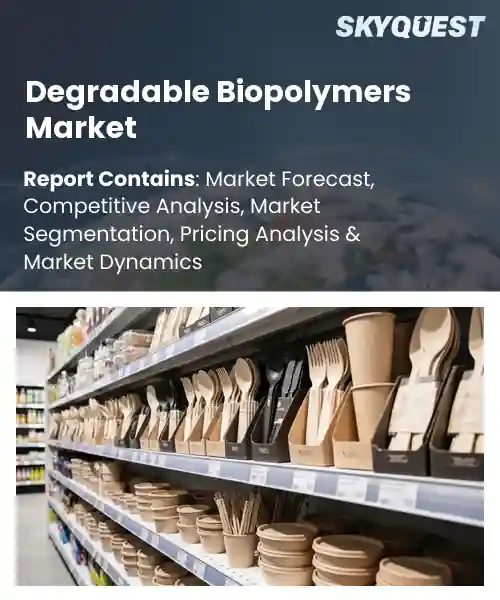
Degradable Biopolymers Market
Report ID: SQMIG15E3384
Report ID: SQMIG15E3384
[email protected]
USA +1 351-333-4748
Report ID:
SQMIG15E3384 |
Region:
Global |
Published Date: March, 2026
Pages:
157
|Tables:
94
|Figures:
76


Global Degradable Biopolymers Market size was valued at USD 12.0 Billion in 2024 and is poised to grow from USD 13.8 Billion in 2025 to USD 42.21 Billion by 2033, growing at a CAGR of 15.0% during the forecast period (2026-2033).
The global degradable biopolymer market has been reshaped and industry priorities have changedas a result of growing regulatory pressure and consumer demand for reduced plastic pollution. Degradable biopolymers are derived from available biological sources that can be broken down under certain environmental conditions, and they can reduce life cycle emissions and reduce landfill waste. The degradable biopolymer sector has moved from niche research labs to commercial production over the past few decades with the example of polylactic acid (PLA) being used in packaging and PHAs (polyhydroxyalkanoates) being used to make agricultural films. Ongoing investment in refining food supplies and processing technologies have improved the performance of the materials as well as their cost competitiveness, which will further expand the market for degradable biopolymers.
With an increase in production capacity for degradable biopolymers, a driver of increased rates of adoption on a global level is the declining costs of bio-feedstock and processing, which directly affects commercial viability and creates opportunities for new market segments. As fermentation and enzymatic conversion advance (increase in scale), unit costs will decrease, resulting in companies in the packaging, consumer products, and agricultural sectors substituting traditional plastic materials with PLA and custom-made polyester degradable biopolymers.
How is AI Accelerating Innovation in the Degradable Biopolymers Market?
Artificial Intelligence (AI), through combining predictive modeling with actual, experimental practice, is speeding up the innovative progress in the degradable biopolymers market. Among the critical components of this progress are aspects enabled by machine learning (i.e., data-driven predicting the required properties of the biopolymer) as well as aspects supported by the ability to use generative formulation techniques along with the rapidly automated testing that utilizes high-throughput methodologies. Using these tools, scientists can now prioritize chemical combinations that provide both optimal performance and biodegradability levels. On a current basis, much faster timeframes (iteration cycles) are realized through use of AI. Additionally, the ability to utilize AI to assist with optimization of all of the necessary design parameters (e.g., strain engineering, choice of catalysts, processing conditions, etc.) while optimizing compatibility with various recycling streams, allows for better successful commercial scaling processes.
Market forces in the market are driving a greater demand for developable, sustainable alternatives while simultaneously creating increasing levels of regulatory pressure for proven developable products. In conjunction with the above-described benefits, tools that minimize the risk of product development and lead time to commercial product availability will continue to facilitate innovative advancements in tangible and practical applications.
Market snapshot - 2026-2033
Global Market Size
USD 12.0 Billion
Largest Segment
Fastest Growth
PLA (Polylactic Acid)
Growth Rate
15.0% CAGR
To get more insights on this market click here to Request a Free Sample Report
Global degradable biopolymers market is segmented into chemical class/type, degradation mechanism, application industry and region. Based on chemical class/type, the market is segmented into PLA (Polylactic Acid), PHA (polyhydroxyalkanoates), PBS (polybutylene succinate), starch blends and PBAT (polybutylene adipate terephthalate). Based on degradation mechanism, the market is segmented into biodegradable, compostable and oxo-degradable. Based on application industry, the market is segmented into flexible packaging, rigid packaging, agricultural mulch films, medical & healthcare and consumer goods. Based on region, the market is segmented into North America, Europe, Asia Pacific, Latin America and Middle East & Africa.
The PLA segment has taken the lead with large degradable biopolymers market share because it utilizes established manufacturing techniques, has clear material characteristics, and tunable mechanical properties that align with the key needs of the industry. Aligning with the industry's requirements for biodegradable polymers, converters and brands will have more incentives to use PLA in their packaging formats. Lactic acid production and established supply chain relationships will help stabilize costs, providing converters and brands with incentives to buy PLA over the long term, helping to create a leadership position for PLA in the overall market.
As per degradable biopolymers market analysis, the PHA segment of the market is expanding very quickly because PHA is truly biodegradable in a wide range of environments and is also being produced through cutting-edge technology. New developments related to the production of PHA, including feedstock flexibility and property tunability, will result in many applications of PHA where customers are looking for assurance of biodegradability, e.g., agricultural films, and medical disposables, and open new higher margin applications and opportunities for large scale production investment.
As per degradable biopolymers market forecast, the flexible packaging segment is the fastest growing in the market to hold the largest potential opportunity for the use of degradable biopolymers. Manufacturers will utilize the most versatile materials with processability, clarity, and barrier property characteristics to meet consumer expectations for convenience and shelf life, and thus, formulators will focus on materials with flexible chemistries. The procurement of materials for manufacturing brands that have sustainability commitments, as well as the need to reduce waste, will help drive supply chain consolidation.
As per degradable biopolymers market outlook, the medical & healthcare segment is emerging as a fast-growing market with very strict sterility requirements and growing demand for single-use biodegradable medical devices and disposables. Advancements in both the development of medical grade biopolymers as well as government support for the safe treatment of waste are accelerating the adoption of biodegradable medical devices. Together, these trends are creating high-value niche opportunities for new formulations and contract manufacturing, which will help create new market opportunities.
To get detailed segments analysis, Request a Free Sample Report
Asia Pacific region dominates due to their combined manufacturing capabilities in terms of scale, well-integrated supply chains and concentrated research and development ecosystems. Strong industrial capacity exists to produce large quantities of biopolymer feedstocks and biopolymer products, while the proximity to the raw materials, as well as the specialized chemical industries, provide for optimum time-to-market. Partnerships between universities, research institutes and industry encourage fast-tracked formulation and application of innovation throughout the packaging, medical, and agricultural segments.
Degradable biopolymers in Japan are a well-developed segment based on advanced materials research, high level of collaboration between academia and industry, and development of chemical manufacturing expertise. Laboratory research and innovations developed at universities and research institutes translate into high-quality commercialization through the services provided by contract manufacturers who use highly specialized processing techniques. The Japanese market focuses on the development of medical devices, specialized packaging and functional films, as these sectors place significant importance on both performance requirements and regulatory compliance.
Degradable biopolymers in South Korea are characterized by their significant scale-up industrial capabilities, vigorous research and development activities, and highly specializedpolymer processing expertise. Large manufacturers and small start-up companies actively collaborate in adapting the formulation of degradable biopolymers to meet customer requirements in packaging, electronic components, and specialized applications. Subsidies from government and industry encourage demonstration projects and support integration with manufacturing ecosystems.
The strong development of the European degradable biopolymers market is a result of the established policy framework that supports circular economy principles and materials sustainability. There is increasing demand for biodegradable products as a result of consumer awareness and brand commitments to reduce dependence on traditional plastic product categories, like packaging, textiles, and agriculture. Availability of effective recycling systems and waste management practices helps facilitate the integration of degradable products into global circular economy strategies. By utilizing public procurement policies and local company sustainability projects, countries support the initial adoption of degradable biopolymer products. The presence of an extensive network of research facilities, technology suppliers, and converters provides rapid opportunities to convert newly developed chemistries into large-scale manufactured products. Collaborative supply chains, between raw material suppliers, polymer producers and end-users, provide a reliable connection between the use of biodegradable products and regional regulations and market needs, ultimately increasing the potential for Europe to be both the leading market and center for innovation in this emerging market segment.
As per degradable biopolymers market regional outlook, Germany market is focused on a highly advanced industry comprised of chemical and polymer manufacturing companies. Large and specialty converters within Germany produce high-quality biodegradable formulations that meet the needs of strict regulatory and product quality specifications. Through strong collaboration between research institutions, market associations, and leading brands in the industry, there are numerous pilot projects being implemented for biodegradable packaging and production in Germany. An emphasis on material traceability, adherence to standardized testing methods, and compatibility with circular economy waste management systems are creating the building blocks for continued growth of this market and adoption of industrial uses of biodegradable plastics.
As per degradable biopolymers market regional forecast, UK is thriving due to an energetic innovation environment, the presence of many nimble, fast-growing start-ups and strong engagement of the private sector, all of which are facilitating the rapid commercialization of these biopolymers. A surge in retailer demand for biodegradable packaging solutions has resulted in testing of biodegradable packaging solutions within the supply chains of retailers and brands. The rapid iteration and scaling of products is also facilitated by the partnerships that occur between universities, polymer innovators and converters.
The degradable biopolymers market in France is developing as a result of strong academic research, innovation hubs and active participation from brands. The push to create sustainable alternatives is supported by the eco-design and high-quality packaging provided by the food, cosmetics and luxury segments. The pilot production of specialty applications and the extensive collaboration of polymer developers with converters allow manufacturers to create customized solutions. Public support initiatives and private sector partnerships encourage experimentation and gradual scaling of the market, which positions France as a developing regional hub for the degradable biopolymers industry.
As per degradable biopolymers industry analysis, North America is expanding its capacity to produce degradable biopolymers through a combination of innovation, manufacturing scale, and partnerships for industry-related research. There is an established network of polymer chemists, pilot manufacturing facilities, and converters throughout North America, which is helping to develop application-specific solutions quickly for the packaging, healthcare, and specialized industrial markets.
The degradable biopolymers market in the U.S. is supported by a large body of research on new materials, active investment from the private sector in developing new biopolymers and the ability of converters to produce commercial formulations for these new biopolymers. Philanthropic commitments to sustainability from many of the largest brands and procurement of alternative materials are helping to drive the demand for these materials. Collaboration between universities, research laboratories, and corporations is enhancing the speed at which new technologies are being deployed in packaging, medical devices, and industrial applications. Efforts focused on ensuring certification of products, equivalency in performance with non-degradable materials, and building partnerships in the supply chain are providing market maturity and facilitating wider acceptance of degradable biopolymers.
The degradable biopolymers market in Canada is heavily influenced by the availability of a wide range of biomass feedstocks and provincial incentive programs supporting the development of sustainable materials. Manufacturers partner with converters to develop custom formulations for degradable biopolymers used in packaging, agricultural films, and medical applications. Working with industry partners to evaluate products through lifecycle assessment and provide clear sustainability reporting will improve confidence in the market. Cross-border cooperation with regional stakeholders and investment in pilot projects will accelerate the commercialization of degradable biopolymers and continue to strengthen the integration of the North American supply chain for these products.
To know more about the market opportunities by region and country, click here to
Buy The Complete Report
Regulatory Incentives and Policies
The presence of clear regulations and policies ensures an environment where manufacturing, investing, and downstreaming can all find confidence in making the transition to using biodegradable biopolymers. Regulations will also improve the sustainability of alternatives through decreased regulations as well as procurement policies that promote the use of sustainable alternatives instead of conventional sources. Regulations promote investments in supply chain technologies while allowing suppliers to build reputable relationships with their customers and ultimately speed up acceptance of these sustainable alternatives by developing trust between customers and suppliers without relying on temporary voluntary programs.
Corporate Sustainability Commitments
Long term sustainable commitments from major retailers and brands, provide guidance for how businesses should create products and source materials that achieve their long term environmental objectives through sourcing biodegradable biopolymers, which creates constant procurement demands on suppliers so that suppliers reformulate product packaging and develop new production lines as well as obtaining certification for new product lines. The interest in reducing the overall environmental impact of their products and being able to meet stakeholder expectations provide additional motivation for suppliers and customers to work together collaboratively throughout the entire value chain to develop long-term agreements and create premium prices for sustainable products. This helps to encourage suppliers to expand and add capacity in their production of biodegradable alternatives.
High Production Cost Structure
High costs for production of biodegradable polymers are restricting their ability to compete with well-established traditional plastics and reducing the rate of overall market adoption. High input costs, processing methods that are not as widely used, and economies of scale that are not as developed, lead to higher costs for finished products and keep cost-conscious manufacturers and purchasers from using biodegradable polymers. As margins are tight or short-term cost savings are more important for end users, the use of traditional materials procurement results in fewer signals of demand that can support capacity expansion. The resulting price premium for biodegradable polymers limits the amount of funds available for investment, lengthens the time required for new formulas to become commercial products, and limits degradable biopolymers market growth.
Challenges with Feedstock Supply Chain
Feedstock supply chain challenges are adding uncertainty with regards to the sustainable and consistent production and scaling of biodegradable polymers and therefore restricting the expansion of the market. Variability of availability, seasonality of supply, and regional dependence all make procurement more complex and also increase the risk of operations for manufacturers looking to maintain steady supply streams. Competing demands from various industries and the need to adhere to sustainable sourcing criteria increase the pressure on supply availability and therefore require significantly more due diligence and traceability from suppliers. These challenges increase the perceived risk associated with supply and reduce the likelihood of long-term supply contracts thus limiting the manufacturer’s ability to guarantee that its customers will have access to products and ultimately reducing sales in the market.
Request Free Customization of this report to help us to meet your business objectives.
The competitive environment is influenced by the strategies of mergers and acquisitions (M&A) in addition to development strategies between industry players to establish production relationships. The overall trend is to consolidate a number of brands into a single supply chain that can be used repeatedly. To illustrate this point, Versalis acquired Novamont in October 2023, Carbios teamed up with L’Oréal, Nestlé and PepsiCo to form a packaging consortium, and Polymateria grew through a large capital investment and a major development deal with Lotte Chemical all in an effort to drive technological differentiation and faster time to market.
Circular Design Integration: With growing interest in circular design in the market, there is a corresponding increase in demand for biodegradable/compostable biopolymers, as brands are redesigning their package offerings to be recyclability/no end-of-life recovery solutions. Manufacturers, retailers and waste managers are working together to accelerate the adoption of design for disassembly and mono material, in order to simplify processing. In addition to promoting lifecycle thinking, providing material transparency, and creating partnerships that allow formulation choices to be aligned with evolving recovery and sustainability infrastructures, there is an increase in consumer preference for regenerative or natural products.
Biopolymer Innovation Ecosystems: Advancing performance and application diversity within the area of biodegradable/compostable biopolymers is being driven by the establishment of a growing innovation ecosystem an environment. Licensing, developing, and sharing platforms will allow for quicker time to market and will provide support to create tailored solutions for packaging, agricultural, and consumer products. The degradable biopolymers market trend will also aid with commercialization, value chain integration, and differentiation of products based on functionality, traceability, and regulatory alignment.
SkyQuest’s ABIRAW (Advanced Business Intelligence, Research & Analysis Wing) is our Business Information Services team that Collects, Collates, Correlates, and Analyses the Data collected by means of Primary Exploratory Research backed by robust Secondary Desk research.
As per SkyQuest analysis, the global degradable biopolymers industry is being driven primarily by escalating regulatory and consumer pressure to reduce plastic pollution, which is compelling brands and regulators to adopt biodegradable alternatives. Falling biofeedstock and processing costs serve as a second powerful driver by improving commercial viability and expanding applications. However high production costs remain a key restraint, limiting competitiveness versus conventional plastics. Asia Pacific dominates the market owing to large-scale manufacturing, integrated supply chains and strong R&D ecosystems. PLA is the leading segment given its mature supply chain, processing compatibility and suitability for packaging applications. These dynamics support steady growth while highlighting cost and supply challenges.
| Report Metric | Details |
|---|---|
| Market size value in 2024 | USD 12.0 Billion |
| Market size value in 2033 | USD 42.21 Billion |
| Growth Rate | 15.0% |
| Base year | 2024 |
| Forecast period | 2026-2033 |
| Forecast Unit (Value) | USD Billion |
| Segments covered |
|
| Regions covered | North America (US, Canada), Europe (Germany, France, United Kingdom, Italy, Spain, Rest of Europe), Asia Pacific (China, India, Japan, Rest of Asia-Pacific), Latin America (Brazil, Rest of Latin America), Middle East & Africa (South Africa, GCC Countries, Rest of MEA) |
| Companies covered |
|
| Customization scope | Free report customization with purchase. Customization includes:-
|
To get a free trial access to our platform which is a one stop solution for all your data requirements for quicker decision making. This platform allows you to compare markets, competitors who are prominent in the market, and mega trends that are influencing the dynamics in the market. Also, get access to detailed SkyQuest exclusive matrix.
Table Of Content
Executive Summary
Market overview
Parent Market Analysis
Market overview
Market size
KEY MARKET INSIGHTS
COVID IMPACT
MARKET DYNAMICS & OUTLOOK
Market Size by Region
KEY COMPANY PROFILES
Methodology
For the Degradable Biopolymers Market, our research methodology involved a mixture of primary and secondary data sources. Key steps involved in the research process are listed below:
1. Information Procurement: This stage involved the procurement of Market data or related information via primary and secondary sources. The various secondary sources used included various company websites, annual reports, trade databases, and paid databases such as Hoover's, Bloomberg Business, Factiva, and Avention. Our team did 45 primary interactions Globally which included several stakeholders such as manufacturers, customers, key opinion leaders, etc. Overall, information procurement was one of the most extensive stages in our research process.
2. Information Analysis: This step involved triangulation of data through bottom-up and top-down approaches to estimate and validate the total size and future estimate of the Degradable Biopolymers Market.
3. Report Formulation: The final step entailed the placement of data points in appropriate Market spaces in an attempt to deduce viable conclusions.
4. Validation & Publishing: Validation is the most important step in the process. Validation & re-validation via an intricately designed process helped us finalize data points to be used for final calculations. The final Market estimates and forecasts were then aligned and sent to our panel of industry experts for validation of data. Once the validation was done the report was sent to our Quality Assurance team to ensure adherence to style guides, consistency & design.
Analyst Support
Customization Options
With the given market data, our dedicated team of analysts can offer you the following customization options are available for the Degradable Biopolymers Market:
Product Analysis: Product matrix, which offers a detailed comparison of the product portfolio of companies.
Regional Analysis: Further analysis of the Degradable Biopolymers Market for additional countries.
Competitive Analysis: Detailed analysis and profiling of additional Market players & comparative analysis of competitive products.
Go to Market Strategy: Find the high-growth channels to invest your marketing efforts and increase your customer base.
Innovation Mapping: Identify racial solutions and innovation, connected to deep ecosystems of innovators, start-ups, academics, and strategic partners.
Category Intelligence: Customized intelligence that is relevant to their supply Markets will enable them to make smarter sourcing decisions and improve their category management.
Public Company Transcript Analysis: To improve the investment performance by generating new alpha and making better-informed decisions.
Social Media Listening: To analyze the conversations and trends happening not just around your brand, but around your industry as a whole, and use those insights to make better Marketing decisions.
REQUEST FOR SAMPLE
 REQUEST FREE CUSTOMIZATION
Global Degradable Biopolymers Market size was valued at USD 12.0 Billion in 2024 and is poised to grow from USD 13.8 Billion in 2025 to USD 42.21 Billion by 2033, growing at a CAGR of 15.0% during the forecast period (2026-2033).
Competitive landscape is shaped by strategic M&A, industrial partnerships and rapid product innovation as incumbents consolidate and brands secure circular supply chains; for example Versalis completed the acquisition of Novamont in Oct 2023, Carbios formed a packaging consortium with L'Oréal, Nestlé and PepsiCo, and Polymateria expanded via a sizable investment and a development deal with Lotte Chemical, driving tech differentiation and faster market entry. 'BASF SE', 'NatureWorks LLC', 'Novamont S.p.A.', 'Total Corbion PLA', 'Green Dot Bioplastics', 'Bio-on S.p.A.', 'Tereos', 'Biome Bioplastics', 'Danimer Scientific, Inc.', 'Braskem', 'Eastman Chemical Company', 'Novamont', 'PureCycle Technologies', 'Algix', 'Trellis Earth Products', 'Plastics for Change', 'Circleback', 'HExpol Compounding', 'Bioplastics International', 'Genomatica'
Regulatory incentives and coherent policy frameworks create a predictable environment that encourages manufacturers, investors, and downstream users to transition toward degradable biopolymers. By reducing regulatory uncertainty and offering procurement preferences, incentives improve the commercial viability of sustainable alternatives and lower perceived adoption risk. Clear standards and supportive measures stimulate supply chain investments, enable scale up of production facilities, and foster research collaborations, which together build industry confidence and accelerate market acceptance without relying on transient voluntary initiatives. This regulatory clarity encourages long term planning and commitment across sectors.
Circular Design Integration: Circular design principles are increasing demand for degradable biopolymers as brands redesign packaging to prioritize end of life recovery, compostability and material recyclability. Collaboration among manufacturers, retailers and waste managers is accelerating adoption through design for disassembly and mono material approaches that simplify processing. Consumer preference for regenerative products and corporate commitments to closed loop systems encourage substitution of conventional plastics. The trend emphasizes lifecycle thinking, material transparency and partnerships that align formulation choices with evolving recovery infrastructure and sustainability.
Pacific region dominates due to their combined manufacturing capabilities in terms of scale, well-integrated supply chains and concentrated research and development ecosystems.
The PLA (Polylactic Acid) segment leads the market due to its well-established manufacturing processes, stable supply chain, and strong suitability for packaging applications with tunable mechanical properties.
High production costs, including expensive raw materials, limited economies of scale, and complex processing techniques, restrict the competitiveness of degradable biopolymers compared to conventional plastics.
The flexible packaging segment is the fastest growing due to increasing demand for sustainable packaging solutions that offer flexibility, durability, and improved shelf-life performance.


Want to customize this report? This report can be personalized according to your needs. Our analysts and industry experts will work directly with you to understand your requirements and provide you with customized data in a short amount of time. We offer $1000 worth of FREE customization at the time of purchase.
Feedback From Our Clients


 USA (+1) 351-333-4748

