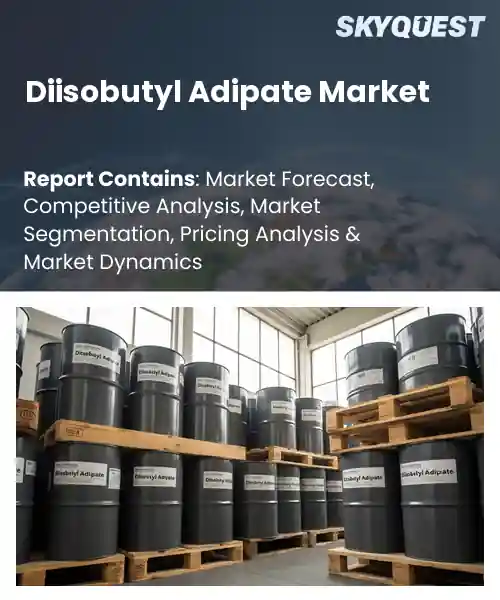
Diisobutyl Adipate Market
Report ID: SQMIG35A3767
Report ID: SQMIG35A3767
[email protected]
USA +1 351-333-4748
Report ID:
SQMIG35A3767 |
Region:
Global |
Published Date: June, 2026
Pages:
157
|Tables:
116
|Figures:
77


Global Diisobutyl Adipate Market size was valued at USD 20.0 Million in 2024 and is poised to grow from USD 20.92 Million in 2025 to USD 29.98 Million by 2033, growing at a CAGR of 4.6% during the forecast period (2026-2033).
The key trend driving the global diisobutyl adipate sector is the shift away from traditional phthalate plasticizers toward safer, low toxicity adipate esters, which has redefined formulation choices across plastics and personal care industries. Diisobutyl adipate serves as a low viscosity, good low temperature performance plasticizer and emollient used in PVC, films, adhesives, and its market matters because it links regulatory compliance with product safety. Over the past decade demand grew as regulators in Europe and North America restricted certain phthalates, prompting brand owners to qualify adipate based alternatives; at the same time Asia Pacific consumption expanded with rapid packaging growth.
This regulatory substitution has catalyzed growth factors and opened opportunities for manufacturers, because formulators seeking high performance, compliant additives have increased orders for diisobutyl adipate. As demand rose, producers invested in capacity expansions and support, enabling more competitive pricing and faster qualification for applications such as PVC cable sheathing, flexible films, sealants, and emollients. Concurrently, rising urbanization and ecommerce boosted packaging volumes, which in turn raised demand for safe plasticizers in food contact and medical films. On the supply side volatility in adipic acid feedstocks has encouraged research into bio based routes, creating a sustainability value proposition that accelerates adoption.
How is AI Optimizing Supply Chain Forecasting in the Diisobutyl Adipate Market??
AI is optimizing supply chain forecasting in the Diisobutyl adipate market by bringing together demand sensing, multi source data fusion, and scenario based simulation. Ingesting both internal and external signals, modeling feedstock and logistics constraints and utilizing explainable Machine Learning to improve decision-making around procurement and inventory management are key components of this approach. Currently, we see specialty chemical manufacturers leveraging these tools in order to provide better anticipation of their customers' ordering patterns and supply interruptions. In an extremely niche and regulatory-sensitive market, improved forecasting allows for better management of excess inventory/stock piles and quicker response times to customer demand and raw material supply disruptions.
In January 2025, Versalis launched a high purity bio based plasticizer aimed at adipate applications and this development underlines substitution risk and supply flexibility. AI driven forecasting helps map alternative feedstock flows and timing, enabling producers to switch production plans more confidently and support market efficiency and growth.
Market snapshot - (2026-2033)
Global Market Size
USD 20.0 Million
Largest Segment
Industrial Grade Diisobutyl Adipate
Fastest Growth
Cosmetic & Pharmaceutical Grade Diisobutyl Adipate
Growth Rate
4.6% CAGR
To get more insights on this market click here to Request a Free Sample Report
Global diisobutyl adipate market is segmented by product purity grade, application target formulation, end-use industry, distribution channel and region. Based on product purity grade, the market is segmented into industrial grade diisobutyl adipate and cosmetic & pharmaceutical grade diisobutyl adipate. Based on application target formulation, the market is segmented into plasticizers for polymers, solvent & chemical intermediates and emollients & cosmetics base. Based on end-use industry, the market is segmented into packaging industry, cosmetics & personal care, chemicals & petrochemicals and automotive & transportation. Based on distribution channel, the market is segmented into direct and indirect. Based on region, the market is segmented into North America, Europe, Asia Pacific, Latin America and Middle East & Africa.
Based on the global diisobutyl adipate market growth, industrial grade diisobutyl adipate segment dominates because it aligns with the high-volume, cost-sensitive requirements of polymer plasticizer use, offering acceptable purity for mass applications and easier sourcing at scale. Compatibility with typical polymer substrates and existing methods of production makes it easier for companies to formulate high-quality products and keep their prices low. Thus allowing manufacturers to focus on maintaining a consistent supply of goods at low prices relative to their competitors, encouraging customers to buy from them and consolidate their market share where large industrial buyers and demand from consumers exists.
However, cosmetic & pharmaceutical grade diisobutyl adipate is emerging as the most rapidly expanding area due to tightening purity and safety expectations in personal care and therapeutic formulations, rising demand for multifunctional emollients, and formulation innovation. Higher value applications and regulatory alignment are prompting investment and new product development, accelerating premium market opportunities.
Indirect segment dominates because independent distributors and wholesalers provide broad accessibility, inventory buffers, and technical sales support that match the diverse ordering patterns of formulators. Reduced procurement barriers across diverse end users are lower due to smaller order quantities, having faster lead times, and being able to provide logistics services in a bundled manner, which encourages greater trial and usage, and keeps demand high throughout again a variety of applications, thus stabilising the supply chains for manufacturers.
Meanwhile, direct distribution is the fastest growing route as manufacturers pursue closer customer relationships, customized supply agreements and digital ordering portals. Strategic direct sales enable tailored formulations, tighter quality control and better margin capture, encouraging producers to invest in direct logistics and account management, which expands strategic partnerships and high value long term contracts.
To get detailed segments analysis, Request a Free Sample Report
As per the global diisobutyl adipate market share, Asia Pacific dominates the industry due to a combination of large scale industrial capacity, cost efficient production ecosystems and concentrated end market demand across multiple manufacturing hubs. Regional strengths include a concentration of interconnected chemical products manufacturers, an abundance of transportation options, and numerous supply chain partners to provide continuous access to inputs and quickly deliver finished goods. The demand for chemical raw materials from various formulation-based industries (i.e. cosmetics, paints and coatings, specialty industrial uses) is especially high due to a strong focus on innovation and product development in the region. Policies that promote manufacturing growth and provide funding to improve process efficiencies through technical collaboration between suppliers and customers create competitive advantages to manufacturers.
Diisobutyl adipate market in Japan is characterized by demand from high performance applications and strong integration with specialty chemical manufacturers. Domestic formulators value consistent quality and collaboration with industrial users in automotive and electronics supply chains. Many companies that do business internationally or sell high-priced items in a domestic market have a strong emphasis on developing new ideas, meeting regulations, and providing efficient transportation and storage of their products.
Diisobutyl adipate market in South Korea benefits from close ties to advanced manufacturing and export driven chemical supply chains. Korean producers emphasize rapid scale up, technical service and close collaboration with downstream formulators in electronics, automotive and specialty coatings sectors. Logistics, supplier networks, and efficiency in operational performance drive the market. This will result in competitive ingredients and provide the foundation to develop tailored ingredients based on the needs of industrial and consumer markets.
Based on global diisobutyl adipate regional forecast, Rapid expansion of the industry in North America is driven by a dynamic mix of innovation oriented demand, strong industrial end markets and improving supply chain responsiveness. Local suppliers & distributors focus on tech, formulating or tailoring supply to be fit for the owner of a brand, in the segments of personal care, specialty coatings & performance materials. Greater emphasis will be directed toward establishing sustainable sources & more clarity around regulations will drive use of refined esters for the differentiation in applications. Stronger partnership models with manufacturers, contract manufacturers & research contracts will enable faster new product development & faster launch into the market. Cross border trade flows and established logistics corridors further enhance market agility, allowing suppliers to respond quickly to evolving customer preferences and to scale service offerings across diverse end use segments.
Diisobutyl adipate market in United States is driven by strong demand from formulation intensive sectors and well developed specialty chemicals ecosystem. To enable them to achieve their performance and sustainability goals, domestic suppliers focus on providing technical service, application support, and working closely together with brand owners. This environment encourages the innovation of formulations and the adoption of high-quality (refined) grades designed specifically for customers in the personal care, industrial coatings, and high value end-use categories.
Diisobutyl adipate market in Canada reflects a balance between domestic processing and cross border supply coordination with neighboring markets. Canadian producers and distributors emphasize clean production practices, reliable logistics and close technical engagement with formulators in personal care and specialty industrial segments. Strong supplier relationships and a focus on tailored product specifications support adoption by niche manufacturers. Market dynamics favor collaboration, quality consistency and responsiveness to sustainability oriented customer preferences.
As per global diisobutyl adipate regional outlook, Europe is strengthening its position in the industry through a combination of regulatory rigor, advanced formulation expertise and a strong emphasis on sustainability credentials. The creation of new products and custom grades is accelerated through collaborations between industry and research institutions that include collaborative research and technology partnerships. The successful distribution of product from one area to another depends on infrastructure that is adequate for supporting both the physical distribution of a product across borders and the certification pathways needed by suppliers to satisfy the requirements of each jurisdiction they operate within for cross-border product transfer. Furthermore, through the establishment of circularity stories, green sourcing initiatives and transparent supply chain practices, products are able to provide perceived value to highly discerning customers. Therefore, European participants are able to secure high margins and differentiate their products within established high-end niches.
Diisobutyl adipate market in Germany is supported by advanced chemical processing infrastructure and close integration with automotive, coatings and specialty formulation industries. German suppliers emphasize stringent quality management, technical application support and collaborative development with industrial users. Established logistics networks and a skilled workforce enable reliable supply for domestic manufacturers and export oriented partners. The market favors premium grades, performance focused formulations and close alignment with regulatory and sustainability expectations.
Diisobutyl adipate market in United Kingdom is characterized by strong formulation expertise in personal care and chemicals. Technical assistance, custom blend processes, and partnering with brand owners to create different uses for their products is offered by suppliers. The development of a unique profile is supported by a focus on innovation, compliance with regulations and sustainability where applicable. The participants in this marketplace are focused on delivering service models to meet their domestic and global customers' needs, and customizing specifications to reflect them.
Diisobutyl adipate market in France benefits from a strong cosmetics and fine chemicals heritage that drives demand for high purity and characterized excipients. Luxury and specialty brands benefit from French formulators and ingredient suppliers that prioritize creative application development, regulatory compliance, and traceability. The participants in the market place a high priority on custom technical service, sustainable sourcing stories, and differentiating their products to meet the specific needs of manufacturers who are very selective.
To know more about the market opportunities by region and country, click here to
Buy The Complete Report
Growth In Personal Care Applications
Diisobutyl Adipate has many beneficial and emollient qualities, as well as compatibility with various types of cosmetics, which has driven its use in personal care products, improving texture, spreading ability and decreasing greasiness. Manufacturers are using this ester more frequently to improve creams, lotions and makeup's sensory qualities and stability, making it a favoured choice by formulators. As brands continue to focus on consumers’ sensory experience and formulation flexibility, the increased use of this ingredient will contribute to volume growth and wider market acceptance globally for all areas of personal care.
Preference For Environmentally Friendly Solvents
The trend towards regulatory and consumer demand for safer and less toxic solvent systems has led to increased interest in using esters such as diisobutyl adipate (DBA) by formulators, due to DBA’s lower volatility and superior biodegradability. Formulators are motivated to use DBA in formulations that have environmental credentials due to the growing consumer emphasis for sustainable products. As a result, the increased demand from manufacturers seeking to create products that are consistent with corporate responsibility commitments and consumer preference for greener ingredient choices will continue to drive the growth of this product in key markets.
Fluctuating Raw Material Availability
A variable feedstock supply and sourcing chain creates uncertainty for manufacturers and complicates a procurement plan, therefore increasing the risk in formulation and discouraging substantial investments and expansions based on their supplier relationships. As producers are faced with interrupted production or must find less suitable alternatives due to an unstable supply of ingredients, this will lead to a significant decrease in product consistency, which is an essential key to maintaining healthy relationships with suppliers. As a result, these producers lack confidence with their buyer base due to the uncertainty of ingredient availability.
Regulatory and Compliance Challenges
There is an increasing compliance burden for producers as a result of the evolving chemical safety, labeling, and environmental impact, this increases both the cost and time to comply with regulations, thus creating obstacles to entering and expanding into the market. Due to the uncertainty of local/regional requirements there is an inclination to adopt a conservative approach by manufacturers which limits innovating formulations and cross-border supply. Additionally, smaller manufacturers may not be able to meet regulations and may have a longer time to launch their product as they use their resources to address the varying regulatory requirements instead of increasing production.
Request Free Customization of this report to help us to meet your business objectives.
Competition in the global diisobutyl adipate market outlook is evolving from volume competition to feedstock and sustainability differentiation, driving M&A, strategic capacity deals, partnerships, and product innovation. Major suppliers and regional consolidations remain influential while BASF deployed biomass balanced Plastomoll DOA BMB and Aekyung expanded capacity via the VPCHEM acquisition, and biofeedstock and fermentation startups are accelerating technology-driven substitution.
Top Player’s Company Profile
Recent Developments
SkyQuest’s ABIRAW (Advanced Business Intelligence, Research & Analysis Wing) is our Business Information Services team that Collects, Collates, Correlates, and Analyses the Data collected by means of Primary Exploratory Research backed by robust Secondary Desk research.
As per SkyQuest analysis, the global diisobutyl adipate industry is advancing as a key driver is regulatory-driven substitution away from phthalate plasticizers toward lower-toxicity adipate esters, which has expanded demand across polymers and personal care. A second driver is growing interest in sustainable formulations and bio-based feedstocks that appeal to brand owners and consumers. A restraint is fluctuating raw material availability and related feedstock volatility that can disrupt supply and raise costs. The Asia Pacific region is leading due to ample supply of production capacity, as well as vigorous consumption demand across multiple end markets. The market share for Industrial Grade Diisobutyl Adipate, an industrial plasticizer used in high-volume polymer applications is by far the largest of any category.
| Report Metric | Details |
|---|---|
| Market size value in 2024 | USD 20.0 Million |
| Market size value in 2033 | USD 29.98 Million |
| Growth Rate | 4.6% |
| Base year | 2024 |
| Forecast period | (2026-2033) |
| Forecast Unit (Value) | USD Million |
| Segments covered |
|
| Regions covered | North America (US, Canada), Europe (Germany, France, United Kingdom, Italy, Spain, Rest of Europe), Asia Pacific (China, India, Japan, Rest of Asia-Pacific), Latin America (Brazil, Rest of Latin America), Middle East & Africa (South Africa, GCC Countries, Rest of MEA) |
| Companies covered |
|
| Customization scope | Free report customization with purchase. Customization includes:-
|
To get a free trial access to our platform which is a one stop solution for all your data requirements for quicker decision making. This platform allows you to compare markets, competitors who are prominent in the market, and mega trends that are influencing the dynamics in the market. Also, get access to detailed SkyQuest exclusive matrix.
Table Of Content
Executive Summary
Market overview
Parent Market Analysis
Market overview
Market size
KEY MARKET INSIGHTS
COVID IMPACT
MARKET DYNAMICS & OUTLOOK
Market Size by Region
KEY COMPANY PROFILES
Methodology
For the Diisobutyl Adipate Market, our research methodology involved a mixture of primary and secondary data sources. Key steps involved in the research process are listed below:
1. Information Procurement: This stage involved the procurement of Market data or related information via primary and secondary sources. The various secondary sources used included various company websites, annual reports, trade databases, and paid databases such as Hoover's, Bloomberg Business, Factiva, and Avention. Our team did 45 primary interactions Globally which included several stakeholders such as manufacturers, customers, key opinion leaders, etc. Overall, information procurement was one of the most extensive stages in our research process.
2. Information Analysis: This step involved triangulation of data through bottom-up and top-down approaches to estimate and validate the total size and future estimate of the Diisobutyl Adipate Market.
3. Report Formulation: The final step entailed the placement of data points in appropriate Market spaces in an attempt to deduce viable conclusions.
4. Validation & Publishing: Validation is the most important step in the process. Validation & re-validation via an intricately designed process helped us finalize data points to be used for final calculations. The final Market estimates and forecasts were then aligned and sent to our panel of industry experts for validation of data. Once the validation was done the report was sent to our Quality Assurance team to ensure adherence to style guides, consistency & design.
Analyst Support
Customization Options
With the given market data, our dedicated team of analysts can offer you the following customization options are available for the Diisobutyl Adipate Market:
Product Analysis: Product matrix, which offers a detailed comparison of the product portfolio of companies.
Regional Analysis: Further analysis of the Diisobutyl Adipate Market for additional countries.
Competitive Analysis: Detailed analysis and profiling of additional Market players & comparative analysis of competitive products.
Go to Market Strategy: Find the high-growth channels to invest your marketing efforts and increase your customer base.
Innovation Mapping: Identify racial solutions and innovation, connected to deep ecosystems of innovators, start-ups, academics, and strategic partners.
Category Intelligence: Customized intelligence that is relevant to their supply Markets will enable them to make smarter sourcing decisions and improve their category management.
Public Company Transcript Analysis: To improve the investment performance by generating new alpha and making better-informed decisions.
Social Media Listening: To analyze the conversations and trends happening not just around your brand, but around your industry as a whole, and use those insights to make better Marketing decisions.
REQUEST FOR SAMPLE
 REQUEST FREE CUSTOMIZATION
Global Diisobutyl Adipate Market size was valued at USD 20.0 Million in 2024 and is poised to grow from USD 20.92 Million in 2025 to USD 29.98 Million by 2033, growing at a CAGR of 4.6% during the forecast period (2026-2033).
Competition in the global diisobutyl adipate market is evolving from volume competition to feedstock and sustainability differentiation, driving M&A, strategic capacity deals, partnerships, and product innovation. Major suppliers and regional consolidations remain influential while BASF deployed biomass balanced Plastomoll DOA BMB and Aekyung expanded capacity via the VPCHEM acquisition, and biofeedstock and fermentation startups are accelerating technology-driven substitution. 'BASF SE', 'Lanxess AG', 'Eastman Chemical Company', 'ExxonMobil Chemical', 'Sinopec', 'Saudi Aramco', 'Dow Inc', 'SABIC', 'LyondellBasell Industries', 'Formosa Plastics Corporation', 'PetroChina Company', 'Chevron Phillips Chemical', 'TotalEnergies', 'Shell Chemical', 'Ineos Group', 'Reliance Industries', 'Polynt SpA', 'Valtris Specialty Chemicals', 'Hallstar Company', 'Gantrade Corporation'
𝗦𝘂𝘀𝘁𝗮𝗶𝗻𝗮𝗯𝗹𝗲 𝗙𝗼𝗿𝗺𝘂𝗹𝗮𝘁𝗶𝗼𝗻 𝗗𝗲𝗺𝗮𝗻𝗱: Rising emphasis on sustainability and cleaner-label product formulations is encouraging manufacturers and downstream formulators to favor diisobutyl adipate for its biodegradability and bio-based compatibility. Brands seeking to reduce environmental footprints and meet consumer preferences are reformulating personal care, lubricant and coatings to incorporate esters that balance performance with lower ecological impact. This trend is driving collaboration across supply chains toward certified feedstocks, transparent sourcing, marketing narratives that highlight renewable inputs and reduced lifecycle burdens, increasing strategic value for ester suppliers.
Why does Asia Pacific Dominate the Global Diisobutyl Adipate Market? |@12


Want to customize this report? This report can be personalized according to your needs. Our analysts and industry experts will work directly with you to understand your requirements and provide you with customized data in a short amount of time. We offer $1000 worth of FREE customization at the time of purchase.
Feedback From Our Clients


 USA (+1) 351-333-4748

