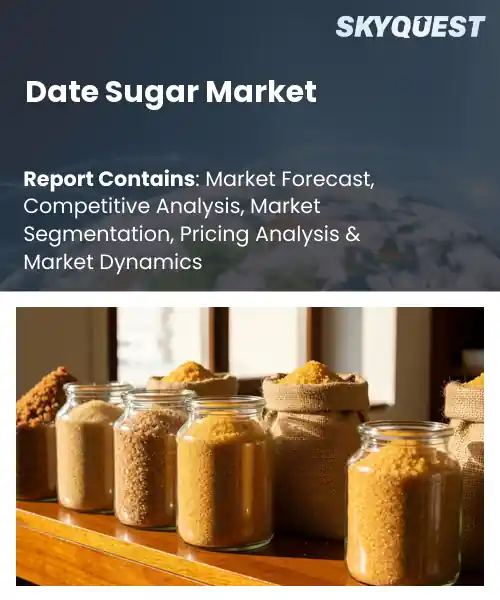
Date Sugar Market
Report ID: SQMIG30I2961
Report ID: SQMIG30I2961
[email protected]
USA +1 351-333-4748
Report ID:
SQMIG30I2961 |
Region:
Global |
Published Date: June, 2026
Pages:
157
|Tables:
115
|Figures:
77


Global Date Sugar Market size was valued at USD 466.95 Million in 2024 and is poised to grow from USD 497.4 Million in 2025 to USD 824.42 Million by 2033, growing at a CAGR of 6.52% during the forecast period (2026-2033).
The date sugar market refers to the production, processing, and distribution of sweeteners derived from the fruit of date palms, primarily in North Africa, the Middle East, and parts of South Asia. Its significance stems from a rising demand for natural low‑glycemic alternatives to refined sucrose, driven by health‑concious consumers and regulatory pushes toward reduced added sugars. Historically, date sugar was a niche product used in traditional cuisines of the Gulf and Sahara, but the 2010s saw an expansion as multinational food firms incorporated it into energy bars, breakfast cereals, and beverage formulations. This evolution reflects broader trends toward sustainability. One pivotal catalyst for global date sugar expansion is the increasing adoption of clean‑label claims by major retailers, which compel manufacturers to replace refined sucrose with natural alternatives that can be labeled simply as date sugar. This shift triggers a cascade of supply‑chain investments, as growers in Saudi Arabia and Egypt receive financing to upgrade orchards, thereby boosting yields and stabilizing prices. Consequently, food processors gain a reliable, non‑GMO sweetener that aligns with consumer demand for provenance, enabling product lines such as high‑protein bars and dairy‑free yogurts to command premium margins and drive market penetration across emerging and mature markets.
How is AI-driven automation impacting the Date sugar market?
AI driven automation is reshaping the date sugar sector by linking farm data with processing lines. Machine learning models predict optimal harvest windows based on climate patterns, reducing waste and ensuring consistent sugar content. Robotic sorting and grinding units adjust speed in real time, improving yield and lowering labor costs. Supply chain platforms use AI to match production with retailer demand, smoothing inventory and shortening delivery cycles. These technologies complement the market’s expansion driven by rising health awareness and the search for natural sweeteners, making date sugar more competitive against conventional sugar. Manufacturers also employ AI to monitor moisture levels during drying, preventing crystallization issues and extending shelf life.In March 2024 a leading date sugar processor introduced AI driven sorting technology, boosting throughput and reducing manual handling. The system integrates vision sensors with machine learning to separate high quality crystals from lower grade material, delivering a more uniform product and lowering energy consumption across the plant.
Market snapshot - (2026-2033)
Global Market Size
USD 466.95 Million
Largest Segment
Powder
Fastest Growth
Liquid
Growth Rate
6.52% CAGR
To get more insights on this market click here to Request a Free Sample Report
Global date sugar market is segmented by form, category, end-use, distribution channel and region. Based on form, the market is segmented into Powder, Liquid and Crystalline. Based on category, the market is segmented into Conventional and Organic. Based on end-use, the market is segmented into Food Processing, Foodservice and Retail and Households. Based on distribution channel, the market is segmented into Direct Sales and Indirect Retail. Based on region, the market is segmented into North America, Europe, Asia Pacific, Latin America and Middle East & Africa.
Powder segment dominates because its fine texture seamlessly integrates into a wide array of processed formulations, allowing manufacturers to replace conventional sweeteners without altering product consistency. The ease of dosage, stability during high‑temperature operations, and compatibility with dry‑mix processes make it the preferred choice for large‑scale producers. Consequently, it drives procurement volumes and shapes supplier focus across the date sugar market throughout the supply chain from sourcing to final packaging.
However, liquid segment is witnessing the strongest growth momentum as beverage innovators seek natural sweetening solutions that dissolve instantly without residual granules. Its fluid nature supports cold‑brew drinks, functional smoothies, and ready‑to‑drink teas, driving formulation flexibility. This rapid adoption expands market reach and creates new partnership opportunities for ingredient suppliers.
Food processing segment dominates because manufacturers require a stable, granulated sweetener that withstands thermal treatments and long shelf lives, making date sugar an ideal alternative to refined sugars. Its natural label aligns with clean‑label trends, while its functional properties support texture, browning, and moisture retention in baked goods, confectionery, and dairy applications. These advantages cement its central role in procurement strategies across the date sugar market for global food manufacturers.
Meanwhile, foodservice segment emerges as the key high‑growth area as restaurants, cafés, and catering firms embrace natural sweeteners to satisfy health‑conscious diners. The on‑premise preparation of desserts, sauces, and coffees benefits from the ease of sprinkling and immediate solubility, accelerating adoption and opening new distribution channels for date sugar producers.
To get detailed segments analysis, Request a Free Sample Report
Asia Pacific dominates due to a convergence of strong culinary traditions that favor natural sweeteners, a large and increasingly health‑conscious consumer base, and supportive regulatory frameworks that encourage the adoption of clean‑label ingredients. The region benefits from efficient supply chains linking date‑producing regions to manufacturers, fostering rapid product development across bakery, confectionery, and beverage categories. Collaborative research between academia and industry enhances formulation expertise, while trade agreements streamline import processes. These combined forces create a dynamic ecosystem that positions Asia Pacific as the leading consumer and innovator of date sugar worldwide.
Japan Date Sugar Market
Date Sugar Market in Japan benefits from a cultural preference for mild, low‑glycemic sweeteners and a well‑established clean‑label movement among consumers. Food manufacturers are integrating date sugar into confectionery, snack bars, and functional drinks to meet demand for natural ingredients. Retail channels emphasize health‑focused product lines, and supply chains capitalize on efficient import logistics, reinforcing Japan’s role as a key adopter of date sugar across both traditional and modern food categories.
South Korea Date Sugar Market
Date Sugar Market in South Korea is propelled by a fast‑growing interest in natural sweetness and the government’s encouragement of healthier food options. Manufacturers are experimenting with date sugar in ready‑to‑eat meals, desserts, and beverages to align with consumer expectations for low‑calorie, functional ingredients. Distribution networks rapidly adopt these products, while culinary innovators highlight the versatility of date sugar in both traditional Korean recipes and contemporary fusion dishes, solidifying South Korea’s emerging position in the market.
North America’s rapid expansion is driven by increasing consumer awareness of metabolic health, demand for clean‑label ingredients, and a strong retail presence of health‑focused brands. Food processors are substituting refined sugars with date sugar to cater to low‑glycemic product formulations across snack, dairy, and beverage segments. Regulatory clarity around natural sweeteners supports broader adoption, while supply chain initiatives ensure consistent availability of high‑quality dates. Innovation hubs in major cities foster collaboration between ingredient suppliers and culinary developers, leading to novel applications such as functional nutrition bars and premium desserts. The combination of health‑centric consumer preferences, supportive policy environment, and robust distribution networks accelerates the rapid uptake of date sugar throughout the United States and Canada.
United States Date Sugar Market
Date Sugar Market in United States is shaped by a vibrant health‑conscious consumer base seeking alternatives to conventional sugars. Leading food manufacturers are incorporating date sugar into baked goods, protein snacks, and dairy alternatives to align with low‑glycemic and natural ingredient trends. Retail chains emphasize natural sweetener aisles, while culinary schools promote date sugar in curriculum, reinforcing its credibility. Supply logistics from key date‑producing regions ensure steady input, positioning the United States as a major growth engine for date sugar.
Canada Date Sugar Market
Date Sugar Market in Canada benefits from strong consumer demand for clean‑label products and a regulatory framework that supports natural sweeteners. Food processors are integrating date sugar into breakfast cereals, plant‑based yogurts, and confectionery to meet low‑glycemic expectations. Retailers highlight these offerings within health‑focused sections, while research institutions collaborate with ingredient suppliers to fine‑tune formulation stability. The country’s efficient import pathways and commitment to sustainable sourcing reinforce Canada’s role as an important adopter and catalyst for broader North American acceptance of date sugar.
Europe strengthens its position through proactive sustainability agendas, robust food safety standards, and consumer appetite for natural sweeteners. Manufacturers across bakery, dairy, and confectionery are adopting date sugar to align with clean‑label regulations and low‑glycemic product requirements. Collaborative research projects among universities and ingredient firms drive innovation in texture and flavor optimization, enabling wider application in premium and functional foods. Trade policies facilitate smooth import of quality dates, while retail networks emphasize health‑oriented product segments. Moreover, culinary traditions that value natural sugars support seamless integration of date sugar into both traditional desserts and modern gastronomy, reinforcing Europe’s strategic advancement in the global date sugar arena.
Germany Date Sugar Market
Date Sugar Market in Germany is propelled by a strong emphasis on product transparency and nutritional labeling. Food manufacturers are incorporating date sugar into breads, granola, and dairy alternatives to meet consumer expectations for natural, low‑glycemic sweeteners. Retail environments feature dedicated sections for clean‑label ingredients, while scientific collaborations with local research institutes refine processing techniques. The efficient logistics infrastructure ensures reliable supply, positioning Germany as a leading European hub for date sugar adoption across both conventional and innovative food categories.
United Kingdom Date Sugar Market
Date Sugar Market in United Kingdom reflects rising consumer interest in plant‑based and low‑sugar diets. Food companies are experimenting with date sugar in pastries, protein bars, and beverage formulations to satisfy clean‑label criteria. Supermarket chains allocate prominent shelf space for natural sweeteners, while culinary schools incorporate date sugar into training modules, enhancing its credibility. Collaborative efforts between ingredient suppliers and research universities improve functional performance, and streamlined import channels ensure consistent availability, establishing United Kingdom as a dynamic driver of date sugar growth in the European market.
France Date Sugar Market
Date Sugar Market in France benefits from a culinary culture that values natural flavors and artisanal sweetness. Food producers are integrating date sugar into desserts, yogurts, and snack formulations to meet consumer demand for healthier alternatives. Retail outlets highlight these products within gourmet sections, while gastronomic institutes explore its applications in classic French pastries, fostering innovation. Partnerships with Mediterranean date exporters ensure steady supply, and regulatory alignment with EU standards supports seamless market entry, positioning France as an influential player in the European date sugar landscape.
To know more about the market opportunities by region and country, click here to
Buy The Complete Report
Rising Demand for Natural Sweeteners
Health‑Focused Product Innovation
Supply Constraints of Premium Dates
Regulatory Uncertainty Across Regions
Request Free Customization of this report to help us to meet your business objectives.
Competitive dynamics in the global date sugar market are shaped by legacy sugar producers expanding into natural sweeteners and by emerging entrants emphasizing health‑focused formulations. Nordzucker’s recent review of European sugar developments signals a strategic shift toward diversifying its product mix, while U.S. industrial sugar reports highlight rising demand for alternative sweeteners, prompting firms to invest in R&D and partnership models.
Top Player’s Company Profile
Recent Developments
SkyQuest’s ABIRAW (Advanced Business Intelligence, Research & Analysis Wing) is our Business Information Services team that Collects, Collates, Correlates, and Analyses the Data collected by means of Primary Exploratory Research backed by robust Secondary Desk research. As per SkyQuest analysis, the global date‑sugar market is propelled primarily by the rising demand for natural sweeteners, as health‑conscious consumers and clean‑label retailers push manufacturers toward low‑glycemic alternatives. A second important driver is health‑focused product innovation, where processors exploit date sugar’s moisture‑retention and caramel notes to launch fortified snacks and dairy‑free items. The powder form remains the dominant segment because its fine texture fits seamlessly into bulk dry‑mix processes, driving the largest procurement volumes. Asia Pacific leads the market, benefiting from strong culinary traditions, large consumer bases and supportive regulations. However, supply constraints of premium dates, tied to seasonal harvests and limited geographic sources, restrain growth by creating raw‑material volatility.
| Report Metric | Details |
|---|---|
| Market size value in 2024 | USD 466.95 Million |
| Market size value in 2033 | USD 824.42 Million |
| Growth Rate | 6.52% |
| Base year | 2024 |
| Forecast period | (2026-2033) |
| Forecast Unit (Value) | USD Million |
| Segments covered |
|
| Regions covered | North America (US, Canada), Europe (Germany, France, United Kingdom, Italy, Spain, Rest of Europe), Asia Pacific (China, India, Japan, Rest of Asia-Pacific), Latin America (Brazil, Rest of Latin America), Middle East & Africa (South Africa, GCC Countries, Rest of MEA) |
| Companies covered |
|
| Customization scope | Free report customization with purchase. Customization includes:-
|
To get a free trial access to our platform which is a one stop solution for all your data requirements for quicker decision making. This platform allows you to compare markets, competitors who are prominent in the market, and mega trends that are influencing the dynamics in the market. Also, get access to detailed SkyQuest exclusive matrix.
Table Of Content
Executive Summary
Market overview
Parent Market Analysis
Market overview
Market size
KEY MARKET INSIGHTS
COVID IMPACT
MARKET DYNAMICS & OUTLOOK
Market Size by Region
KEY COMPANY PROFILES
Methodology
For the Date Sugar Market, our research methodology involved a mixture of primary and secondary data sources. Key steps involved in the research process are listed below:
1. Information Procurement: This stage involved the procurement of Market data or related information via primary and secondary sources. The various secondary sources used included various company websites, annual reports, trade databases, and paid databases such as Hoover's, Bloomberg Business, Factiva, and Avention. Our team did 45 primary interactions Globally which included several stakeholders such as manufacturers, customers, key opinion leaders, etc. Overall, information procurement was one of the most extensive stages in our research process.
2. Information Analysis: This step involved triangulation of data through bottom-up and top-down approaches to estimate and validate the total size and future estimate of the Date Sugar Market.
3. Report Formulation: The final step entailed the placement of data points in appropriate Market spaces in an attempt to deduce viable conclusions.
4. Validation & Publishing: Validation is the most important step in the process. Validation & re-validation via an intricately designed process helped us finalize data points to be used for final calculations. The final Market estimates and forecasts were then aligned and sent to our panel of industry experts for validation of data. Once the validation was done the report was sent to our Quality Assurance team to ensure adherence to style guides, consistency & design.
Analyst Support
Customization Options
With the given market data, our dedicated team of analysts can offer you the following customization options are available for the Date Sugar Market:
Product Analysis: Product matrix, which offers a detailed comparison of the product portfolio of companies.
Regional Analysis: Further analysis of the Date Sugar Market for additional countries.
Competitive Analysis: Detailed analysis and profiling of additional Market players & comparative analysis of competitive products.
Go to Market Strategy: Find the high-growth channels to invest your marketing efforts and increase your customer base.
Innovation Mapping: Identify racial solutions and innovation, connected to deep ecosystems of innovators, start-ups, academics, and strategic partners.
Category Intelligence: Customized intelligence that is relevant to their supply Markets will enable them to make smarter sourcing decisions and improve their category management.
Public Company Transcript Analysis: To improve the investment performance by generating new alpha and making better-informed decisions.
Social Media Listening: To analyze the conversations and trends happening not just around your brand, but around your industry as a whole, and use those insights to make better Marketing decisions.
REQUEST FOR SAMPLE
 REQUEST FREE CUSTOMIZATION


Want to customize this report? This report can be personalized according to your needs. Our analysts and industry experts will work directly with you to understand your requirements and provide you with customized data in a short amount of time. We offer $1000 worth of FREE customization at the time of purchase.
Feedback From Our Clients


 USA (+1) 351-333-4748

