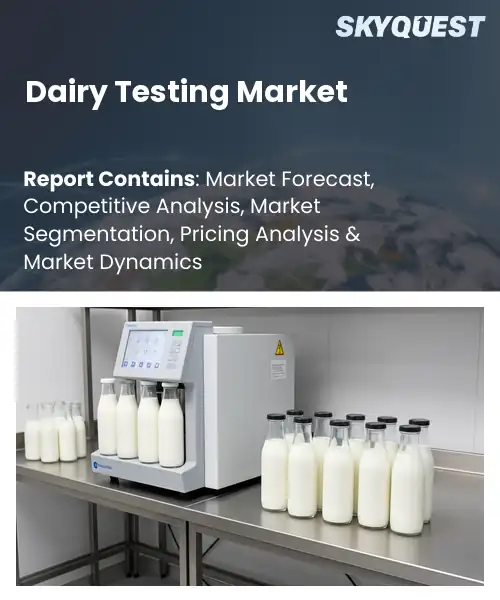
Dairy Testing Market
Report ID: SQMIG35J2543
Report ID: SQMIG35J2543
[email protected]
USA +1 351-333-4748
Report ID:
SQMIG35J2543 |
Region:
Global |
Published Date: July, 2026
Pages:
157
|Tables:
173
|Figures:
79


Global Dairy Testing Market size was valued at USD 4.24 Billion in 2024 and is poised to grow from USD 4.57 Billion in 2025 to USD 8.34 Billion by 2033, growing at a CAGR of 7.8% during the forecast period (2026-2033).
The Growth Driver of the Global Dairy Testing Market is stringent regulations on food safety in combination with increasing consumer preference towards quality. With regulators like EFSA and FDA setting stringent limits for residue of antibiotics and aflatoxins, the processors have no choice but to spend money on platforms which can give quantitative information. This has made it necessary for processors like Danone and Nestle to install scanners on their production lines, thus saving themselves from rejections and minimizing time in the market. This means more orders for the machinery makers and more income for the service providers.
The global market for dairy testing consists of analysis tools and devices used to test safety, quality, and composition of milk and dairy products. The importance of the market is due to consumer requirements regarding safety of food, regulatory requirements, and food contamination scandals which have made it necessary for manufacturers to implement thorough testing procedures. This market was formed in the late 1990s because of replacing traditional microbiological testing by immuno-assays which allowed detection of adulterants like melamine. In recent years, owing to dairy production development in Asia and use of blockchain technology, investment in spectroscopic and molecular diagnostics has been growing rapidly.
How is AI Enhancing Accuracy and Speed in the Dairy Testing Market?
The introduction of AI in the dairy testing industry has come through the incorporation of machine learning models in the spectroscopic and sensing systems. The machine learning models ensure that the interpretation of complicated data is immediate to identify contaminants and off flavors that could be ignored using traditional technologies. The real-time analytics eliminate the need for extensive laboratory processes, making quick quality assessments possible. The automatic analysis of images of the milk samples increases the process of bacterial counts without compromising accuracy. With the connection to cloud databases, various laboratories can collaborate to form a collective safety system that changes according to emerging patterns.
Market snapshot - (2026-2033)
Global Market Size
USD 4.24 Billion
Largest Segment
Safety Testing
Fastest Growth
Composition Testing
Growth Rate
7.8% CAGR
To get more insights on this market click here to Request a Free Sample Report
Global dairy testing market is segmented by test type, product type, technology, end user, sample type, testing location and region. Based on test type, the market is segmented into Safety Testing, Quality Testing, Composition Testing and Others. Based on product type, the market is segmented into Milk, Cheese, Yogurt and Others. Based on technology, the market is segmented into PCR-Based Testing, Immunoassay Testing, Chromatography Testing and Others. Based on end user, the market is segmented into Dairy Processing Companies, Testing Laboratories, Regulatory Agencies and Others. Based on sample type, the market is segmented into Raw Dairy Products and Processed Dairy Products. Based on testing location, the market is segmented into In-House Testing and Third-Party Laboratory Testing. Based on region, the market is segmented into North America, Europe, Asia Pacific, Latin America and Middle East & Africa.
Segment dealing with safety testing leads the market since dairy companies are interested in ensuring safety of their products by detecting pathogens to comply with government regulations and preserve consumer safety. As a result, there is always a stable demand for microbiological tests that can detect the presence of various pathogenic organisms like Salmonella, Listeria, and E. coli which would guarantee the absence of harmful products and prevent product recalls. Besides, the awareness of customers about food safety adds more pressure on producers to use testing procedures which emphasizes the leading role of safety testing segment within the dairy testing market.
On the other side, the fastest growing segment is dealing with composition testing since there is a need to obtain information about nutrients contained in dairy products.
The chromatography testing segment holds precedence since it provides a high level of specific and versatile analysis capability in the detection of various residue, allergen, and flavor compounds in dairy samples. This type of test is valued for its ability to accurately separate various proteins and lipids present in dairy and thus provide reliable quantification of such compounds. The continuous improvement of testing methods and the use of mass spectrometry increase sensitivity of detection making chromatography testing a core technology in meeting all regulations and consumer demands on the dairy testing market.
On the other hand, PCR based testing segment shows the fastest growth trend since the application of molecular diagnostics allows for quick detection of DNA of pathogens and thus helps to make real time decisions about food safety.
To get detailed segments analysis, Request a Free Sample Report
North America continues to be a leader in dairy testing due to several reasons, namely advanced research environment, solid regulatory structures, and tight technology integration into dairy supply chains. There are highly reputable universities and industry labs operating in the USA and Canada which continuously improve analytical procedures. High quality assurance standards set by government and large dairy manufacturers lead to stable demand for accurate testing procedures. The innovation-driven environment and active venture capital activity promote fast adoption of automation and digital tracking technologies. Collaborative networks between research universities and dairy companies allow transferring knowledge and thus quickly validating new products and satisfying regulatory requirements.
The Dairy Testing Market in the United States is positively impacted by an established system comprising highly specialized labs, and a high-level attention to food safety. The top dairy processors in the US together with governmental organizations actively collaborate with technology vendors and use state-of-the-art methods of detecting microorganisms and composition analysis. The stress on traceability and quick response to contamination incidents promotes the development of automated solutions, along with innovation within academic collaborations.
Market for Dairy Testing in Canada is influenced by the strict food safety guidelines of the country along with the proactive approach towards ensuring quality of dairy products. There is an integration between the provincial dairy boards and the research institutes through which they implement the use of sophisticated spectroscopic and immunoassay techniques. The importance of sustainability and certification of organic products promotes the adoption of non-invasive testing systems.
The European market sees a dynamic rise in its dairy testing market driven by food safety standards across Europe, high consumer awareness of origin, and scientific prowess prevailing across the region. The unification of regulations from the EU is creating a level playing field that makes it necessary for the producers to perform routine testing, while local authorities adapt their regulations in line with local dynamics of the market. Research investment in regional clusters of the dairy industry helps in developing innovative testing systems for new contaminants and allergens. Partnership between international dairy companies and tech pioneers in real-time monitoring systems is facilitating innovations in the testing market.
The Dairy Testing Market in Germany relies heavily on the solid engineering background and numerous specialized laboratories for testing. It is regulated from above and industry standards that stimulate using highly accurate chromatography and molecular methods. The cooperation between scientific institutions and top dairy cooperatives is aimed at improving residue detection and authentication methods. The need to provide high-quality products for export stimulates constant investments into equipment and makes Germany the standard setter in Europe.
The UK Dairy Testing Market is driven by an active regulatory framework and thriving food-tech landscape. The governmental bodies are committed to food safety and allergen disclosure, which motivates dairy manufacturers to employ rapid immunologic testing and mobile spectroscopy. Effective cooperation of scientific institutions and industry accelerators promotes the development of predictive analytics to assess contamination risks. Consumers' attention to traceability and sustainable sourcing also drives the need for effective authentication tests.
French Dairy Testing Industry is an interesting mix of stringent regulations along with rich history. The nation’s food safety organizations collaborate with famous dairy areas to implement advanced technologies such as enzyme-linked and mass spectrometry for quality assurance purposes. The focus on designation of origin products calls for rigorous testing of their genuineness and traceability. New partnerships among biotech companies and traditional dairy unions have been instrumental in developing innovative rapid test kits that enable better detection of contaminants without compromising on the unique sensory attributes of the product range.
Asia Pacific continues to gain strength within the space of dairy testing through increased milk production and greater consciousness regarding food safety combined with the establishment of testing facilities. There are many countries within the region that have begun working to ensure that their regulations meet international standards, thus requiring dairy processors to utilize advanced testing methods. The increasing production of premium dairy products like specialty cheeses and functional milks necessitates more precise compositional and microbiological analysis. The alliance of research institutions in the region with technology companies worldwide hastens the adoption of automated data-based systems capable of providing real-time monitoring.
Japanese Dairy Testing Market enjoys an elaborate quality control system and effective governmental supervision. Top dairy producers cooperate with research institutions to apply advanced chromatographic and biosensor technologies in residues’identification. Food safety is an important requirement for domestic and foreign markets, which is why dairy testing equipment is constantly upgraded. New cooperation with robotics companies is bringing automation into sample processing while retaining the precision characteristic of the Japanese dairy industry.
Market for Dairy Testing in South Korea is influenced by strict policies of food safety on a national level and a fast-developing pattern of dairy product consumption. Cooperation of leading dairy product manufacturers and local biotech companies stimulates the use of rapid immunoassay kits and portable spectroscopy equipment. Incentives provided by the government to use new technologies motivate investments in the development of analytical solutions based on AI. Increasing demand for premium dairy products due to health awareness drives the need for accurate analysis of compositions.
To know more about the market opportunities by region and country, click here to
Buy The Complete Report
Increasing Demand for Food Safety
Consumer concerns about dairy contamination have forced manufacturers to use testing procedures, and such actions guarantee both the quality of their products and their good name. More and more retailers ask for proof of safety, thus forcing the manufacturers to apply more testing in their production lines. The increased importance of preventive measures does not only protect the population from any negative effects but also gives manufacturers a chance to prove their compliance with safety standards and thus create additional market demand for dairy testing services.
Advancements in Rapid Testing Technologies
Technologies related to fast testing, like immunoassay tests and molecular testing techniques, are now being used on dairy production lines, which will allow detecting pathogens and adulteration quickly. Such ability helps to reduce the time between taking a sample and analyzing results, thus helping to take immediate measures to prevent product recalls and unnecessary wastage. Increased efficiency and improved consumer trust contribute to the use of such innovations by all types of businesses – big manufacturers and artisanal dairies alike, and this, in its turn, contributes to increased demand for such advanced and easy-to-use testing systems.
High Costs of Testing Equipment
The high capital requirements involved in the purchase of modern dairy testing technology act as a deterrent to adoption, especially for smaller and medium-sized enterprises, since they lack funds. Modern technology usually requires high purchasing costs, installation costs, and maintenance costs, thus making it difficult for the company to implement new technologies that will enhance their quality control process. As such, most companies continue using outdated techniques because of the high cost associated with acquiring and implementing modern technologies. Additionally, there are few affordable funding sources available for this purpose.
Stringent Regulatory Approval Processes
Rigorous regulatory approval procedures associated with innovative dairy testing techniques lead to increased time and cost of compliance, thus discouraging manufacturers from offering their innovations on the market. Regulatory agencies may demand the conduct of various validation tests and audits as part of ensuring the quality of the testing method, which could result in delays and higher cost of operations. While such measures are critical for public health safety, they limit the process of adopting innovations and hinder the quick response to new risks in the market environment. Continuous changes in regulatory procedures slow down innovation adoption.
Request Free Customization of this report to help us to meet your business objectives.
Increased competition between traditional laboratories and new biotech companies will influence the dairy testing market worldwide as companies compete for contracts related to certification of new milk products. Examples of cooperation include, for instance, TurtleTree Labs – a cellular agriculture leader working together with testing laboratories to prove the safety of the products and The Bland Company that uses innovative protein assay platforms via collaboration with testing laboratories.
Rapid Adoption of Rapid Tests: Manufacturers are relying on the use of on-site and quick test tools in an attempt to gain insights on the quality and safety of their milk in almost real-time. Such portable tools do not need any special training to operate, produce results within minutes, and allow instant measures to be taken to improve the situation and avoid the milk from spoiling. The availability of quick tests is useful for fulfilling the increasing demands for dairy products that can be traced by consumers and helps small-scale farms meet retailer requirements without complex laboratories.
Integration of Digital Platforms: Dairy testing is being revolutionized by connecting lab results with cloud-based analytics through digital platforms, allowing people involved to be able to keep track of the quality metrics in real-time from remote locations. Automated dashboards help in making predictions regarding herd management, feed changes, and other activities, and they even reduce human interference through alerts. This connectivity also helps researchers to collaborate and create benchmarks for innovation and improvement in the industry. This way of testing based on data and quality assurance is much more productive than traditional methods.
SkyQuest’s ABIRAW (Advanced Business Intelligence, Research & Analysis Wing) is our Business Information Services team that Collects, Collates, Correlates, and Analyses the Data collected by means of Primary Exploratory Research backed by robust Secondary Desk research.
As per SkyQuest analysis, the global dairy testing market will witness growth of 7.8% CAGR up to 2033, mainly due to rising need for food safety that forces manufacturers to perform thorough testing, although the high costs associated with testing devices is a major constraint on market adoption by small processors. North America will remain at the top of the market due to robust regulations and well-established research capabilities in the region, with safety testing being the largest segment owing to quick pathogen detection needs of manufacturers. The other driver of market growth will be rapid development of new fast testing technologies including immunodiagnostic and molecular tests.
| Report Metric | Details |
|---|---|
| Market size value in 2024 | USD 4.24 Billion |
| Market size value in 2033 | USD 8.34 Billion |
| Growth Rate | 7.8% |
| Base year | 2024 |
| Forecast period | (2026-2033) |
| Forecast Unit (Value) | USD Billion |
| Segments covered |
|
| Regions covered | North America (US, Canada), Europe (Germany, France, United Kingdom, Italy, Spain, Rest of Europe), Asia Pacific (China, India, Japan, Rest of Asia-Pacific), Latin America (Brazil, Rest of Latin America), Middle East & Africa (South Africa, GCC Countries, Rest of MEA) |
| Companies covered |
|
| Customization scope | Free report customization with purchase. Customization includes:-
|
To get a free trial access to our platform which is a one stop solution for all your data requirements for quicker decision making. This platform allows you to compare markets, competitors who are prominent in the market, and mega trends that are influencing the dynamics in the market. Also, get access to detailed SkyQuest exclusive matrix.
Table Of Content
Executive Summary
Market overview
Parent Market Analysis
Market overview
Market size
KEY MARKET INSIGHTS
COVID IMPACT
MARKET DYNAMICS & OUTLOOK
Market Size by Region
KEY COMPANY PROFILES
Methodology
For the Dairy Testing Market, our research methodology involved a mixture of primary and secondary data sources. Key steps involved in the research process are listed below:
1. Information Procurement: This stage involved the procurement of Market data or related information via primary and secondary sources. The various secondary sources used included various company websites, annual reports, trade databases, and paid databases such as Hoover's, Bloomberg Business, Factiva, and Avention. Our team did 45 primary interactions Globally which included several stakeholders such as manufacturers, customers, key opinion leaders, etc. Overall, information procurement was one of the most extensive stages in our research process.
2. Information Analysis: This step involved triangulation of data through bottom-up and top-down approaches to estimate and validate the total size and future estimate of the Dairy Testing Market.
3. Report Formulation: The final step entailed the placement of data points in appropriate Market spaces in an attempt to deduce viable conclusions.
4. Validation & Publishing: Validation is the most important step in the process. Validation & re-validation via an intricately designed process helped us finalize data points to be used for final calculations. The final Market estimates and forecasts were then aligned and sent to our panel of industry experts for validation of data. Once the validation was done the report was sent to our Quality Assurance team to ensure adherence to style guides, consistency & design.
Analyst Support
Customization Options
With the given market data, our dedicated team of analysts can offer you the following customization options are available for the Dairy Testing Market:
Product Analysis: Product matrix, which offers a detailed comparison of the product portfolio of companies.
Regional Analysis: Further analysis of the Dairy Testing Market for additional countries.
Competitive Analysis: Detailed analysis and profiling of additional Market players & comparative analysis of competitive products.
Go to Market Strategy: Find the high-growth channels to invest your marketing efforts and increase your customer base.
Innovation Mapping: Identify racial solutions and innovation, connected to deep ecosystems of innovators, start-ups, academics, and strategic partners.
Category Intelligence: Customized intelligence that is relevant to their supply Markets will enable them to make smarter sourcing decisions and improve their category management.
Public Company Transcript Analysis: To improve the investment performance by generating new alpha and making better-informed decisions.
Social Media Listening: To analyze the conversations and trends happening not just around your brand, but around your industry as a whole, and use those insights to make better Marketing decisions.
REQUEST FOR SAMPLE
 REQUEST FREE CUSTOMIZATION
Global Dairy Testing Market size was valued at USD 4.24 Billion in 2024 and is poised to grow from USD 4.57 Billion in 2025 to USD 8.34 Billion by 2033, growing at a CAGR of 7.8% during the forecast period (2026-2033).
Intensified rivalry among traditional analytical labs and emerging biotech firms is reshaping the global dairy testing market, as companies vie for contracts to certify novel milk products. Recent collaborations, such as cellular‑agriculture pioneer TurtleTree Labs partnering with testing laboratories to validate safety, and The Bland Company leveraging advanced protein assay platforms through a testing‑lab alliance, illustrate how strategic partnerships and technology integration are driving competitive differentiation. 'Eurofins Scientific SE', 'SGS SA', 'Bureau Veritas SA', 'Intertek Group plc', 'Mérieux NutriSciences Corporation', 'Neogen Corporation', 'Thermo Fisher Scientific Inc.', 'Bio-Rad Laboratories, Inc.', 'bioMérieux SA', 'QIAGEN N.V.', 'Merck KGaA', 'PerkinElmer, Inc.', 'Agilent Technologies, Inc.', 'Romer Labs Division Holding GmbH', 'ALS Limited', 'Charm Sciences, Inc.', 'IDEXX Laboratories, Inc.', 'Randox Laboratories Ltd.', 'FOSS Analytical A/S', 'Shimadzu Corporation'
Growing consumer awareness of dairy contamination risks drives producers to adopt comprehensive testing protocols, ensuring product integrity and maintaining brand reputation. Retailers increasingly require validated safety data, prompting manufacturers to integrate advanced analytical methods across supply chains. This heightened emphasis on preventative quality control not only safeguards public health but also creates a competitive advantage for companies that can demonstrate rigorous testing compliance, thereby expanding market demand for specialized dairy testing solutions. These practices also foster stronger partnerships with regulatory bodies and improve traceability throughout the dairy production network.
Rapid Adoption Of Rapid Tests: Producers are increasingly turning to rapid, on‑farm testing solutions to obtain near‑real‑time insights into milk quality and safety. These portable devices require minimal training, deliver results within minutes, and enable immediate corrective actions, reducing spoilage and enhancing supply‑chain transparency. The convenience of rapid tests aligns with growing consumer demand for traceable dairy products and supports small‑scale farms in meeting stringent retailer standards without extensive laboratory infrastructure, thereby fostering broader market participation and strengthening overall product integrity across global dairy markets.
Why does North America Dominate the Global Dairy Testing Market? |@12


Want to customize this report? This report can be personalized according to your needs. Our analysts and industry experts will work directly with you to understand your requirements and provide you with customized data in a short amount of time. We offer $1000 worth of FREE customization at the time of purchase.
Feedback From Our Clients


 USA (+1) 351-333-4748

