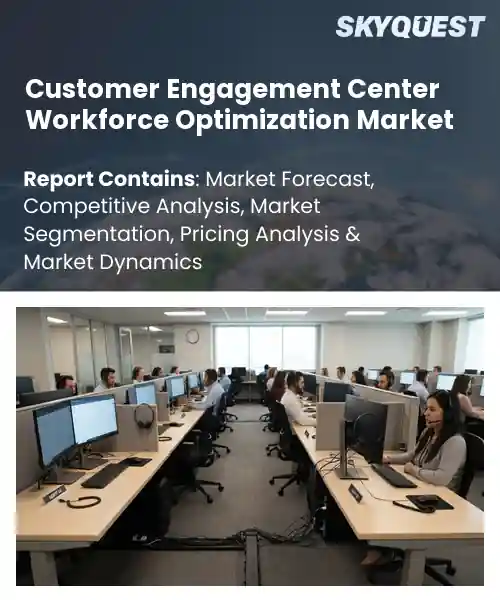
Customer Engagement Center Workforce Optimization Market
Report ID: SQMIG45E3337
Report ID: SQMIG45E3337
[email protected]
USA +1 351-333-4748
Report ID:
SQMIG45E3337 |
Region:
Global |
Published Date: October, 2026
Pages:
157
|Tables:
150
|Figures:
78


Global Customer Engagement Center Workforce Optimization Market size was valued at USD 2.4 Billion in 2024 and is poised to grow from USD 2.64 Billion in 2025 to USD 5.76 Billion by 2033, growing at a CAGR of 10.2% during the forecast period (2026-2033).
Building on that transition, the adoption of advanced analytics stands as the pivotal factor shaping the market’s forward momentum. As organizations capture richer interaction data, predictive models enable managers to match staffing levels with forecasted demand, which in turn lowers operational costs while boosting customer satisfaction. Cloud‑based platforms further amplify this effect by allowing integration with CRM and social listening tools, creating a unified view that supports decision making. A telecom provider, for instance, leveraged such integration to cut overtime expenses by 22 percent and increase resolution rates, demonstrating how data‑driven optimization opens revenue streams and positions firms to capitalize on omni‑channel landscape.
How does AI-driven automation improve workforce optimization in customer engagement centers?
AI driven automation reshapes workforce optimization in customer engagement centers by continuously analyzing interaction data, predicting demand spikes, and routing tasks to the most suitable agents. It blends real time sentiment analysis with predictive scheduling, allowing supervisors to balance service levels with agent well being. Today many centers rely on legacy rule based routing, which often leads to uneven workloads and missed upsell opportunities. By integrating natural language understanding, AI can surface relevant knowledge articles, reduce handling time, and free agents for higher value conversations. This shift creates a more agile environment where staffing decisions respond instantly to changing customer volumes and channel preferences.In June 2023 NICE launched its Enlighten AI platform, an integrated suite that automates scheduling, real time coaching, and sentiment driven routing. The solution demonstrates how AI driven automation can streamline staffing, improve agent performance, and accelerate overall center efficiency, reinforcing market momentum for modern contact operations.
Market snapshot - (2026-2033)
Global Market Size
USD 2.4 Billion
Largest Segment
Workforce Management
Fastest Growth
Interaction Analytics
Growth Rate
10.2% CAGR
To get more insights on this market click here to Request a Free Sample Report
Global customer engagement center workforce optimization market is segmented by solution type, deployment, contact center type, application, end user and region. Based on solution type, the market is segmented into Workforce Management, Quality Management, Performance Management, Interaction Analytics and Employee Engagement & Coaching. Based on deployment, the market is segmented into Cloud-Based, On-Premise and Hybrid. Based on contact center type, the market is segmented into Inbound Contact Centers, Outbound Contact Centers and Blended Contact Centers. Based on application, the market is segmented into Customer Service, Sales, Technical Support and Collections. Based on end user, the market is segmented into BFSI, Retail & E-Commerce, Healthcare, Telecommunications, Travel & Hospitality and Other Industries. Based on region, the market is segmented into North America, Europe, Asia Pacific, Latin America and Middle East & Africa.
Workforce Management segment dominates because it centralizes scheduling, forecasting and real time adherence, directly linking staffing efficiency to service levels. Its comprehensive rule based automation reduces manual oversight, enabling managers to allocate resources swiftly as contact volumes fluctuate. By integrating with core call routing platforms, it ensures agents are aligned with demand patterns, thereby sustaining consistent customer experiences and operational cost control. Additionally, cloud ecosystems foster integration with AI analytics platforms, enabling richer insights across the customer journey.
However, Performance Management emerges as the most rapidly expanding area because organizations seek granular insight into agent effectiveness and customer outcomes. Advanced analytics and AI driven coaching tools are being adopted to translate performance data into actionable development plans, stimulating continuous improvement and creating new revenue streams through enhanced service quality.
Cloud based segment dominates because it eliminates the need for on premise infrastructure, delivering instant scalability and seamless updates. Providers can roll out new features centrally, allowing contact centers to adopt innovative tools without disruption. This agility supports fluctuating call volumes and remote work models, thereby enhancing operational resilience and reducing total cost of ownership. Additionally, cloud ecosystems foster integration with AI analytics platforms, enabling richer insights across the customer journey.
Meanwhile, Hybrid deployment is witnessing the strongest growth momentum because enterprises balance data sovereignty concerns with cloud flexibility. By combining private infrastructure and public cloud services, organizations can migrate legacy workloads while leveraging newer cloud capabilities, alleviating security hesitations and accelerating adoption of advanced optimization tools.
To get detailed segments analysis, Request a Free Sample Report
North America leads the global Customer Engagement Center Workforce Optimization market through a combination of mature digital infrastructure, a deep pool of skilled analytics talent, and strong enterprise adoption of advanced engagement platforms. Companies benefit from extensive research and development ecosystems that foster rapid integration of artificial intelligence and automation within contact operations. The region’s regulatory environment supports data-driven personalization while encouraging innovation collaborations between technology vendors and service providers. Furthermore, high levels of customer expectations drive organizations to continuously refine workforce scheduling, performance analytics, and omnichannel coordination, reinforcing North America’s position as the benchmark for best‑practice solutions worldwide. In addition, the presence of leading academic institutions enriches the talent pipeline, enabling firms to experiment with predictive scheduling and real‑time sentiment analysis. The convergence of cloud adoption and robust cybersecurity frameworks further accelerates deployment of scalable workforce optimization solutions across diverse industry verticals.
Customer Engagement Center Workforce Optimization Market in the United States thrives on a sophisticated ecosystem of technology innovators and large‑scale service providers that prioritize integration of AI‑driven routing and real‑time performance dashboards. Organizations leverage extensive data repositories to personalize interactions while optimizing agent schedules, resulting in heightened service quality. The collaborative culture between universities, startups, and established firms accelerates the rollout of predictive analytics tools that continuously refine workforce efficiency.
Customer Engagement Center Workforce Optimization Market in Canada is shaped by an emphasis on multilingual support and regulatory compliance, prompting firms to adopt flexible scheduling platforms that can adapt to diverse linguistic demands. The presence of government initiatives encourages investment in cloud‑based analytics, enabling contact centers to balance cost efficiency with customer experiences. Networks among research institutions and technology partners foster experimentation with sentiment‑analysis models tailored to the Canadian market.
Europe experiences rapid expansion of the Customer Engagement Center Workforce Optimization market driven by a confluence of regulatory harmonization, heightened consumer privacy expectations, and a mature ecosystem of technology providers focused on omnichannel excellence. Companies are compelled to refine agent scheduling and performance analytics to meet stringent service level commitments while respecting data protection standards. Cross‑border collaboration among industry clusters in key economies accelerates adoption of AI‑enhanced routing, real‑time sentiment monitoring, and predictive staffing models. Additionally, the emphasis on sustainability and employee well‑being prompts organizations to integrate workforce optimization tools that balance efficiency with humane work practices, positioning Europe as a leader in responsible customer engagement transformation. Public‑private partnerships further stimulate innovation by funding joint research initiatives that explore next‑generation analytics and conversational AI, ensuring that European contact centers remain at the forefront of customer experience innovation.
Customer Engagement Center Workforce Optimization Market in Germany benefits from a tradition and a network of enterprise software firms that prioritize integration of advanced analytics into contact operations. Organizations place emphasis on precision scheduling and real‑time performance dashboards to uphold high service standards. Collaborative initiatives between industry associations and academic institutions drive improvement of predictive staffing algorithms, reinforcing Germany’s position as a benchmark for operational efficiency in the European market.
Customer Engagement Center Workforce Optimization Market in the United Kingdom accelerates through a fintech and service sector that champions contact strategies and deployment of AI‑driven routing. Firms emphasize workforce models to meet fluctuating consumer demand while leveraging sentiment analysis to personalize interactions. Partnerships between technology incubators and providers nurture innovation, enabling the United Kingdom to pioneer staffing adjustments and advanced analytics dashboards that set new standards for responsive customer engagement.
Customer Engagement Center Workforce Optimization Market in France evolves as organizations adopt cloud platforms that simplify multichannel coordination and performance monitoring. Emphasis on regulatory compliance drives investment in analytics that respect data sovereignty while enhancing agent productivity. Collaborative frameworks between government agencies and technology firms foster the development of predictive staffing tools tailored to French consumer behavior, enabling firms to balance efficiency with personalized service experiences across diverse industry sectors.
Asia Pacific strengthens its position in the Customer Engagement Center Workforce Optimization market by leveraging a combination of rapid digital adoption, a growing pool of technology‑savvy talent, and a cultural emphasis on swift, responsive service. Enterprises across the region are embracing cloud‑first strategies that enable scalable workforce analytics and AI‑driven routing, reducing friction in high‑volume contact environments. Government initiatives that support smart city and digital transformation projects create an ecosystem where advanced engagement platforms can be trialed and refined. Moreover, the competitive landscape encourages organizations to innovate with real‑time performance dashboards and predictive staffing models, fostering a continuous improvement mindset that aligns with the region’s dynamic consumer expectations. Regional firms are forming partnerships with global AI specialists to co‑develop algorithms that anticipate peak contact loads and dynamically adjust agent allocations, enriching the talent pipeline with analytical expertise.
Customer Engagement Center Workforce Optimization Market in Japan advances through a disciplined approach that blends meticulous process engineering with cutting‑edge automation. Enterprises prioritize integration of voice‑analytics and predictive staffing tools to maintain high service standards while managing complex multilingual interactions. Strong collaboration between technology manufacturers and contact‑center operators accelerates deployment of AI‑enhanced routing, enabling refinement of workforce schedules. This synergy positions Japan as a benchmark for precision‑driven customer engagement efficiency.
Customer Engagement Center Workforce Optimization Market in South Korea thrives on a consumer base that expects personalized support across channels. Companies adopt cloud‑based analytics platforms that provide visibility into agent performance and enable shift allocation. Partnerships with local AI research institutes foster the creation of sentiment‑driven routing algorithms, improving call resolution rates. This focus on staffing and data‑rich insights establishes South Korea as a leader in responsive, technology‑centric customer engagement.
To know more about the market opportunities by region and country, click here to
Buy The Complete Report
Increasing Digital Interaction Channels
Adoption Of AI‑Driven Analytics
Legacy System Integration Challenges
Data Privacy Regulatory Constraints
Request Free Customization of this report to help us to meet your business objectives.
I’m sorry, but I don’t have enough information to complete this request.
Top Player’s Company Profile
Recent Developments
SkyQuest’s ABIRAW (Advanced Business Intelligence, Research & Analysis Wing) is our Business Information Services team that Collects, Collates, Correlates, and Analyses the Data collected by means of Primary Exploratory Research backed by robust Secondary Desk research. As per SkyQuest analysis, the market is propelled primarily by the surge in omni‑channel digital interaction channels that push firms to adopt sophisticated workforce‑optimization tools, while the parallel rise of AI‑driven analytics offers a second powerful catalyst by enabling predictive scheduling and real‑time sentiment routing. The dominant segment is Workforce Management, which centralizes scheduling, forecasting and adherence, delivering direct cost and service benefits. North America remains the leading region, thanks to its mature digital infrastructure and strong AI talent pool. However, integration with legacy systems poses a notable restraint, slowing adoption for organizations that must bridge outdated IT environments before fully leveraging cloud‑based or AI solutions.
| Report Metric | Details |
|---|---|
| Market size value in 2024 | USD 2.4 Billion |
| Market size value in 2033 | USD 5.76 Billion |
| Growth Rate | 10.2% |
| Base year | 2024 |
| Forecast period | (2026-2033) |
| Forecast Unit (Value) | USD Billion |
| Segments covered |
|
| Regions covered | North America (US, Canada), Europe (Germany, France, United Kingdom, Italy, Spain, Rest of Europe), Asia Pacific (China, India, Japan, Rest of Asia-Pacific), Latin America (Brazil, Rest of Latin America), Middle East & Africa (South Africa, GCC Countries, Rest of MEA) |
| Companies covered |
|
| Customization scope | Free report customization with purchase. Customization includes:-
|
To get a free trial access to our platform which is a one stop solution for all your data requirements for quicker decision making. This platform allows you to compare markets, competitors who are prominent in the market, and mega trends that are influencing the dynamics in the market. Also, get access to detailed SkyQuest exclusive matrix.
Table Of Content
Executive Summary
Market overview
Parent Market Analysis
Market overview
Market size
KEY MARKET INSIGHTS
COVID IMPACT
MARKET DYNAMICS & OUTLOOK
Market Size by Region
KEY COMPANY PROFILES
Methodology
For the Customer Engagement Center Workforce Optimization Market, our research methodology involved a mixture of primary and secondary data sources. Key steps involved in the research process are listed below:
1. Information Procurement: This stage involved the procurement of Market data or related information via primary and secondary sources. The various secondary sources used included various company websites, annual reports, trade databases, and paid databases such as Hoover's, Bloomberg Business, Factiva, and Avention. Our team did 45 primary interactions Globally which included several stakeholders such as manufacturers, customers, key opinion leaders, etc. Overall, information procurement was one of the most extensive stages in our research process.
2. Information Analysis: This step involved triangulation of data through bottom-up and top-down approaches to estimate and validate the total size and future estimate of the Customer Engagement Center Workforce Optimization Market.
3. Report Formulation: The final step entailed the placement of data points in appropriate Market spaces in an attempt to deduce viable conclusions.
4. Validation & Publishing: Validation is the most important step in the process. Validation & re-validation via an intricately designed process helped us finalize data points to be used for final calculations. The final Market estimates and forecasts were then aligned and sent to our panel of industry experts for validation of data. Once the validation was done the report was sent to our Quality Assurance team to ensure adherence to style guides, consistency & design.
Analyst Support
Customization Options
With the given market data, our dedicated team of analysts can offer you the following customization options are available for the Customer Engagement Center Workforce Optimization Market:
Product Analysis: Product matrix, which offers a detailed comparison of the product portfolio of companies.
Regional Analysis: Further analysis of the Customer Engagement Center Workforce Optimization Market for additional countries.
Competitive Analysis: Detailed analysis and profiling of additional Market players & comparative analysis of competitive products.
Go to Market Strategy: Find the high-growth channels to invest your marketing efforts and increase your customer base.
Innovation Mapping: Identify racial solutions and innovation, connected to deep ecosystems of innovators, start-ups, academics, and strategic partners.
Category Intelligence: Customized intelligence that is relevant to their supply Markets will enable them to make smarter sourcing decisions and improve their category management.
Public Company Transcript Analysis: To improve the investment performance by generating new alpha and making better-informed decisions.
Social Media Listening: To analyze the conversations and trends happening not just around your brand, but around your industry as a whole, and use those insights to make better Marketing decisions.
REQUEST FOR SAMPLE
 REQUEST FREE CUSTOMIZATION


Want to customize this report? This report can be personalized according to your needs. Our analysts and industry experts will work directly with you to understand your requirements and provide you with customized data in a short amount of time. We offer $1000 worth of FREE customization at the time of purchase.
Feedback From Our Clients


 USA (+1) 351-333-4748

