Cotton Yarn Market
Report ID: SQMIG30D2011
Report ID: SQMIG30D2011
[email protected]
USA +1 351-333-4748
Report ID:
SQMIG30D2011 |
Region:
Global |
Published Date: February, 2025
Pages:
157
|Tables:
64
|Figures:
71


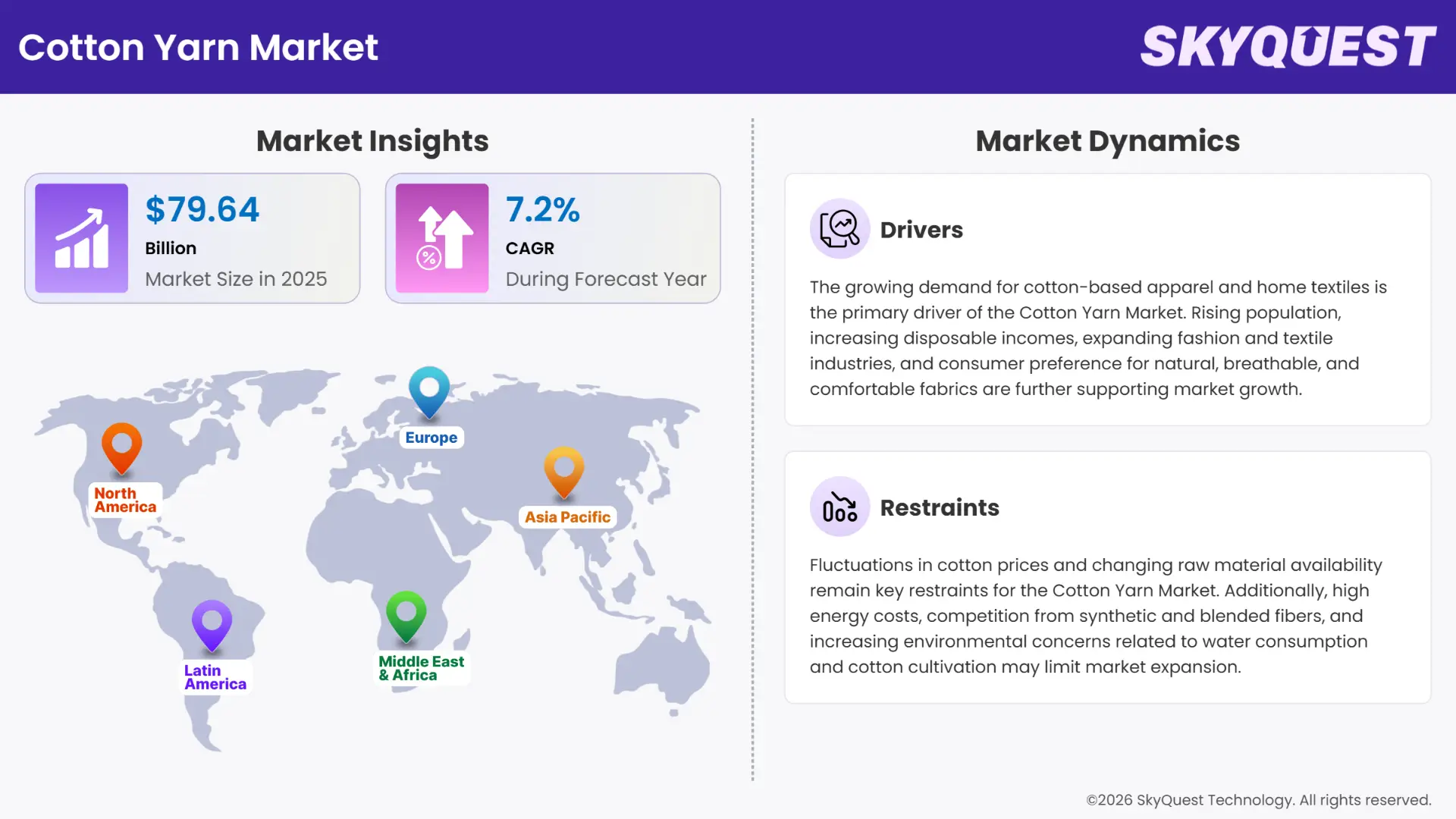
Global Cotton Yarn Market size was valued at USD 74.29 Billion in 2024 and is poised to grow from USD 79.64 Billion in 2025 to USD 138.89 Billion by 2033, growing at a CAGR of 7.2% during the forecast period (2026–2033).
Key Takeaways: Market Trends & Insights
The surge in consumer health consciousness globally has propelled an increased preference for natural fibers, specifically boosting the consumption of cotton yarns and steering the market's growth trajectory in the forecast period. Cotton yarns find extensive use in apparel and home textile applications, offering a versatile material for various fabric creations. Additionally, industrial textiles are witnessing a surge in popularity owing to their utilization across diverse sectors such as automotive, construction, electrical, and electronics industries, among others.
Cotton yarn, essentially composed of twisted and plied cotton fibers, serves as the fundamental material for crafting woven or knitted fabrics. The manufacturing process involves spinning raw cotton and subsequently carding it into roving, which serves as the foundational material for knitting or weaving. Carded yarn, specifically crafted from cotton, stands as a textile material capable of being spun into strands of yarn, contributing significantly to the production of a wide array of textile products.
To get more insights on this market click here to Request a Free Sample Report
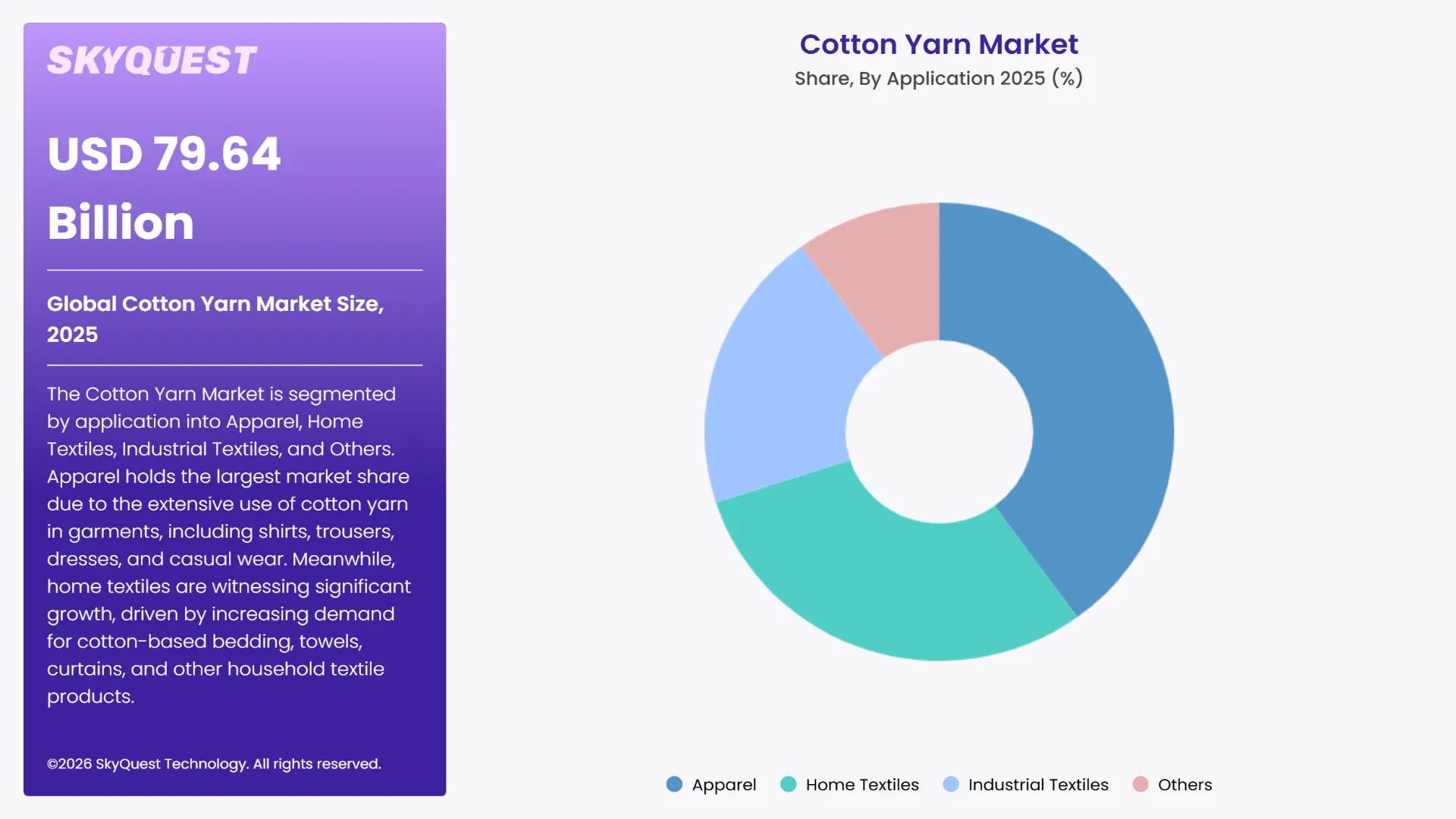
Global Cotton Yarn Market is segmented by Type, Application and region. Based on Type, the market is segmented into Carded Yarn, Combed Yarn and Other. Based on Application, the market is segmented into Apparel, Home Textiles, Industrial Textiles and Others. Based on region, the market is segmented into North America, Europe, Asia Pacific, Latin America and Middle East & Africa.
The home textiles segment plays a crucial role in the cotton yarn market, catering to a diverse range of products designed for household applications. Cotton yarn serves as a fundamental material in the creation of various home textile items such as bed linens, towels, curtains, upholstery fabrics, and other household essentials. Renowned for its comfort, breathability, and absorbency, cotton yarn remains a preferred choice for manufacturing home textiles.
In 2022, the apparel segment emerged as a significant stakeholder in the cotton yarn market, holding a substantial market share. This prominence is strongly associated with the growing demographic influence of the Gen Z and millennial population worldwide. These generations wield considerable purchasing power and demonstrate a propensity for spending notably higher amounts on clothing compared to their predecessors.
The carded yarn segment emerged as the dominant force in the market during 2022. This segment's prominence is closely linked to the carding process, a technique integral to the creation of carded yarn. Carding involves the utilization of toothed cards to meticulously eliminate short fibers and impurities from cotton, ensuring a refined quality of yarn.
The combed yarn segment occupies a significant and distinctive position within the cotton yarn market due to its specialized production process and resulting high-quality output. Combed yarn, crafted from carefully selected superior-grade cotton fibers, undergoes an additional refinement step beyond the standard carding process. This refinement involves the meticulous combing of fibers to eliminate shorter strands and impurities, resulting in a finer, smoother, and more uniform yarn compared to carded yarn.
To get detailed segments analysis, Request a Free Sample Report
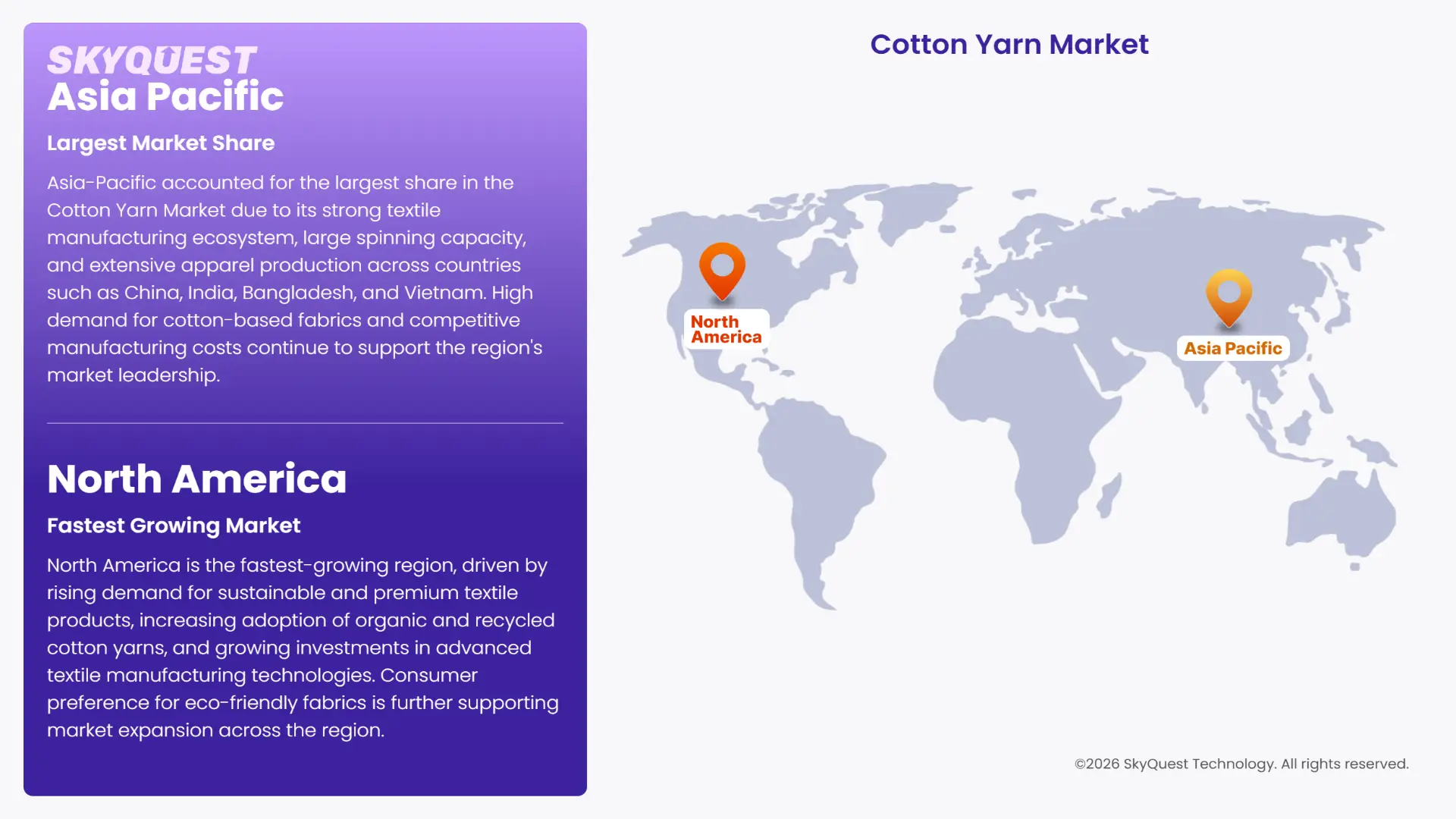
The textile industry in North America presents promising avenues for substantial market growth. In particular, the U.S. textile sector is characterized by its extensive fabric and yarn manufacturing capabilities, catering to a diverse spectrum of products crafted from various materials, including cotton, wool, and a multitude of synthetic fibers.
In 2022, Asia Pacific commanded a substantial market value of USD 77.21 billion, cementing its position as a frontrunner within the industry. This dominance is forecasted to persist over the estimated period, largely driven by rising demand emanating from the region's burgeoning population. The rapid expansion of the textile industry in Asia Pacific owes much to the pivotal roles played by key countries within the region, especially China, India, Japan, and Southeast Asia.
To know more about the market opportunities by region and country, click here to
Buy The Complete Report
Rising Demand and Awareness of Sustainability in Fashion Industry to Augment Market Growth
High Price of Cotton Yarn Relative to Synthetic Yarn is Likely to Hinder Market Growth
Request Free Customization of this report to help us to meet your business objectives.
The competitive environment of the global cotton yarn market is dynamic and characterized by the presence of a mix of well-established brands, emerging players, and niche producers. Innovation is a key competitive factor. Leading brands invest in research and development to introduce new flavors, packaging formats, and health-focused variations to cater to changing consumer preferences. They often set the trends in the industry.
SkyQuest's ABIRAW (Advanced Business Intelligence, Research & Analysis Wing) is our Business Information Services team that Collects, Collates, Correlates, and Analyses the Data collected by means of Primary Exploratory Research backed by robust Secondary Desk research.
The global cotton yarn market analysis reveals a dynamic marketplace with a number of standout trends and difficulties. Cotton yarn, derived from natural cotton obtained through the harvesting of cotton plants, undergoes various spinning processes during its production. Globally, cotton yarn can be broadly classified into two primary types based on the spinning techniques employed: carded and combed yarns. These distinct types of yarn possess unique characteristics that significantly impact their intended applications and the quality of the final textile products. Combed yarn, for instance, stands out as a product manufactured from superior-grade cotton fibers, incorporating an additional step of combing beyond the carding process used in standard yarn production.
| Report Metric | Details |
|---|---|
| Market size value in 2024 | USD 74.29 Billion |
| Market size value in 2033 | USD 138.89 Billion |
| Growth Rate | 7.2% |
| Base year | 2024 |
| Forecast period | 2026–2033 |
| Forecast Unit (Value) | USD Billion |
| Segments covered |
|
| Regions covered | North America (US, Canada), Europe (Germany, France, United Kingdom, Italy, Spain, Rest of Europe), Asia Pacific (China, India, Japan, Rest of Asia-Pacific), Latin America (Brazil, Rest of Latin America), Middle East & Africa (South Africa, GCC Countries, Rest of MEA) |
| Companies covered |
|
| Customization scope | Free report customization with purchase. Customization includes:-
|
To get a free trial access to our platform which is a one stop solution for all your data requirements for quicker decision making. This platform allows you to compare markets, competitors who are prominent in the market, and mega trends that are influencing the dynamics in the market. Also, get access to detailed SkyQuest exclusive matrix.
Table Of Content
Executive Summary
Market overview
Parent Market Analysis
Market overview
Market size
KEY MARKET INSIGHTS
COVID IMPACT
MARKET DYNAMICS & OUTLOOK
Market Size by Region
KEY COMPANY PROFILES
Methodology
For the Cotton Yarn Market, our research methodology involved a mixture of primary and secondary data sources. Key steps involved in the research process are listed below:
1. Information Procurement: This stage involved the procurement of Market data or related information via primary and secondary sources. The various secondary sources used included various company websites, annual reports, trade databases, and paid databases such as Hoover's, Bloomberg Business, Factiva, and Avention. Our team did 45 primary interactions Globally which included several stakeholders such as manufacturers, customers, key opinion leaders, etc. Overall, information procurement was one of the most extensive stages in our research process.
2. Information Analysis: This step involved triangulation of data through bottom-up and top-down approaches to estimate and validate the total size and future estimate of the Cotton Yarn Market.
3. Report Formulation: The final step entailed the placement of data points in appropriate Market spaces in an attempt to deduce viable conclusions.
4. Validation & Publishing: Validation is the most important step in the process. Validation & re-validation via an intricately designed process helped us finalize data points to be used for final calculations. The final Market estimates and forecasts were then aligned and sent to our panel of industry experts for validation of data. Once the validation was done the report was sent to our Quality Assurance team to ensure adherence to style guides, consistency & design.
Analyst Support
Customization Options
With the given market data, our dedicated team of analysts can offer you the following customization options are available for the Cotton Yarn Market:
Product Analysis: Product matrix, which offers a detailed comparison of the product portfolio of companies.
Regional Analysis: Further analysis of the Cotton Yarn Market for additional countries.
Competitive Analysis: Detailed analysis and profiling of additional Market players & comparative analysis of competitive products.
Go to Market Strategy: Find the high-growth channels to invest your marketing efforts and increase your customer base.
Innovation Mapping: Identify racial solutions and innovation, connected to deep ecosystems of innovators, start-ups, academics, and strategic partners.
Category Intelligence: Customized intelligence that is relevant to their supply Markets will enable them to make smarter sourcing decisions and improve their category management.
Public Company Transcript Analysis: To improve the investment performance by generating new alpha and making better-informed decisions.
Social Media Listening: To analyze the conversations and trends happening not just around your brand, but around your industry as a whole, and use those insights to make better Marketing decisions.
REQUEST FOR SAMPLE
 REQUEST FREE CUSTOMIZATION
Cotton Yarn Market size was valued at USD 74.29 Billion in 2024 and is poised to grow from USD 79.64 Billion in 2025 to USD 138.89 Billion by 2033, growing at a CAGR of 7.2% during the forecast period (2026–2033).
Key vendors in the Cotton Yarn Market include Vardhman Textiles Limited, Welspun India Limited, Trident Limited, Nahar Spinning Mills Limited, Raymond Limited, Sutlej Textiles and Industries Limited, Alok Industries Limited, KPR Mill Limited, and The Lakshmi Mills Company Limited. These companies are focusing on expanding spinning capacities, improving yarn quality, adopting advanced textile technologies, and developing sustainable cotton yarn products to meet growing demand from the apparel and home textile industries.
The key driver of the Cotton Yarn Market is the growing demand for cotton-based textiles and apparel worldwide. Rising population, increasing disposable incomes, expanding fashion and home textile industries, and growing consumer preference for natural and breathable fabrics are significantly driving demand for cotton yarn across global textile manufacturing.
The key market trend in the Cotton Yarn Market is the increasing adoption of sustainable and recycled cotton yarns. Textile manufacturers are focusing on organic cotton, recycled fibers, low-impact dyeing, and resource-efficient spinning technologies to reduce environmental impact while meeting growing consumer demand for eco-friendly and responsibly produced textiles.
Asia-Pacific accounted for the largest share in the Cotton Yarn Market due to its strong textile manufacturing base, abundant cotton production, and large-scale spinning capacity. Countries such as China, India, Bangladesh, and Vietnam are major textile production hubs, supported by competitive labor costs and strong demand from apparel and home textile industries.


Want to customize this report? This report can be personalized according to your needs. Our analysts and industry experts will work directly with you to understand your requirements and provide you with customized data in a short amount of time. We offer $1000 worth of FREE customization at the time of purchase.
Feedback From Our Clients


 USA (+1) 351-333-4748

