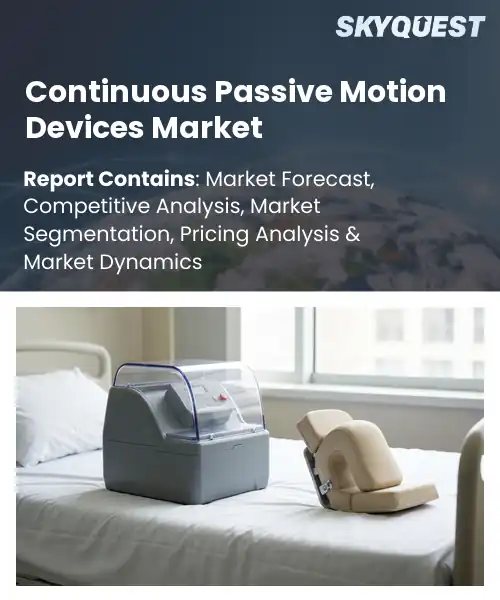
Continuous Passive Motion Devices Market
Report ID: SQMIG35A3572
Report ID: SQMIG35A3572
[email protected]
USA +1 351-333-4748
Report ID:
SQMIG35A3572 |
Region:
Global |
Published Date: May, 2026
Pages:
157
|Tables:
119
|Figures:
77


Global Continuous Passive Motion Devices Market size was valued at USD 617.3 Million in 2024 and is poised to grow from USD 639.52 Million in 2025 to USD 848.66 Million by 2033, growing at a CAGR of 3.6% during the forecast period (2026-2033).
Continuous passive motion (CPM) devices are automated rehabilitation devices that are used to move joints through a controlled range of motion. The market is growing due to the rising incidence of orthopedic surgeries and the emphasis on accelerated recovery. The market matters because better outcomes in the postoperative period lead to shorter hospital stays and less long-term disability. An example of this is the use of CPM after total knee arthroplasty in hospitals to maintain joint mobility. The sector evolved from large hospital-only machines to patient-friendly portable systems with the advent of battery operation, digital controls and evidence-based protocols by manufacturers, expanding use in outpatient and home-care settings over time.
The technological innovation providing compact connected systems is a major driver of the global CPM devices market. As these advances reduce the barriers to home-based rehabilitation, they open up growth opportunities for manufacturers and care providers. Devices can incorporate telemonitoring and programmable protocols that allow clinicians to prescribe individualized regimens of motion and monitor adherence remotely, thereby reducing the need for in-person visits to the clinic and enabling patients to be discharged earlier from the hospital. For example, in orthopedics, patients can complete their therapy at home under virtual supervision. This means lower costs for payers because of fewer readmissions, clinics can grow their rental and remote care offerings and startups can find ways to bundle hardware with subscription software.
How is IoT improving patient adherence in the continuous passive motion devices market?
IoT has connected stand-alone machines into care tools in CPM market and improved patient adherence. It has sensors to track activity and joint movement, wireless connections to apps and web-based services, and interfaces to deliver intelligible feedback and gentle nudges to patients. Now there are more home-use devices and clinician dashboards that allow therapists to check on progress, change protocols and test out new ones without returning to the clinic. It makes rehab more fun and less boring for the patients and their caregivers. Market reports and research prototypes show an increased adoption of IoT enabled CPM Systems and tele supervised rehab models.
In June 2025, Kinetec said it was digitally upgrading its CPM with improved patient monitoring and cloud analytics. The enhancement demonstrated potential utility of IoT features such as remote tracking and automatic prompts in supporting therapy routines and easing transitions of care.
Market snapshot - (2026-2033)
Global Market Size
USD 617.3 Million
Largest Segment
Knee Joint CPM Devices
Fastest Growth
Shoulder Joint CPM Devices
Growth Rate
3.6% CAGR
To get more insights on this market click here to Request a Free Sample Report
Global continuous passive motion devices market is segmented by device type, design outlook, patient demographic, end-user and region. Based on device type, the market is segmented into Knee Joint CPM Devices, Shoulder Joint CPM Devices, Hip Joint CPM Devices, Ankle Joint CPM Devices and Others. Based on design outlook, the market is segmented into Portable Devices and Fixed Devices. Based on patient demographic, the market is segmented into Pediatric, Adult and Geriatric. Based on end-user, the market is segmented into Hospitals, Ambulatory Surgical Centers, Home Care Settings and Others. Based on region, the market is segmented into North America, Europe, Asia Pacific, Latin America and Middle East & Africa.
The Knee Joint CPM Devices segment is anticipated to be the largest segment due to the routine use of continuous passive motion in knee arthroplasty and ligament repair protocols for managing stiffness and improving functional outcomes. Solid clinical data, surgeon preference and well established rehab pathways continue to drive ongoing demand, forcing manufacturers to optimize device ergonomics, therapy presets and ancillary consumables. Within the hospital and rehab procurement arena, knee solutions that offer a proven return on care are favored, and investment and product refinements are ongoing throughout the Continuous Passive Motion Devices market.
The Shoulder Joint CPM Devices, however, are the fastest growing sub-segment owing to rising adoption of the device in outpatient rehabilitation, increasing awareness about the benefits of early mobilization post rotator cuff and stabilization procedures, and development of adjustable range controls and patient comfort. Such innovations are opening the door to specialised portable solutions and new clinical applications.
The Portable Devices segment is driving the growth of the market due to the increasing trend of outpatient surgery and home-based rehabilitation. Emphasis is given to lighter battery powered continuous passive motion systems to allow early start of therapy and better patient comfort. Manufacturers are investing in compact form factors, intuitive controls and remote monitoring capabilities that makes them easier to use and easier for clinicians to manage. Payers and providers want portable options that reduce time spent in the facility and improve adherence. This leads to concentrated product development and market preference in Continuous Passive Motion Devices Market.
Fixed Devices are experiencing strong growth momentum, as rehabilitation centers and hospitals seek robust, high precision systems for intensive in-patient protocols, advanced sensor integration and multi-axis motion control. Institutional demand for and opportunities for premium, differentiated continuous passive motion solutions are being driven by emerging innovations and procurement programs for comprehensive therapy suites.
To get detailed segments analysis, Request a Free Sample Report
North America is leading due to a combination of advanced clinical infrastructure, industry expertise and strong integration between research institutions and commercial developers. Payers and providers in the region have developed pathways to support technology adoption in both acute care and outpatient rehabilitation settings, which helps to accelerate the translation of clinical evidence into practice. A strong network of distributors, service providers and post acute care facilities support device deployment and maintenance. Continuous cooperation of orthopedists, rehabilitation specialists and manufacturers promotes iterative improvement of the product. The regulatory and reimbursement environments are rigorous, but well understood by market participants, which reduces commercial uncertainty. High clinical awareness by practitioners and patients, together with active participation in clinical research and early adoption of innovation, drives market leadership, creating a virtuous cycle that reinforces dominance.
Continuous passive motion devices The US is characterized by strong hospital demand, extensive outpatient rehabilitation networks and active involvement of orthopedic surgeons in device selection. Introduction of advanced features and generation of evidence via clinical trial activity and collaborative product development with academic centers Distribution and servicing are well developed, with wide clinical placement and servicing. Payer engagement and institutional procurement practices drive adoption. Clinician familiarity and patient preference for minimally invasive rehabilitation options support consistent utilization across care settings.
The Canadian market for CONTINUOUS PASSIVE MOTION (CPM) DEVICE is expected to be driven by a combined push from public hospitals, rehabilitation centers and regional procurement bodies that are focusing on clinical efficacy and cost conscious adoption. Training and after sales service is provided through the connection between manufacturers and rehabilitation professionals. Provincial health authorities and integrated care pathways drive the patterns of device selection and use. Focus on patient outcomes and multi-disciplinary models of rehabilitation. Easy to implement in hospital and community settings. Centralized buying systems affect the participation of suppliers and the market dynamics.
The Canadian market for CONTINUOUS PASSIVE MOTION (CPM) DEVICE is expected to be driven by a combined push from public hospitals, rehabilitation centers and regional procurement bodies that are focusing on clinical efficacy and cost conscious adoption. Training and after sales service is provided through the connection between manufacturers and rehabilitation professionals. Provincial health authorities and integrated care pathways drive the patterns of device selection and use. Focus on patient outcomes and multi-disciplinary models of rehabilitation. Easy to implement in hospital and community settings. Centralized buying systems affect the participation of suppliers and the market dynamics.
Continuous Motion Machines Germany is anchored by strong clinical engagement of orthopedic centers, a large medical device manufacturing base, and established procurement channels in hospitals. Promotion of systematic adoption focusing on evidence based practice and integration of rehabilitation protocols into surgical pathways Local manufacturers and technology providers work with clinical partners to tailor device features to clinician preferences. Robust service and training networks enable clinical integration and the development of advanced solutions appropriate for inpatient and outpatient care settings.
The United Kingdom’s Continuous Passive Motion Devices market is witnessing rapid adoption on the back of dynamic commissioning practices, focus on early supported discharge models, and rising contribution of private sector in postoperative rehabilitation. Home based solutions are being actively explored by clinical networks and rehabilitation services to reduce hospital stay and improve patient throughput. The manufacturer engagement is focused on real world effectiveness and ease of use in community settings. Changing procurement approaches and pilot programs in integrated care systems also facilitate rapid market adoption and broader application across care pathways.
Focus on patient centric care and functional recovery drive the France Continuous Passive Motion Machine Market with better collaborations of rehabilitation specialists, regional hospitals and device suppliers. The increasing interest in home and outpatient rehabilitation models calls for the evaluation of devices supporting the continuity of care outside the hospital. Awareness and uptake are driven by national clinical societies and pilot projects. Strategic partnerships support market development through training, local service delivery, and alignment with existing postoperative care protocols.
The Asia Pacific is boosting its position through a mix of increasing clinical demand, growing medical device manufacturing capabilities and strategic alliances with established global players. The demand for devices that help patients recover from surgery in an efficient manner is supported by the governments and private health systems focusing on enhancing surgical and rehabilitation services. Local companies innovate to develop cost-competitive solutions that are suited to local care models, while multinational companies bring advanced technologies and clinical expertise. Distribution networks reach to secondary and tertiary care. Integration of telehealth for remote monitoring and support. Growing clinical research activity and pilot programs across a number of markets are helping to accelerate global regional progress and build evidence and clinician confidence.
Continuous Passive Motion Machines The Japanese market is characterized by high clinical standards, an intense integration of technology in rehabilitation pathways and a mature medical device industry focused on quality and precision. Device manufacturers can work with clinical institutions to rigorously test and improve the product functions. Design is based on patient comfort and usability. Established hospital networks enable structured adoption. Service delivery and training of rehabilitation teams provides uniform implementation across care settings, reinforcing market acceptance and continued use.
CPM Devices South Korea’s market is changing as new technology is being adopted quickly, with industry and clinical cooperation and domestic manufacturing remaining strong. Increased emphasis on home-based rehabilitation solutions and digital integration supports new service models that take device use outside of hospitals. Healthcare provider and device companies work together to create training and support structures for successful clinical rollout. Strategic exports and international partnerships also drive local innovation and position the market as a growing source of regional supply and expertise.
To know more about the market opportunities by region and country, click here to
Buy The Complete Report
Increasing Demand For Postoperative Rehabilitation
Technological Advancements In Device Design
High Device Acquisition And Maintenance Costs
Limited Clinical Evidence And Guidelines
Request Free Customization of this report to help us to meet your business objectives.
Global Continuous Passive Motion Devices Market Competitive Environment: The global continuous passive motion devices market is dominated by consolidation and technology differentiation. Incumbents are using acquisitions and partnerships to ramp up smart connectivity and telehealth capabilities, and new entrants are pushing the envelope on home tele rehabilitation and robotic features. Examples include recent M&A and product upgrade activity among established vendors and telehealth partnerships that accelerate feature rollouts and channel shifts.
SkyQuest’s ABIRAW (Advanced Business Intelligence, Research & Analysis Wing) is our Business Information Services team that Collects, Collates, Correlates, and Analyses the Data collected by means of Primary Exploratory Research backed by robust Secondary Desk research.
As per SkyQuest analysis, the global continuous passive motion devices market is propelled by a key driver that is increasing demand for postoperative rehabilitation while a major restraint is high device acquisition and maintenance costs. North America is the dominating region, supported by advanced clinical infrastructure and established care pathways, and the knee joint CPM devices category is the dominating segment due to routine incorporation in knee arthroplasty protocols. A second driver is rapid technological advancement toward portable, IoT enabled and telehealth integrated systems that expand home based rehabilitation and improve patient adherence. Opportunities center on device miniaturization and data driven care models, tempered by procurement and evidence challenges.
| Report Metric | Details |
|---|---|
| Market size value in 2024 | USD 617.3 Million |
| Market size value in 2033 | USD 848.66 Million |
| Growth Rate | 3.6% |
| Base year | 2024 |
| Forecast period | (2026-2033) |
| Forecast Unit (Value) | USD Million |
| Segments covered |
|
| Regions covered | North America (US, Canada), Europe (Germany, France, United Kingdom, Italy, Spain, Rest of Europe), Asia Pacific (China, India, Japan, Rest of Asia-Pacific), Latin America (Brazil, Rest of Latin America), Middle East & Africa (South Africa, GCC Countries, Rest of MEA) |
| Companies covered |
|
| Customization scope | Free report customization with purchase. Customization includes:-
|
To get a free trial access to our platform which is a one stop solution for all your data requirements for quicker decision making. This platform allows you to compare markets, competitors who are prominent in the market, and mega trends that are influencing the dynamics in the market. Also, get access to detailed SkyQuest exclusive matrix.
Table Of Content
Executive Summary
Market overview
Parent Market Analysis
Market overview
Market size
KEY MARKET INSIGHTS
COVID IMPACT
MARKET DYNAMICS & OUTLOOK
Market Size by Region
KEY COMPANY PROFILES
Methodology
For the Continuous Passive Motion Devices Market, our research methodology involved a mixture of primary and secondary data sources. Key steps involved in the research process are listed below:
1. Information Procurement: This stage involved the procurement of Market data or related information via primary and secondary sources. The various secondary sources used included various company websites, annual reports, trade databases, and paid databases such as Hoover's, Bloomberg Business, Factiva, and Avention. Our team did 45 primary interactions Globally which included several stakeholders such as manufacturers, customers, key opinion leaders, etc. Overall, information procurement was one of the most extensive stages in our research process.
2. Information Analysis: This step involved triangulation of data through bottom-up and top-down approaches to estimate and validate the total size and future estimate of the Continuous Passive Motion Devices Market.
3. Report Formulation: The final step entailed the placement of data points in appropriate Market spaces in an attempt to deduce viable conclusions.
4. Validation & Publishing: Validation is the most important step in the process. Validation & re-validation via an intricately designed process helped us finalize data points to be used for final calculations. The final Market estimates and forecasts were then aligned and sent to our panel of industry experts for validation of data. Once the validation was done the report was sent to our Quality Assurance team to ensure adherence to style guides, consistency & design.
Analyst Support
Customization Options
With the given market data, our dedicated team of analysts can offer you the following customization options are available for the Continuous Passive Motion Devices Market:
Product Analysis: Product matrix, which offers a detailed comparison of the product portfolio of companies.
Regional Analysis: Further analysis of the Continuous Passive Motion Devices Market for additional countries.
Competitive Analysis: Detailed analysis and profiling of additional Market players & comparative analysis of competitive products.
Go to Market Strategy: Find the high-growth channels to invest your marketing efforts and increase your customer base.
Innovation Mapping: Identify racial solutions and innovation, connected to deep ecosystems of innovators, start-ups, academics, and strategic partners.
Category Intelligence: Customized intelligence that is relevant to their supply Markets will enable them to make smarter sourcing decisions and improve their category management.
Public Company Transcript Analysis: To improve the investment performance by generating new alpha and making better-informed decisions.
Social Media Listening: To analyze the conversations and trends happening not just around your brand, but around your industry as a whole, and use those insights to make better Marketing decisions.
REQUEST FOR SAMPLE
 REQUEST FREE CUSTOMIZATION
Global Continuous Passive Motion Devices Market size was valued at USD 617.3 Million in 2024 and is poised to grow from USD 639.52 Million in 2025 to USD 848.66 Million by 2033, growing at a CAGR of 3.6% during the forecast period (2026-2033).
Competitive activity in the global continuous passive motion devices market is centered on consolidation and technology differentiation, where incumbents pursue acquisitions and partnerships to add smart connectivity and telehealth capabilities, while new entrants press on home tele rehabilitation and robotic features. Examples include recent M&A and product upgrade activity among established vendors and telehealth partnerships that drive faster feature rollouts and channel shifts. 'Enovis', 'Bio-Med', 'BTL Industries', 'Furniss Corporation', 'Chinesport', 'Rimec', 'OPED GmbH', 'Kinetec Medical Products', 'Comfortland Medical', 'Mettler Electronics', 'Medline Industries', 'Stryker', 'Zimmer Biomet', 'Smith & Nephew', 'Surgi-Care', 'Performance Health', 'OPTP', 'Patterson Medical', 'ScripHessco', 'Drive DeVilbiss Healthcare'
The greater emphasis on restoring joint mobility after surgery has led clinicians and rehabilitation teams to integrate continuous passive motion devices into postoperative care pathways, because these devices facilitate gentle, controlled movement that supports tissue healing and reduces joint stiffness. Their use complements therapeutic protocols by enabling early motion when active exercises may not be feasible, thereby improving functional outcomes and patient comfort. As a result, hospitals and rehabilitation centers increasingly adopt CPM technology to standardize recovery practices and enhance overall rehabilitation efficiency.
Integrated Home Based Rehabilitation: Manufacturers and providers are shifting toward integrated home based rehabilitation models that prioritize patient convenience, continuity of care and caregiver support. Devices are redesigned for easy setup, portability and comfort while linking to remote monitoring and virtual therapy services. The trend enables personalized treatment plans, improved adherence via reminders and education, and sustained clinician oversight outside institutional settings. It promotes coordinated care transitions, provider acceptance, and expanded use across postoperative and chronic musculoskeletal pathways focused on efficient, patient centered recovery.
Why does North America Dominate the Global Continuous Passive Motion Devices Market? |@12


Want to customize this report? This report can be personalized according to your needs. Our analysts and industry experts will work directly with you to understand your requirements and provide you with customized data in a short amount of time. We offer $1000 worth of FREE customization at the time of purchase.
Feedback From Our Clients


 USA (+1) 351-333-4748

