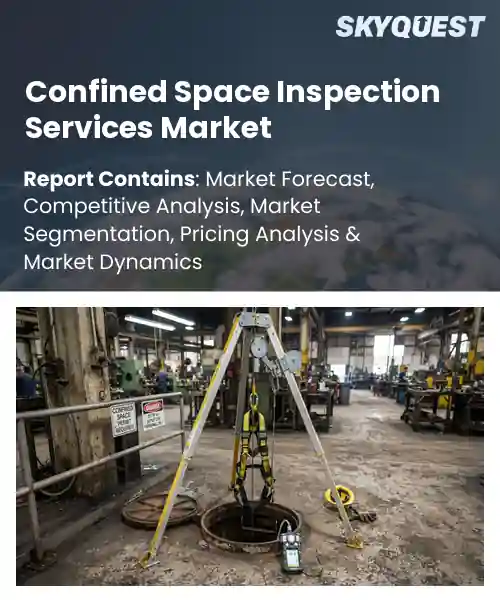
Confined Space Inspection Services Market
Report ID: SQMIG20L2121
Report ID: SQMIG20L2121
[email protected]
USA +1 351-333-4748
Report ID:
SQMIG20L2121 |
Region:
Global |
Published Date: August, 2026
Pages:
157
|Tables:
124
|Figures:
77


Global Confined Space Inspection Services Market size was valued at USD 3.16 Billion in 2024 and is poised to grow from USD 3.45 Billion in 2025 to USD 6.98 Billion by 2033, growing at a CAGR of 9.2% during the forecast period (2026-2033).
The confined space inspection services market comprises firms that assess, monitor, and certify enclosed environments such as tanks, tunnels, and silos for safety. Its importance stems from frameworks like OSHA and EU directives that penalize non‑compliance, making inspection a prerequisite for continued operations. Historically, the market emerged in the early 2000s when accidents in petrochemical plants highlighted gaps in risk management, prompting companies to outsource expertise rather than rely on internal teams. Over the past decade, adoption of inspection tools and the rise of certification bodies have accelerated market expansion, turning inspection from a periodic task into a safety service. Building on that regulatory foundation, industrial digitalization now fuels the growth phase for confined space inspection services. Sensors, drones, and cloud analytics enable real monitoring, allowing clients to shift from reactive compliance checks to predictive safety management. A Texas oil refinery integrated wireless gas detectors with a centralized dashboard, cutting entry‑permit time by 40 percent and averting two incidents. This capability creates demand for providers who install, calibrate, and interpret data, generating revenue through training, software licensing, and managed contracts. Consequently, firms that blend expertise with digital platforms are poised to capture expanding market share as industries prioritize risk mitigation.
How is AI improving safety and efficiency in the confined space inspection services market?
Artificial intelligence is reshaping confined space inspection by turning raw sensor data into actionable insights. Machine learning algorithms analyze images from drones and fixed cameras to spot cracks, gas leaks or temperature spikes in real time. Predictive models flag areas that may deteriorate, allowing crews to plan interventions before a hazard materializes. Natural language interfaces let operators query conditions without leaving a control room, reducing the need for personnel to enter dangerous zones. Integrated AI platforms also schedule inspections based on risk scores, streamlining workflows and cutting downtime while keeping workers out of harm’s way.Drägerwerk October 2025, launched its X Viz Confined Space Monitoring System that uses AI driven video analytics to monitor multiple enclosures from a central hub. The system alerts supervisors to abnormal gas levels and visual defects instantly, cutting entry time and boosting overall safety across the market.
Market snapshot - (2026-2033)
Global Market Size
USD 3.16 Billion
Largest Segment
Visual Inspection
Fastest Growth
Robotic Inspection
Growth Rate
9.2% CAGR
To get more insights on this market click here to Request a Free Sample Report
Global confined space inspection services market is segmented by service type, inspection method, end-use industry, asset type and region. Based on service type, the market is segmented into Visual Inspection, Non-destructive Testing (NDT), Robotic Inspection, Environmental Monitoring and Integrity Assessment. Based on inspection method, the market is segmented into Manual Inspection and Remote Inspection. Based on end-use industry, the market is segmented into Oil & Gas, Power Generation, Chemicals & Petrochemicals, Water & Wastewater, Mining, Manufacturing and Others. Based on asset type, the market is segmented into Storage Tanks, Pipelines, Boilers & Pressure Vessels, Sewers & Underground Utilities and Others. Based on region, the market is segmented into North America, Europe, Asia Pacific, Latin America and Middle East & Africa.
Visual Inspection segment dominates because it provides immediate direct observation that aligns with established safety procedures in confined environments. Operators can quickly assess conditions, identify hazards, and verify compliance without specialized equipment, which reduces preparation time and cost. This ease of execution coupled with regulatory expectations for visual verification reinforces its preference across industries, sustaining its leading position in the confined space inspection services market for both regulatory purposes and continued.
However, Robotic Inspection segment is witnessing the strongest growth momentum because advances in navigation and sensor integration enable safe access to highly hazardous confined spaces. Companies adopt these systems to minimize worker exposure and capture high resolution data, driving new service offerings and expanding market reach. This innovation accelerates future expansion and creates fresh opportunities for providers.
Manual Inspection segment dominates because it leverages human judgment and tactile feedback, which are critical for nuanced assessments within confined spaces. Inspectors can adapt instantly to unexpected conditions, perform direct measurements, and verify compliance through hands on interaction, fostering trust among asset owners. This reliability and the ability to address complex scenarios keep manual approaches at the forefront of the confined space inspection services market for both regulatory purposes and continued.
Meanwhile, Remote Inspection segment is emerging as the high growth area because connectivity improvements and imaging technologies allow experts to evaluate confined environments from safe distances. This reduces downtime, lowers labor risk, and enables time data sharing across teams, encouraging broader adoption across asset categories. The resulting efficiencies fuel rapid market expansion and open new service models.
To get detailed segments analysis, Request a Free Sample Report
North America dominates due to mature regulatory frameworks, high safety compliance awareness, and presence of large industrial sectors such as oil and gas, chemical, and manufacturing. Advanced technological adoption, including remote monitoring and drone‑assisted inspections, enhances service efficiency. Strong professional training programs and a network of certified inspection firms ensure consistent quality. The market benefits from integrated supply chains and high capital investment capacity, allowing firms to offer comprehensive risk assessment and remediation solutions. Collaborative partnerships between regulators, industry associations, and service providers reinforce best practices, cementing the region’s leadership. In addition, the emphasis on worker protection drives continuous improvement in inspection methodologies, while the availability of specialized insurance products encourages broader adoption of certified services. Moreover, the region’s focus on digital transformation fosters real‑time data analytics that further differentiate service providers.
Confined Space Inspection Services Market in the United States benefits from stringent occupational safety regulations that require regular third‑party assessments across high‑risk sectors. A dense concentration of engineering firms equipped with advanced sensor technologies supports rapid deployment of inspection teams. Collaborative initiatives between federal agencies and industry groups promote standardization of procedures, while a robust training ecosystem supplies a steady stream of qualified inspectors. These factors combine to sustain a sophisticated service landscape that meets evolving client expectations.
Confined Space Inspection Services Market in Canada is shaped by provincial safety codes that align closely with national standards, fostering uniform compliance expectations. The country's extensive natural resource sector creates steady demand for specialized inspection expertise, particularly in mining and energy infrastructure. Growing emphasis on environmental stewardship encourages integration of non‑intrusive monitoring techniques. Partnerships between certification bodies and technology providers facilitate adoption of portable gas detection and remote visual inspection tools, enhancing both safety outcomes and operational efficiency.
Europe rapid expansion is propelled by harmonized safety directives that elevate baseline requirements across member states, compelling organizations to seek qualified inspection services. The region's advanced manufacturing base, coupled with a strong focus on sustainability, generates demand for inspections that assess both occupational risk and environmental impact. Investment in digital twins and predictive analytics enables service firms to offer proactive monitoring solutions, reducing downtime for critical infrastructure. Cross‑border collaboration among certification entities and research institutions accelerates the diffusion of best practices and innovative inspection technologies. Additionally, heightened public awareness of worker welfare supports stricter enforcement and continuous improvement, reinforcing Europe’s position as a growth engine for confined space inspection services. The growing prevalence of complex infrastructure projects, such as offshore wind farms and high‑speed rail networks, further amplifies the need for specialized confined space assessments that meet rigorous European standards.
Confined Space Inspection Services Market Germany is driven by a robust industrial sector that includes automotive, chemicals, and energy, all of which operate extensive plant networks. National regulations mandate periodic third‑party inspections, fostering a mature pool of certified service providers. German firms lead in integrating automation and robotics into confined space assessments, enhancing precision and worker safety. Close cooperation between industry associations and research institutes promotes continuous advancement of inspection protocols, reinforcing Germany’s leading position within the European market.
Confined Space Inspection Services Market United Kingdom experiences fastest growth as construction and offshore energy sectors expand, creating heightened demand for specialized inspection expertise. The regulatory environment emphasizes competency verification, driving firms to adopt accredited training schemes and digital record‑keeping platforms. Innovation hubs in the region accelerate the development of wearable safety sensors and AI‑driven risk modeling, positioning service providers at the forefront of technology adoption. Collaborative frameworks between government bodies and private operators ensure that emerging best practices are rapidly disseminated across the market.
Confined Space Inspection Services Market France is emerging as firms tap into the country's growing renewable energy and nuclear infrastructure projects, which require rigorous confined space assessments. French legislation promotes a preventive safety culture, encouraging early‑stage risk identification and the use of non‑intrusive inspection tools. Local certification bodies are aligning with European standards, facilitating cross‑border service delivery. Investment in training academies and partnerships with technology startups foster the adoption of portable monitoring devices, gradually expanding market depth and capability.
Asia Pacific is strengthening its position through a combination of rapid industrialization, heightened regulatory attention, and aggressive adoption of emerging inspection technologies. Nations such as Japan and South Korea are investing heavily in safety management frameworks that prioritize regular confined space evaluations for manufacturing, petrochemical, and infrastructure projects. Integration of IoT sensors, drone surveillance, and augmented reality visualization enables service providers to deliver real‑time hazard detection and comprehensive reporting. Collaborative research initiatives between academic institutions and technology firms accelerate the development of lightweight, portable inspection equipment tailored to dense urban environments. Moreover, growing awareness of occupational health risks among stakeholders drives demand for certified expertise, fostering a competitive ecosystem that elevates the overall quality and reliability of confined space inspection services across the region.
Confined Space Inspection Services Market Japan benefits from a mature manufacturing landscape that emphasizes precision safety protocols and continuous improvement. Stringent national guidelines mandate comprehensive risk assessments for confined environments, encouraging reliance on specialized inspection firms equipped with advanced robotics and high‑definition imaging systems. Strong collaboration between industry consortia and research universities drives innovation in sensor miniaturization and real‑time data analytics. Government incentives supporting safety technology adoption further accelerate market maturity, positioning Japan as a benchmark for sophisticated confined space inspection practices.
Confined Space Inspection Services Market South Korea is propelled by extensive petrochemical complexes and large‑scale infrastructure development that demand rigorous confined space safety measures. National safety standards require periodic third‑party verification, fostering a vibrant ecosystem of certified inspection providers. The country’s strong emphasis on digital transformation has led to the integration of AI‑based hazard modeling and autonomous drone inspections, improving accuracy and reducing exposure time for personnel. Partnerships between conglomerates and technology startups facilitate rapid deployment of innovative monitoring solutions, reinforcing South Korea’s emerging reputation as a hub for advanced confined space inspection capabilities.
To know more about the market opportunities by region and country, click here to
Buy The Complete Report
Increasing Emphasis on Worker Safety
Adoption Of Advanced Inspection Technologies
High Cost Of Specialized Equipment
Limited Availability Of Trained Personnel
Request Free Customization of this report to help us to meet your business objectives.
The market is dominated by a few large inspection firms that are accelerating growth through strategic M&A, joint ventures and advanced sensor integration; SGS SA’s recent acquisition of a niche drone‑inspection specialist and Bureau Veritas’s partnership with a leading AI analytics platform illustrate how players are leveraging technology to expand service breadth and improve safety outcomes in confined environments.
Top Player’s Company Profile
Recent Developments
SkyQuest’s ABIRAW (Advanced Business Intelligence, Research & Analysis Wing) is our Business Information Services team that Collects, Collates, Correlates, and Analyses the Data collected by means of Primary Exploratory Research backed by robust Secondary Desk research. As per SkyQuest analysis, the global confined space inspection services market is propelled primarily by an increasing emphasis on worker safety, which pushes firms to seek qualified third‑party assessments, while the adoption of advanced inspection technologies such as robotics and AI‑driven sensors serves as a second driver accelerating service adoption. The visual inspection segment remains the dominant offering because it satisfies regulatory demands with quick, cost‑effective assessments. North America leads the market, benefitting from mature safety regulations and strong technology uptake. However, the high cost of specialized equipment restrains broader penetration, especially among price‑sensitive operators, tempering overall growth in the coming years.
| Report Metric | Details |
|---|---|
| Market size value in 2024 | USD 3.16 Billion |
| Market size value in 2033 | USD 6.98 Billion |
| Growth Rate | 9.2% |
| Base year | 2024 |
| Forecast period | (2026-2033) |
| Forecast Unit (Value) | USD Billion |
| Segments covered |
|
| Regions covered | North America (US, Canada), Europe (Germany, France, United Kingdom, Italy, Spain, Rest of Europe), Asia Pacific (China, India, Japan, Rest of Asia-Pacific), Latin America (Brazil, Rest of Latin America), Middle East & Africa (South Africa, GCC Countries, Rest of MEA) |
| Companies covered |
|
| Customization scope | Free report customization with purchase. Customization includes:-
|
To get a free trial access to our platform which is a one stop solution for all your data requirements for quicker decision making. This platform allows you to compare markets, competitors who are prominent in the market, and mega trends that are influencing the dynamics in the market. Also, get access to detailed SkyQuest exclusive matrix.
Table Of Content
Executive Summary
Market overview
Parent Market Analysis
Market overview
Market size
KEY MARKET INSIGHTS
COVID IMPACT
MARKET DYNAMICS & OUTLOOK
Market Size by Region
KEY COMPANY PROFILES
Methodology
For the Confined Space Inspection Services Market, our research methodology involved a mixture of primary and secondary data sources. Key steps involved in the research process are listed below:
1. Information Procurement: This stage involved the procurement of Market data or related information via primary and secondary sources. The various secondary sources used included various company websites, annual reports, trade databases, and paid databases such as Hoover's, Bloomberg Business, Factiva, and Avention. Our team did 45 primary interactions Globally which included several stakeholders such as manufacturers, customers, key opinion leaders, etc. Overall, information procurement was one of the most extensive stages in our research process.
2. Information Analysis: This step involved triangulation of data through bottom-up and top-down approaches to estimate and validate the total size and future estimate of the Confined Space Inspection Services Market.
3. Report Formulation: The final step entailed the placement of data points in appropriate Market spaces in an attempt to deduce viable conclusions.
4. Validation & Publishing: Validation is the most important step in the process. Validation & re-validation via an intricately designed process helped us finalize data points to be used for final calculations. The final Market estimates and forecasts were then aligned and sent to our panel of industry experts for validation of data. Once the validation was done the report was sent to our Quality Assurance team to ensure adherence to style guides, consistency & design.
Analyst Support
Customization Options
With the given market data, our dedicated team of analysts can offer you the following customization options are available for the Confined Space Inspection Services Market:
Product Analysis: Product matrix, which offers a detailed comparison of the product portfolio of companies.
Regional Analysis: Further analysis of the Confined Space Inspection Services Market for additional countries.
Competitive Analysis: Detailed analysis and profiling of additional Market players & comparative analysis of competitive products.
Go to Market Strategy: Find the high-growth channels to invest your marketing efforts and increase your customer base.
Innovation Mapping: Identify racial solutions and innovation, connected to deep ecosystems of innovators, start-ups, academics, and strategic partners.
Category Intelligence: Customized intelligence that is relevant to their supply Markets will enable them to make smarter sourcing decisions and improve their category management.
Public Company Transcript Analysis: To improve the investment performance by generating new alpha and making better-informed decisions.
Social Media Listening: To analyze the conversations and trends happening not just around your brand, but around your industry as a whole, and use those insights to make better Marketing decisions.
REQUEST FOR SAMPLE
 REQUEST FREE CUSTOMIZATION


Want to customize this report? This report can be personalized according to your needs. Our analysts and industry experts will work directly with you to understand your requirements and provide you with customized data in a short amount of time. We offer $1000 worth of FREE customization at the time of purchase.
Feedback From Our Clients


 USA (+1) 351-333-4748

