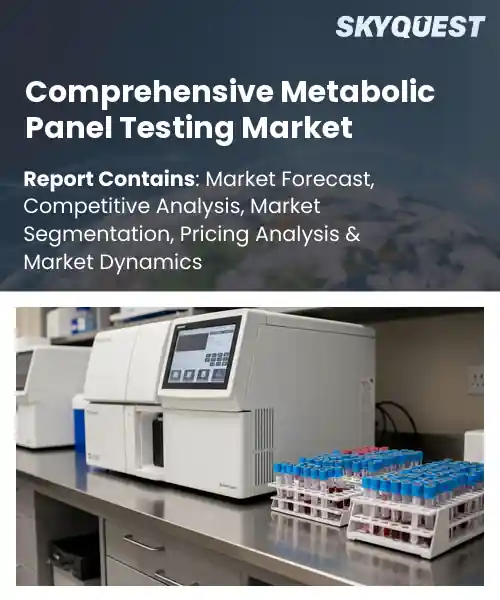
Comprehensive Metabolic Panel Testing Market
Report ID: SQMIG35A3539
Report ID: SQMIG35A3539
[email protected]
USA +1 351-333-4748
Report ID:
SQMIG35A3539 |
Region:
Global |
Published Date: May, 2026
Pages:
157
|Tables:
177
|Figures:
79


Global Comprehensive Metabolic Panel Testing Market size was valued at USD 15.2 Billion in 2024 and is poised to grow from USD 16.25 Billion in 2025 to USD 27.71 Billion by 2033, growing at a CAGR of 6.9% during the forecast period (2026-2033).
Comprehensive metabolic panel testing has seen an increase in demand due to the rise in chronic health conditions and the need for routine monitoring of patients with chronic health conditions. The market that encompasses glucose and electrolyte testing includes laboratory services, reagents and instrumentation to assist in the routine monitoring of patients’ metabolic panels (CMP), as well as supporting diagnostic evaluation processes, and as such, receiving an early diagnosis reduces the number of complications and costs to the healthcare system. Testing has shifted over the years from being performed in a hospital laboratory setting to an outpatient setting and private laboratory setting with the pending introduction of the new automated instruments, standardized panels for testing metabolic panels, and the introduction of electronic ordering systems.
Typical examples of the shifting testing environment are the significant increase in the number of metabolic panels ordered as part of the routine management of patients with diabetes, for the evaluation of a patient prior to surgery, or for conducting an annual health assessment. Growth is being driven by technological advancements in laboratory information systems and analyzer automation that enable the clinician to order a panel more quickly and accurately. Therefore, the economic impact associated with ordering higher volumes of panels will be lessened as reference laboratories and hospital systems expand their offerings to routine CMPs in chronic disease management, preoperative pathways and emergency triage, generating increased revenues. Furthermore, favorable reimbursement policies, consolidation among laboratory service providers, and expanding access in emerging markets cause testing penetration to increase, while opportunities lie in point of care integration, bundled wellness packages, and data driven population health initiatives.
How is AI Enhancing Diagnostic Accuracy In The Comprehensive Metabolic Panel Testing Market?
Artificial Intelligence (AI) is enhancing diagnostic precision by applying laboratory intelligence to pattern recognition within the context of comprehensive metabolic panel testing. Several facets of this development are: the automated identification of atypical analyte constellations, identification of preanalytical issues that could distort results, adaptive quality control systems that alert laboratories to assay drift, and contextual interpretation which links test results back to the patient history.
The comprehensive metabolic panel testing market indicates an increasing acceptance of AI-enabled chemistry analyzers and middleware to minimize the need for manual review of test results and to improve harmonization of results across networks. The aforementioned developments result in greater consistency and clinical usefulness of CMP test results while allowing clinicians to appropriately prioritize follow-up and decrease instances of repeat CMP testing. Siemens Healthineers has announced their commitment to developing a new Research and Development (R&D) center focused on advancing their Atellica chemistry and immunoassay portfolio as well as accompanying AI-related technologies. This investment will allow Siemens to scale up AI-driven automation/quality control systems resulting in improved consistency of CMP test results and increased efficiency within the laboratory.
Market snapshot - (2026-2033)
Global Market Size
USD 15.2 Billion
Largest Segment
Kidney Function Tests
Fastest Growth
Glucose Tests
Growth Rate
6.9% CAGR
To get more insights on this market click here to Request a Free Sample Report
Global comprehensive metabolic panel testing market is segmented by test type, component, technology, application, end user, sample type and region. Based on test type, the market is segmented into Liver Function Tests, Kidney Function Tests, Electrolyte Tests, Glucose Tests, Protein Tests and Others. Based on component, the market is segmented into Instruments & Analyzers, Reagents & Consumables and Software & Services. Based on technology, the market is segmented into Automated Analyzers, Point-of-Care Testing and Laboratory Information Systems Integration. Based on application, the market is segmented into Routine Health Screening, Chronic Disease Monitoring, Liver Disease Diagnosis, Kidney Disease Diagnosis, Diabetes Management and Others. Based on end user, the market is segmented into Hospitals, Diagnostic Laboratories, Clinics and Ambulatory Care Centers. Based on sample type, the market is segmented into Blood Serum and Plasma. Based on region, the market is segmented into North America, Europe, Asia Pacific, Latin America and Middle East & Africa.
As per comprehensive metabolic panel testing market analysis, the Reagents & Consumables segment is the largest contributor to the global market. This dominance occurs for two reasons: first, reagents form the base of every comprehensive metabolic panel testing , and secondly, they are critical for determining the accuracy achieved by these tests and for facilitating the throughput. The fact that reagents are continuously used in routine screening and the monitoring of diseases results in continuous demand, providing a strong incentive for manufacturers to improve their reagent formulations (and gain regulatory approval). When reagents perform reliably, laboratory standardization may occur, which then results in consolidation of laboratory purchasing and drug suppliers focused on the leading producers of reagents; these factors contribute to the leadership of specific manufacturers in the comprehensive metabolic panel testing market.
As per comprehensive metabolic panel testing market outlook, the Software & Service segment is emerging as the fastest-growing component. As the demand for data integration, analysis, and remote monitoring of patient and laboratory personnel during the comprehensive metabolic panel testing test process continues to grow, the number of laboratories adopting cloud-based laboratory information systems and service-oriented laboratories is expected to increase. This adoption will enhance laboratory workflow efficiency, present recurring revenue opportunities in the form of subscriptions and service contracts, drive increased investment, and potentially provide future channels for market growth.
The Liver Function Tests segment leads the way when it comes to providing critical parameters about whether or not an individual’s liver is functioning properly (i.e., is preserved) and, at the same time, whether or not their body is maintaining its normal metabolism within allowable ranges. Because of this, clinicians rely upon these tests to help screen for drug toxicity or chronic liver disease, assist in preoperative assessment (i.e., determine if the patient is healthy enough to undergo surgery) and aid them in making decisions regarding the diagnosis of illness or the appropriate course of treatment. The centrality of liver function testing to these activities continues to provide high volumes of testing and a constant demand from clinicians. Consequently, manufacturers are focused on improving the robustness and standardization of assays for these analytes, thereby enhancing their leadership across laboratories and settings of care.
At the same time, Glucose Testing is emerging as the fastest growing segment because of the increasing amount of diabetes being managed today as well as the expanding use of monitoring platforms to measure glucose as part of a comprehensive metabolic panel. Factors such as improved sensitivity of assays, compliance with point of care testing (POCT) and the expansion of screening programs for individuals with diabetes are facilitating their adoption as well as creating a downstream need for customized reagents, analyzers and data services, thereby fueling the growth of this market.
To get detailed segments analysis, Request a Free Sample Report
As per comprehensive metabolic panel testing market regional forecast, the North American region is leading the global market due to extensive clinical infrastructures; the large volume of providers performing tests; and the mature laboratory base. The established reimbursement mechanisms and well-developed hospital laboratory networks not only support routine and specialty testing but are also critical components in establishing relationships between the various entities involved, which result in a robust collaborative effort through the development of new assays. A significant number of major manufacturers and reagent suppliers are currently operating in the region at the same time there are several large national laboratories serving as catalysts for the development of both innovation and supply chain reliability. In addition, clinical research programs and industry-academic partnerships for conducting research have accelerated the validation and uptake of new assays. High patient education levels, integrated electronic health records, and the competitive nature of the private diagnostic sector also serve to reinforce the depth and breadth of the market. Additionally, the regulatory framework for accessing these tests is specifically designed to ensure patient safety, in conjunction with allowing timely access to the marketplace, fosters a sustainable leadership position with ongoing capability improvements.
The United States Comprehensive Metabolic Panel Testing Market benefits from the presence of many laboratory networks, diagnostic companies, and clinical research activity. There is extensive use of electronic health records to combine all laboratory data which enhances both testing usage and management of care over long periods of time. There are private laboratories and specialized reference laboratories that are well established and provide high levels of innovation and enable the rapid launch of new assays. Established reimbursement systems and established relationships with healthcare providers support routine testing. Clinical guidelines and public awareness support continued demand for comprehensive metabolic profiling.
Canada’s Comprehensive Metabolic Panel Testing Market is supported by the universal healthcare framework, which provides equal access to laboratory diagnostics and standardized clinical pathways. There are provincial laboratory systems and centralized testing networks that help support the same quality of services and reach patients throughout the country. Partnerships and collaboration between public health laboratories and private laboratories allow for the development of new methods and the ability to increase capacity. Because of the emphasis placed by healthcare providers on prevention and integrated chronic disease management programs, there is an increased role for routine metabolic panels. Investment in modernizing laboratories and training the laboratory workforce improves reliability of services provided to urban and regional patients.
As per comprehensive metabolic panel testing market regiona analysis, the rapid expansion of market in Europe is driven by coordinated healthcare policy emphasis on early detection, standardized clinical guidelines, and growing integration of diagnostics into care pathways. Strong national healthcare systems and expanding private laboratory networks enhance access and throughput. Pan European regulatory harmonization and collaborative research initiatives facilitate cross border clinical validation and technology transfer. Investment in laboratory automation and digital reporting improves efficiency and clinician engagement. Innovation hubs and partnerships between established diagnostic vendors and emerging biotech firms accelerate assay diversification. Patient engagement, preventive health programs, and focused chronic disease management contribute to steady expansion across major European markets.
Comprehensive Metabolic Panel Testing Market in Germany is characterized by a strong industrial base in diagnostics, extensive hospital laboratory infrastructure, and active clinical research collaborations. Laboratory automation and quality management are widespread, supporting high throughput and reliable test results. Close partnerships between manufacturers and clinical centers enable rapid evaluation of novel assays. Established reimbursement pathways and structured care protocols integrate metabolic testing into routine clinical practice. The combination of manufacturing expertise and clinical demand sustains market depth and technical sophistication.
Comprehensive Metabolic Panel Testing Market in the United Kingdom is experiencing faster adoption due to concerted efforts to modernize laboratory services and integrate diagnostics into community and hospital care. National health system initiatives promote standardization and efficient use of laboratory resources. Expansion of private partnerships and diagnostic service providers enhances capacity and turnaround times. Emphasis on digital health records and care coordination supports broader utilization of metabolic panels for chronic disease management and preventive care. Investment in workforce development and laboratory networks underpins sustained growth momentum.
Comprehensive Metabolic Panel Testing Market in France is emerging as laboratory modernization efforts and public health initiatives increase diagnostic utilization. Regional laboratory consolidation and investment in automated platforms improve access and consistency of testing. Collaboration between clinical centers and diagnostic companies supports method evaluation and guideline alignment. Preventive health programs and a focus on integrated care for chronic conditions elevate demand for routine metabolic monitoring. Growing awareness among clinicians and patients promotes broader adoption and service diversification across public and private laboratory settings.
Asia Pacific is strengthening its position in the Comprehensive Metabolic Panel testing market through strategic investments in laboratory infrastructure, local manufacturing capacity, and regulatory streamlining that supports faster adoption of validated assays. Expansion of hospital networks, centralized reference laboratories, and point of care initiatives improves access in urban and regional markets. Partnerships between multinational diagnostic firms and domestic players facilitate technology transfer and tailored product offerings. Growing emphasis on preventive health, digital laboratory platforms, and capacity building in clinical research enhances market maturity. Export oriented manufacturing and regional collaboration in quality standards further position the region as an increasingly important contributor to global diagnostic supply and innovation.
Comprehensive Metabolic Panel Testing Market in Japan benefits from advanced healthcare infrastructure, high laboratory quality standards, and a strong domestic diagnostics industry focused on precision and reliability. Integration of laboratory data into clinical workflows and emphasis on evidence based practice support sustained utilization. Collaborative research between academic centers and manufacturers drives method refinement. Robust hospital networks and specialized testing facilities enable efficient delivery of metabolic panels. Focus on technological refinement and service quality reinforces the market position within the regional landscape.
Comprehensive Metabolic Panel Testing Market in South Korea is marked by rapid laboratory modernization, strong public private collaboration, and an innovation driven diagnostics sector. High adoption of automated platforms and digital reporting enhances throughput and clinician access to results. Strategic alliances between domestic companies and global firms support technology adoption and reagent supply. Government initiatives to bolster laboratory capacity and export oriented production underpin market development. Clinical awareness and integration of testing into routine care pathways contribute to expanding utilization across healthcare settings.
To know more about the market opportunities by region and country, click here to
Buy The Complete Report
Rising Chronic Disease Prevalence
Advancements In Diagnostic Technologies
Reimbursement And Pricing Limitations
Sample Quality And Preanalytic Challenges
Request Free Customization of this report to help us to meet your business objectives.
Competition in the global comprehensive metabolic panel testing market is driven by incumbents scaling lab automation and throughput while DTC and at home entrants push sample collection innovation. Established diagnostics companies pursue partnerships and product launches such as instrument rollouts and lab network tie ups, while SiPhox's at home blood test and Function Health's subscription model exemplify tech driven disruption and partnership led access strategies.
SkyQuest’s ABIRAW (Advanced Business Intelligence, Research & Analysis Wing) is our Business Information Services team that Collects, Collates, Correlates, and Analyses the Data collected by means of Primary Exploratory Research backed by robust Secondary Desk research.
As per SkyQuest analysis, a key driver is the rising prevalence of chronic metabolic disorders and aging populations driving demand for routine metabolic monitoring. A second driver is rapid advancements in diagnostic technologies, including automated analyzers, AI-enabled middleware and laboratory information systems that increase throughput and diagnostic consistency. A restraint is reimbursement and pricing limitations that reduce commercial incentives for laboratories to expand services. North America dominates the market thanks to advanced clinical infrastructure, established reimbursement frameworks and leading diagnostic manufacturers. Reagents and consumables is the dominating segment because their continual use underpins assay accuracy, throughput and steady recurring revenue that sustains supplier influence.
| Report Metric | Details |
|---|---|
| Market size value in 2024 | USD 15.2 Billion |
| Market size value in 2033 | USD 27.71 Billion |
| Growth Rate | 6.9% |
| Base year | 2024 |
| Forecast period | (2026-2033) |
| Forecast Unit (Value) | USD Billion |
| Segments covered |
|
| Regions covered | North America (US, Canada), Europe (Germany, France, United Kingdom, Italy, Spain, Rest of Europe), Asia Pacific (China, India, Japan, Rest of Asia-Pacific), Latin America (Brazil, Rest of Latin America), Middle East & Africa (South Africa, GCC Countries, Rest of MEA) |
| Companies covered |
|
| Customization scope | Free report customization with purchase. Customization includes:-
|
To get a free trial access to our platform which is a one stop solution for all your data requirements for quicker decision making. This platform allows you to compare markets, competitors who are prominent in the market, and mega trends that are influencing the dynamics in the market. Also, get access to detailed SkyQuest exclusive matrix.
Table Of Content
Executive Summary
Market overview
Parent Market Analysis
Market overview
Market size
KEY MARKET INSIGHTS
COVID IMPACT
MARKET DYNAMICS & OUTLOOK
Market Size by Region
KEY COMPANY PROFILES
Methodology
For the Comprehensive Metabolic Panel Testing Market, our research methodology involved a mixture of primary and secondary data sources. Key steps involved in the research process are listed below:
1. Information Procurement: This stage involved the procurement of Market data or related information via primary and secondary sources. The various secondary sources used included various company websites, annual reports, trade databases, and paid databases such as Hoover's, Bloomberg Business, Factiva, and Avention. Our team did 45 primary interactions Globally which included several stakeholders such as manufacturers, customers, key opinion leaders, etc. Overall, information procurement was one of the most extensive stages in our research process.
2. Information Analysis: This step involved triangulation of data through bottom-up and top-down approaches to estimate and validate the total size and future estimate of the Comprehensive Metabolic Panel Testing Market.
3. Report Formulation: The final step entailed the placement of data points in appropriate Market spaces in an attempt to deduce viable conclusions.
4. Validation & Publishing: Validation is the most important step in the process. Validation & re-validation via an intricately designed process helped us finalize data points to be used for final calculations. The final Market estimates and forecasts were then aligned and sent to our panel of industry experts for validation of data. Once the validation was done the report was sent to our Quality Assurance team to ensure adherence to style guides, consistency & design.
Analyst Support
Customization Options
With the given market data, our dedicated team of analysts can offer you the following customization options are available for the Comprehensive Metabolic Panel Testing Market:
Product Analysis: Product matrix, which offers a detailed comparison of the product portfolio of companies.
Regional Analysis: Further analysis of the Comprehensive Metabolic Panel Testing Market for additional countries.
Competitive Analysis: Detailed analysis and profiling of additional Market players & comparative analysis of competitive products.
Go to Market Strategy: Find the high-growth channels to invest your marketing efforts and increase your customer base.
Innovation Mapping: Identify racial solutions and innovation, connected to deep ecosystems of innovators, start-ups, academics, and strategic partners.
Category Intelligence: Customized intelligence that is relevant to their supply Markets will enable them to make smarter sourcing decisions and improve their category management.
Public Company Transcript Analysis: To improve the investment performance by generating new alpha and making better-informed decisions.
Social Media Listening: To analyze the conversations and trends happening not just around your brand, but around your industry as a whole, and use those insights to make better Marketing decisions.
REQUEST FOR SAMPLE
 REQUEST FREE CUSTOMIZATION
Global Comprehensive Metabolic Panel Testing Market size was valued at USD 15.2 Billion in 2024 and is poised to grow from USD 16.25 Billion in 2025 to USD 27.71 Billion by 2033, growing at a CAGR of 6.9% during the forecast period (2026-2033).
Competition in the global comprehensive metabolic panel testing market is driven by incumbents scaling lab automation and throughput while DTC and at home entrants push sample collection innovation. Established diagnostics companies pursue partnerships and product launches such as instrument rollouts and lab network tie ups, while SiPhox's at home blood test and Function Health's subscription model exemplify tech driven disruption and partnership led access strategies. 'Quest Diagnostics', 'Labcorp', 'Abbott Laboratories', 'Roche Diagnostics', 'Siemens Healthineers', 'Danaher Corporation', 'Thermo Fisher Scientific', 'Bio-Rad Laboratories', 'Randox Laboratories', 'Ortho Clinical Diagnostics', 'Mindray', 'Sysmex Corporation', 'HORIBA', 'DiaSys Diagnostic Systems', 'Trivitron Healthcare', 'ERBA Diagnostics', 'Beckman Coulter', 'Biosystems', 'Nova Biomedical', 'Meril Life Sciences'
The rising prevalence of chronic conditions such as diabetes, liver disease, kidney dysfunction and metabolic syndrome heightens clinical reliance on comprehensive metabolic panel testing for diagnosis, monitoring, and therapeutic decision making. Routine monitoring requirements and ongoing disease management reinforce demand across outpatient clinics, hospitals and specialty centers, encouraging laboratories to expand CMP offerings and integrate tests into care pathways. Increased clinical dependence on metabolic profiling also supports investment in laboratory capacity, service diversification and outreach programs that broaden test utilization.
Integrated Digital Diagnostics: Expansion of digital health platforms and laboratory information systems is enabling seamless ordering, result delivery and longitudinal patient monitoring for comprehensive metabolic panels. Connectivity between point of care devices, electronic health records and telemedicine workflows supports personalized care pathways, faster clinician decision making and remote chronic disease management. Vendors prioritize interoperable software, secure data exchange and user friendly clinician dashboards to improve adoption. This trend drives partnerships between diagnostics companies and digital health firms to create integrated services that simplify workflows and enhance patient engagement.
Why does North America Dominate the Global Comprehensive Metabolic Panel Testing Market? |@12


Want to customize this report? This report can be personalized according to your needs. Our analysts and industry experts will work directly with you to understand your requirements and provide you with customized data in a short amount of time. We offer $1000 worth of FREE customization at the time of purchase.
Feedback From Our Clients


 USA (+1) 351-333-4748

