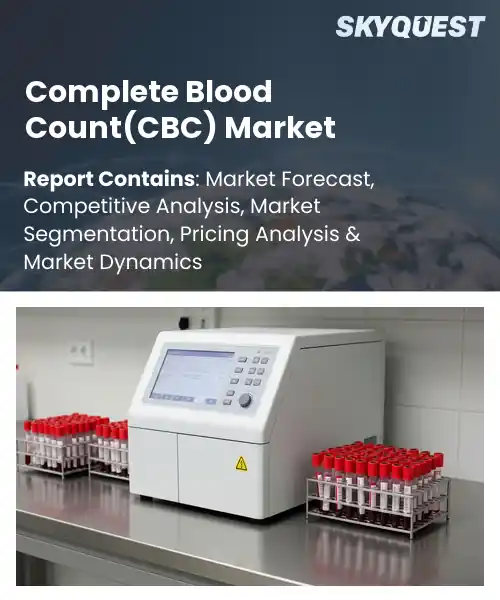
Complete Blood Count(CBC) Market
Report ID: SQMIG35A4308
Report ID: SQMIG35A4308
[email protected]
USA +1 351-333-4748
Report ID:
SQMIG35A4308 |
Region:
Global |
Published Date: August, 2026
Pages:
157
|Tables:
116
|Figures:
77


Global Complete Blood Count(Cbc) Market size was valued at USD 10.84 Billion in 2024 and is poised to grow from USD 11.57 Billion in 2025 to USD 19.43 Billion by 2033, growing at a CAGR of 6.7% during the forecast period (2026-2033).
The global Complete Blood Count (CBC) market includes manufacturers, distributors, and service providers that supply hematology analyzers, reagents, and software to hospitals, clinics, and laboratories. This test is of great significance because it is the most commonly performed test and it is crucial in diagnosing anemia, infections, and clotting disorders. The advancement of this market occurred since 1950s when the test was conducted manually using a microscope. The main drivers in the market evolution were rising occurrences of chronic diseases and the increasing population. For example, U.S. CBC volume grew 12 % between 2015 and 2022, while emerging economies such as India embraced portable analyzers to serve rural patients, expanding the test’s clinical footprint.
Technological integration stands as the pivotal growth catalyst for the CBC market, because data analytics and connectivity enable clinicians to transform raw cell counts into actionable insights, thereby increasing test utilization in chronic‑care pathways. Cloud‑based platforms now aggregate results from bedside analyzers, allowing physicians to monitor anemia trends in dialysis patients and adjust therapy in time, a practice that has reduced hospitalization rates by up to 15 % in several European health systems. This capability attracts investment from medical‑device firms seeking software‑as‑a‑service models, while reimbursement reforms that reward outcome‑based care further expand demand, creating a virtuous cycle of adoption and innovation.
How is AI-Driven Automation Reshaping the Global Complete Blood Count (CBC) Market?
The Complete Blood Count market is being revolutionized by automation technology powered by artificial intelligence (AI), bringing such innovations like sophisticated algorithms into hematology analyzers, which facilitates the process of handling samples and enables getting reliable and faster results. Present-day systems employ machine-learning models which detect any irregularities in the blood profile and minimize manual interventions while providing remote diagnostics by allowing more hospitals to perform tests in labs and at the point of care. Above mentioned evolution results in greater throughput in labs, lower error level, and enables healthcare professionals to obtain important information with minimal effort making CBC tests more accurate and applicable in diverse healthcare environments.
In March 2025, Sysmex America expanded its automated hematology portfolio with the XQ-320, designed for rapid and reliable CBC testing. The analyzer incorporates advanced flagging and quality-monitoring capabilities to identify potential abnormalities and support laboratory decision-making. Such intelligent automation demonstrates how algorithm-driven analysis can improve CBC accuracy, speed, and workflow efficiency, accelerating adoption of advanced hematology systems.
Market snapshot - (2026-2033)
Global Market Size
USD 10.84 Billion
Largest Segment
Hematology Analyzers
Fastest Growth
Reagents & Consumables
Growth Rate
6.7% CAGR
To get more insights on this market click here to Request a Free Sample Report
Global complete blood count(cbc) market is segmented by product type, test type, application, end user and region. Based on product type, the market is segmented into hematology analyzers, reagents & consumables and controls & calibrators. Based on test type, the market is segmented into 3-part differential and 5-part differential. Based on application, the market is segmented into routine health screening, disease diagnosis and treatment monitoring. Based on end user, the market is segmented into hospitals, diagnostic laboratories and clinics. Based on region, the market is segmented into North America, Europe, Asia Pacific, Latin America and Middle East & Africa.
Hematology analyzers segment dominates because they integrate advanced optical and electronic technologies that deliver rapid, high precision cell counts, meeting the core demand of CBC testing. They are capable of automating sample handling, which not only lowers manual errors and the need for human intervention but also yields significant information required for clinical decision making. By combining speed, precision, efficiency, and cost benefit, they become the main factor for market adoption in different healthcare sectors.
However, reagents and consumables segment experiences the fastest growth as laboratories adopt increasingly sophisticated assay kits that enhance test sensitivity and expand panel capabilities. Ongoing innovations in reagent chemistry and demand for point of care solutions trigger demand for new revenue opportunities as well as for expanded use of CBC tests in new clinical approaches.
5-part differential segment leads because it provides detailed leukocyte profiling that enables clinicians to distinguish subtle variations in white blood cell populations, crucial for accurate disease identification. The provision of individualized data on levels of neutrophils, eosinophils, lymphocytes, monocytes, and basophils allows clinicians to make accurate differential diagnoses and formulate effective treatment plans. This kind of data is consistent with the entire body of current clinical guideline recommendations, thus making the five-part model instrumental in modern hematology and improving the quality of care delivered to the patients around the globe.
Meanwhile, 3-part differential segment is emerging as the fastest expanding area as cost conscious facilities seek simpler yet reliable CBC solutions. Its streamlined analysis reduces instrument complexity and consumable usage, appealing to high volume settings. The rising acceptance of the economical method stimulates the advancement of this market, which promotes easier access to blood testing, especially in under-resourced areas.
To get detailed segments analysis, Request a Free Sample Report
North America leads the industry through a combination of advanced diagnostic infrastructure, strong research and development ecosystems, and well‑established reimbursement frameworks that encourage widespread assay utilization. Practitioners in the healthcare sector in the US and Canada have reaped the rewards of adopting automated systems for hematology testing at an early stage. The many academic medical institutions and clinical laboratories located in this area are conducive to constant innovation, leading to greater sensitivity of assays and data integration. In addition, the clear procedures for regulation of new devices and favorable policies result in reduced time to marketing of new technologies. The presence of big players in biotechnology and a collaborative relationship between the industry and the practitioners contribute to the increased speed of product development and its distribution.
Complete blood count(CBC) market in the United States is shaped by a network of hospital laboratories and a commercial diagnostic sector that prioritize rapid turnaround and analytical precision. Top companies work together with research organizations to develop analyzers; reimbursement guidelines support regular testing throughout speciality and primary care. This broad creation supports hospitals in their quest for innovation and makes the USA the leader in CBC technology development for clinical decision making and results.
Complete blood count(CBC) market in Canada benefits from a funded health system that emphasizes preventive screening and laboratory practices across provinces. Collaborative frameworks between academic hospitals and equipment manufacturers facilitate adoption of sophisticated hematology platforms, while national guidelines promote routine CBC ordering for a broad range of clinical indications. This supportive environment drives steady demand for reliable, high‑throughput solutions and positions Canada as a key contributor to regional market innovation.
Europe expands rapidly due to integrated health‑care networks, strong governmental support for diagnostic innovation, and a growing emphasis on early disease detection across member states. Nations such as Germany, the UK and France invest a lot of their money in modernizing laboratory infrastructure and encouraging interactions between research institutes and equipment suppliers. Uniform regulatory standards applicable to all the countries of the European Union simplify the process of approval of the final products and stimulate multinational producers to implement innovative hematology analyzers. As the number of people knowing about chronic diseases increases, the consumption of CBC testing increases in primary and specialized healthcare systems, which creates additional demand for automated high-throughput solutions. Moreover, public health initiatives aimed at screening of the population help incorporate CBC testing into clinical processes.
Complete blood count(CBC) market in Germany is driven by a robust network of university hospitals and a strong industrial base that prioritizes precision diagnostics. The country’s commitment to digital health integration encourages adoption of fully automated hematology systems capable of delivering rapid, high‑volume analysis. Strategic public‑private partnerships accelerate research on novel biomarkers, reinforcing Germany’s role as a leader in CBC technology development across Europe for clinical decision support and outcomes.
Complete blood count(CBC) market in the United Kingdom experiences accelerated growth thanks to health service initiatives that embed routine hematology testing within primary care pathways. The focus on early identification of anemia and infections increases the need for efficient small-scale analyzers used both in hospitals and community clinics. Collaboration with leading universities in various research projects greatly contributes towards successful development of new biomarker panels and makes Britain a country which quickly implements innovative CBC solutions.
Complete blood count(CBC) market in France is emerging as healthcare providers adopt standardized screening protocols to address rising chronic disease prevalence. Funding laboratory automation is beneficial for the plans that aim to have accurate diagnostics with shorter waiting times. The business relations between French biotech companies and international machinery producers allow adapting CBC platforms according to their clinical activity and making the use of these platforms widely accepted by hospitals and outpatient clinics and strengthening France’s position on the European market.
Asia Pacific is strengthening its position in the industry through a convergence of expanding healthcare access, rising prevalence of chronic illnesses, and rapid adoption of automation technologies across diverse economies. The advanced diagnostic landscape in Japan shows a focus on high-precision instruments and integration with electronic health records while the efficient biotech industry in South Korea brings about innovation in small, high-throughput machines intended for hospitals and point-of-care usage. Policies in this region also help to improve the processes of research and product development by encouraging investments in medical device manufacturing. Moreover, increasing digital health initiatives and telemedicine adoption create demand for interoperable CBC solutions that can feed real‑time data to clinicians. These factors collectively enhance the region’s capability to meet growing diagnostic needs and position Asia Pacific as a pivotal growth engine for the global CBC ecosystem.
Complete blood count(CBC) market in Japan is characterized by a strong emphasis on precision diagnostics and seamless integration with national health informatics systems. Leading players in the industry work in unison with teaching hospitals in order to improve analyzers' performance; in addition, government initiatives allow for the introduction of these advanced hematology solutions in both academic hospitals and smaller community labs. This makes it possible to sustain the need for precise high-throughput technologies and continue strengthening Japan’s leadership in the field of CBC innovations.
Complete blood count(CBC) market in South Korea benefits from a dynamic biotech ecosystem that prioritizes rapid development of compact, high‑efficiency analyzers for diverse clinical settings. The close cooperation among manufacturers of medical devices and university research groups speeds up the process of bringing the technology of AI-based data interpretation to life, while governmental initiatives support national manufacturing and export of high-tech diagnostic devices. Such a positive situation leads to an increased use of CBC tests in hospitals, outpatient clinics, and platforms for telemedicine.
To know more about the market opportunities by region and country, click here to
Buy The Complete Report
Increasing Preventive Health Screenings
Advancements in Automated Hematology Analyzers
High Cost of Advanced Equipment
Regulatory Compliance Complexity
Request Free Customization of this report to help us to meet your business objectives.
The competitive landscape of the global complete blood count(CBC) market outlook is shaped by incumbents leveraging mergers, strategic partnerships and rapid technology upgrades; Abbott expanded its Alinity h platform with AI‑driven data analytics, Siemens Healthineers partnered with Philips to integrate imaging and lab workflows, while Sysmex introduced high‑throughput XN‑1000 instruments and secured reagent supply deals with Thermo Fisher, intensifying pressure on rivals and accelerating innovation cycles.
Top Player’s Company Profile
Recent Developments
SkyQuest’s ABIRAW (Advanced Business Intelligence, Research & Analysis Wing) is our Business Information Services team that Collects, Collates, Correlates, and Analyses the Data collected by means of Primary Exploratory Research backed by robust Secondary Desk research.
As per SkyQuest analysis, the global CBC market is propelled primarily by rising preventive health screenings that embed routine blood counts into primary‑care visits, boosting test volumes across hospitals and clinics. A second strong catalyst is the rapid expansion of point‑of‑care devices, which deliver rapid, AI‑assisted results at the bedside or in community settings, widening access beyond central laboratories. The market is led by North America, where advanced diagnostic infrastructure and favorable reimbursement spur adoption. Hematology analyzers play a crucial role in the landscape of products because they provide extensive accuracy and automation that result in the majority of revenues. Nonetheless, getting the most modern analyzers has a very steep price, which represents the key hindrance preventing institutions with limited budgets from acquiring them.
| Report Metric | Details |
|---|---|
| Market size value in 2024 | USD 10.84 Billion |
| Market size value in 2033 | USD 19.43 Billion |
| Growth Rate | 6.7% |
| Base year | 2024 |
| Forecast period | (2026-2033) |
| Forecast Unit (Value) | USD Billion |
| Segments covered |
|
| Regions covered | North America (US, Canada), Europe (Germany, France, United Kingdom, Italy, Spain, Rest of Europe), Asia Pacific (China, India, Japan, Rest of Asia-Pacific), Latin America (Brazil, Rest of Latin America), Middle East & Africa (South Africa, GCC Countries, Rest of MEA) |
| Companies covered |
|
| Customization scope | Free report customization with purchase. Customization includes:-
|
To get a free trial access to our platform which is a one stop solution for all your data requirements for quicker decision making. This platform allows you to compare markets, competitors who are prominent in the market, and mega trends that are influencing the dynamics in the market. Also, get access to detailed SkyQuest exclusive matrix.
Table Of Content
Executive Summary
Market overview
Parent Market Analysis
Market overview
Market size
KEY MARKET INSIGHTS
COVID IMPACT
MARKET DYNAMICS & OUTLOOK
Market Size by Region
KEY COMPANY PROFILES
Methodology
For the Complete Blood Count(CBC) Market, our research methodology involved a mixture of primary and secondary data sources. Key steps involved in the research process are listed below:
1. Information Procurement: This stage involved the procurement of Market data or related information via primary and secondary sources. The various secondary sources used included various company websites, annual reports, trade databases, and paid databases such as Hoover's, Bloomberg Business, Factiva, and Avention. Our team did 45 primary interactions Globally which included several stakeholders such as manufacturers, customers, key opinion leaders, etc. Overall, information procurement was one of the most extensive stages in our research process.
2. Information Analysis: This step involved triangulation of data through bottom-up and top-down approaches to estimate and validate the total size and future estimate of the Complete Blood Count(CBC) Market.
3. Report Formulation: The final step entailed the placement of data points in appropriate Market spaces in an attempt to deduce viable conclusions.
4. Validation & Publishing: Validation is the most important step in the process. Validation & re-validation via an intricately designed process helped us finalize data points to be used for final calculations. The final Market estimates and forecasts were then aligned and sent to our panel of industry experts for validation of data. Once the validation was done the report was sent to our Quality Assurance team to ensure adherence to style guides, consistency & design.
Analyst Support
Customization Options
With the given market data, our dedicated team of analysts can offer you the following customization options are available for the Complete Blood Count(CBC) Market:
Product Analysis: Product matrix, which offers a detailed comparison of the product portfolio of companies.
Regional Analysis: Further analysis of the Complete Blood Count(CBC) Market for additional countries.
Competitive Analysis: Detailed analysis and profiling of additional Market players & comparative analysis of competitive products.
Go to Market Strategy: Find the high-growth channels to invest your marketing efforts and increase your customer base.
Innovation Mapping: Identify racial solutions and innovation, connected to deep ecosystems of innovators, start-ups, academics, and strategic partners.
Category Intelligence: Customized intelligence that is relevant to their supply Markets will enable them to make smarter sourcing decisions and improve their category management.
Public Company Transcript Analysis: To improve the investment performance by generating new alpha and making better-informed decisions.
Social Media Listening: To analyze the conversations and trends happening not just around your brand, but around your industry as a whole, and use those insights to make better Marketing decisions.
REQUEST FOR SAMPLE
 REQUEST FREE CUSTOMIZATION
Global Complete Blood Count(Cbc) Market size was valued at USD 10.84 Billion in 2024 and is poised to grow from USD 11.57 Billion in 2025 to USD 19.43 Billion by 2033, growing at a CAGR of 6.7% during the forecast period (2026-2033).
The competitive landscape of the global CBC market is shaped by incumbents leveraging mergers, strategic partnerships and rapid technology upgrades; Abbott expanded its Alinity h platform with AI‑driven data analytics, Siemens Healthineers partnered with Philips to integrate imaging and lab workflows, while Sysmex introduced high‑throughput XN‑1000 instruments and secured reagent supply deals with Thermo Fisher, intensifying pressure on rivals and accelerating innovation cycles. 'Sysmex Corporation', 'Danaher Corporation', 'Abbott Laboratories', 'Siemens Healthineers AG', 'F. Hoffmann-La Roche Ltd.', 'HORIBA, Ltd.', 'Mindray Bio-Medical Electronics Co., Ltd.', 'Nihon Kohden Corporation', 'Boule Diagnostics AB', 'Diatron MI Zrt.', 'EKF Diagnostics Holdings plc', 'Shenzhen Dymind Biotechnology Co., Ltd.', 'Erba Mannheim', 'DIRUI Industrial Co., Ltd.', 'Orphee SA', 'Drew Scientific Ltd.', 'Agappe Diagnostics Ltd.', 'BioSystems S.A.', 'Randox Laboratories Ltd.', 'Analytik Jena GmbH+Co. KG'
Growing public awareness of early disease detection encourages routine complete blood count testing, prompting clinics to incorporate CBC panels into standard health examinations and expanding the overall patient base. This broader utilization increases test frequency, while clinicians rely on CBC results to monitor health trends and initiate timely interventions. Insurers also acknowledge the preventive value of regular testing, leading to supportive coverage policies that further stimulate market growth through sustained demand across primary care, hospital, and ambulatory settings national and global markets.
Point‑Of‑Care Testing Expansion: The shift toward decentralized diagnostics is driving rapid adoption of portable CBC analyzers in clinics, urgent‑care centers, and even home settings. Clinicians value immediate results that accelerate treatment decisions, while patients appreciate reduced travel and faster reporting. Manufacturers are responding with compact devices that integrate wireless data transmission, AI‑assisted interpretation, and easy maintenance. This trend expands market reach beyond traditional laboratory infrastructure, creates new revenue streams, and aligns with broader healthcare moves toward personalized, real‑time care and better patient outcomes overall.
Why does North America Dominate the Global Complete Blood Count(CBC) Market? |@12


Want to customize this report? This report can be personalized according to your needs. Our analysts and industry experts will work directly with you to understand your requirements and provide you with customized data in a short amount of time. We offer $1000 worth of FREE customization at the time of purchase.
Feedback From Our Clients


 USA (+1) 351-333-4748

