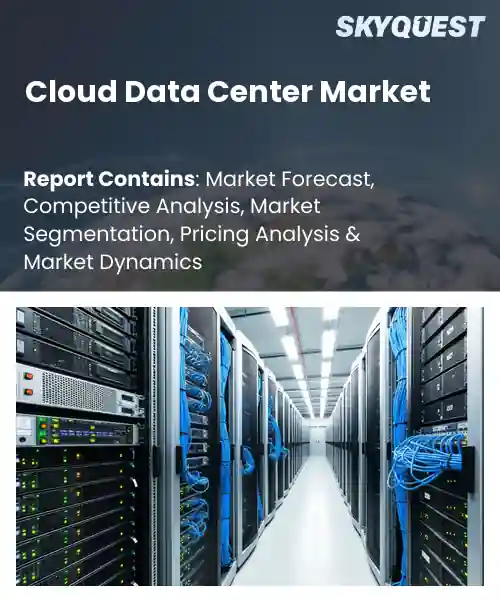
Cloud Data Center Market
Report ID: SQMIG45B2338
Report ID: SQMIG45B2338
[email protected]
USA +1 351-333-4748
Report ID:
SQMIG45B2338 |
Region:
Global |
Published Date: June, 2026
Pages:
157
|Tables:
148
|Figures:
78


Global Cloud Data Center Market size was valued at USD 423.8 Billion in 2024 and is poised to grow from USD 476.31 Billion in 2025 to USD 1212.58 Billion by 2033, growing at a CAGR of 12.39% during the forecast period (2026-2033).
Cloud data centers are defined as physical infrastructures containing thousands of servers, storage devices, and networking equipment capable of providing computing power to businesses and end users. The importance of this industry is driven by the fact that one can move IT load to scalable, flexible, and pay-as-you-go platforms to minimize downtime and speed up the transformation. The key factor driving the demand for cloud data centers is the increase in the volume of data produced by internet-of-things devices and videos and AI applications. In the 2010s, Amazon, Microsoft, and Google opened edge locations close to metropolitan areas, showing how important the geographical closeness is for the provision of services.
Rise in the need for edge computing requires companies to bring their infrastructure closer to their end-users and minimize latency. Such an approach opens new possibilities in creating cost-effective modular infrastructure that can be set up in various regions and used by retailers for real-time analysis of sales and by autonomous vehicles to use maps without depending on remote clouds. In adopting hybrid approaches, businesses will have to buy services that offer both core dependability and edge adaptability, thus pushing vendors to innovate in terms of interconnection protocols and management systems. It will lead to investment in small but effective sites and increase the total market revenue globally.
How is AI-driven Automation Reshaping the Cloud Data Center Market?
Automation powered by artificial intelligence is revolutionizing the cloud data center landscape as intelligent software gets embedded into every level of operations. Intelligent machine learning models now make demand predictions, scale resources in real time, and schedule maintenance proactively to prevent any problems. It leads to decreased energy waste, reduced costs of operation, and provides an opportunity for engineers to concentrate on other priorities. While the providers are increasing capacity to satisfy explosive digital workloads, artificial intelligence helps to increase utilization of current racks and to develop a new generation of modular facilities faster. Providers integrate artificial intelligence into their orchestration software, hyper-converged infrastructure, and edge nodes creating a continuous loop of gathering data and using it to drive actions that result in more data.
Market snapshot - (2026-2033)
Global Market Size
USD 423.8 Billion
Largest Segment
Solution
Fastest Growth
Services
Growth Rate
12.39% CAGR
To get more insights on this market click here to Request a Free Sample Report
Global cloud data center market is segmented by component, data center type, deployment model, organization size, end user and region. Based on component, the market is segmented into Solution and Services. Based on data center type, the market is segmented into Hyperscale Data Centers, Colocation Data Centers and Enterprise Data Centers. Based on deployment model, the market is segmented into Public Cloud, Private Cloud and Hybrid Cloud. Based on organization size, the market is segmented into Small & Medium Enterprises (SMEs) and Large Enterprises. Based on end user, the market is segmented into IT & Telecommunications, BFSI, Healthcare, Government & Public Sector, Retail & E-commerce, Media & Entertainment, Energy & Utilities, Manufacturing and Others. Based on region, the market is segmented into North America, Europe, Asia Pacific, Latin America and Middle East & Africa.
Solution segment is prevalent because it offers an integrated solution through hardware and software packages that make installation and management easier for the data centers. Provisioning becomes easy and risk free by offering a pretested solution, and it makes the organization adopt cloud solutions quickly since it offers assured performance. The embedded management solutions in the package further boost adoption and confidence among organizations using the Cloud Data Center Market.
On the other hand, the Services segment is gaining momentum due to outsourcing of design, migration, and optimization skills. Organizations can access skills as and when required by adopting managed and consulting services, and this model helps them adopt cloud solutions faster along with creating business opportunity within the Cloud Data Center Market.
The public cloud segment is dominant because of the infinite scalability and elastic resources which go in line with digital transformation programs. The service providers can provide standardized services from a common infrastructure platform which will help the business entities to save capital investments and yet use the latest technologies like AI and serverless computing. This way of operating makes it easier for the businesses to go global, speed up the time to market and reduce risks, thereby, being the best option for businesses looking at agility in the Cloud Data Center Market.
On the contrary, the private cloud segment is becoming the most important high-growth segment for the Cloud Data Center Market due to the emphasis on data sovereignty and customizability.
To get detailed segments analysis, Request a Free Sample Report
North America tops in the international cloud data centers market owing to the combination of state-of-the-art IT infrastructure, technology innovation ecosystem, and adoption of cloud services by the businesses. The US houses a number of cloud providers, research organizations, and venture capital firms that contribute to the constant increase of capacity and product differentiation. On the other hand, Canada boasts favorable regulation, strategic location about connectivity, and highly qualified workforce that attracts multinational organizations. The region ensures reliable power supply, cutting-edge data protection policies, and business-friendly climate conducive to rapid construction of cloud facilities. Thus, the region presents a good value proposition to international businesses in terms of speed, performance, and compliance.
Cloud Data Center Market in the United States is defined by the drive towards the development of hyperscale data centers with features such as artificial intelligence, edge computing, and power solutions. Major players in the market use interconnected data centers and fiber networks to provide low-latency services to various industries. The presence of a community of startups and research institutions drives technological advancements in cooling technologies and server designs.
Canadian Cloud Data Center Market is helped by the country's regulatory environment that incentivizes data localization and compliance in relation to privacy regulations, thus positioning it well as a good place for multinationals to set up base. Proximity to internet exchange locations will result in faster connectivity and reduced latency on behalf of North American users. Availability of renewable sources of energy will help in furthering green initiatives, whereas availability of a competent workforce will ensure the technical know-how required for running data centers.
Asia Pacific is seeing the rise of its cloud data center market due to rising digitization efforts, increasing demand for online services, and investments made by international players to get closer to developing markets. Countries like Japan and South Korea have high internet penetration rates along with developed manufacturing and fintech industries, which need reliable and low-latency computing facilities. Data localization initiatives and government policies favoring the adoption of renewable energy sources fuel capacity expansion even more. The emphasis on edge computing and artificial intelligence workloads in Asia Pacific results in a competitive market in which data centers distinguish themselves through innovative cooling technologies and densified networking.
Japanese Cloud Data Center Market is influenced by a focus on technology superiority and consumer environment. High density data centers with innovative cooling technology and AI-based resource management are preferred to cater to needs of the financial, gaming, and automotive industries. Energy-saving government initiatives along with availability of renewable power sources provide for the sustainablegrowth. Proximity to major urban centers allows to ensure ultra-low latency connections, thus solidifying the position of Japan as a critical access point for regional cloud computing services.
South Korea Cloud Data Center Market benefits from a well-connected society and strong digital economy, which calls for sophisticated cloud infrastructure. Telecom companies and cloud providers cooperate to create low-latency facilities supporting gaming, e-commerce and industrial applications. Smart city projects and development of 5G technology provide fertile ground for edge-based data centers in South Korea. Importance of renewable energy usage and green certification also corresponds to international market standards.
With a balanced approach of regulatory harmonization, investments into sustainable energy generation, and a commitment to data sovereignty that suits businesses looking to be compliant, Europe continues to fortify its presence in the cloud data center industry. Europe offers an extensive interconnected system within several jurisdictions that guarantees cross-border data flow without violating the existing privacy policies. As a result of public-private cooperation, ultra-efficient centers powered by renewable energy become increasingly popular in Europe, with operational expenses reflecting sustainability. Moreover, the advanced financial and manufacturing industries of Europe make heavy use of advanced analytics and AI workloads, urging service providers to offer high-performing, low-latency services.
Cloud Data Center Market in Germany is supported by industrial foundations and its attitude towards the adoption of renewable energy. Cloud service providers create highly efficient data centers utilizing wind and solar energy, thus meeting the country’s climate policies and providing reliable services to industries like manufacturing and automobile sectors. Reliable network connectivity through central European exchanges allows maintaining low latency within Europe. Joint research programs carried out by industry and academics contribute to constant innovations in cooling and automation technologies.
Cloud Data Center Market in the United Kingdom enjoys a conducive regulatory framework that promotes data privacy and innovation at the same time. Leading vendors in the market incorporate modularity and cooling technologies to serve the needs of their financial services, media, and government sectors customers. The presence of the country’s fiber network and proximity of its coastlines make it easy to connect to European and transatlantic destinations. Green power and carbon neutral initiatives inspire the usage of clean powered facilities, making the United Kingdom an important element of Europe’s cloud data centers.
Market of Cloud Data Centers in France is driven by national policies promoting digital sovereignty and sustainability. Service providers have been setting up hyperscale centers running renewable power sources close to important urban and industrial areas, serving industries like aviation, retail, and healthcare. Close cooperation between government organizations and tech companies results in quick implementation of edge computing centers, which help improve latency-sensitive tasks. Stress on energy efficiency and circular economy confirms ambitions of France to become a country offering environmentally friendly cloud services.
To know more about the market opportunities by region and country, click here to
Buy The Complete Report
Increasing Enterprise Cloud Adoption
The migration of essential workloads to either the public or private cloud is on the rise, resulting in consistent demand for data center infrastructures that are scalable, reliable, and low latency. In response, organizations invest in new infrastructures with state-of-the-art cooling and power backup capabilities, thus ensuring agility and control over data management. Flexibility in the provision of leased data centers leads to prolonged contract terms as companies aim to map their infrastructures to digital transformation initiatives and strategic positioning.
Regulatory Push for Data Localization
Governments around the world are tightening rules requiring certain types of information to stay within the country’s borders, forcing companies to create or grow their data centers on location. This trend creates the need for a facility network located in different regions and able to ensure compliance, avoid risks of transferring information across the border, and gain some latency benefits. Providers who show their ability to guarantee high levels of security, use sovereign clouds, and have governance frameworks will be interesting for companies that have to comply with laws but pursue digital projects at the same time.
High Capital Expenditure Requirements
Setting up and maintaining data centers of the latest kind requires considerable initial financial investments on the part of the companies in acquiring the land, constructing the buildings, installing the electricity network, and developing the cooling system. Such financial burden acts as a barrier preventing new companies from entering the market and constraining the current ones from scaling their capacities quickly when needed due to the growth of demand in the market. Thus, companies can delay implementation of their migration strategies or choose shared services, which hinders the development of the whole market.
Complex Compliance Across Jurisdictions
The data center provider needs to operate in a highly varied environment, which consists of different rules concerning privacy, security, and the environment that differ greatly from one region to another. Such an operating environment requires a certain level of legal knowledge and flexible policy making that leads to higher costs and slower development of the business. Due to the abovementioned factors, companies face difficulties in implementing their business plans; hence, they are less motivated to expand and develop. Besides, it becomes difficult to conduct audits due to the differences in jurisdiction.
Request Free Customization of this report to help us to meet your business objectives.
The competition among players continues to grow due to the use of AI-powered workloads, hybrid cloud services, and cloud infrastructure optimizations that force organizations to distinguish themselves by quickly embracing innovative technologies and making smart investments. For instance, Microsoft's commitment of more than $60 billion to neocloud data center companies such as Nscale (with $23 billiondedicated to British startup Nscale) is an example of large investment partnerships, according to industry experts.
Edge Computing Integration: With the need for ultra-low latency and real-time operations, there is an increasing trend of cloud data centers to adopt edge nodes where the core infrastructure is extended close to the user's end. This approach facilitates effective orchestration of data from distributed locations and improves application performance. It also addresses new application scenarios such as autonomous systems and immersive experiences. In doing so, providers have started restructuring their network architectures to establish hybrid ecosystems that incorporate both central and local resources.
Sustainability‑Driven Infrastructure: Environmental awareness along with companies' ESG pledges have pushed cloud providers to reconsider data center design towards more energy-efficient and carbon-neutral solutions. They implement approaches like using renewable energy sources, cooling methods, and load balancing to achieve low energy consumption. The focus on environmentally friendly solutions not only decreases ecological impact but positively influences company reputations as well. With the increasing role of sustainability in competition, the providers incorporate the practices of the circular economy into their facilities of lifecycle management.
SkyQuest’s ABIRAW (Advanced Business Intelligence, Research & Analysis Wing) is our Business Information Services team that Collects, Collates, Correlates, and Analyses the Data collected by means ofPrimary Exploratory Research backed by robust Secondary Desk research.
As per SkyQuest analysis, the global cloud data center market is driven mainly by the rising trend of enterprise cloud adoption, resulting in the need for scalable and low-latency data centers, with the second factor being the growing pressures of data localization regulations driving operators to extend their geographical reach. The solutions segment leads the market due to the provision of comprehensive hardware-software solutions that ease implementation, while North America retains its dominant position due to its advanced technological infrastructure and investment environment. The development of the market is hampered, however, by the significant capital expenditure needed for the construction and operation of top-notch data centers.
| Report Metric | Details |
|---|---|
| Market size value in 2024 | USD 423.8 Billion |
| Market size value in 2033 | USD 1212.58 Billion |
| Growth Rate | 12.39% |
| Base year | 2024 |
| Forecast period | (2026-2033) |
| Forecast Unit (Value) | USD Billion |
| Segments covered |
|
| Regions covered | North America (US, Canada), Europe (Germany, France, United Kingdom, Italy, Spain, Rest of Europe), Asia Pacific (China, India, Japan, Rest of Asia-Pacific), Latin America (Brazil, Rest of Latin America), Middle East & Africa (South Africa, GCC Countries, Rest of MEA) |
| Companies covered |
|
| Customization scope | Free report customization with purchase. Customization includes:-
|
To get a free trial access to our platform which is a one stop solution for all your data requirements for quicker decision making. This platform allows you to compare markets, competitors who are prominent in the market, and mega trends that are influencing the dynamics in the market. Also, get access to detailed SkyQuest exclusive matrix.
Table Of Content
Executive Summary
Market overview
Parent Market Analysis
Market overview
Market size
KEY MARKET INSIGHTS
COVID IMPACT
MARKET DYNAMICS & OUTLOOK
Market Size by Region
KEY COMPANY PROFILES
Methodology
For the Cloud Data Center Market, our research methodology involved a mixture of primary and secondary data sources. Key steps involved in the research process are listed below:
1. Information Procurement: This stage involved the procurement of Market data or related information via primary and secondary sources. The various secondary sources used included various company websites, annual reports, trade databases, and paid databases such as Hoover's, Bloomberg Business, Factiva, and Avention. Our team did 45 primary interactions Globally which included several stakeholders such as manufacturers, customers, key opinion leaders, etc. Overall, information procurement was one of the most extensive stages in our research process.
2. Information Analysis: This step involved triangulation of data through bottom-up and top-down approaches to estimate and validate the total size and future estimate of the Cloud Data Center Market.
3. Report Formulation: The final step entailed the placement of data points in appropriate Market spaces in an attempt to deduce viable conclusions.
4. Validation & Publishing: Validation is the most important step in the process. Validation & re-validation via an intricately designed process helped us finalize data points to be used for final calculations. The final Market estimates and forecasts were then aligned and sent to our panel of industry experts for validation of data. Once the validation was done the report was sent to our Quality Assurance team to ensure adherence to style guides, consistency & design.
Analyst Support
Customization Options
With the given market data, our dedicated team of analysts can offer you the following customization options are available for the Cloud Data Center Market:
Product Analysis: Product matrix, which offers a detailed comparison of the product portfolio of companies.
Regional Analysis: Further analysis of the Cloud Data Center Market for additional countries.
Competitive Analysis: Detailed analysis and profiling of additional Market players & comparative analysis of competitive products.
Go to Market Strategy: Find the high-growth channels to invest your marketing efforts and increase your customer base.
Innovation Mapping: Identify racial solutions and innovation, connected to deep ecosystems of innovators, start-ups, academics, and strategic partners.
Category Intelligence: Customized intelligence that is relevant to their supply Markets will enable them to make smarter sourcing decisions and improve their category management.
Public Company Transcript Analysis: To improve the investment performance by generating new alpha and making better-informed decisions.
Social Media Listening: To analyze the conversations and trends happening not just around your brand, but around your industry as a whole, and use those insights to make better Marketing decisions.
REQUEST FOR SAMPLE
 REQUEST FREE CUSTOMIZATION
Global Cloud Data Center Market size was valued at USD 423.8 Billion in 2024 and is poised to grow from USD 476.31 Billion in 2025 to USD 1212.58 Billion by 2033, growing at a CAGR of 12.39% during the forecast period (2026-2033).
The competitive landscape is intensifying as AI‑driven workloads, hybrid‑cloud strategies and cloud‑infrastructure optimization push operators to differentiate through rapid technology adoption and strategic capital deployment. Microsoft’s pledge of over $60 billion to neocloud data‑center firms, including a $23 billion allocation to British startup Nscale, exemplifies large‑scale partnership funding, while industry analysts highlight aggressive M&A activity aimed at consolidating AI‑ready capacity and expanding hybrid‑cloud footprints. 'Amazon.com, Inc.', 'Microsoft Corporation', 'Alphabet Inc.', 'Alibaba Group Holding Limited', 'Oracle Corporation', 'IBM Corporation', 'Tencent Holdings Limited', 'Equinix, Inc.', 'Digital Realty Trust, Inc.', 'NTT DATA Group Corporation', 'China Telecom Corporation Limited', 'China Mobile Limited', 'China Unicom (Hong Kong) Limited', 'OVH Groupe SA', 'Rackspace Technology, Inc.', 'KDDI Corporation', 'Singtel (Singapore Telecommunications Limited)', 'Telefónica, S.A.', 'Deutsche Telekom AG', 'Fujitsu Limited'
Enterprises are increasingly moving critical workloads to public and private cloud environments, which creates a sustained demand for scalable, reliable, and low‑latency data center infrastructure. This shift drives investment in modern facilities equipped with advanced cooling, power redundancy, and connectivity options, enabling organizations to achieve agility while maintaining control over data processing. Providers that can offer flexible leasing models and rapid provisioning benefit from longer‑term contracts as businesses seek to align infrastructure with digital transformation roadmaps and strategic positioning objectives.
Edge Computing Integration: As enterprises seek ultra‑low latency and real‑time processing, cloud data centers are increasingly deploying edge nodes that extend core infrastructure closer to end‑users. This shift enables seamless data orchestration across distributed sites, enhances application performance, and supports emerging use cases such as autonomous systems and immersive experiences. Providers are rearchitecting network topologies, fostering hybrid ecosystems that combine centralized resources with localized capacity, thereby creating more resilient service delivery models that align with evolving digital transformation strategies globally.
Why does North America Dominate the Global Cloud Data Center Market? |@12


Want to customize this report? This report can be personalized according to your needs. Our analysts and industry experts will work directly with you to understand your requirements and provide you with customized data in a short amount of time. We offer $1000 worth of FREE customization at the time of purchase.
Feedback From Our Clients


 USA (+1) 351-333-4748

